
India's Payment-System Architecture: RBI, PSS Act and NPCI
India's Payment-System Architecture: RBI, PSS Act and NPCI. A detailed chapter in Payment Systems & Digital Banking, with explanations and examples for Indian banking examinations.
By Akhilesh Saini · Reviewed 8 Oct 2026
1. Why a payment system exists
Imagine A has ₹10,000 in Bank X and wants to send ₹2,000 to B at Bank Y. A may see only two things: a debit message and a credit message. Behind them, several institutions cooperate to send an instruction, authenticate it, calculate obligations, post account entries and arrange final settlement. A payment system is the set of rules, participants, technology and procedures that makes this possible.
Digital banking is not one single system. A mobile app is a channel; UPI is a payment interface/system; the customer's balance is a deposit claim on a bank; and interbank settlement discharges obligations between participants.
2. Five questions behind any payment
- Who is paying? The payer/remitter.
- Who receives? The payee/beneficiary.
- Which payment instruction is sent? Amount, destination identifier and authorisation.
- Who processes it? Bank, payment-service provider, system operator, switch or clearing infrastructure.
- When is the obligation finally settled? Immediately, in batches or through a separate settlement cycle.
A familiar app can hide all five steps. Exams frequently ask about the infrastructure, not the app screen.
3. Instrument, channel, system and money
| Concept | Meaning | Example |
|---|---|---|
| Payment instrument | Means of giving or storing payment value/instruction | Card, payment voucher, authorised payment mandate |
| Channel | Customer-facing way to initiate transaction | Mobile banking, internet banking, branch, ATM, POS |
| Payment system | Rules and infrastructure for payment processing/clearing/settlement | NEFT, RTGS, IMPS, UPI |
| Payment service/application | Software interface to a system | BHIM, bank UPI app |
| Underlying money/value | What is ultimately transferred or claimed | Bank deposits, prepaid stored value, central-bank digital currency |
Exam trap: saying that every payment app is itself a separate payment system.
4. The Payment and Settlement Systems Act, 2007
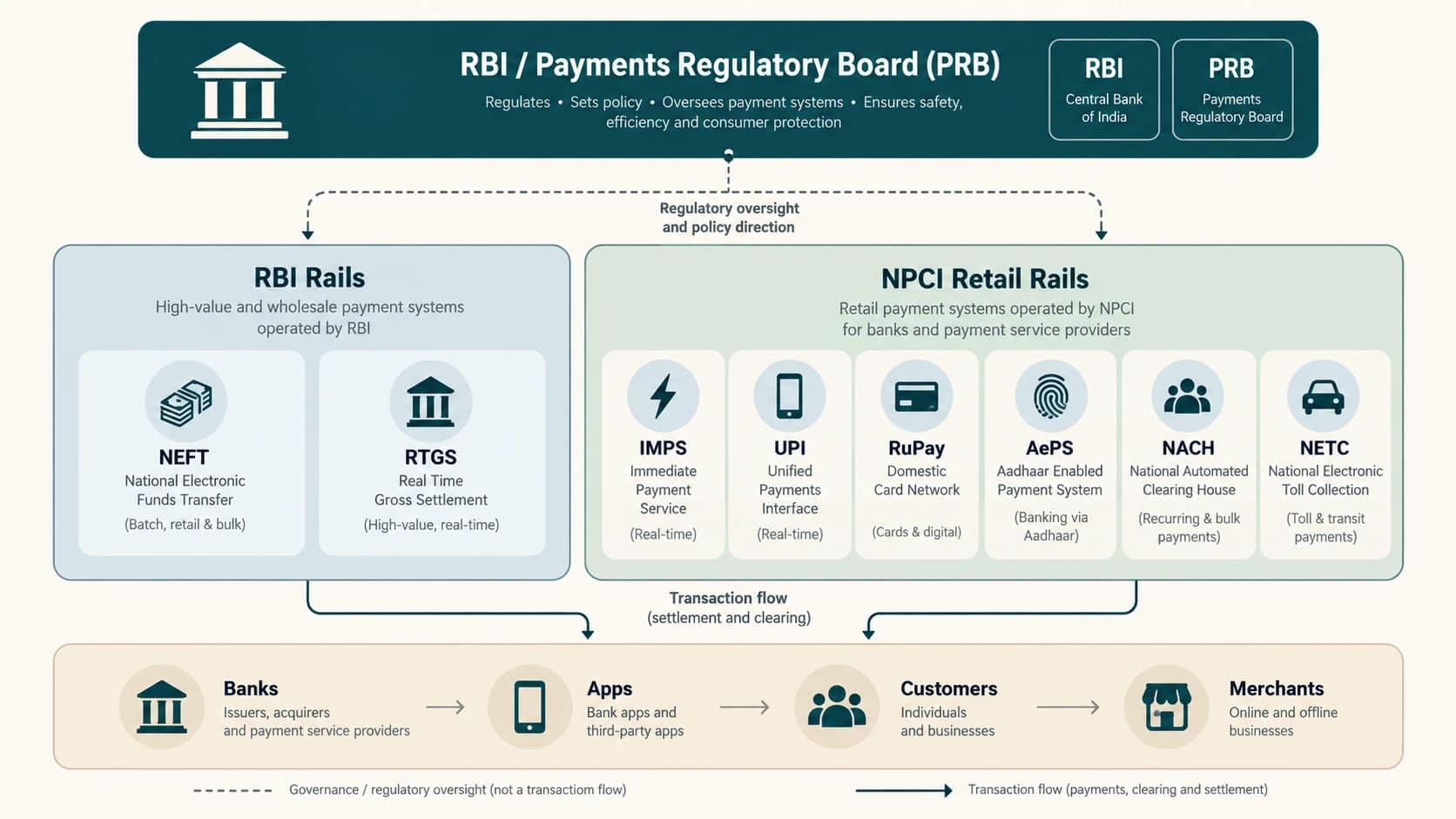
The Payment and Settlement Systems Act (PSS Act), 2007 designates the Reserve Bank of India as the authority for payment-system regulation and supervision. The Act came into force on 12 August 2008. It creates a legal foundation for authorisation of operators and for concepts such as netting and settlement finality.
RBI may establish conditions, standards, regulatory directions and oversight requirements to support the safety and efficiency of payment systems. The Payments Regulatory Board (PRB) now exercises relevant powers under the PSS Act framework, following the 2025 regulatory-board reforms. Older study notes may still refer to the former Board for Regulation and Supervision of Payment and Settlement Systems (BPSS); do not confuse that historical body with the current PRB.
5. Why authorisation matters
Payment systems can become essential public infrastructure. If a large operator fails operationally, many institutions and customers may be affected. RBI therefore oversees authorised operators and payment arrangements. Authorisation is different from licensing an ordinary shopping website or a phone application.
6. RBI's role
RBI's major payment responsibilities include:
- regulation and oversight under the PSS Act;
- ownership/operation of NEFT and RTGS;
- settlement-account and central-bank-money infrastructure;
- standards for payment safety, resilience and customer protection;
- authorisation/oversight of relevant payment-system operators, payment aggregators and issuers;
- policy development for interoperable digital payments.
RBI regulates many systems that RBI itself does not operate.
7. NPCI's role
National Payments Corporation of India (NPCI) was incorporated in 2008 as an umbrella organisation for retail payment and settlement systems. It develops/operates the underlying infrastructure for products such as:
- IMPS;
- UPI;
- RuPay;
- AePS and APBS;
- NACH;
- National Financial Switch (NFS);
- NETC/FASTag;
- e-RUPI.
NPCI is not the RBI, and NPCI is not the customer's deposit-taking bank. The bank generally maintains the customer's bank-account liability.
8. Clearing, netting and settlement
Authorisation means approving the instruction after the relevant checks. Clearing means transmitting, reconciling or determining obligations. Settlement means discharge of obligations by transferring value or posting final settlement entries.
For illustration, three banks owe one another many small payments. Rather than moving every rupee for every item separately between settlement accounts, a system may calculate each bank's net obligation and settle that total. This is net settlement.
In gross settlement, each payment settles individually. Real-time gross settlement is designed especially for finality and large-value payments.
9. Settlement finality
Finality answers the question: Can a settled transfer be unwound merely because one participant changed its mind? Payment systems need clear rules about the point after which a settlement is final. RTGS settlements in RBI's books are final and irrevocable within the system framework. A fraud complaint or legal dispute is a separate question from system settlement finality.
10. On-us and off-us
- On-us: payer and payee are serviced by the same relevant bank/operator, depending on context.
- Off-us: transaction involves another participating bank/operator.
Example: a card issued by Bank A used at an ATM acquired by Bank B is generally an off-us card transaction. This often involves an interoperable network.
11. Interoperability
Interoperability allows customers of participating institutions to use a common network regardless of their own issuer bank. A RuPay card or UPI account does not need every merchant to bank with the same institution as the payer.
12. Settlement risk and operational risk
Payment systems face different risks:
- credit risk: participant fails to fulfil an obligation;
- liquidity risk: participant cannot settle on time despite ultimate solvency;
- operational risk: system, communications or processing failure;
- fraud/security risk: unauthorised or deceptive activity;
- legal risk: uncertainty in rights, finality or obligations.
Strong payment systems use risk controls, redundancy, supervision and defined dispute mechanisms.
13. Payment Aggregator vs Payment Gateway
A Payment Aggregator (PA) facilitates acceptance/processing of merchant payments and may handle/route funds under the regulated model. A Payment Gateway (PG) primarily supplies technical infrastructure to transmit payment messages and does not necessarily handle funds. These roles can overlap in a business group, but regulatory treatment depends on actual functions. Neither label is automatically equivalent to a bank.
14. Core Banking and payment systems
A Core Banking Solution (CBS) maintains deposits and transactions in a centralised bank system. A customer may use UPI at one bank and internet banking NEFT at another. Both ultimately affect CBS account balances, but the interbank payment rail differs.
15. Exam priority
Remember this architecture:
RBI = legal authority + NEFT/RTGS operator
NPCI = major interoperable retail payment infrastructure
Bank = customer account/issuer/participant
App = customer interface
Practical illustration
A shopkeeper receives ₹500 through a UPI QR code. The customer's UPI app displays success; NPCI infrastructure routes payment messages; payer/payee banks debit/credit accounts; final interbank obligations are discharged under the relevant settlement arrangement. The displayed success message and interbank settlement mechanism are related but not identical concepts.
Quick check — BA-11-01
- Which statute gives RBI payment-system regulatory authority?
- Who owns/operates NEFT and RTGS?
- Name four NPCI payment products.
- What is the difference between clearing and settlement?
- Is BHIM itself a central bank?
Answers: 1. PSS Act, 2007. 2. RBI. 3. For example, UPI, IMPS, RuPay, NACH. 4. Clearing determines/routes obligations; settlement discharges them. 5. No.