
NEFT and RTGS
NEFT and RTGS. A detailed chapter in Payment Systems & Digital Banking, with explanations and examples for Indian banking examinations.
By Akhilesh Saini · Reviewed 8 Oct 2026
1. Why two RBI payment rails?
NEFT and RTGS are both RBI-owned/operated electronic funds-transfer systems. But they use distinct settlement designs. A bank customer sending an ordinary remittance may prefer NEFT, while a business sending a large and time-sensitive transfer may choose RTGS.
Understanding batch vs transaction-by-transaction settlement is more important than merely remembering minimum amounts.
2. NEFT — full form and purpose
National Electronic Funds Transfer (NEFT) is a nationwide electronic transfer system operated by RBI. NEFT enables transfer to an account at a participating member bank. It can be initiated through participating bank channels such as mobile/internet banking or a branch.
RBI introduced NEFT in 2005. Its present design is available around the clock, including weekends and holidays.
3. NEFT's half-hourly processing
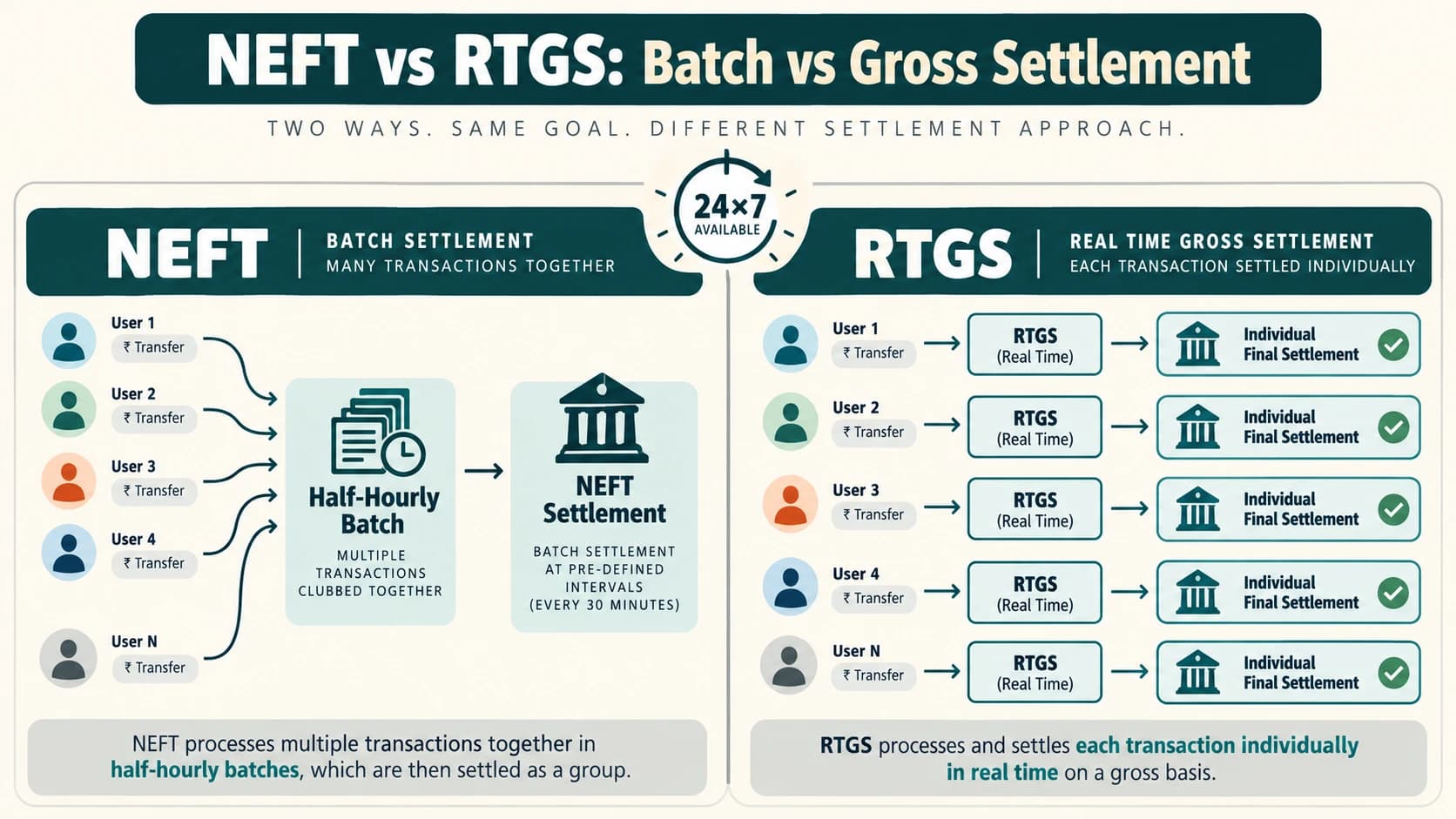
NEFT settles instructions in 48 half-hourly batches each day under the documented RBI framework. Think of it as a bus service departing regularly every half hour instead of an individual train leaving for each passenger.
Because the batches operate continuously, customer credit normally arrives promptly, but NEFT is not RTGS-style real-time gross settlement.
4. NEFT 24×7 history
NEFT became round-the-clock from 16 December 2019. The earlier idea that NEFT is confined to ordinary banking hours is outdated.
5. Amount rules
RBI does not impose a universal minimum or maximum NEFT transfer amount for an account-holder transfer; participating banks may impose channel-specific limits based on their approved policy. Special treatment applies to cash remittances by non-account holders, subject to the applicable rules.
Never assume a particular mobile app's lower limit is the RBI's national limit.
6. NEFT transfer details
Typical information includes:
- payer/remitter's bank account;
- beneficiary name;
- beneficiary bank and branch identifiers;
- beneficiary account number;
- IFSC;
- amount and transaction reference.
IFSC = Indian Financial System Code. It routes the instruction to the correct participating bank/branch. A typo in beneficiary details can cause delay, rejection or wrong-credit issues. Banks and customers should verify destination details carefully.
7. NEFT's reference number
A transaction reference helps trace a transfer. Banks may present this as a UTR or another reference. A reference number is not itself proof that a fraud claim is justified or that a payment cannot be disputed.
8. RTGS — full form
Real Time Gross Settlement (RTGS) settles fund transfers:
- Real time: processed individually as received;
- Gross: each payment settled on its own, without netting it into a batch.
RTGS is the principal large-value payment system owned/operated by RBI.
9. RTGS and finality
Because RTGS settlement is completed in RBI's books on an individual basis, it provides final and irrevocable settlement within system rules. This makes it especially suitable for time-critical, high-value interbank and customer transfers.
10. RTGS floor and ceiling
The currently prescribed RBI minimum RTGS amount is ₹2 lakh. RBI does not prescribe an upper ceiling. Banks can impose appropriate operational/risk controls.
11. RTGS operating hours
RTGS became 24×7×365 from 14 December 2020. It is not a system that operates only when bank branches are open.
12. Why RTGS is different from instant retail payments
UPI and IMPS can be experienced by the customer as instant. But an instant customer-facing credit does not make those systems RTGS. The distinction concerns the underlying clearing and settlement architecture, not just the speed of the app notification.
13. Simple illustration — NEFT vs RTGS
A business has to pay ₹12 lakh for equipment. Both a participating bank's NEFT and RTGS channel might be available. If the business needs individual gross settlement immediately, RTGS is the clearer conceptual match. If it uses NEFT, the instruction is included in the system's frequent batch processing. Charges and bank-specific service conditions may differ.
14. NEFT vs RTGS master comparison
| Feature | NEFT | RTGS |
|---|---|---|
| Full form | National Electronic Funds Transfer | Real Time Gross Settlement |
| Operator | RBI | RBI |
| Settlement | Half-hourly batches | Individually, gross and real time |
| Operating availability | 24×7 | 24×7 |
| Current RBI minimum | No universal minimum | ₹2 lakh |
| Current RBI maximum | No universal maximum | No RBI upper ceiling |
| Best remembered as | Nationwide electronic retail/hybrid remittance | High-value immediate final settlement |
15. What if beneficiary is not credited?
Banks should track transaction status and handle returns/failed credits under RBI system rules. Customer action: check transaction reference; verify beneficiary details; contact remitting bank; follow complaint channels as needed. Do not repeatedly initiate a second transfer without checking the first transaction's status.
16. Charges vs system rules
RBI rules can cap or waive certain categories of charges. Actual bank charges depend on whether the transaction is inward/outward, channel and bank policy. These figures are not durable enough to embed across evergreen lessons or diagrams.
17. Common confusions
- NEFT batch does not mean available only one or two times daily.
- RTGS gross does not mean the transfer has no compliance or operational checks.
- NEFT/RTGS 24×7 does not mean every branch counter stays open 24×7.
- No RBI upper ceiling does not mean the customer necessarily has an unlimited mobile-banking limit.
- Instant customer credit is not synonymous with RTGS settlement.
Quick check — BA-11-02
- What does NEFT stand for?
- How does NEFT settle transfers?
- What is RTGS's defining feature?
- Is RTGS now 24×7?
- Which system currently has a ₹2 lakh RBI floor?
Answers: 1. National Electronic Funds Transfer. 2. Half-hourly batches. 3. Individual real-time gross settlement. 4. Yes. 5. RTGS.