
IMPS, UPI and BHIM
IMPS, UPI and BHIM. A detailed chapter in Payment Systems & Digital Banking, with explanations and examples for Indian banking examinations.
By Akhilesh Saini · Reviewed 8 Oct 2026
1. Why instant retail payments grew
People need fast transfers for:
- splitting expenses;
- paying shops;
- emergency family remittances;
- e-commerce;
- small-business collections.
NPCI helped build interoperable instant retail payment rails that work beyond normal branch hours. Two central products are IMPS and UPI.
2. IMPS — Immediate Payment Service
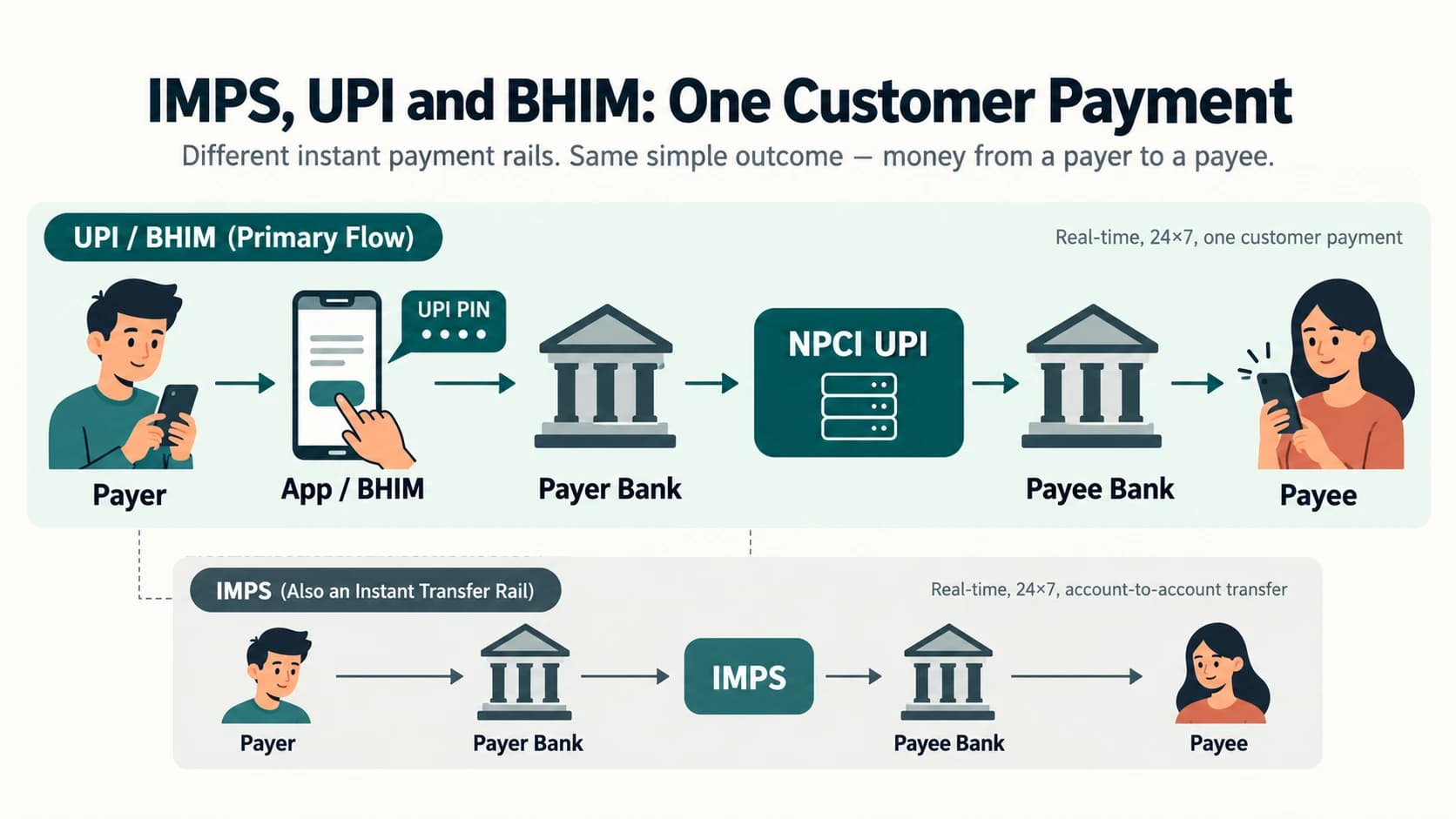
IMPS is NPCI's 24×7 immediate payment service for interbank funds transfer, available through authorised member-bank channels. Customers can initiate transfers via mobile/internet banking and other supported channels.
IMPS can use destination account number and IFSC, and historically supported mobile-number/MMID-based addressing. Exact supported options depend on participating banks.
3. IMPS amount rules
NPCI's product FAQ presently states a ₹5 lakh per-transaction limit for channels other than SMS and IVR. A bank may impose a smaller limit. The number is an updateable snapshot, not a definition of IMPS.
4. UPI — Unified Payments Interface
UPI is NPCI's interoperable instant-payment framework. It allows a user to initiate and receive payments from supported bank accounts and other permitted instruments through participating applications.
It is built over instant-payment infrastructure, with a layer of standardised identifiers and app-based interactions. The familiar experience is scan QR → review payee/amount → authorise → receive confirmation.
5. UPI ID / Virtual Payment Address
A VPA (Virtual Payment Address) or UPI ID is an address used to route payments without routinely typing the beneficiary's full bank account details. An address might look like example@bankhandle.
A VPA is not a separate deposit account. Funds remain associated with a bank account or an eligible linked instrument under the product design.
6. UPI PIN and authentication
The UPI PIN is a secret used to authorise specified debit transactions. It is not something a recipient needs to tell you to credit your account. In a normal UPI receive-money transaction, the payee does not enter a PIN just to receive funds.
Fraud-prevention lesson:
If someone claims you must enter your UPI PIN to receive an ordinary payment, stop and verify. You may actually be authorising a payment out.
7. Payer, payee and payment request
- Payer: initiates/authorises sending money.
- Payee: receives.
- Push payment: payer authorises sending.
- Collect/request: a request for the payer to approve a future debit, where this feature is supported and allowed.
A collect request is not money already received. It requires the payer to verify and authorise.
8. P2P and P2M
P2P = person-to-person (friend pays friend).
P2M = person-to-merchant (customer pays shop).
Transaction limits and permitted instruments may differ between the two. A credit-card-on-UPI facility may support specified merchant transactions but not unrestricted cash transfer to individuals.
9. QR payments
A QR code encodes routing/payment details. Two common kinds:
- Static QR: generally identifies the merchant/payee; payer may enter amount.
- Dynamic QR: may already contain amount and order-specific information.
A QR is a payment instruction aid, not a guarantee that a merchant is legitimate. Verify the payee name displayed in the app.
10. BHIM
BHIM stands for Bharat Interface for Money. It is an NPCI-supported UPI application. It is not a distinct substitute payment rail that settles every payment outside UPI.
A customer can use BHIM or another supported UPI app; both may access the UPI ecosystem. Different apps may offer different user interfaces or added services.
11. The UPI ecosystem participants
A simplified flow includes:
- payer and UPI application;
- payer's payment-service provider/bank;
- NPCI UPI switch/network;
- payee's bank/payment-service provider;
- payee and merchant interface, if relevant.
Final interbank settlement is separate from the on-screen authorisation/credit messages.
12. UPI AutoPay
UPI AutoPay enables recurring electronic mandates for eligible use cases such as subscriptions, insurance or loan payments. The user authorises a mandate with parameters and later debits follow applicable rules.
Recurring mandate ≠ indefinite permission without conditions. Amount, frequency, validity, consent and cancellation controls matter.
13. UPI Lite
UPI Lite is designed for quick low-value payments using a permitted pre-funded/value structure, with fewer repeated authentication steps for qualifying small transactions. Its maximum balance, transaction limits and product variants are updated periodically.
Do not teach UPI Lite as though it is identical to a normal UPI transfer authenticated afresh by PIN each time.
14. UPI 123PAY
UPI 123PAY enables UPI experiences on feature phones/without the same smartphone-app interface, through supported approaches. It is a financial-inclusion feature. Use the latest NPCI rules for available interaction modes.
15. RuPay credit card on UPI
Eligible RuPay credit cards can be linked to participating UPI applications for permitted merchant transactions. This differs from a normal UPI debit from a savings account: the underlying source is a credit-card line, with billing and repayment obligations.
It is not equivalent to unrestricted person-to-person credit-card cash transfer.
16. Credit line on UPI
Certain approved pre-sanctioned credit lines may be accessed through UPI under the regulator/network framework. This is another example of UPI being an interface to a payment/funding source, not the money itself.
17. International UPI
UPI international merchant acceptance and cross-border linkages are available only at supported locations, banks, applications and corridors. Exchange rates, charges and eligibility can vary. A cross-border feature is not proof that all UPI apps can pay every merchant globally.
18. Failed transaction vs wrong recipient
These situations differ:
- Failed transaction: money debited but payment not completed or credit not confirmed; system TAT/reversal rules apply.
- Wrong recipient: customer authorised the wrong payee; recovery can require a bank-led complaint/dispute process and may not be an automatic reversal.
- Fraud/unauthorised payment: special complaint and liability rules may apply.
If unsure, immediately contact bank/app support through official channels and use the proper complaint process. Detailed liability rules are in BA-12.
19. UPI is not a wallet
Ordinary bank-account UPI transfers debit a bank account. Some supported UPI arrangements use prepaid instruments or other approved funding instruments, but UPI itself should not automatically be described as a standalone wallet balance.
20. UPI limits are not one universal number
The permitted amount can depend on:
- P2P vs P2M;
- special merchant categories;
- bank/channel;
- linked instrument;
- recent rule updates.
21. IMPS vs UPI vs BHIM
| Question | IMPS | UPI | BHIM |
|---|---|---|---|
| What is it? | Instant transfer service | Instant payment interface/network | UPI app |
| Main provider/infrastructure | NPCI | NPCI | NPCI-supported application |
| Addressing | Account + IFSC, other supported identifiers | UPI ID, QR, account and other supported modes | UPI identifiers and supported modes |
| Bank-account transfers | Yes | Yes | Via UPI |
| Operates 24×7 | Yes | Yes | When its UPI services are functioning |
Quick check — BA-11-03
- What does IMPS stand for?
- Is a UPI ID itself a bank account?
- What does BHIM stand for?
- Which UPI flow usually requires a PIN: receiving money or authorising a debit?
- What is UPI AutoPay?
Answers: 1. Immediate Payment Service. 2. No. 3. Bharat Interface for Money. 4. Authorising a debit. 5. Recurring electronic mandate facility.