
Cards, RuPay, ATMs, POS and Contactless Payments
Cards, RuPay, ATMs, POS and Contactless Payments. A detailed chapter in Payment Systems & Digital Banking, with explanations and examples for Indian banking examinations.
By Akhilesh Saini · Reviewed 8 Oct 2026
1. Why cards matter
Cards let customers access a payment network and an underlying source of funds without using cash. They also enable remote purchases and cash withdrawals through interoperable networks. A card is not always money stored inside a piece of plastic; in most cases it is a credential giving access to a bank account, credit line or prepaid value.
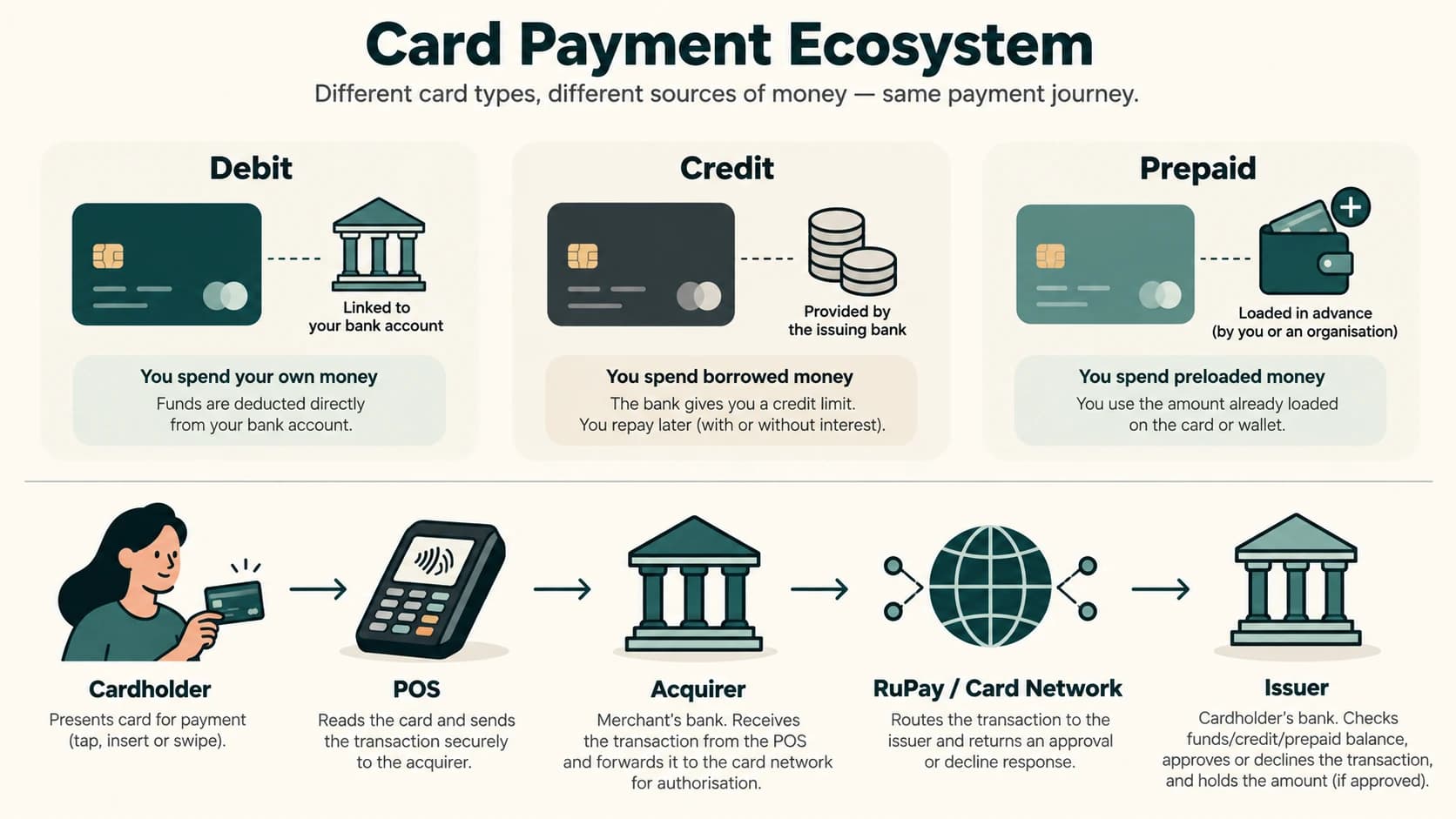
2. Debit card
A debit card usually draws from the customer's linked bank deposit account. If you have ₹8,000 available and pay ₹2,000 by debit card, the bank generally reduces available funds by that amount (subject to pending authorisations and settlement).
Debit cards provide:
- ATM access;
- POS merchant purchases;
- e-commerce transactions, when enabled;
- domestic/international usage depending on issuer and controls;
- contactless transactions where supported.
3. Credit card
A credit card enables purchases against an approved revolving credit facility. The issuer pays/settles the merchant transaction through the scheme, and the cardholder owes the issuer according to the card agreement.
Key terms include:
- credit limit;
- billing cycle and statement date;
- due date;
- total amount due and minimum amount due;
- interest-free period subject to eligibility;
- finance charges on revolving dues.
Paying only the minimum due may avoid immediate payment default under card terms, but it does not erase the remaining debt or its interest cost.
4. Prepaid card / PPI
A Prepaid Payment Instrument (PPI) holds value paid in advance, subject to RBI's PPI framework. Examples can include eligible wallets and prepaid cards. PPIs differ in KYC, permitted uses, cash withdrawal, interoperability and loading features.
An open-loop prepaid card, a closed merchant gift card and a full-KYC wallet do not necessarily carry the same legal permissions. Learn the funding concept rather than treating all prepaid products as identical.
5. Debit vs credit vs prepaid
| Feature | Debit card | Credit card | Prepaid instrument |
|---|---|---|---|
| Main source | Linked bank balance | Issuer's approved credit line | Value loaded in advance |
| Repayment obligation | No separate card loan for ordinary spending | Yes | Normally spending uses pre-funded value |
| Typical risk | Account funds can be debited | Debt/interest if not repaid | Stored-value/issuer and permitted-use risks |
| Regulatory framework | Bank/card/payment directions | Credit-card conduct directions | PPI directions and applicable card rules |
6. RuPay
RuPay is India's domestic card-payment network developed/operated by NPCI. It facilitates interoperable card payments across participating issuers, acquirers and merchants. RuPay is a network, not a category of loan or a deposit account.
Visa and Mastercard are examples of other card networks. A single issuer may offer cards on different schemes according to its arrangements and eligibility.
7. Issuer and acquirer
The issuer provides the card to the customer and maintains the relevant account or credit line. The acquirer enables merchant acceptance, generally through acquiring-bank/payment-service relationships.
Example:
- Customer's RuPay card issued by Bank A;
- Shop's POS terminal acquired by Bank B;
- Card-network messages connect the two;
- Settlement follows network and interbank arrangements.
8. POS and mPOS
Point of Sale (POS) refers to merchant-side facilities for accepting payments. A POS terminal can capture a card transaction using:
- chip + PIN;
- magnetic-stripe fallback where permitted;
- contactless/NFC;
- other supported interfaces.
A mobile POS (mPOS) uses portable/mobile-connected equipment. POS is an acceptance channel, not the name of one payment network.
9. ATMs
Automated Teller Machines (ATMs) can provide cash withdrawals and other account services. ATMs can be:
- on-site at or near a bank branch;
- off-site away from a branch;
- run through relevant bank/non-bank arrangements;
- part of an interoperable shared network.
Customer access depends on participating bank/network and card or cardless-withdrawal support.
10. National Financial Switch — NFS
NPCI's National Financial Switch (NFS) is a major shared ATM switching network. It helps route interoperable ATM transactions among participating institutions. NFS is different from a cash dispenser: it is the network/switch, not the machine.
11. White-label ATM
A White Label ATM (WLA) is owned/operated by an authorised non-bank WLA operator under RBI rules. The presence of a non-bank operator does not mean the withdrawal bypasses the banking/payment network or that the machine creates a bank deposit.
12. Brown-label ATM — common exam terminology
In a brown-label arrangement, a service provider may own/manage ATM hardware and/or site operations while a sponsoring bank remains responsible for specified banking/network obligations. Contracts can differ; this label is best understood as an operations model rather than a standalone statutory bank category.
13. Contactless/NFC cards
NFC (Near Field Communication) lets an enabled card or device communicate at very short range with a contactless terminal. Transaction limits and when a PIN is required follow current network and RBI/issuer rules.
A tap payment can be a card-network payment, while UPI Tap & Pay uses UPI-related functionality. The tap gesture alone does not identify the underlying payment system.
14. Tokenisation
Card tokenisation replaces sensitive card credentials in a specified device/merchant/token-requestor context with a token used for permitted transactions. The objective is to reduce unnecessary exposure of actual card numbers to merchants or intermediaries.
Tokenisation does not eliminate all risks; malware, account takeover or social engineering may still occur.
15. 3-D Secure, OTP and PIN
Payment security can involve:
- possession of card/device;
- knowledge of PIN/password;
- OTP or app-based authentication;
- biometric or risk-based factors under permitted designs.
OTP is not the same as UPI PIN. Never share either merely because someone claims to be providing a refund.
16. Card-not-present vs card-present
A physical POS tap/insert is typically card-present. An online purchase where details or a token are sent is card-not-present. Authentication and fraud controls differ.
17. ATM fees and limits
ATM free-transaction counts, charges, contactless thresholds and other numerical rules change over time. The textbook should emphasise:
Cards are credentials; issuers hold the customer's account or credit exposure; acquirers serve merchants; networks route payment messages.
18. Illustrative merchant payment
Suppose a customer taps a debit card for ₹1,250. Merchant terminal sends authorisation through acquirer and card network; issuer checks card/account/risk controls; authorisation response returns; clearing/settlement occurs under scheme rules. Authorisation and final settlement are not the same event, even if the customer walks away immediately after approval.
Quick check — BA-11-04
- Whose money ordinarily funds a debit-card purchase?
- What is the primary economic feature of a credit card?
- Is RuPay a bank or a card network?
- What does NFS connect?
- What does tokenisation protect?
Answers: 1. The customer's linked deposit balance. 2. A repayable revolving credit line. 3. Card network. 4. Participating ATM networks/institutions. 5. Reduces exposure of sensitive card credentials by substituting tokens.