
AePS, APBS and Aadhaar-Enabled Banking
AePS, APBS and Aadhaar-Enabled Banking. A detailed chapter in Payment Systems & Digital Banking, with explanations and examples for Indian banking examinations.
By Akhilesh Saini · Reviewed 8 Oct 2026
1. Why Aadhaar-based banking matters
A customer in a remote village may not have a smartphone, nearby bank branch or physical debit card available. Aadhaar-linked authentication and the Business Correspondent network can enable basic transactions through a micro-ATM and a participating bank.
But Aadhaar authentication, Aadhaar-based account routing, and Government benefit transfer are different parts of the ecosystem.
2. AePS — full form
Aadhaar Enabled Payment System (AePS) is an NPCI-operated interoperable financial-inclusion payment system. It supports eligible transactions at participating BC/micro-ATM channels using Aadhaar-based authentication and bank participation.
Common supported services include:
- cash withdrawal;
- cash deposit at enabled points;
- balance enquiry;
- mini statement;
- other permitted services/transactions.
Exact availability depends on issuer, acquirer, device and network rules.
3. AePS roles
A typical AePS service involves:
- customer/account holder;
- BC/micro-ATM agent and acquiring institution;
- NPCI transaction-routing network;
- issuer bank where account is maintained;
- UIDAI-based authentication service for the relevant authentication step.
The Aadhaar number helps locate/authenticate the customer through the permitted architecture. It is not itself a bank account.
4. Example — village cash withdrawal
A customer visits a legitimate BC point, selects withdrawal, provides authorised Aadhaar/bank details and completes permitted biometric or other authentication. The acquiring channel sends the request through the system to the issuer bank; the issuer validates the account/transaction; the agent provides cash after successful confirmation. The bank account, not the Aadhaar number, bears the debit.
5. Micro-ATM
A micro-ATM is a compact device/terminal used at an authorised last-mile outlet. It may support biometric or other customer authentication and banking transactions. It is not automatically a full ATM cash-dispenser machine.
6. On-us / off-us AePS
- On-us: acquiring and issuing institution are the same where the arrangement qualifies.
- Off-us: a different participant bank serves the account and a network switches the transaction.
Interoperability lets customers use authorised access points beyond their own bank's premises.
7. APBS — Aadhaar Payment Bridge System
Aadhaar Payment Bridge System (APBS) supports routing of eligible Aadhaar-linked bulk credits such as Government benefits to the Aadhaar-mapped beneficiary bank account. This is fundamentally payment routing, not an in-person biometric cash withdrawal service.
APBS is associated with the JAM/DBT architecture described in Module 09.
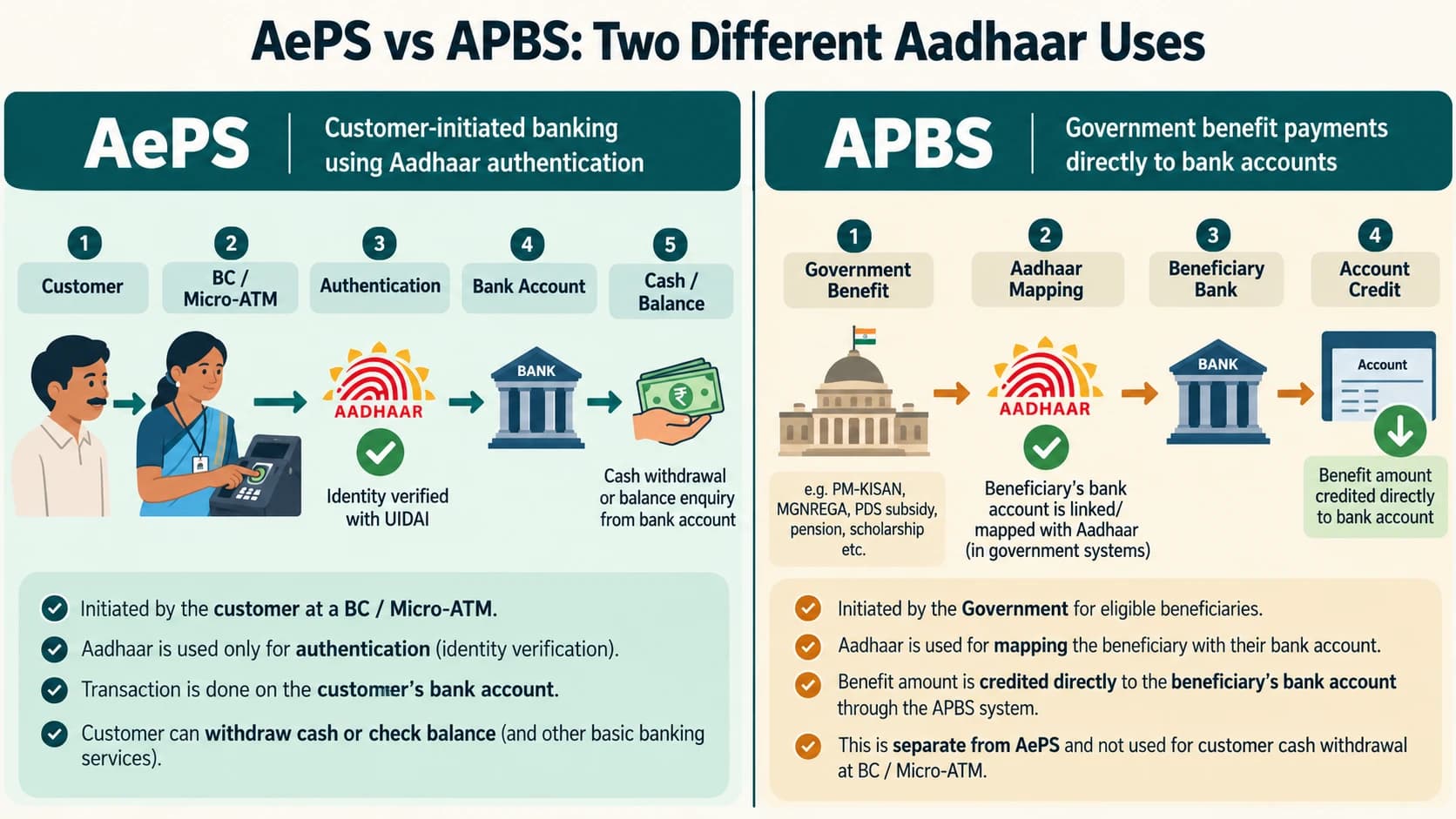
8. APBS flow
Government department / scheme
→ eligible beneficiary/payment file
→ Aadhaar-based mapping/payment routing through NPCI/banks
→ beneficiary bank account
→ status/reconciliation.
Different DBT schemes may use account/IFSC routes instead. Not every DBT payment necessarily uses APBS.
9. Aadhaar seeding vs mapping
Bank seeding links Aadhaar information with the customer's bank record through the applicable authorised process. NPCI mapper update makes the applicable Aadhaar-linked destination bank available for APBS routing.
These can involve separate processing/status steps; a bank-record link alone should not be assumed to prove the active mapper destination.
10. Why the mapper matters
If a person holds accounts at Banks A and B, an Aadhaar-linked DBT payment needs an authorised destination. The bank mapped under the applicable Aadhaar payment routing arrangement determines the recipient institution. Incorrect/incomplete seeding or mapping can cause failed/delayed benefits.
11. DBT is not AePS
| Term | Main task | Typical example |
|---|---|---|
| DBT | Government sends eligible benefit | Pension/subsidy transfer |
| APBS | Routes eligible Aadhaar-linked credits | Benefit sent to mapped bank |
| AePS | Aadhaar-authenticated customer banking transaction | Cash withdrawal at BC |
| Aadhaar seeding | Bank account identity-link process | Customer authorises account linkage |
| Micro-ATM | Field device/access point | BC transaction terminal |
12. Biometric fraud and safety
Aadhaar-based authentication can be misused if identity data, device controls, agents or consent are compromised. Users should:
- transact only with authorised outlets;
- obtain and inspect receipts/alerts;
- monitor bank-account entries;
- never allow unexplained repeated authentication;
- promptly report unauthorised debits;
- use UIDAI controls/biometric-lock features where appropriate.
The exact liability and complaint timetable is taught in BA-12, not embedded as changing numbers here.
13. Identity ≠ consent ≠ payment
A valid identity match does not automatically mean every transaction was properly authorised by the account holder. Good system controls require authentication, explicit transaction consent, data minimisation and dispute handling.
14. Aadhaar Pay vs AePS
Merchant acceptance products based on Aadhaar authentication can differ from the customer cash-withdrawal AePS channel. Do not automatically describe every Aadhaar-enabled merchant payment as an AePS cash withdrawal. Check the precise NPCI product and participant rules.
15. Financial inclusion benefit
The combination of:
- PMJDY/basic accounts;
- BC network;
- Aadhaar-based authentication;
- APBS/DBT;
- interoperable AePS cash access
can connect a remote customer to formal banking. But successful inclusion still requires functioning connectivity, accurate mapping, accessible grievance channels and alternatives if authentication fails.
Quick check — BA-11-05
- What is the full form of AePS?
- What is APBS primarily used for?
- Is Aadhaar itself a bank account?
- What is a micro-ATM?
- Does every DBT payment automatically use APBS?
Answers: 1. Aadhaar Enabled Payment System. 2. Routing eligible Aadhaar-based benefit credits. 3. No. 4. Last-mile transaction device. 5. No.