
NACH, Bharat Connect, NETC and e-RUPI
NACH, Bharat Connect, NETC and e-RUPI. A detailed chapter in Payment Systems & Digital Banking, with explanations and examples for Indian banking examinations.
By Akhilesh Saini · Reviewed 8 Oct 2026
1. Why not every payment uses UPI
Different payment problems require different designs:
- a utility must collect bills from millions of consumers;
- a lender needs authorised EMI debits;
- an employer pays thousands of salaries;
- a driver pays highway tolls without stopping;
- a sponsor wants to provide a voucher usable for an approved purpose.
This lesson explains four specialised payment ecosystems.
2. NACH — National Automated Clearing House
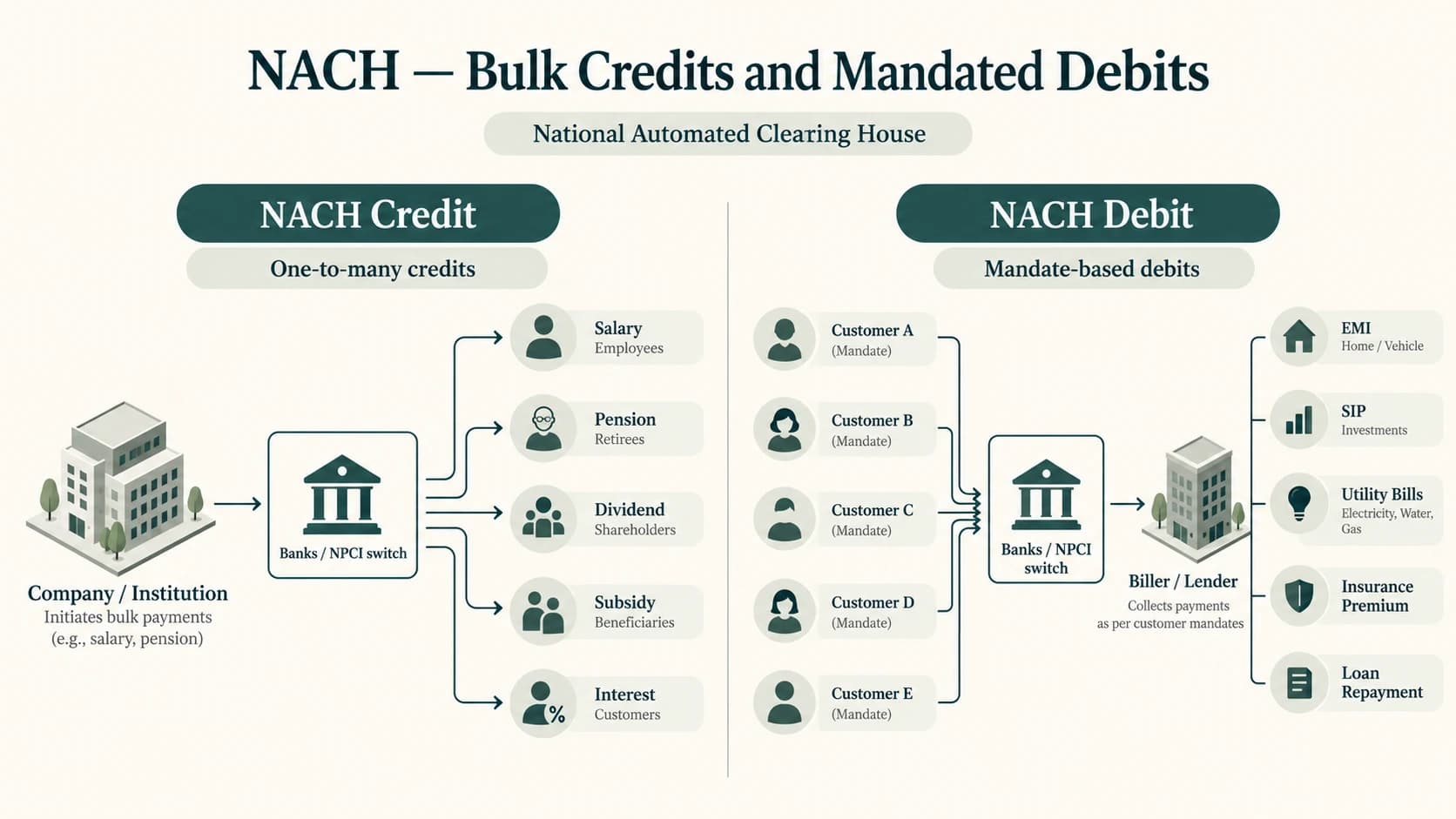
NACH is NPCI's standardised system for high-volume electronic credit and debit transactions. It brings consistency and automation to recurring/bulk payments, replacing fragmented older systems such as the earlier ECS arrangements over time.
3. NACH-Credit
In a NACH-Credit arrangement, an institution originates many credits for distribution. Examples:
- salary;
- pension;
- dividend;
- Government benefits where this route is applicable;
- large-scale refunds or disbursements.
One sponsor can pay many destination accounts efficiently.
4. NACH-Debit
NACH-Debit enables recurring collections from multiple customer accounts under a valid mandate. Examples:
- EMI;
- insurance premium;
- utility charges;
- systematic investment instruction when supported;
- other permitted scheduled collections.
Debit requires appropriate mandate authority. Mere possession of an account number should not give a biller unrestricted power to debit the account.
5. What is a mandate?
A mandate is an instruction/authorisation from the customer permitting a specified recurring debit within defined terms. Common attributes include:
- customer/beneficiary identity;
- creditor/biller;
- amount or ceiling;
- frequency;
- start/end/validity;
- authentication and cancellation terms.
An e-mandate can be created/authenticated electronically using approved channels rather than signed paper alone.
6. NACH vs UPI AutoPay
Both can support recurring payments, but they are not identical rails.
- NACH: bulk/recurring clearing and debit/credit mandates under NACH rules.
- UPI AutoPay: recurring UPI mandate execution under UPI rules.
They may support similar customer needs through different operational arrangements.
7. BBPS / Bharat Connect
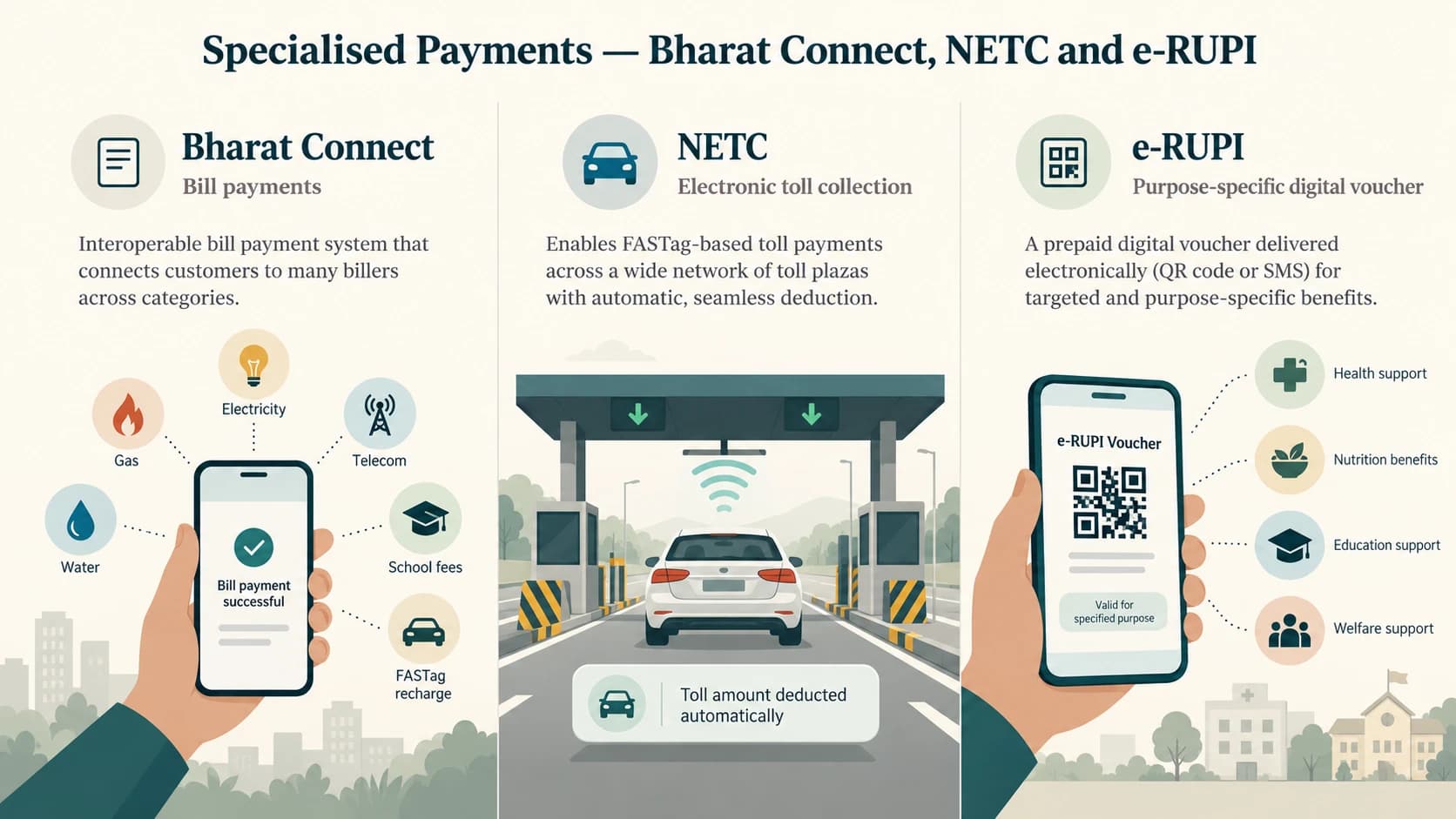
Bharat Bill Payment System (BBPS) is India's interoperable bill-payment ecosystem, also branded Bharat Connect. The objective is to make recurring and other eligible bill payments accessible through a common network with standardised services, confirmation and grievance handling.
8. BBPS governance
Under RBI's Bharat Bill Payment System Directions, 2024, NPCI Bharat BillPay Limited (NBBL) is the authorised payment-system provider for BBPS. Participating Bharat Bill Payment Operating Units (BBPOUs) and certified agent institutions form part of the ecosystem.
It is inaccurate to say NBBL is an ordinary merchant that supplies all electricity/water/telecom services itself.
9. Bharat Connect customer example
A customer opens a participating app to pay an electricity bill:
- Selects biller/category;
- enters bill reference or fetches bill;
- verifies consumer name and amount;
- selects payment mode;
- pays through a participating channel;
- receives reference/confirmation and can use formal dispute channels.
The bill-payment service and underlying funding rail need not be the same thing. A BBPS bill might be paid using one of several approved payment methods.
10. BBPS vs NACH
BBPS is primarily a bill-payment ecosystem. NACH is a bulk clearing/mandate system. An organisation may use NACH for authorised recurring debits while also participating in bill-presentment/payment infrastructure. Similar end use does not mean the systems are identical.
11. NETC — National Electronic Toll Collection
NPCI's National Electronic Toll Collection (NETC) programme provides interoperable electronic toll payment, commonly through FASTag. The programme includes network rules, clearing, settlement and disputes across issuers and toll plazas.
12. FASTag and RFID
A FASTag is a vehicle-associated RFID tag fixed to the windscreen and linked to a permitted source of payment (for example a prepaid balance or account arrangement). An enabled toll-plaza reader identifies the tag and processes the toll amount. It reduces stopping time, cash handling and congestion.
RFID = Radio Frequency Identification. RFID is not identical to NFC on a contactless card, though both use short-range radio technology in different operating designs.
13. FASTag participants
Typical roles:
- vehicle owner/user;
- issuing bank/tag issuer;
- acquiring toll-plaza participant;
- NPCI NETC network;
- toll operator/beneficiary;
- linked payment account/instrument.
Interoperability means the driver need not have a tag issued by the exact institution that serves every toll plaza.
14. FASTag is not ordinary UPI QR
Both reduce cash use, but:
- UPI QR identifies a payee/payment instruction;
- FASTag/NETC uses a vehicle-specific RFID identifier and toll collection system.
A current app may let users recharge FASTag by UPI. That funding method is separate from the tag's toll-payment rail.
15. e-RUPI — concept
e-RUPI is an NPCI-supported purpose-specific digital voucher/payment solution. It can be issued for identified beneficiary/use cases, with redemption under the product's rules. A sponsor may fund the voucher for an approved service; the beneficiary presents the voucher to a participating service provider.
16. e-RUPI flow
Sponsor
→ issuer bank / voucher generation
→ beneficiary receives voucher
→ specified merchant/provider redeems
→ payment settles according to the framework.
Think of e-RUPI as a purpose-/person-linked prepaid voucher design, not a general-purpose bank savings account.
17. e-RUPI vs UPI
UPI is a broad interoperable instant-payment interface. e-RUPI is a voucher product that uses relevant payment infrastructure but imposes voucher-specific issuance and redemption rules. The fact that both can be handled digitally does not make them the same product.
18. e-RUPI vs digital rupee
e-RUPI voucher and e₹ (CBDC) are different:
- e-RUPI: issuer-funded, purpose-specific prepaid voucher arrangement;
- e₹: a digital form of central-bank money issued by RBI under the CBDC framework.
Their names look similar but their legal/economic nature differs radically.
19. Comparison across specialised rails
| System | Best remembered for | Common use |
|---|---|---|
| NACH-Credit | Bulk credits | Salaries, pensions, institutional disbursements |
| NACH-Debit | Bulk recurring debit | EMI, subscriptions/premiums with mandate |
| Bharat Connect / BBPS | Interoperable bill presentment and payment | Utilities and other eligible bill categories |
| NETC / FASTag | RFID toll payments | Highway toll |
| e-RUPI | Purpose-specific digital voucher | Sponsored service/benefit redemption |
20. Update-sensitive details
Do not freeze:
- current e-RUPI issuance/redemption ceilings;
- FASTag recharging and KYC rules;
- newly supported BBPS bill categories;
- NACH settlement schedules;
- product fees or operator counts.
Quick check — BA-11-06
- What do NACH-Credit and NACH-Debit support?
- What is an e-mandate?
- What is Bharat Connect also called?
- Which technology is central to FASTag?
- Is e-RUPI the same as RBI's CBDC?
Answers: 1. Bulk credits and authorised recurring debits. 2. Electronically authenticated standing debit authority. 3. BBPS. 4. RFID. 5. No.