
CBDC, FinTech, Account Aggregators and Digital Lending
CBDC, FinTech, Account Aggregators and Digital Lending. A detailed chapter in Payment Systems & Digital Banking, with explanations and examples for Indian banking examinations.
By Akhilesh Saini · Reviewed 8 Oct 2026
1. Digital innovation is more than payments
Indian financial technology now also changes:
- the representation of money;
- how financial data can be shared with consent;
- how customers compare and obtain credit;
- how regulated firms deliver services;
- how digital identity and applications connect to banks.
Four useful concepts here are CBDC, FinTech, Account Aggregators and digital lending.
2. What is a CBDC?
A Central Bank Digital Currency (CBDC) is a digital form of central-bank money. India's CBDC is the Digital Rupee (e₹), issued by RBI. Under the documented retail model, a participating user holds/transacts in e₹ through supported wallets.
It aims to have cash-like attributes such as central-bank backing and settlement finality while using digital technology.
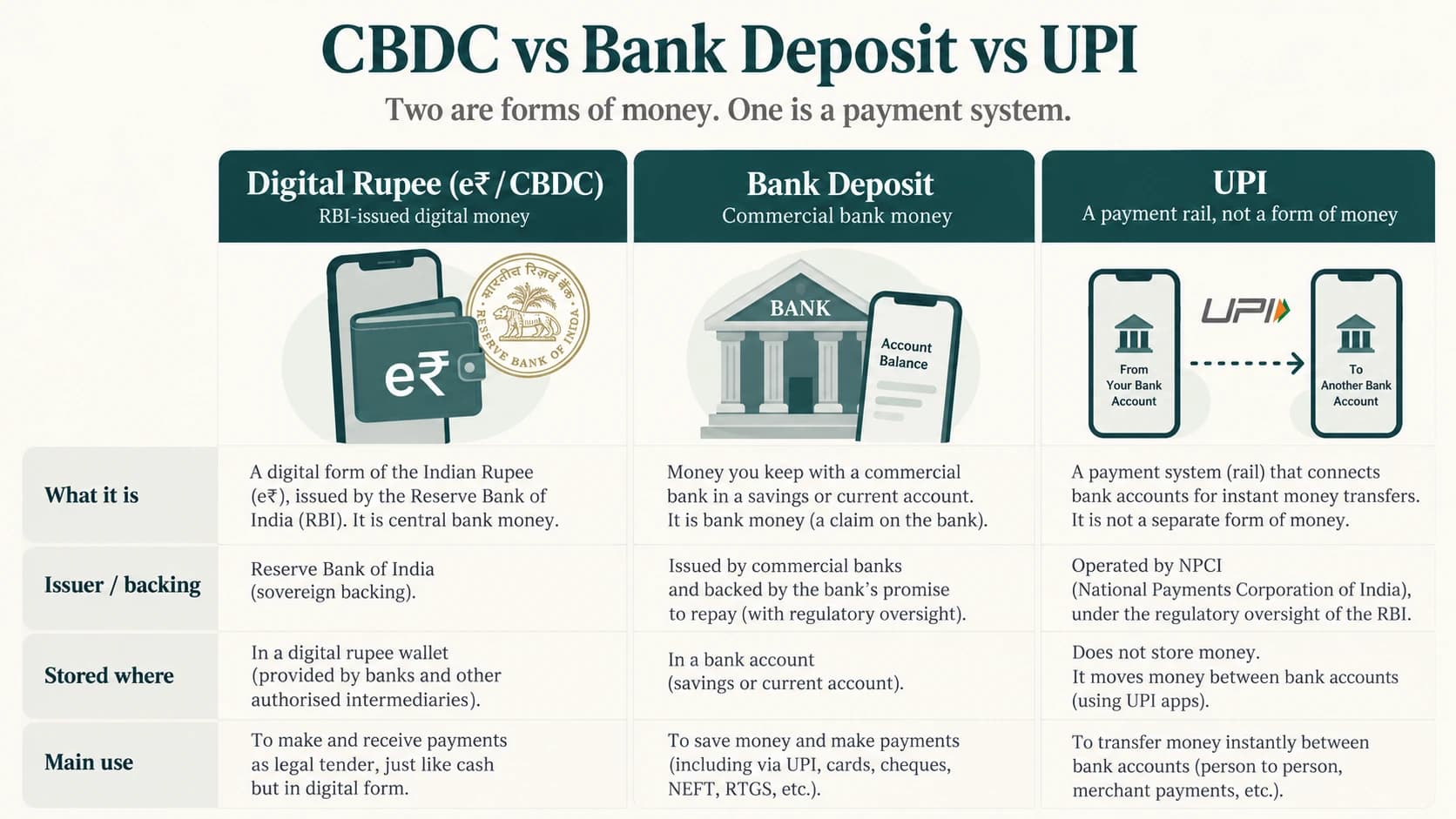
3. Cash vs bank deposit vs CBDC
| Property | Physical cash | Commercial-bank deposit | RBI digital rupee |
|---|---|---|---|
| Issuer / primary obligor | RBI / sovereign currency framework | Commercial bank | RBI |
| Form | Notes/coins | Bank account ledger entry | Digital central-bank money |
| Customer holds | Physical currency | Claim on bank | CBDC value/claim under digital rupee design |
| Example payment | Hand over notes | UPI/NEFT/IMPS bank-account transfer | Eligible e₹ wallet payment |
The distinction is whose liability the money represents.
4. Retail vs wholesale CBDC
- Retail CBDC (e₹-R): aimed at eligible individual/business transactions through supported distribution and wallet arrangements.
- Wholesale CBDC (e₹-W): focused on designated institutional/interbank/financial-market settlement use cases.
RBI began wholesale and retail pilots in 2022. Those historical milestones are suitable for evergreen examination preparation; current pilot scale/features belong in the living layer.
5. e₹ vs UPI
UPI is a payment interface/rail that commonly transfers commercial-bank money or uses other approved sources. Digital rupee is money issued by RBI. A CBDC wallet may support QR interoperability with payment acceptance infrastructure, but that does not convert every UPI balance into RBI-issued digital currency.
6. CBDC vs cryptocurrency
CBDC is issued/controlled by the sovereign central bank under its legal framework. Decentralised cryptocurrencies or private crypto-assets are not issued by RBI as national currency. Do not confuse:
- legal monetary issuer;
- underlying technology;
- speculative market asset.
Using distributed-ledger technology does not automatically make every digital asset a CBDC.
7. CBDC programmability and pilots
Programmability can attach rules to where or how funds are used in a controlled pilot. This may be useful in targeted transfers or institutional settlement experiments. But experimental programme design does not establish that every future digital rupee will be programmable or unrestricted in the same manner.
8. What is FinTech?
Financial Technology (FinTech) refers to technology-enabled innovation in financial products, services or business models. Examples:
- digital payments;
- digital lending;
- consent-based data sharing;
- insurtech;
- regtech;
- fraud analytics;
- automated compliance.
FinTech is a broad industry term, not one RBI licence category.
9. RegTech and SupTech
- RegTech: technology used by regulated firms for compliance, risk and reporting.
- SupTech: technology used by supervisors/regulators for oversight and supervision.
Example: automated suspicious-transaction surveillance for a bank is RegTech; a regulator's analytical supervisory platform may be SupTech.
10. Account Aggregator (AA) — definition
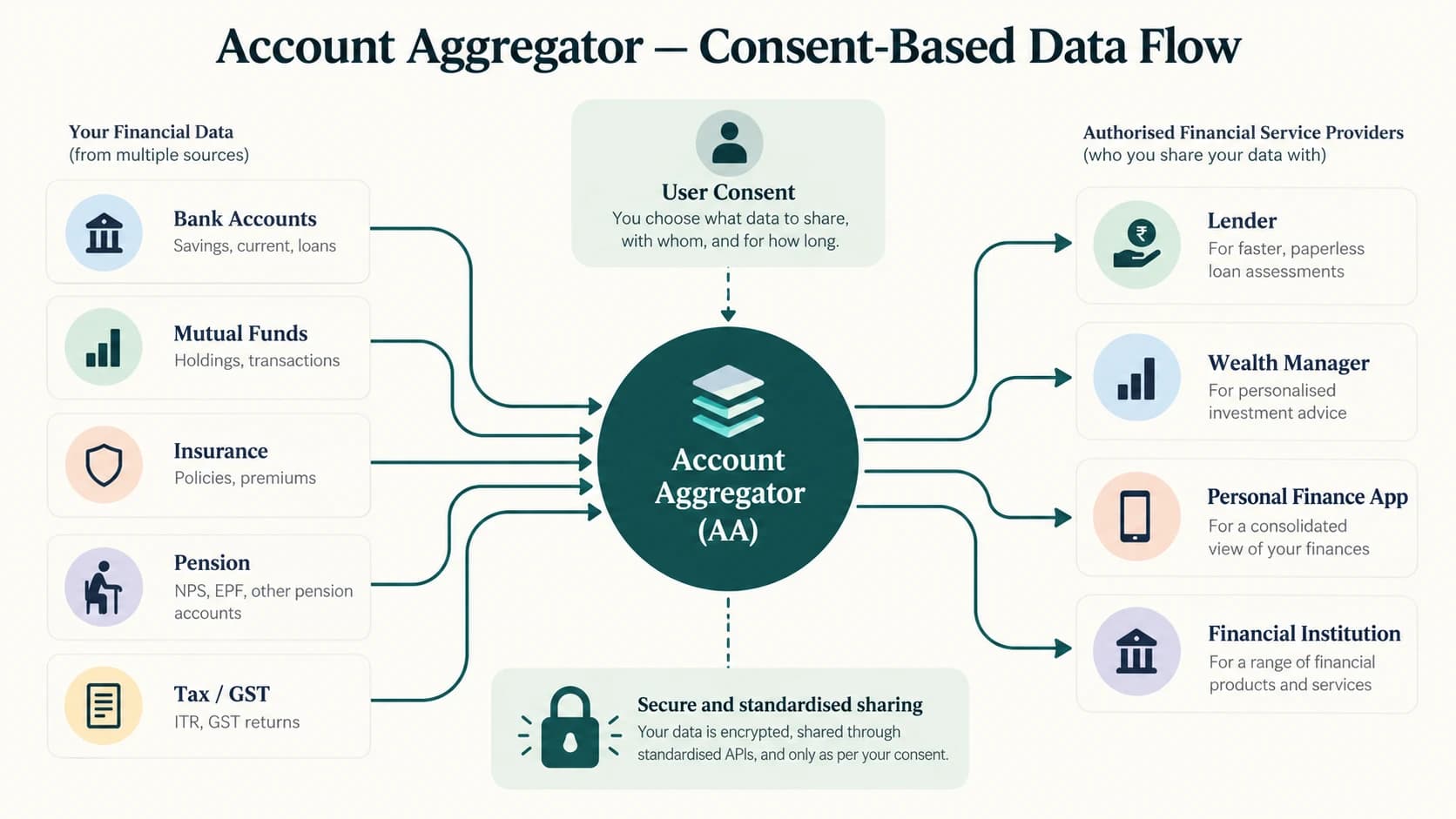
An Account Aggregator is a regulated consent-management/data-sharing intermediary within India's financial-information ecosystem. The RBI NBFC-Account Aggregator framework provides for explicit customer consent before information is retrieved or shared.
Crucial point: an AA is not a payments app and does not move customer funds merely because its name includes 'account'.
11. FIP and FIU
- Financial Information Provider (FIP): regulated/data-holding institution that makes eligible customer data available under valid consent.
- Financial Information User (FIU): eligible institution that receives authorised customer information for a permitted purpose.
- AA: manages customer consent and facilitates secure data transfer without becoming owner of customer finances.
12. AA consent flow
Customer
→ selects required financial-data sharing
→ AA consent request/artefact
→ FIP validates and supplies permitted data
→ FIU uses data for disclosed purpose.
The customer can review/revoke consent according to the framework. The AA is not supposed to ask for/store bank-account passwords or UPI PINs.
13. Why AAs can improve credit access
Suppose a self-employed applicant has income across multiple accounts. A lender may need verified cash-flow data. Rather than asking the applicant to email many bank PDFs, the customer may authorise secure data retrieval from participating FIPs for a defined purpose/period.
This can support:
- faster underwriting;
- less paper collection;
- customer control;
- more accurate cash-flow evaluation.
But consent to view information does not guarantee loan approval.
14. AA vs credit bureau
An AA facilitates consented exchange of eligible financial information. A Credit Information Company maintains credit histories/reports/scores under its own legal framework. One does not automatically replace the other.
15. Digital lending
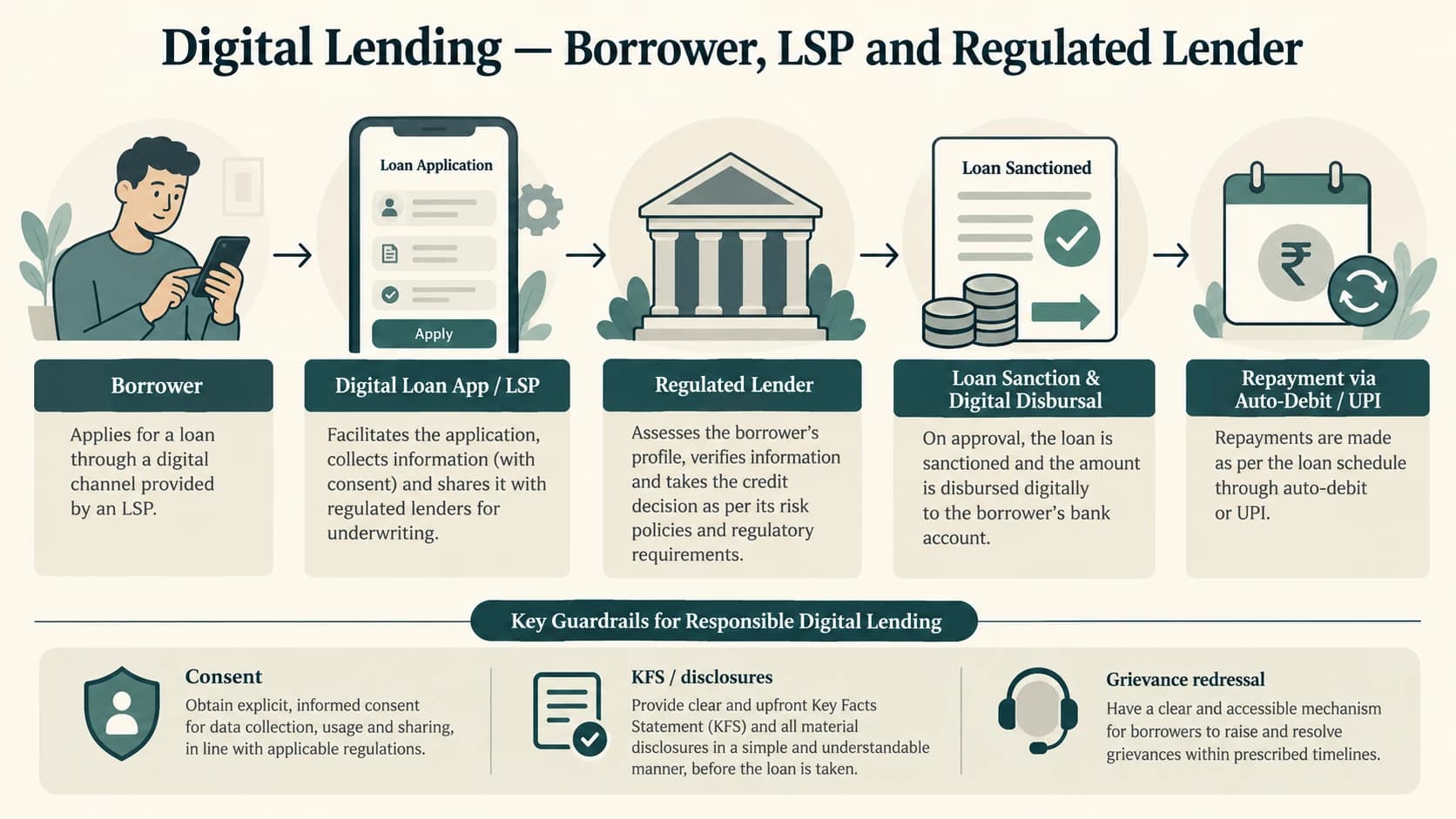
Digital lending means a credit process where substantial stages — application, underwriting, sanction, disbursement, servicing or recovery — use digital interfaces. The lender's responsibilities do not disappear because an app is involved.
A loan offered in a mobile app remains a legal loan with principal, interest, disclosure, repayment and recovery obligations.
16. Regulated Entity (RE) and LSP
- RE: RBI-regulated lender such as a bank or eligible NBFC/HFC under applicable Directions.
- LSP (Lending Service Provider): a third party engaged by the regulated lender to perform certain digital-lending functions.
The LSP may provide technology or customer interface, but regulatory responsibilities remain with the regulated entity as prescribed.
17. Digital Lending App (DLA)
A DLA is a customer-facing digital interface used for relevant lending functions. Whether an app is genuine should not be assessed from its name alone. Check the regulated lender's identity, official application/disclosure details and authorised grievance contacts.
18. Loan comparison and the Key Facts Statement
A borrower should be able to understand:
- lender identity;
- sanctioned amount;
- annualised percentage rate / APR;
- interest rate and fees;
- repayment schedule;
- cooling-off/exit options where prescribed;
- grievance contacts;
- purpose and limits of data collection.
The Key Facts Statement (KFS) is designed to improve comparability and transparency. The precise scope/current model must be checked in up-to-date RBI directions.
19. Fund-flow safeguards
A recurring digital-lending concern is that intermediaries may improperly route customer loan funds through their own pooled accounts. RBI's digital-lending rules seek to protect customers through appropriate direct fund-flow and regulated-entity controls, subject to stated exceptions. Do not assume that every loan disbursement may legally be diverted into any third-party wallet.
20. Data permissions and privacy
An app requesting unrelated access to contacts, gallery or sensitive data is a red flag. Digital lending must comply with appropriate borrower consent, data minimisation and regulatory conditions. A consent screen cannot justify arbitrary data harvesting.
21. Loan service provider is not a payment system
A lending-service app and a payment app solve different problems:
- payment app initiates/accepts value transfers;
- lending app helps originate/service credit;
- AA supports consented financial-data exchange;
- CBDC represents central-bank money.
A business can offer multiple services, but their regulatory character differs.
22. Default Loss Guarantee (DLG)
Some arrangements involve a third party giving limited protection against losses from specified digital-loan portfolios under RBI's rules. DLG is not the same as Government deposit insurance or a waiver of borrower liability. It is an allocation of credit-loss risk between contract parties within a regulated framework.
23. RBI Regulatory Sandbox
A regulatory sandbox allows eligible financial innovators to test products in a controlled environment subject to conditions and safeguards. Sandbox permission is not proof of universal public approval for every product, nor a replacement for all applicable licences outside the test setting.
24. Current regulatory status matters
Digital-lending instructions have been consolidated and revised, including 2025 instruments and later updates/withdrawals.
25. One consolidated comparison
| Item | What it does | Does it itself mean money transfer? |
|---|---|---|
| UPI | Payment messaging/interface | Supports payment from permitted source |
| Retail e₹ | RBI-issued digital money | The money itself can be transferred through supported wallets |
| Account Aggregator | Manages consent-based data sharing | No — not a funds-transfer system |
| Credit bureau/CIC | Maintains borrower credit reports/scores | No |
| Digital Lending App | Customer credit interface | Loan funds may flow through approved channels but app is not inherently money |
| FinTech | Broad category of financial innovation | Depends on the business model |
Quick check — BA-11-07
- Who issues the Digital Rupee?
- Is UPI the same as CBDC?
- What are FIP and FIU?
- Does an AA move funds as a payment system?
- Does a digital lending app remove the bank/NBFC's regulatory responsibilities?
Answers: 1. RBI. 2. No. 3. Financial Information Provider and Financial Information User. 4. No. 5. No.