
How to Read a Cricket Pitch Before a Match: A Practical Guide
Learn to assess cricket pitch grass, moisture, firmness, cracks and weather before the toss, and turn those clues into practical batting and bowling decisions.
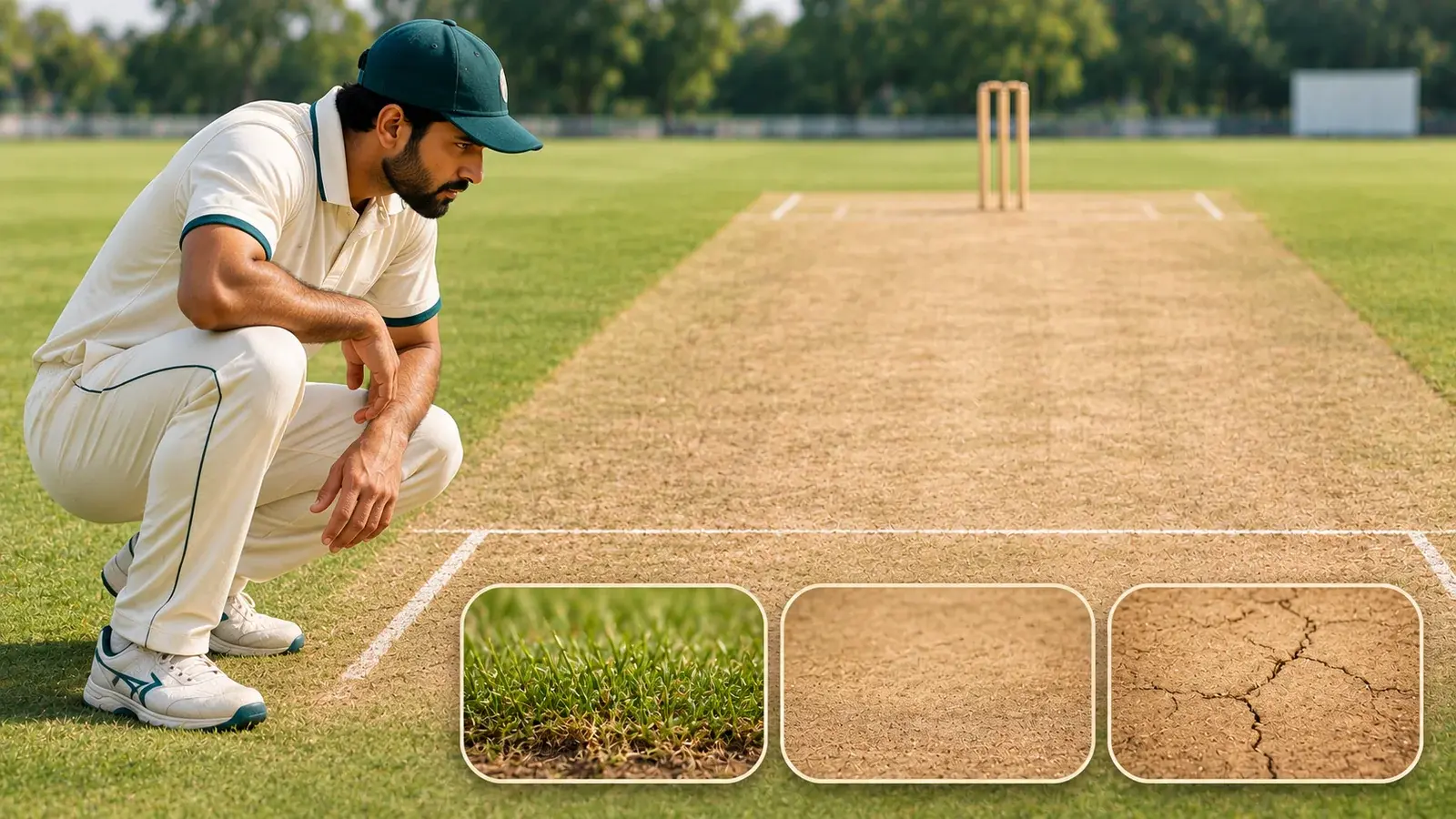
Quick Answer
To read a cricket pitch before the toss, check grass cover, moisture, firmness, surface wear and expected weather. Combine those observations with recent matches on the same strip, if available, and the strengths of both teams.
Green grass may suggest early seam movement; a firm, even surface may offer reliable bounce; dry, worn areas may help spin. None of these clues guarantees how the pitch will play. Make a provisional plan, then test it against the first few overs.
1. Inspect the pitch in five minutes
For players and captains, inspect only where permitted by the ground authority and umpires. Do not scrape, dig into, bounce balls on or otherwise damage the match surface. If watching from home, use the broadcast pitch report and close-up images instead.
| What to check | What it may suggest | What to avoid assuming |
|---|---|---|
| Grass: colour, density and evenness | Lush, moist grass may assist seam | Every green pitch favours pace |
| Moisture: damp patches or recent rain | Soft or unevenly damp areas may affect pace and bounce | A pale surface is dry throughout |
| Firmness: ask groundstaff or use reported readings | Firm, uniform surfaces tend to offer better carry | Hardness guarantees easy batting |
| Cracks, loose soil and old footmarks | Wear may create grip or variable bounce | Every crack will cause sharp turn |
| Smoothness at both ends | Uneven areas may respond differently to similar deliveries | Both ends will behave identically |
Look closely at the usual landing areas at each end, not just the centre of the strip. Firmness and moisture beneath the surface cannot be reliably measured from a photograph.
The Grounds Management Association's pitch-performance guidance explains why uniformity, compaction and surface friction matter.
2. Check the conditions beyond the pitch
Before deciding whether to bat or bowl, gather four extra pieces of information:
- Pitch history: Is it a fresh strip or one used recently? Ask how it played and whether preparation has changed.
- Weather: Check recent rain, expected sunshine, cloud and drying conditions. Swing through the air is different from seam movement after pitching.
- Evening dew: In Indian day-night matches, dew on the outfield can wet the ball and make it harder to grip. It is a possibility, not a certainty.
- Ground dimensions and outfield: Shorter boundaries or a quick outfield may increase scoring even when the pitch itself is not especially fast.
Venue averages are useful background. Compare the same format, recent matches and similar conditions rather than treating a stadium's reputation as today's pitch report.
3. Translate your observations into a match plan
| Likely conditions | Batting approach to consider | Bowling approach to consider |
|---|---|---|
| Early seam movement | Watch the ball closely; avoid unnecessary drives | Test a controlled off-stump line with the new ball |
| Firm, consistent bounce | Play positively when length permits | Use bounce and vary lengths |
| Slow or gripping surface | Time shots patiently; rotate strike | Test spin, cutters and changes of pace |
| Uneven bounce | Reduce speculative shots; prioritise control | Maintain a disciplined, safe attacking length |
These are initial plans, not rigid instructions. A good-length delivery on one surface may be less effective on another. Alert the umpires if conditions appear dangerous rather than trying to exploit unsafe bounce.
4. Should you bat or bowl first?
| Situation | Decision worth considering |
|---|---|
| Fresh, slightly damp surface expected to improve | Bowl first if your seam attack can exploit early assistance |
| Dry, worn multi-day surface expected to deteriorate | Bat first to avoid potentially tougher later innings |
| Day-night limited-overs match with likely heavy dew | Bowl first to avoid handling a wet ball later |
| Even surface with little expected change | Choose according to team strengths and opposition |
In Tests, consider the entire match, particularly the fourth innings. In ODIs and T20s, consider how conditions may change between innings. Neither a green pitch nor a dew forecast automatically settles the toss decision.
Example: an Indian evening T20
Suppose the strip looks firm and dry with a little grass, recent matches suggest good carry, and heavy dew is possible after sunset. A captain could choose to bowl first, keeping a balanced attack rather than assuming spin will be ineffective. If dew does not arrive, the original advantage may disappear. This is an illustrative scenario, not a real match forecast.
5. Confirm your reading once play begins
Watch the first two or three overs for:
- Whether similarly pitched deliveries produce consistent bounce and carry.
- Whether sideways movement occurs before or after pitching.
- Whether the ball comes onto the bat or holds up on the surface.
- Whether edges carry and whether well-timed shots reach the boundary.
Update the plan again when spin is introduced. Record observations separately from predictions: a single ball keeping low is not enough to establish a two-paced pitch.
For the underlying science and broader tactics, read why the cricket pitch shapes match strategy. For help separating atmospheric swing from pitch effects, see why a cricket ball swings.
Further reading
- Grounds Management Association: controlling pitch moisture
- ICC: pitch analysis technology
- ICC: discussion of Indian conditions and dew at the 2023 World Cup
When play starts, use the same observation zones to assess a bowler’s line, length and outcomes.