Why Does a Cricket Ball Swing?
Learn why a cricket ball swings in the air, how the seam and surface affect airflow, and what causes conventional, reverse and late swing.
A fast bowler releases the ball outside off stump. For the first part of its journey it appears to be travelling normally. Then it begins moving sideways through the air, forcing the batter to adjust at the last moment.
Nothing has touched the ball.
It hasn't bounced.
Yet its path has curved.
That movement is swing, and it is produced by aerodynamics.
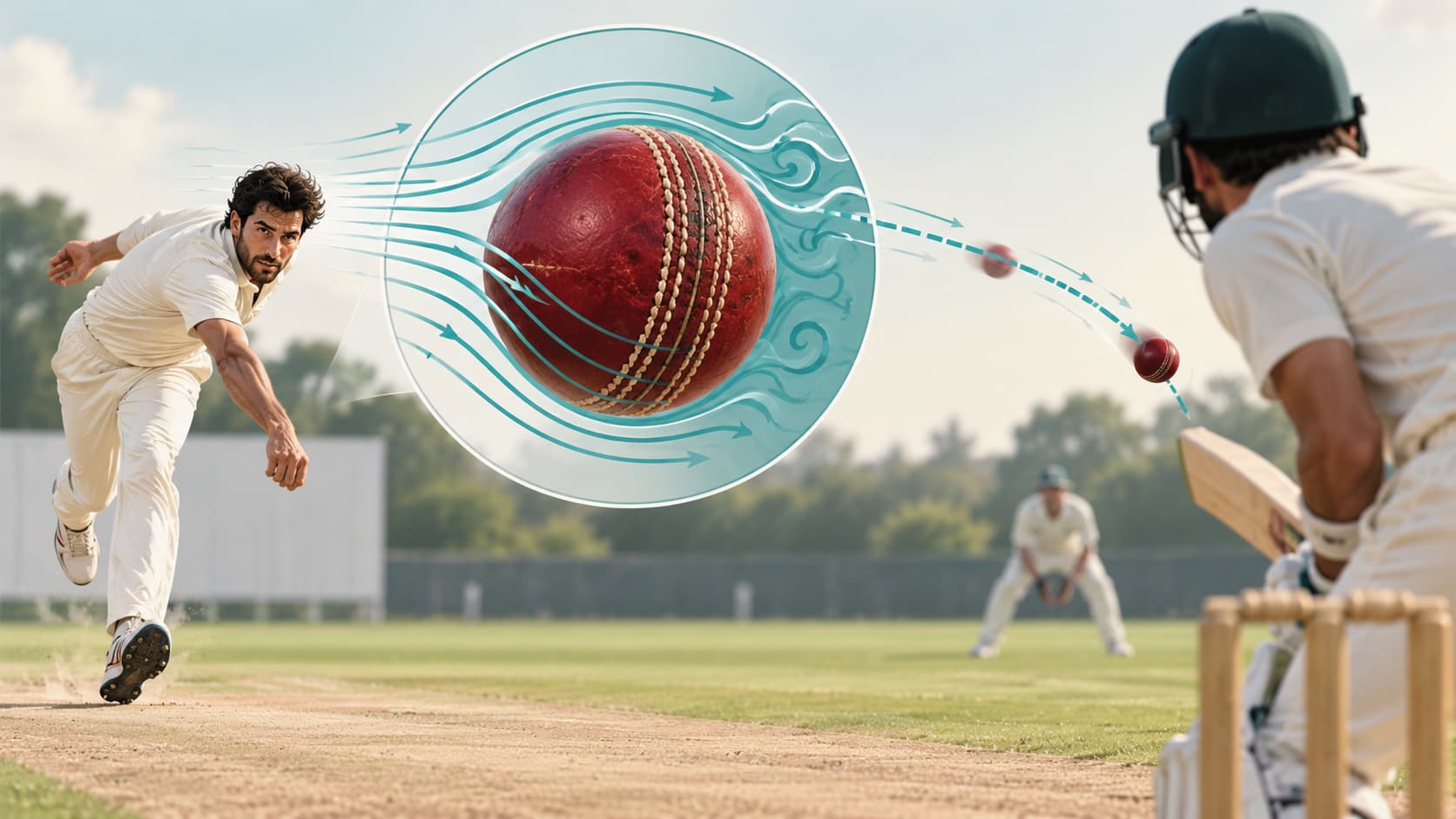
A cricket ball moving through air creates a thin layer of airflow around its surface. The raised seam, the condition of the leather, the ball's speed and the way it is released can make that airflow behave differently on the two sides of the ball.
When the air separates from those two sides at different positions, the pressure around the ball becomes uneven.
That imbalance produces a sideways aerodynamic force.
The ball swings.
The basic idea is straightforward. The interesting part is understanding why something as small as a raised seam can make the airflow asymmetric enough to change the path of a 156–163 gram cricket ball.
Swing Is Movement Through the Air
Before looking at the aerodynamics, it helps to separate three movements that spectators sometimes group together.
Swing
Swing occurs before the ball pitches.
The ball curves sideways through the air because aerodynamic forces are acting on it.
Seam movement
Seam movement happens primarily after the ball hits the pitch.
If the raised seam contacts the surface at an angle, the ball may deviate after bouncing.
Spin
A spin bowler deliberately rotates the ball rapidly so that its interaction with the pitch produces turn. Spin can also create movement through the air called drift, involving aerodynamic effects such as the Magnus force.
A swing bowler is doing something different.
The bowler normally tries to keep the seam relatively stable and angled during flight so that the airflow around the two sides of the ball becomes different.
The Thin Layer of Air That Matters Most
When a cricket ball flies forward, air doesn't simply pass around it as though the ball were surrounded by empty space.
A very thin region of air forms next to the ball's surface.
Aerodynamicists call this the boundary layer.
The air touching the ball is slowed strongly by friction with the surface, while air farther away moves much faster relative to the ball.
Within this boundary layer, the airflow can behave in different ways.
It may be relatively smooth and orderly, called laminar flow, or more disturbed and mixed, called turbulent flow.
"Turbulent" might sound worse, but in this case turbulence can actually help the airflow remain attached to the curved surface of the ball for longer.
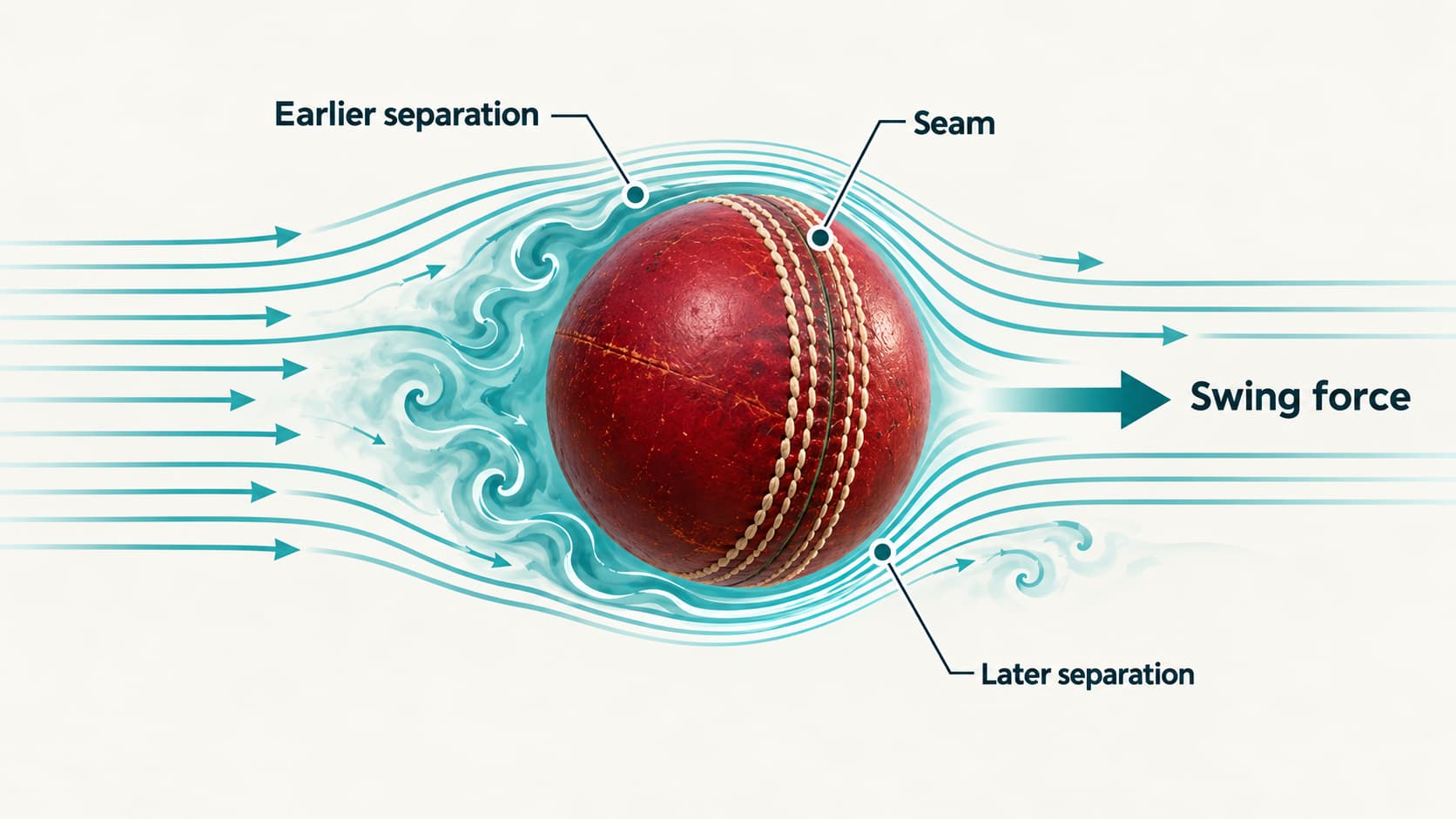
Eventually the airflow can no longer follow the curvature of the ball and breaks away from the surface.
This is called flow separation.
That separation point is crucial to swing.
If the air separates at approximately the same position on both sides, the aerodynamic forces are roughly balanced and there may be little sideways movement.
If it separates differently on the two sides, the wake behind the ball becomes asymmetric and a sideways force can develop.
A major 2024 review of cricket-ball aerodynamics concluded that this asymmetric boundary-layer separation is the fundamental mechanism behind both conventional and reverse swing.
Why the Seam Matters
A cricket ball isn't a perfectly smooth sphere.
Its most obvious irregularity is the raised primary seam.
A swing bowler typically releases the ball with that seam held at an angle to the direction in which the ball is travelling.
That small ridge changes the airflow on the seam side.
Older explanations often described the seam simply as a device that "trips" smooth airflow into turbulence.
That remains a useful beginner-level picture, but recent research suggests the real flow is more complicated.
A 2024 Cambridge review found that the seam can generate organised vortex structures and that a laminar separation bubble can form on the seam side before the airflow reattaches and eventually separates farther around the ball.
You don't need the full fluid mechanics to understand the practical effect.
The useful picture is:
the seam changes how the air behaves on one side of the ball, causing the airflow to leave the two sides differently.
That asymmetry creates swing.
How Conventional Swing Works
Consider a relatively new ball with a prominent seam.
The bowler holds the seam at a small angle rather than pointing it perfectly straight down the pitch.
Air approaches the front of the ball and divides around both sides.
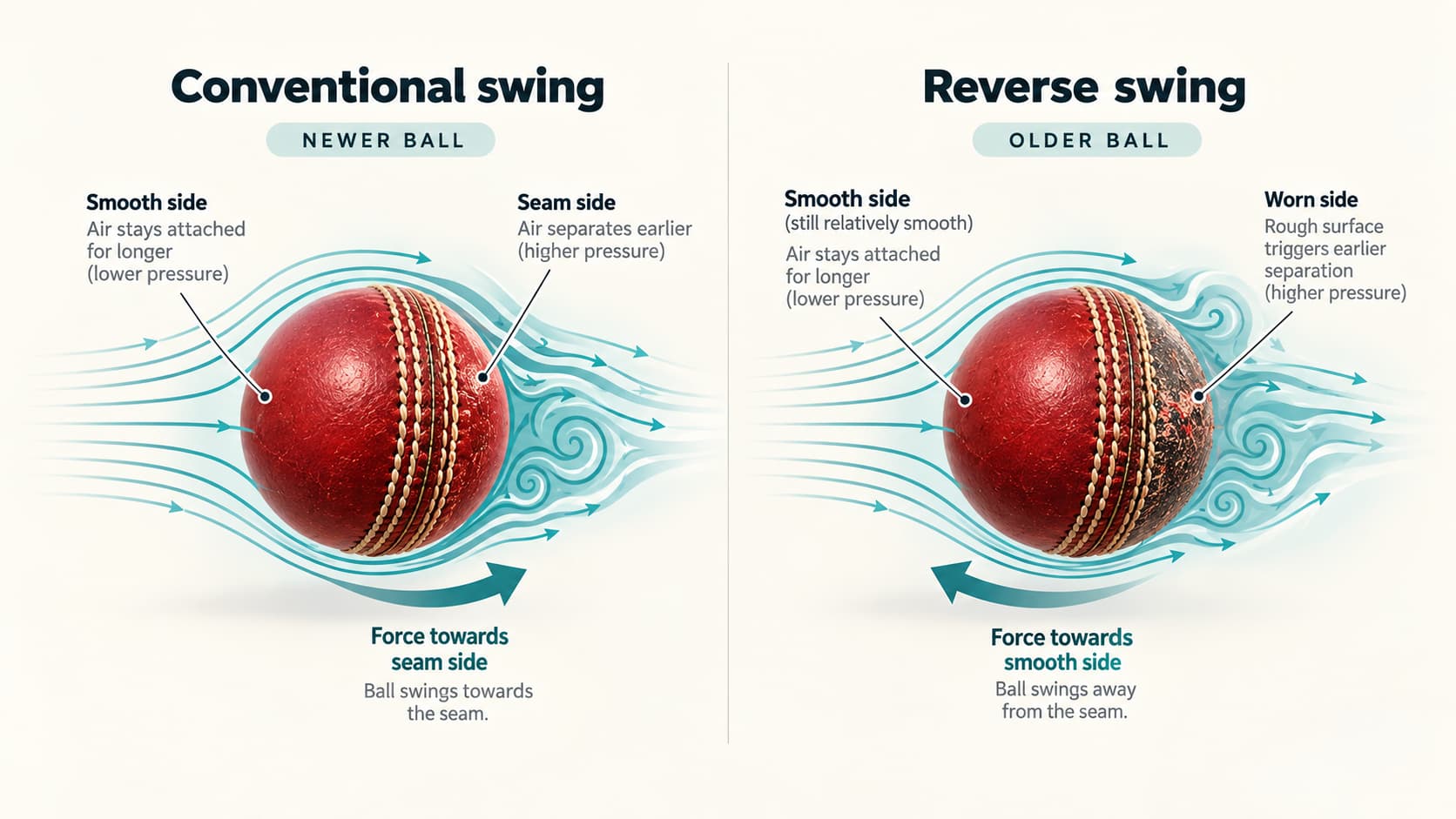
On the side away from the seam, the boundary layer can remain relatively laminar and separate comparatively early.
On the seam side, the raised seam alters the boundary-layer behaviour. The flow can remain effectively attached farther around the ball before separating.
Now the two separation points are different.
That creates an asymmetric wake and pressure distribution behind the ball.
The result is a sideways force.
For conventional swing, modern aerodynamic literature describes the ball as generally swinging toward the direction in which the seam is pointing.
That is the physics underneath an outswinger or inswinger.
The bowler changes the seam orientation and wrist position so that the aerodynamic side force develops in the desired direction.
Why Bowlers Try to Keep the Seam Upright
The seam can only influence the airflow consistently if its orientation remains reasonably stable.
That is why swing bowlers work so hard on wrist position.
They generally release the ball with some backspin around an axis running approximately along the seam.
This doesn't mean they are trying to produce the heavy spin of a leg-spinner or off-spinner.
The slower rotation helps stabilise the seam orientation during flight.
If the ball wobbles badly, the seam continually presents itself to the airflow at changing angles. The aerodynamic asymmetry can then become less consistent.
Classic wind-tunnel and projection experiments found that swing depends strongly on factors including seam angle, ball speed and rotation.
More recent researchers caution that realistic ball rotation, wobble and surface condition still need further investigation before every part of match swing can be quantitatively predicted.
So the practical instruction "keep the seam upright" has sound aerodynamic reasoning behind it, even though the detailed physics is complex.
Why Does One Side of the Ball Get Polished?
Watch a Test match and you will often see fielders repeatedly rubbing one side of the ball on their trousers.
They are trying to preserve a difference between the two surfaces.
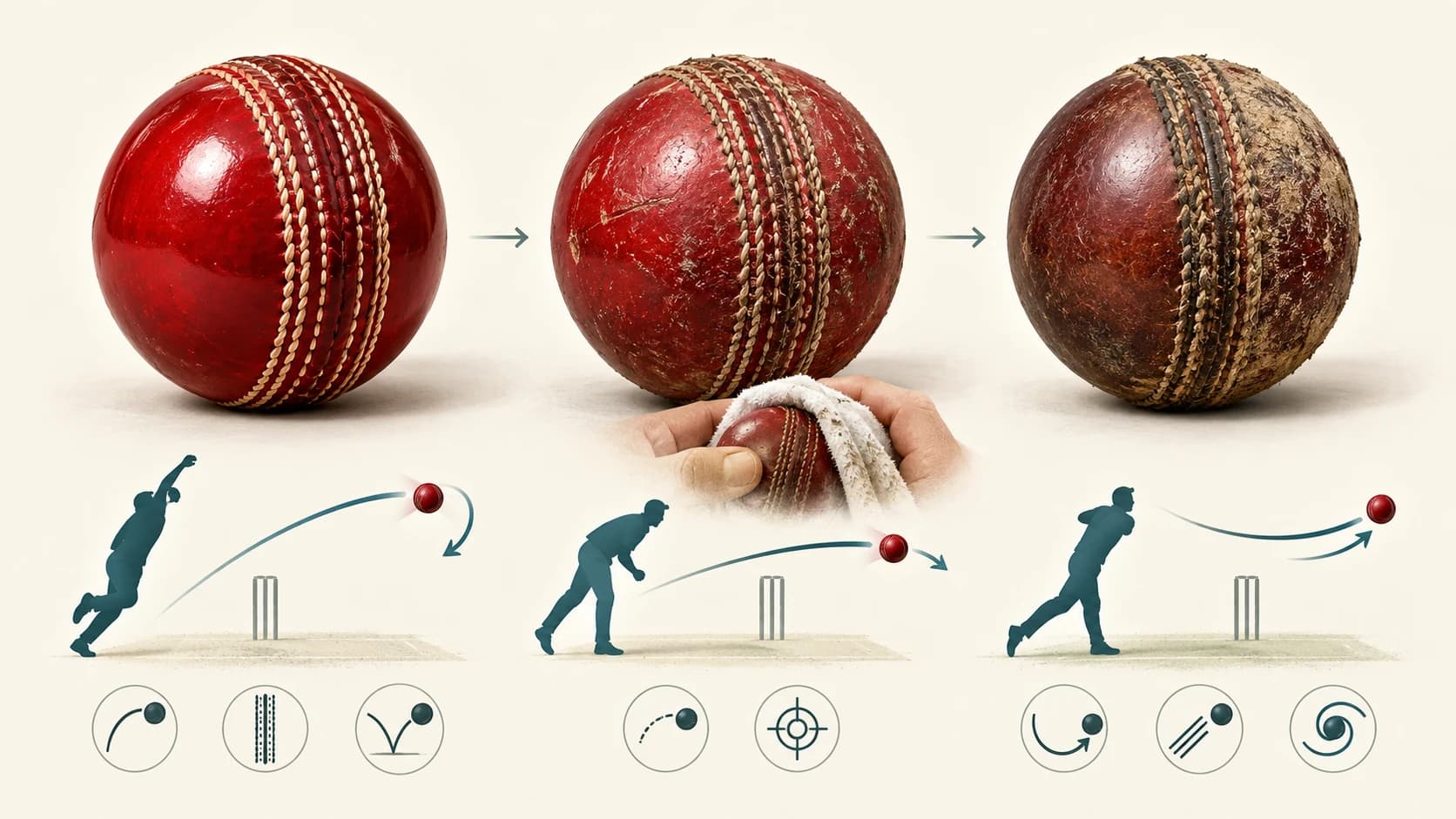
As the ball gets older, normal contact with the pitch, bat, grass and boundary areas gradually wears the leather.
The fielding side may keep one half relatively smooth while the other becomes naturally rougher.
That surface contrast affects how easily the boundary layer becomes disturbed and where the airflow separates.
The simplified explanation often heard on television is:
One side is shiny, one side is rough, so the ball swings.
That isn't completely wrong, but it leaves out an important part of the story.
With a new ball, the seam itself can create the airflow asymmetry even when both sides remain comparatively smooth.
As the ball ages, however, differences in roughness can become increasingly important.
Recent research shows that the amount and direction of swing depend on the combined effects of seam geometry, speed and the condition of both sides of the ball.
Does the Ball Simply Swing Toward the Rough Side?
Not always.
This is one of the reasons simple "shiny side versus rough side" rules can be misleading.
Depending on speed, seam orientation and surface condition, roughness can change the state of the boundary layer and therefore alter where the airflow separates.
Under some conditions, this produces movement one way.
Under different conditions, the airflow regime changes and the same general asymmetry can produce movement in the opposite direction.
That brings us to one of cricket's most fascinating aerodynamic effects.
What Is Reverse Swing?
Reverse swing occurs when the ball moves opposite to the direction expected from conventional swing.
In aerodynamic terms, the asymmetry in airflow separation has reversed.
For conventional swing, the flow separates farther back on the seam side than on the non-seam side.
For reverse swing, the situation changes so that the flow separates farther back on the non-seam side.
The sideways aerodynamic force therefore changes direction.
The bowler may maintain what appears to be a similar seam orientation, yet the ball moves the other way.
That is why it is called reverse swing.
Why Does Reverse Swing Usually Appear With an Older Ball?
As the match continues, the two halves of the ball can develop different surface conditions.
One side may be kept relatively smooth while the other becomes naturally worn and rougher.
At sufficiently high speeds, those differences interact with the seam and the boundary layer in a way that can reverse the positions at which airflow separates.
Research shows that the precise amount of reverse swing varies considerably depending on how rough both sides are. A 2024 review found that strong surface asymmetry can produce considerably more reverse swing than when both sides have become similarly worn.
This explains why managing the condition of the ball has always been such an important skill for fielding sides.
It also explains why reverse swing isn't simply something that automatically happens when a ball becomes old.
The speed, seam, surface condition and airflow must combine appropriately.
Can a New Ball Reverse Swing?
Surprisingly, yes.
Reverse swing is strongly associated with an older ball because surface wear can make it occur at more achievable bowling speeds.
But experiments have demonstrated reverse-swing regimes with new balls at sufficiently high speeds.
Modern research describes new balls switching from conventional to reverse swing after the airflow reaches a sufficiently high Reynolds number — essentially a measure combining ball speed, size and air properties.
You don't need to calculate Reynolds numbers while watching cricket.
The practical idea is simply:
speed changes the way air behaves around the ball.
At one range of speeds, the airflow arrangement may produce conventional swing.
At a higher range, the boundary-layer behaviour can change enough for the swing force to weaken, disappear or reverse.
For older balls with strong surface differences, that transition can happen at different speeds.
So Faster Doesn't Always Mean More Swing
It would be convenient if doubling the speed simply produced more sideways movement.
Cricket-ball aerodynamics doesn't work that neatly.
Speed determines not only the strength of aerodynamic forces but also the state of the airflow itself.
As speed changes, a boundary layer that was previously laminar may undergo transition and become turbulent.
That can shift its separation point dramatically.
So a bowler moving from one speed range to another may pass through:
little swing → conventional swing → reduced swing → reverse swing
depending on the ball and conditions.
This is why two bowlers with different speeds can get very different behaviour from the same type of ball.
What Is "Late Swing"?
Few things trouble a batter more than a ball that appears straight for most of its journey and then seems to move dramatically just before reaching the bat.
Commentators call this late swing.
It is tempting to imagine that some aerodynamic switch suddenly activates near the end of the delivery.
That isn't necessarily what is happening.
If a sideways aerodynamic force acts on the ball during flight, the ball continuously gains sideways velocity. Its lateral displacement therefore becomes increasingly noticeable as it travels farther.
A curved path can consequently look more dramatic late in the flight, even without an entirely new aerodynamic effect suddenly appearing.
Older aerodynamic studies identified this as one explanation for perceived late swing.
There is still room for further research, however. The 2024 Cambridge review found that laboratory descriptions of cricket-ball aerodynamics do not yet explain every behaviour visible in professional ball-tracking data.
So "late swing" is a useful cricket description, but it should not automatically be interpreted as proof that the aerodynamic force itself switched on at the last moment.
Does Humidity Make the Ball Swing More?
This is one of cricket's oldest beliefs.
A cloudy, humid morning arrives in England and commentators immediately start talking about ideal swing conditions.
The scientific evidence is much less straightforward.
Humidity changes the properties of air slightly, but the 2024 review found that its effect on the Reynolds number relevant to a cricket ball is less than about one percent, and previous experimental studies have not demonstrated a direct humidity effect on swing.
Temperature and atmospheric pressure can change air density and viscosity.
Wind also matters because it changes the airflow the ball experiences relative to the pitch.
Atmospheric turbulence around a cricket ground may potentially influence the boundary layer, but the recent review identified this as an area requiring further research rather than a settled explanation.
So the simple statement:
"Humidity makes the ball swing."
is not well supported by current aerodynamic evidence.
Cloudy weather may correlate with other environmental conditions, but cloud itself doesn't pull the cricket ball sideways.
Does Wind Help Swing?
Wind can matter, but not simply because it "pushes the ball."
The aerodynamics depend on the airflow relative to the moving ball.
A headwind or tailwind changes the effective speed of that airflow.
A crosswind changes its direction.
Those changes can alter the Reynolds number, move the stagnation point where air first meets the front of the ball and change the direction of aerodynamic force relative to the pitch.
The 2024 review specifically identifies wind speed and direction as relevant boundary conditions in cricket-ball swing.
That helps explain why the same bowler and ball may behave somewhat differently when bowling from opposite ends of a ground.
Why Do Red, White and Pink Balls Behave Differently?
Colour itself isn't what makes a ball swing differently.
The manufacturing details can be.
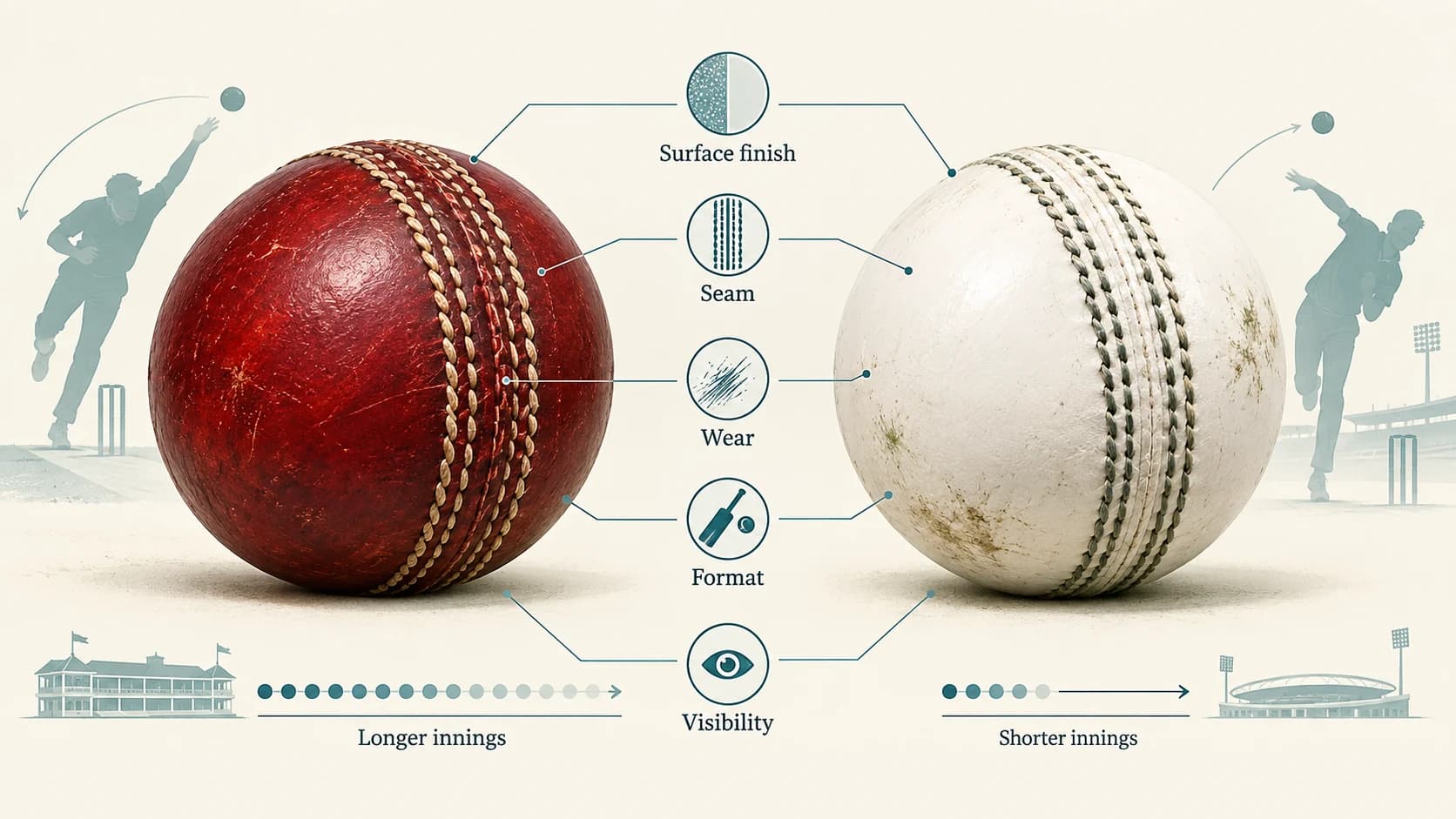
Different cricket balls can vary in:
- seam geometry
- lacquer and surface finish
- leather texture
- secondary seam construction
- how quickly the surface wears
Research comparing different ball types has found differences in the airflow speed at which the transition between conventional and reverse-swing behaviour occurs. Surface texture and seam details are among the likely reasons.
So when players say that a particular brand or colour of ball behaves differently, there can be a genuine aerodynamic basis.
But it is better to think in terms of construction and surface properties rather than assuming the pigment itself changes the physics.
Why Is Ball Maintenance So Important?
The fielding side is effectively managing an aerodynamic object for dozens of overs.
Every bounce and every impact changes its surface a little.
Maintaining one side can preserve the surface asymmetry that later affects swing.
Cricket's laws restrict how players are allowed to do this.
Under MCC Law 41, fielders may polish the ball on their clothing without using an artificial substance; the permitted natural substance under the current law is sweat. Deliberately altering the condition of the ball outside the permitted methods is an offence.
That distinction matters scientifically.
Natural wear and legal polishing can create useful aerodynamic differences.
Artificially damaging one side can create larger surface differences — which is precisely why altering the ball illegally can change its aerodynamic behaviour.
The Science Is More Complicated Than the Commentary
Cricket often reduces swing to a few memorable rules:
Keep the shiny side this way.
Point the seam that way.
Humidity will help.
An old ball reverses.
These rules can sometimes be useful to players, but the underlying physics is richer.
A 2024 review covering roughly 70 years of cricket-ball research concluded that even the established scientific explanations still don't fully reproduce everything observed in professional match tracking.
Real deliveries involve variables that wind-tunnel experiments struggle to reproduce perfectly:
- seam angle
- ball speed
- surface defects
- roughness
- rotation
- wobble
- wind
- air turbulence
- temperature and pressure
Tiny differences can change the boundary layer.
That is partly why a bowler can produce a beautiful outswinger with one delivery and almost no movement with the next despite apparently using the same action.
The Simplest Way to Understand Cricket-Ball Swing
You don't need fluid-dynamics equations to understand the central mechanism.
Think of the process as a chain:
The ball moves through air
↓
A boundary layer forms around its surface
↓
The seam and surface condition affect the airflow differently on each side
↓
The airflow separates from the two sides at different positions
↓
The pressure and wake become asymmetric
↓
A sideways aerodynamic force appears
↓
The ball swings
For conventional swing, that force normally moves the ball toward the seam side.
For reverse swing, the airflow pattern changes and the force points the other way.
Everything the bowler does — wrist position, seam angle, speed, release and maintaining the condition of the ball — is ultimately an attempt to control that tiny layer of moving air.
The batter sees a red or white ball curving through the air.
What is really happening is a fluid-dynamics experiment travelling down the pitch at more than 100 kilometres per hour.