How Does DRS Work in Cricket?
Learn how cricket's DRS works, including player reviews, UltraEdge, ball tracking, LBW decisions, Umpire's Call and when teams lose a review.
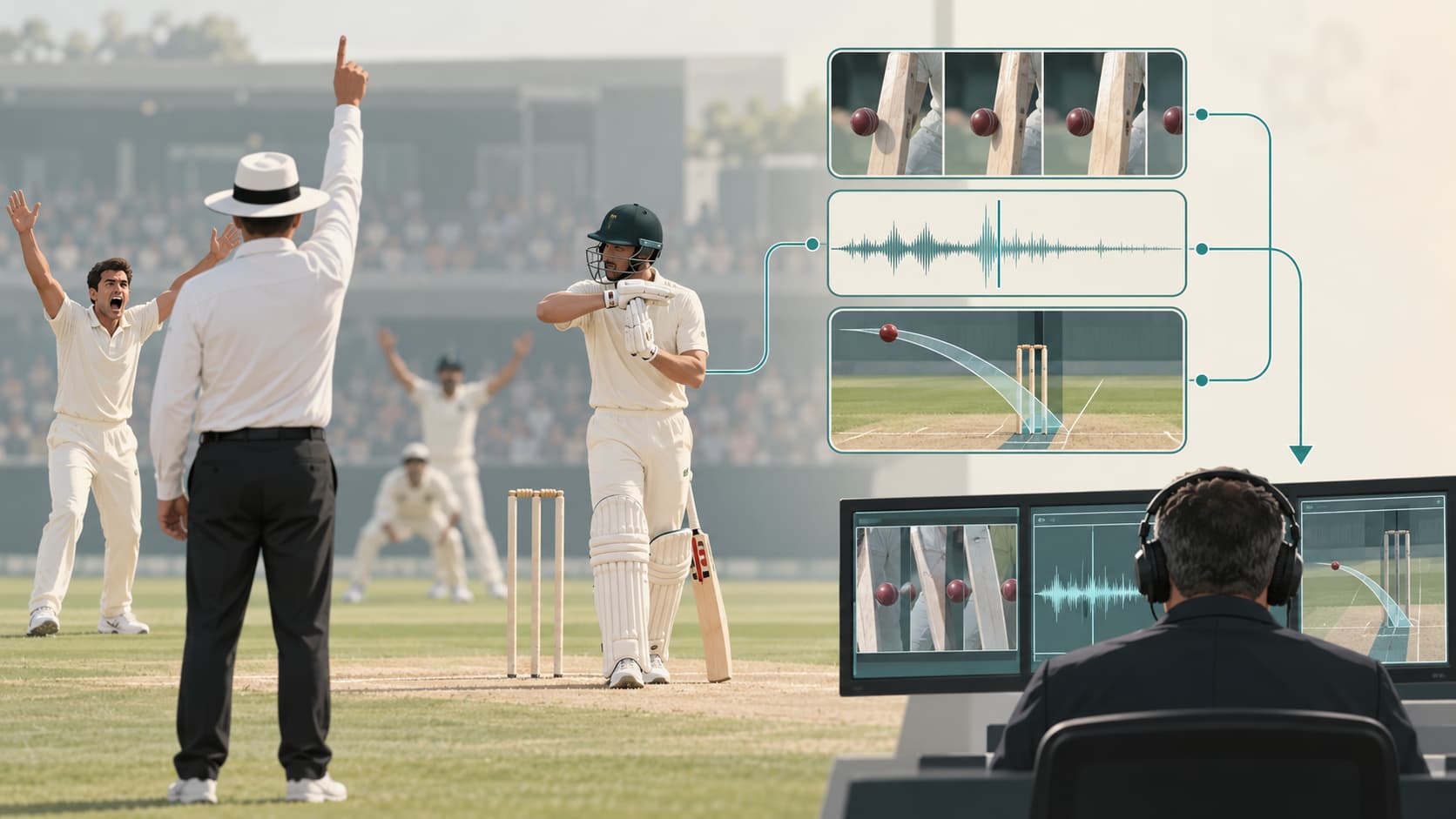
The umpire raises a finger.
The batter looks at the non-striker, taps the bat, thinks for a few seconds and then makes a T shape with both arms.
A moment later, television viewers see slow-motion replays, a waveform looking for a faint edge and, perhaps, a computer-generated ball travelling toward the stumps.
This is the Decision Review System, usually shortened to DRS.
It can sometimes appear as though cricket simply asks a computer whether the batter is out. That isn't really how it works.
DRS is a structured process in which the third umpire uses approved technology to review an on-field decision. Different tools answer different questions. Video might show whether a catch carried. Sound-based technology can help determine whether the ball touched the bat. Ball tracking can estimate where an intercepted delivery would have travelled.
The final result still has to be applied according to cricket's laws and playing conditions.
The ICC defines DRS as a technology-based process used to assist match officials, with both Umpire Reviews, initiated by officials, and Player Reviews, requested by players.
Once you separate those pieces, the system becomes much easier to understand.
DRS Is More Than the Player Review
People often use "DRS" to mean the moment a batter or fielding captain challenges an umpire's decision.
That is only part of the system.
There are two important review routes.
Umpire Review
An on-field umpire can refer certain incidents to the third umpire.
The familiar examples include close run-outs and stumpings, where television replays can provide a better view of whether the batter made their ground before the wicket was broken.
The player does not spend one of the team's reviews when the umpire initiates this type of referral.
Player Review
A player can challenge an on-field dismissal decision under the DRS protocol.
Under the current ICC Test playing conditions, only the batter involved can request a review of an Out decision, while only the fielding captain or acting captain can request a review of a Not out decision. The protocol excludes Timed Out from player review.
So when a bowler believes an LBW appeal should have been given out, the bowler cannot personally demand a review unless they are also acting as captain. The fielding captain makes that decision.
How Does a Player Ask for DRS?
The review signal is deliberately simple.
The player forms a T with both forearms at head height.
But there is a strict time limit.
Under current ICC playing conditions, the request must be made within 15 seconds of the ball becoming dead. The bowler's-end umpire gives the relevant player a prompt after 10 seconds if a review has not yet been requested. A late request can be refused.
Players are allowed some consultation.
The fielding captain can talk to the bowler and other fielders. The two batters can consult one another.
What they cannot do is wait for help from outside the field.
The current protocol allows the umpires to reject a review if they believe the players have received direct or indirect assistance from elsewhere, including signals from the dressing room. Stadium replays are also held back until the review-request window has expired.
Once the review is requested, it cannot simply be withdrawn because the player changes their mind.
What Happens After the T Signal?
The on-field umpire communicates with the third umpire and confirms what was originally decided.
For a dismissal review, that includes information such as:
- what mode of dismissal was being considered
- whether the original decision was Out or Not out
- relevant details needed to interpret the decision
The third umpire then begins examining the available evidence.
One important detail comes before many viewers expect it:
the third umpire checks whether the delivery itself was legal where required.
The current ICC player-review protocol instructs the third umpire to check applicable forms of No ball before continuing with the dismissal review.
Only then does the review move through whatever evidence is relevant to the dismissal.
Not every review needs every technology.
A caught-behind review may depend heavily on replay and edge detection.
An LBW review may need edge detection followed by ball tracking.
A run-out referral may be resolved entirely from camera footage.
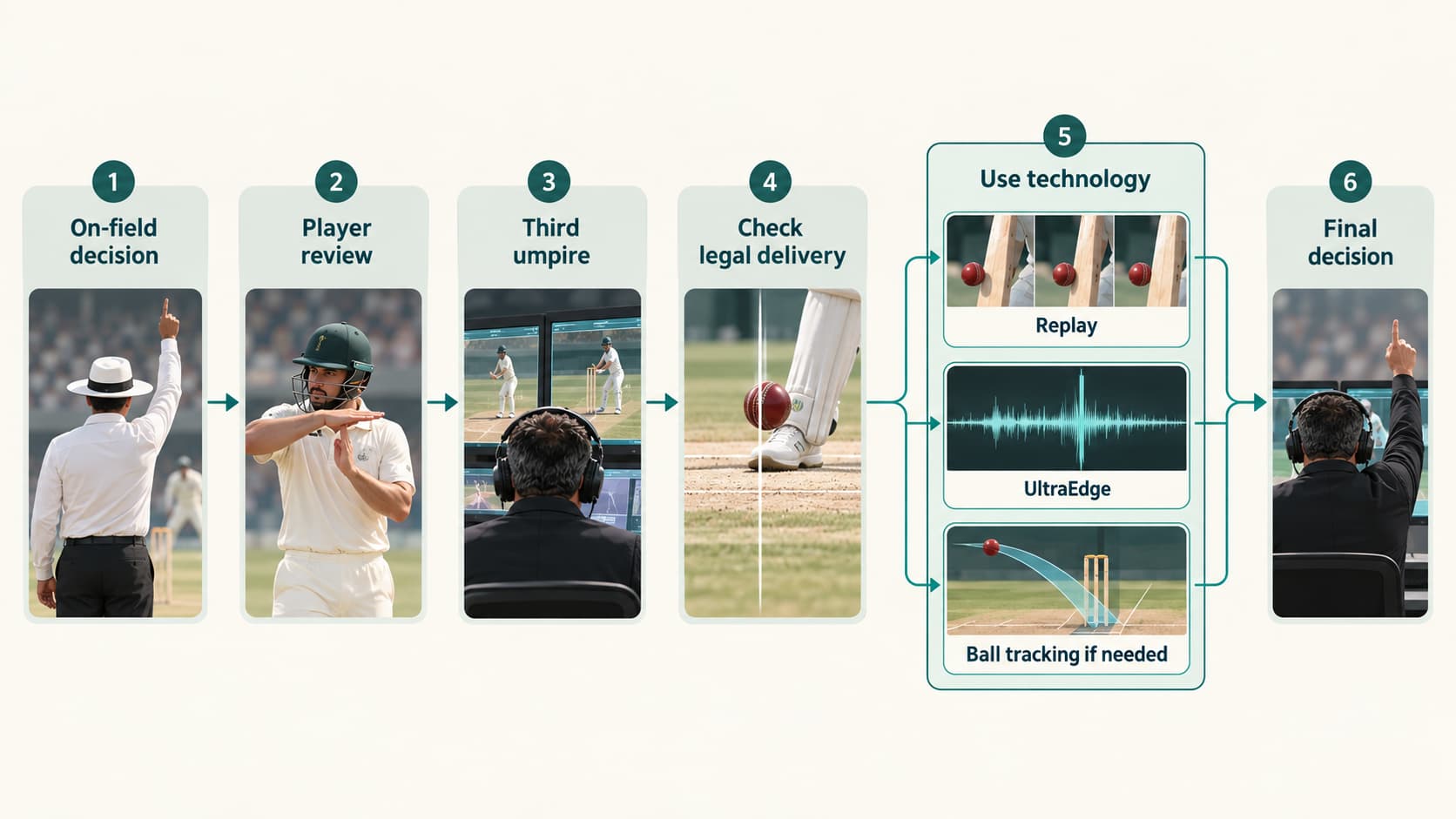
The technology is therefore better thought of as a toolkit, not one machine called "DRS."
The Main Technologies Used in DRS
Current ICC playing conditions permit several types of technology during Player Reviews, including broadcast replays, stump-microphone sound, approved ball tracking, approved sound-based edge detection, heat-based edge detection where available and LED wicket systems.
Video replay
This is the most straightforward part.
The third umpire can examine available camera angles at different speeds.
Video can help answer questions such as:
- Did the ball carry to the fielder?
- Did the bat touch the ball?
- Was the batter's foot grounded behind the crease?
- Was the wicket broken in time?
- Did the ball touch the ground?
Sometimes the camera evidence alone is decisive.
Sometimes it isn't.
UltraEdge and other edge-detection systems
A tiny contact between bat and ball can be almost impossible to identify by sight.
Sound-based edge-detection systems help by synchronising audio information with video of the ball passing the bat.
The ICC currently lists UltraEdge and Real-Time Snickometer as approved sound-based edge-detection technologies.
On television, this commonly appears as a waveform beside slow-motion footage.
If a clear spike corresponds with the moment the ball passes the bat, it may provide evidence of contact.
But the waveform isn't simply a magical "bat detector." Other sounds can occur around the same time: the bat can strike the pad, the boot can scrape the ground or equipment can make noise.
That is why the third umpire considers the waveform together with synchronised video and the wider evidence rather than treating every spike as proof of an edge.
Hot Spot
Where approved and available, thermal imaging can also help identify contact.
Hot Spot uses infrared imagery to look for heat signatures that may appear when the ball contacts surfaces such as the bat.
It is one possible tool under ICC DRS protocols, rather than something guaranteed to be present in every match.
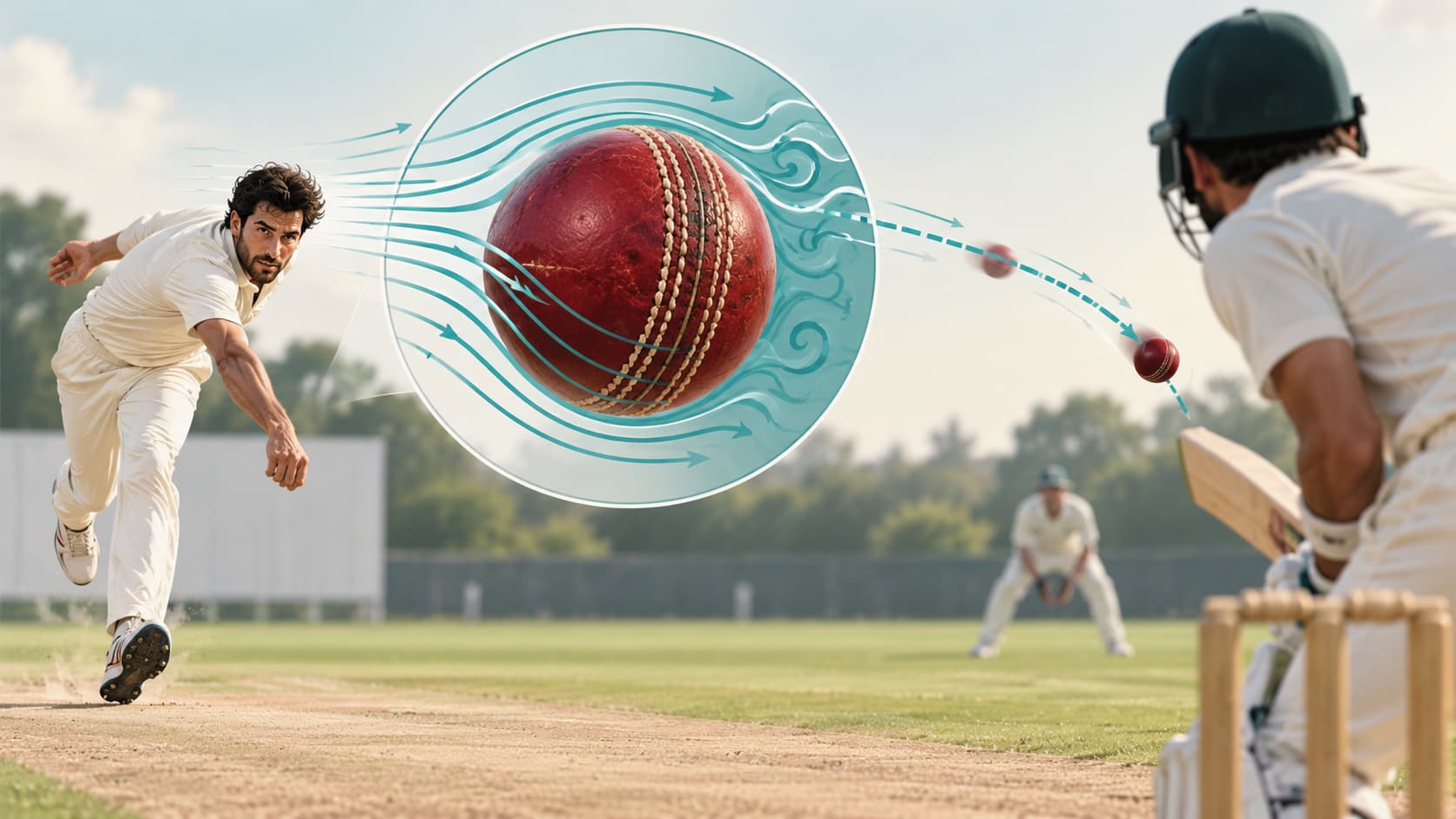
Ball tracking
Ball tracking is most visible during LBW reviews.
ICC-approved systems currently include Hawk-Eye and VirtualEye.
Hawk-Eye describes its cricket technology as using optical tracking and calibrated camera systems to follow ball movement, with its technology now used for both broadcasting and officiating.
Ball tracking does something different from an ordinary replay.
It reconstructs the delivery's path and, when the batter's body interrupts that path, projects where the ball would have continued.
That projected section is what matters for LBW.
How DRS Reviews an LBW Decision
LBW is where DRS looks most complicated because several separate questions have to be answered.
The ball-tracking sequence shown to viewers is usually presented as:
Pitching → Impact → Wickets
But other checks come before that.
First: Was it a legal delivery?
If the delivery was a No ball, an LBW dismissal cannot stand.
Second: Did the ball hit the bat first?
LBW requires the ball to strike the batter without first making the relevant bat contact.
That is why an LBW review may begin with UltraEdge or another form of replay analysis.
If the evidence shows a genuine inside edge before the ball hits the pad, there is no need to ask where the ball would have hit the stumps for the LBW appeal.
If there is no bat involved, ball tracking becomes relevant.
Step 1: Pitching
The first tracking question is where the ball pitched.
For LBW, a delivery pitching outside the batter's leg stump cannot produce an LBW dismissal.
The current ICC protocol defines the pitching decision using the centre of the ball relative to the designated Pitching Zone.
The output can therefore be:
- In Line
- Outside Off
- Outside Leg
There is no ordinary "Umpire's Call" category for the pitching point in this part of the current protocol.
A ball pitching outside off stump can still result in LBW.
A ball pitching outside leg cannot.
Step 2: Impact
Next comes the point where the ball first struck the batter.
If the batter was genuinely attempting a shot, the LBW law normally requires the relevant impact to be in line with the wickets.
The situation changes if the batter made no genuine attempt to play the ball, when impact outside off stump can still be compatible with LBW.
This is also one of the places where Umpire's Call can appear.
Under the current ICC definition:
- In Line means the centre of the ball was inside the Impact Zone.
- Umpire's Call can apply when part of the ball is inside the zone but its centre is outside.
- Outside means the required overlap is absent.
This centre-of-the-ball rule is more precise than the common explanation that DRS simply asks whether "50% of the ball" is in line.
Step 3: Would the Ball Have Hit the Wicket?
Finally, the tracking system projects the ball towards the stumps.
The result is categorised as:
- Hitting
- Umpire's Call
- Missing
For Hitting, the projected ball overlaps the wicket and the centre of the ball is inside the Wicket Zone.
For Umpire's Call, the projected ball still touches the wicket, but its centre does not fall inside that zone.
For Missing, the projected ball misses the wicket.
This distinction explains one of the most debated parts of DRS.
What Exactly Is "Umpire's Call"?
Suppose the umpire gives a batter Not out for LBW.
The fielding captain reviews.
Ball tracking shows the delivery clipping the outside edge of the leg stump, but only marginally enough to fall into the ICC's Umpire's Call category.
The original Not out decision stays.
Now imagine the same delivery had originally been given Out.
If the relevant result remains within the Umpire's Call category rather than meeting the threshold required to overturn the decision, the original Out decision can remain.
That may initially sound inconsistent.
It isn't saying the same ball is simultaneously out and not out.
It reflects the design of the review system: technology must provide enough evidence to justify overturning the original decision.
Marginal tracking results preserve the on-field call instead of treating the model as infinitely precise.
The ICC explicitly defines Umpire's Call as applying to marginal ball-tracking decisions concerning impact or whether the ball would have hit the stumps.
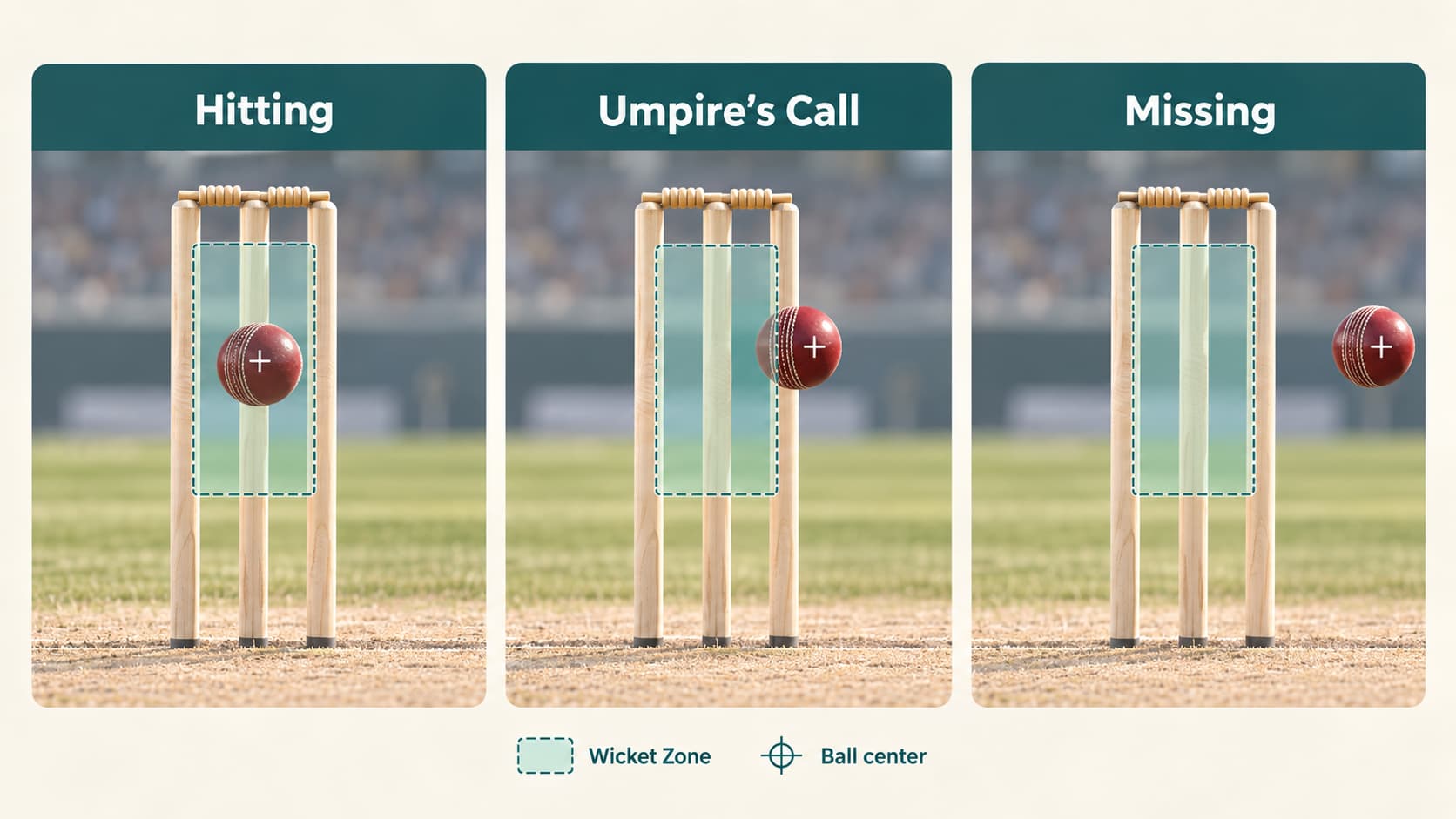
This is also why Umpire's Call is not evidence that "DRS failed."
It is an intentional part of the decision protocol.
Do You Lose a Review on Umpire's Call?
No, not when the decision remains unchanged solely because of Umpire's Call.
Under current ICC conditions, such a review is classified as Unchanged – Umpire's Call and does not count against the team's unsuccessful-review allowance.
This is an important distinction.
A team can challenge a marginal LBW decision without being punished for failing to overturn a call that remains inside the system's built-in margin.
How Many Reviews Does a Team Get?
The useful way to think about DRS allowances is not "you get exactly this many reviews."
Teams are limited by the number of reviews that are classified as unsuccessful.
A successful review does not reduce the allowance.
As of the current ICC men's standard playing conditions:
| Format | Maximum unsuccessful Player Reviews per team per innings |
|---|---|
| Test | 3 |
| ODI | 2 |
| T20I | 2 |
The June 2025 Test conditions allow three unsuccessful reviews per innings, while the current standard ODI and T20I conditions allow two.
Individual competitions can have their own playing conditions, so the applicable tournament rules should always be checked rather than assuming every cricket competition uses precisely the same allowance.
What happens to the review?
A review can broadly end in several ways:
| Outcome | On-field decision | Review allowance |
|---|---|---|
| Successful | Reversed | Retained |
| Unsuccessful | Unchanged | One unsuccessful review used |
| Umpire's Call | Unchanged | Retained |
| Certain technology failures | May remain unchanged | Can be protected/reinstated under the protocol |
The ICC also allows the Match Referee, in specified circumstances, to reinstate an unsuccessful review when the review could not properly be completed because of technology failure.
What If the Evidence Is Inconclusive?
This reveals an important principle behind DRS.
The third umpire isn't supposed to overturn the on-field decision merely because another interpretation seems possible.
Under current ICC protocol, if the available technology does not allow the third umpire to decide with a high degree of confidence that the original decision should change, the evidence is reported as inconclusive and the on-field decision stands.
That means DRS works more like an appeals process than an attempt to recreate the delivery from scratch.
The original decision remains the starting point.
The review looks for sufficient evidence to change it.
Does the Computer Make the Final Decision?
No.
This is another common misconception.
The computer provides information.
The third umpire interprets video, audio and tracking evidence according to the playing conditions and communicates the relevant facts.
The on-field umpire then communicates the resulting decision.
Ball tracking can say that the projected delivery is Hitting, Missing or in the Umpire's Call category.
UltraEdge can provide synchronised evidence of a sound.
A replay can show a foot near the crease.
But those pieces still have to be interpreted through cricket's rules.
Technology does not replace the laws of the game.
It gives the officials additional evidence with which to apply them.
Why Isn't Ball Tracking Just a Replay?
Because part of an LBW decision concerns something that never physically happened.
Once the ball hits the batter's pad, its actual flight toward the wicket stops.
The system can observe:
- how the ball travelled before impact
- where it pitched
- its direction and movement
- where it struck the batter
But the path from that interception point to the stumps is necessarily a projection.
That does not mean the system is guessing casually. Optical tracking systems are designed to reconstruct the ball's movement from calibrated camera data.
But the distinction matters.
The colourful line continuing from the pad to the stumps is not footage of the ball travelling there.
It is a modelled continuation of its trajectory.
That is one reason the DRS protocol contains defined thresholds and an Umpire's Call category around marginal decisions.
Why Do We Sometimes See UltraEdge Before Ball Tracking?
Because the order of questions matters.
Imagine a batter is given out LBW and immediately reviews because they believe they hit the ball.
If UltraEdge and replay establish that the ball hit the bat before the pad, the LBW decision can be dealt with on that evidence.
There is little point in spending time asking whether an LBW ball would have hit the stumps if one of the earlier legal requirements for LBW has already failed.
Likewise, the review checks the legality of the delivery before completing the dismissal analysis.
The process is therefore designed as a sequence.
Each stage can determine whether the next stage is even necessary.
DRS Is Not Only About LBW
LBW gets most of the attention because ball tracking produces the system's most recognisable graphics.
But Player Reviews can concern other dismissal decisions too.
A batter might review a caught-behind decision believing there was no edge.
A fielding captain might challenge a Not out decision believing the batter nicked the ball.
Replays can also reveal another valid mode of dismissal during the review process. Current ICC protocol instructs the third umpire not to withhold factual information that could show the batter was out in another way.
Meanwhile, ordinary third-umpire referrals for situations such as close run-outs and stumpings are part of the wider television-review framework even when a team has not used a Player Review.
Why DRS Still Produces Arguments
Technology can answer some cricket questions remarkably well.
It cannot remove every judgment call.
Fans may still disagree about:
- whether audio proves an edge
- whether video is conclusive
- whether a catch touched the grass
- whether an Umpire's Call threshold feels fair
- how confidently a projected trajectory should be treated
And some decisions involve both measured information and the structure of cricket's laws.
DRS was never designed to make uncertainty disappear.
Its purpose is to give officials better evidence and a formal mechanism for correcting clear errors while preserving defined procedures for marginal cases.
That distinction matters.
A system in which every close decision is automatically replaced by a computer model would be fundamentally different from the DRS cricket currently uses.
The Simplest Way to Understand DRS
When a review begins, think of it as a chain of questions.
For an LBW review, that chain might look like this:
Was the delivery legal?
↓
Did it hit the bat first?
↓
Where did the ball pitch?
↓
Where did it hit the batter?
↓
Would it have hit the stumps?
↓
Is the evidence strong enough to overturn the on-field decision?
Different technologies answer different parts of that chain.
The cameras show what happened.
Edge detection helps reveal contact.
Ball tracking reconstructs and projects the delivery.
The third umpire applies the playing conditions.
And the original umpire's decision remains important whenever the evidence is marginal or inconclusive.
That is what the familiar T-shaped signal really starts: not a single computer calculation, but a carefully ordered review involving human judgment, cricket law and several different technologies working together.