
Money Market and Money-Market Instruments
Money Market and Money-Market Instruments. A detailed chapter in Financial Markets & Investment Awareness, with explanations and examples for Indian banking examinations.
By Akhilesh Saini · Reviewed 8 Oct 2026
Importance: VERY HIGH
Prerequisites: BA-01 and BA-04
Exam lens: meanings, tenor, issuers, secured versus unsecured funding and RBI connections.
1. What is a financial market?
A financial market brings together people and institutions that need funds with others that have funds available. Financial markets mobilise savings, allocate money and provide ways to manage risk. Trading can occur through organised exchanges, electronic platforms or over-the-counter arrangements.
A bank accepts deposits and lends in its ordinary banking business. But the same bank may also borrow overnight, purchase Government bonds, issue permissible debt instruments and trade foreign exchange as a treasury participant.
Three useful questions about any instrument: Who owes the money? For how long? What risk does the investor bear?
2. Money market versus capital market
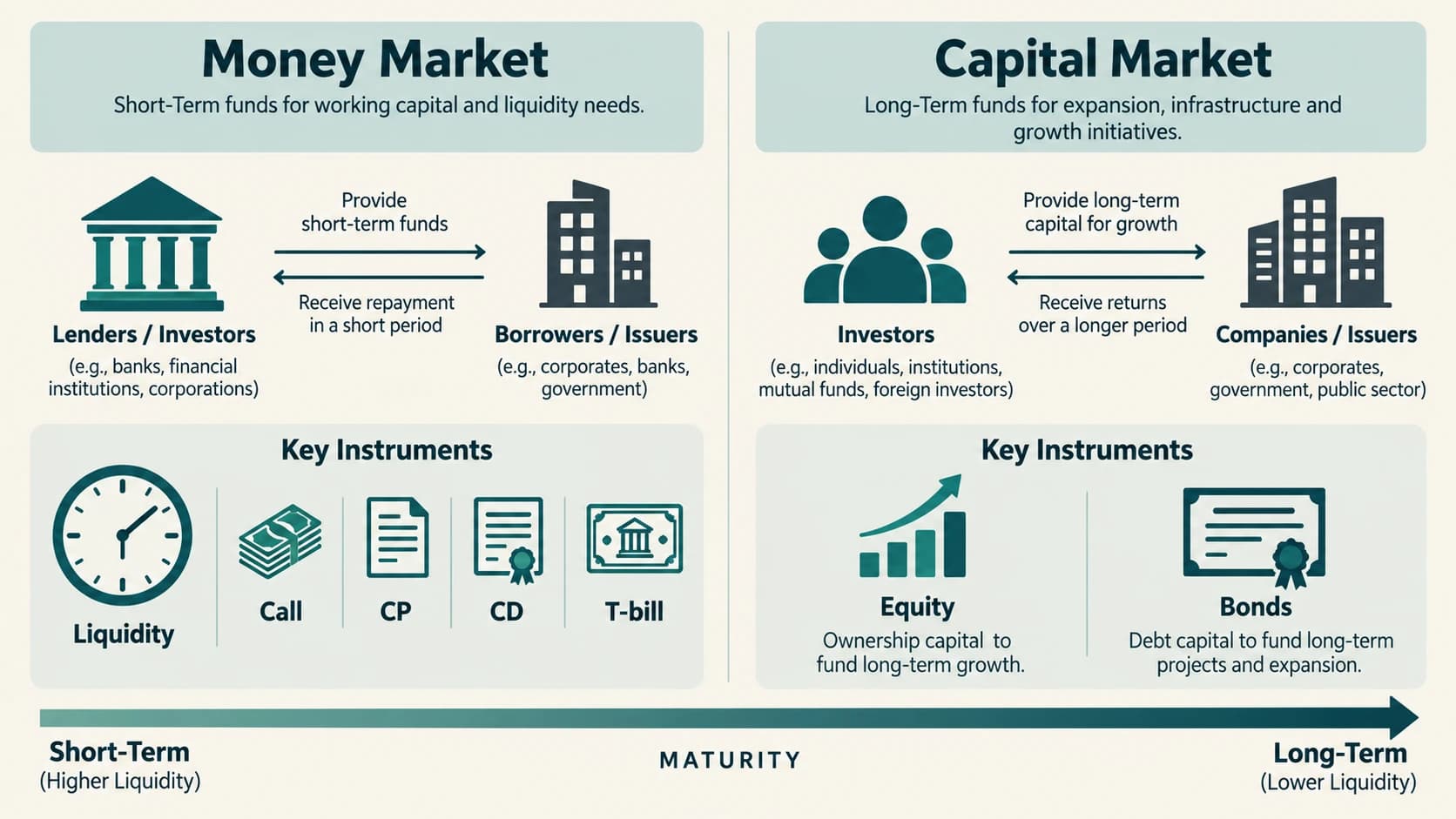
The money market mainly deals in short-term funding instruments, ordinarily with maturity up to one year. The capital market deals in longer-term securities and ownership instruments, including shares and long-term debt.
| Dimension | Money market | Capital market |
|---|---|---|
| Main purpose | Short-term liquidity and working funds | Long-term capital and investment |
| Typical instruments | Call money, CP, CDs, T-bills, repo | Equity, corporate bonds, dated bonds |
| Broad maturity | Usually up to one year | Longer-term debt or perpetual equity |
| Frequent participants | Banks, primary dealers, institutions and other eligible entities | Companies, investors, intermediaries and Governments |
| Risk | Counterparty, liquidity and rate risk | Credit, price, business, market and liquidity risk |
| Regulator | RBI for important money-market segments | SEBI for securities markets; RBI for Government-debt-related areas |
Exception: A Government T-bill is both a Government security (issuer classification) and a money-market instrument (short tenor). Classifications can overlap.
3. Why banks borrow and lend for a day
A bank can face timing differences between incoming funds and outgoing payments. Imagine Bank A will receive a large deposit tomorrow but must settle payments today. Bank B has surplus immediately available funds. Rather than create a long-term loan, Bank A may borrow short-term from Bank B if both are eligible and agree terms.
This is liquidity management. It is not the same as raising permanent share capital.
4. Call money
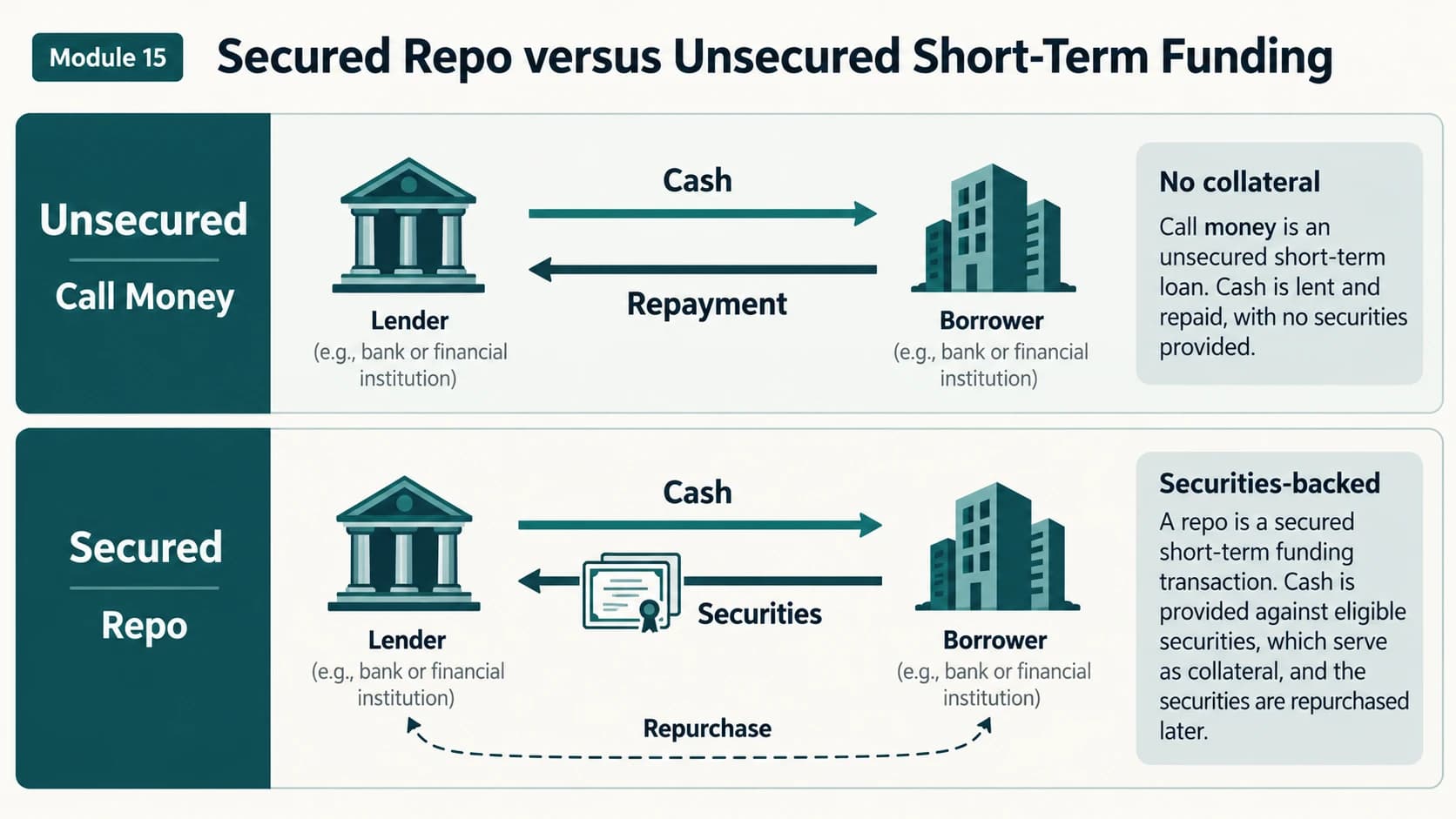
Call money is unsecured borrowing/lending of funds for overnight maturity between eligible market participants.
- The lender makes overnight funds available.
- The borrower pays them back with agreed interest under market arrangements.
- A call-money rate reflects very short-term liquidity conditions.
- It is distinct from the RBI policy repo rate, though monetary policy can influence it.
The weighted average call rate (WACR) is an important operating indicator within India's monetary-policy implementation framework. It should not be assumed identical to repo, SDF or MSF rates.
5. Notice money
Notice money refers to unsecured funding for two to fourteen days, according to RBI's standard classification. It is longer than overnight call money but shorter than the usual term-money band.
6. Term money
Term money in this market refers broadly to unsecured funding from fifteen days up to one year. It is not the same as a consumer's "term deposit" at a bank.
| Interbank money segment | Usual tenure concept |
|---|---|
| Call | Overnight |
| Notice | 2–14 days |
| Term | 15 days–1 year |
Participation rules are regulatory details; not every financial institution may borrow in every money-market segment.
7. Secured versus unsecured funding
Unsecured: Call, notice and term money markets are commonly described as unsecured money lending among eligible counterparties.
Secured: In a repo, securities provide collateral for a short-term financing arrangement.
This distinction matters in stress: a borrower may struggle to obtain unsecured funds despite holding quality securities that can be used in secured transactions.
8. Repurchase agreements — repo
A market repo is an arrangement in which one party sells a security and simultaneously agrees to repurchase it later at an agreed price/date. Economically, the transaction usually resembles secured borrowing backed by securities.
- Cash-receiving party = repo seller / cash borrower.
- Cash-providing party = repo buyer / cash lender.
- The price difference reflects the financing cost.
- The security functions as collateral in economic substance.
Illustration: A participant raises ₹1 crore today against eligible securities and agrees to repurchase later for ₹1,00,05,000. The ₹5,000 difference illustrates a short-period financing cost. The example is not a market quote.
Market repo vs RBI policy repo: The first is a market funding transaction; the second refers to central-bank liquidity operations/policy framework. They are related, but not interchangeable.
9. Reverse repo — whose perspective?
In a given repo transaction, the party providing cash and purchasing securities is engaging in reverse repo from its point of view. One side's repo is the other side's reverse repo. Do not confuse this accounting of perspectives with the RBI's evolving operational instruments (including SDF).
10. Tri-party repo
A tri-party repo adds an authorised infrastructure/intermediary that facilitates aspects such as collateral management, settlement and operational processes. In India, the TREPS ecosystem is a notable secured short-term funding segment, with CCIL performing important market-infrastructure functions.
Crucial distinction: Collateral reduces one kind of risk; it does not eliminate every operational, legal or liquidity risk.
11. Commercial Paper (CP)
Commercial Paper is a short-term money-market debt instrument used by eligible issuers to raise funds. It is typically unsecured and is issued under RBI's applicable framework.
A corporate treasurer may use CP to finance inventories or receivables without obtaining a fresh long-term bank loan. Investors receive a money-market instrument whose repayment depends on the issuer's creditworthiness.
Exam points:
- Short-term financing instrument.
- Not equity: buyers are creditors, not owners.
- Not a bank fixed deposit.
- Often associated with highly rated/eligible institutional issuers, but regulatory eligibility, minimum denominations, maturity bands and rating requirements are rule-dependent.
- Current governing RBI directions for CP and NCDs of up to one-year original maturity are the 2024 Directions, subject to amendments.
12. Certificate of Deposit (CD)
A Certificate of Deposit is a negotiable money-market instrument issued by eligible banks or other eligible institutions according to RBI directions. It represents an obligation to repay its holder under its terms.
A CD differs from a retail bank FD: a standard retail fixed deposit is a customer deposit product; a market CD is a tradable/negotiable short-term funding instrument governed by specialised rules.
Exam trap: A CD is not issued by any company simply because it accepts payment. CP is the more familiar corporate short-term funding instrument; CDs are tied to prescribed deposit-taking issuers.
13. Treasury bills as money-market instruments
Government Treasury bills finance short-term Government borrowing. They are issued through the Government-debt market and will be studied in depth in BA-15-02. Their short tenor makes them money-market instruments even though the issuer is sovereign.
14. Short-term Non-Convertible Debentures
The term NCD broadly denotes a debt instrument that is not convertible into equity. Certain NCDs with original/initial maturity up to one year fall under RBI's relevant 2024 money-market directions. Longer-term listed corporate bonds/debentures have a different securities-market regulatory context.
Do not label all NCDs 'money-market' simply because they are NCDs. Maturity and applicable regulation matter.
15. How short-term instruments earn returns
Two common structures:
Discount: An investor buys a face-value ₹100 instrument for ₹98 and receives ₹100 at maturity. Gain = ₹2, before costs/tax.
Interest-bearing: An investor provides funds and receives interest under the agreed terms.
The annualised yield of a discounted short-duration instrument is not simply its raw ₹2 gain divided by ₹100 without adjusting for purchase price and holding period.
Worked example: simplified annualised holding-period yield
An instrument is bought for ₹98, repaid for ₹100 after 91 days. Assuming a 365-day year, no interim cashflows and simple annualisation:
This is a teaching formula; market conventions can use specified day-count and discount-yield methods.
16. Money market and monetary transmission
When RBI tightens liquidity or policy rates rise, the cost of overnight/short-term funds can increase. A bank's treasury cost may then feed into the broader interest-rate environment. But the actual effect depends on surplus liquidity, corridor conditions, market expectations and credit risk.
17. Main risks
- Credit risk: issuer/counterparty fails to repay.
- Liquidity risk: investor cannot sell or renew funding easily.
- Interest-rate risk: market value changes when rates change.
- Settlement risk: payment and delivery do not occur as expected.
- Concentration risk: excessive funding reliance on one counterparty/market.
Government T-bills have very low sovereign default risk in domestic currency, but an investor who exits before maturity may still face a market-price change.
18. Comparison table — essential instruments
| Instrument | Typical issuer/counterparty | Nature | Security | Exam clue |
|---|---|---|---|---|
| Call money | Eligible banks/market participants | Overnight funds | Unsecured | Overnight |
| Notice money | Eligible money-market participants | 2–14 days | Unsecured | Not call money |
| Term money | Eligible money-market participants | 15 days–1 year | Unsecured | Not a retail FD |
| Repo | Eligible counterparties | Sale and repurchase financing | Securities collateral | Secured funding |
| CP | Eligible corporate/other issuers | Short-term debt | Generally unsecured | Corporate money-market borrowing |
| CD | Eligible banking/other prescribed issuers | Negotiable deposit instrument | Issuer obligation | Not ordinary FD |
| T-bill | Government of India | Short-term sovereign debt | Sovereign claim | Discount, zero coupon |
Quick check — BA-15-01
- Is a T-bill classified by issuer or maturity? Both—Government security and money-market instrument.
- Overnight unsecured interbank funds? Call money.
- Notice-money standard range? 2–14 days.
- What backs a repo? Eligible securities/collateral.
- Is a CD identical to an FD? No.
- Does commercial paper give company ownership? No.
- Must a repo rate equal the RBI policy rate? No.
- Why does RBI monetary policy matter? It can influence market liquidity and short-term funding cost.