
Government Securities, Treasury Bills and the G-Sec Market
Government Securities, Treasury Bills and the G-Sec Market. A detailed chapter in Financial Markets & Investment Awareness, with explanations and examples for Indian banking examinations.
By Akhilesh Saini · Reviewed 8 Oct 2026
Importance: VERY HIGH
Prerequisite: BA-15-01
Exam lens: instruments and tenor, discount vs coupon, issuer, RBI auction role, bond-price/yield relationship, SLR and Retail Direct.
1. Why does Government issue debt?
Governments spend on services, infrastructure, salaries and other public purposes. Tax and non-tax revenues do not always arrive when expenditure is due. Governments therefore borrow from investors through debt instruments.
A Government security (G-Sec) is a tradeable obligation issued by the Central or eligible State Government. The investor lends money; the issuer commits to prescribed repayment and interest/discount terms.
Government securities are important to banks as investments, liquidity collateral, treasury benchmarks and, when eligible, assets for statutory liquidity requirements.
2. Who issues what?
| Instrument | Broad issuer | Usual character |
|---|---|---|
| Treasury bill | Central Government | Short-term; zero coupon |
| Dated Government security | Central Government | Longer-term dated debt; fixed/floating/other permitted coupons |
| Cash Management Bill | Central Government | Temporary cash-flow mismatch instrument |
| State Development Loan (SDL) | State Government | State borrowing, usually dated debt |
An SDL is not an equity share of a State enterprise. It is a State Government debt obligation.
3. Treasury bills
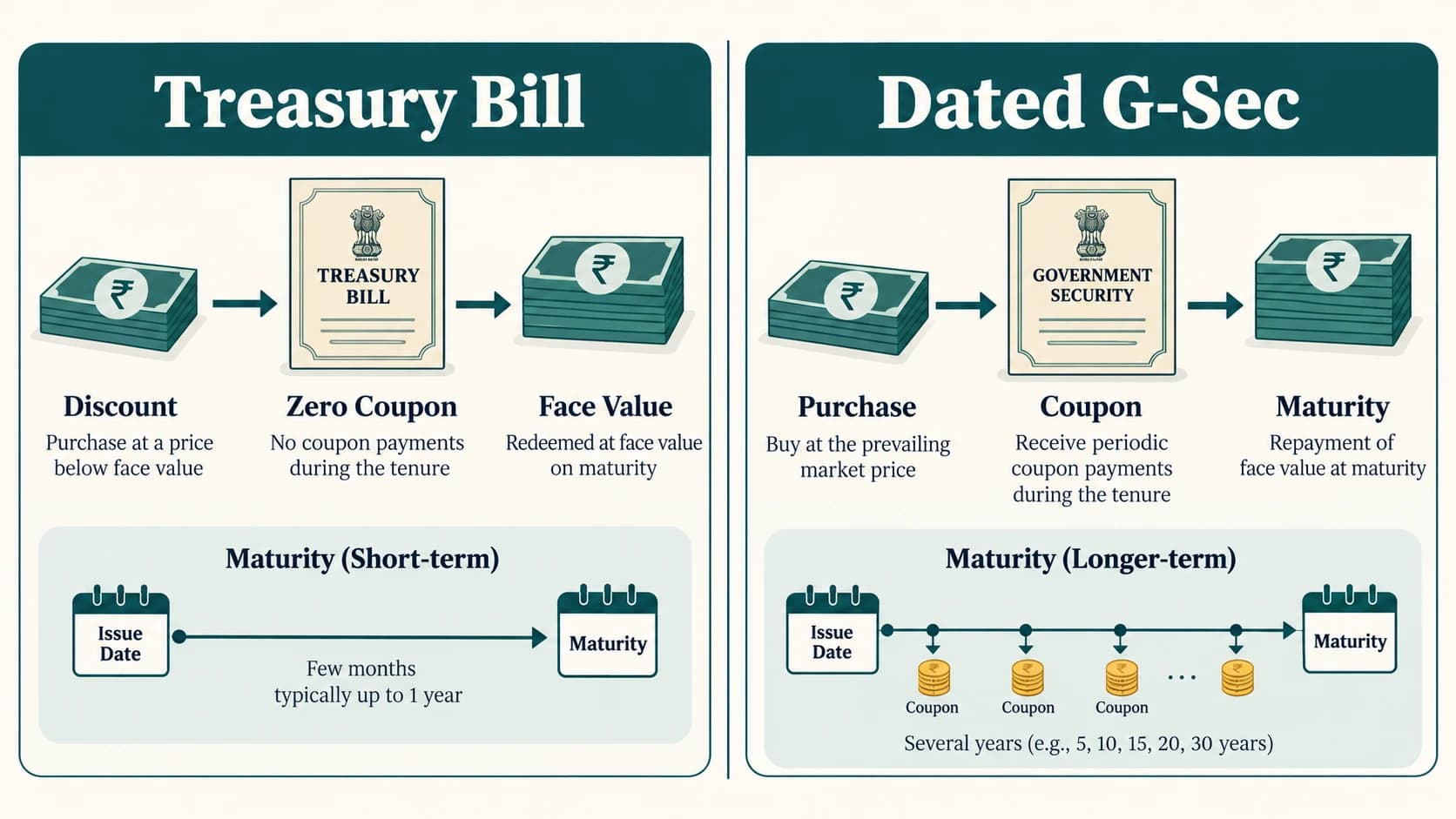
Treasury bills (T-bills) are short-term zero-coupon securities issued at a discount and redeemed at face value. RBI's primer identifies regular tenors of 91, 182 and 364 days; actual issue calendars can be changed.
For a ₹100 face-value T-bill bought at ₹98:
- purchase price ₹98;
- maturity redemption ₹100;
- gross gain ₹2;
- no periodic coupon payment.
Key exam trap: A T-bill doesn't pay a separately scheduled coupon merely because its investor earns a return.
4. Treasury bill worked example
Suppose an illustrative 182-day T-bill has face value ₹1,00,000 and issue price ₹96,500.
- Redemption amount: ₹1,00,000.
- Discount/gross cash gain: ₹1,00,000 − ₹96,500 = ₹3,500.
- Simple annualised holding-period yield (illustrative day count):
The result does not include tax/expenses. Auction pricing and quoting follow applicable market rules; this is a numerical teaching exercise, not an actual tender result.
5. Cash Management Bills (CMBs)
CMBs help address temporary Government cash-flow mismatches. Their size and maturity depend on the Government's immediate cash needs; their maturity is generally shorter than that of standard 91-day T-bills. Like T-bills, they are discount instruments.
6. Dated Government securities
A dated G-Sec has a stated maturity date. Many dated securities pay periodic coupons. Some may have floating or special structures under their terms.
Example: face value ₹1,000, annual coupon 7%:
- annual coupon = ₹70 (assuming annual aggregate payment);
- if payable semi-annually, ₹35 per period in this simplified case;
- final face value is repaid at maturity as prescribed.
The coupon rate is attached to the security's face value. The market yield is influenced by the price at which a buyer purchases it.
7. Coupon versus yield
Suppose the ₹1,000 face-value, 7% coupon bond trades for ₹950. Its annual coupon remains ₹70, but the current yield is:
If the same bond trades for ₹1,050, the current yield is roughly 6.67%.
This shows why coupon ≠ market yield. Yield to maturity (YTM) adds the timing of all remaining coupon and principal cash flows and is generally more informative than current yield.
8. Bond prices and yields move inversely
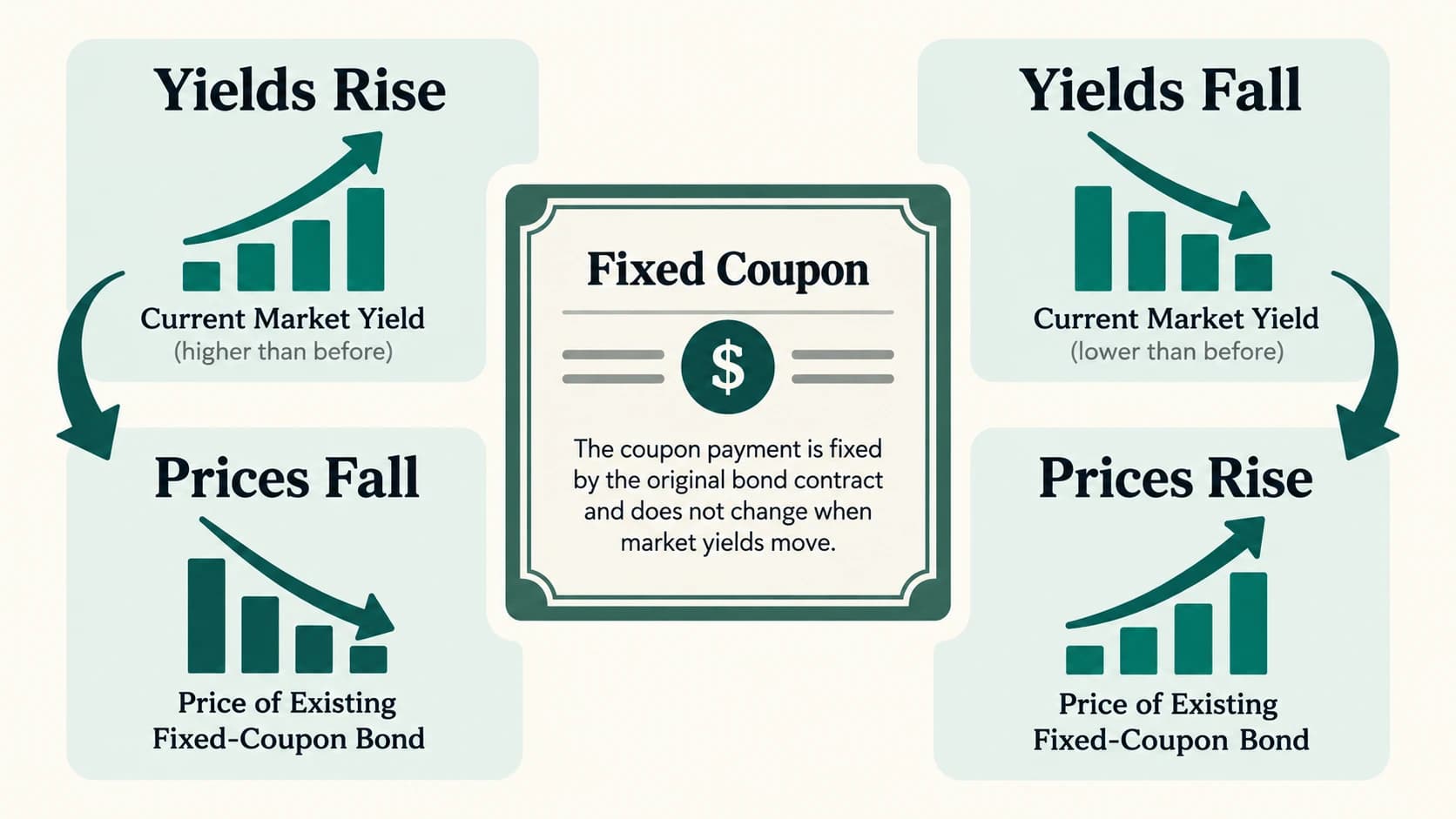
Why does a bond's price fall when market yields rise?
Imagine a bond locked in at a lower coupon. Newly issued similar-risk bonds now offer a higher yield. The old bond becomes less attractive at its former price, so its price needs to decline until its expected return becomes competitive.
Higher market yields → lower prices of existing fixed-rate bonds, other things equal.
Lower market yields → higher prices of existing fixed-rate bonds, other things equal.
This is one of the most useful conceptual rules for bank-exam financial awareness.
9. Duration and sensitivity
Two fixed-rate bonds may react differently to a rate change. A longer duration generally means greater sensitivity of price to a given yield change. Duration depends on maturity, coupon, yield and cash-flow timing.
A 20-year fixed-rate security ordinarily has more interest-rate price risk than a very short T-bill if all other factors are comparable.
10. "Risk-free" does not mean "riskless in every way"
Domestic-currency Central Government securities are regarded as carrying negligible sovereign credit/default risk in the Indian domestic context. Yet investors can still suffer:
- a mark-to-market price decline before maturity;
- liquidity costs if trading is thin;
- inflation risk if purchasing power erodes;
- reinvestment risk when coupons/maturing proceeds are reinvested at lower rates.
Holding a T-bill to maturity and selling a long bond tomorrow are very different investment situations.
11. State Development Loans
States issue SDLs to finance borrowing requirements. SDL yields can differ from comparable Central Government yields because of market liquidity, investor demand, supply and other risk perceptions.
Never assume "G-Sec" always means only Central Government debt when an exam asks about the broader Government-securities market. Name the issuer precisely.
12. Primary market: Government auctions
A primary auction issues/reissues securities to investors. RBI conducts relevant Government-securities auctions as debt manager under its statutory role and rules.
- Competitive bid: investor states yield/price acceptable to them.
- Non-competitive bid: eligible participants seek allotment at the weighted average/derived accepted auction terms, subject to scheme rules.
A primary dealer plays an important intermediary/market-making role in the Government-securities ecosystem.
13. Secondary market: trading outstanding securities
After issuance, securities can trade between holders in the secondary market.
A secondary-market buyer generally pays the existing holder, not a second subscription directly to Government. Trading provides price discovery and liquidity, although actual liquidity differs by security.
14. NDS-OM
Negotiated Dealing System—Order Matching (NDS-OM) is RBI's electronic trading/order-matching system for Government securities. It is distinct from NSE equity trading and from NPCI retail payments.
15. RBI Retail Direct
RBI Retail Direct enables eligible individual investors to open a Retail Direct Gilt (RDG) account and access prescribed Government-securities investments, including participation in primary and secondary markets under the scheme.
The concept is important: retail investors can access the sovereign-debt market without having to buy only an investment fund. Current instrument eligibility, charges, minimum investment and access rules belong in live data.
16. SLR, RBI operations and G-Secs
Banks hold eligible liquid assets to meet Statutory Liquidity Ratio (SLR) requirements; eligible Government securities are important assets for this purpose. The applicable rule determines which securities qualify and how they are valued.
RBI can also buy or sell Government securities as part of liquidity management/monetary operations. Those operations are different from a bank voluntarily buying bonds for investment income.
17. G-Sec yield curve
A yield curve plots yields across maturities for broadly comparable securities. Common shapes:
- Upward-sloping: longer maturities yield more than shorter ones.
- Flat: similar yields across maturities.
- Inverted: shorter maturities yield more than longer ones.
Its shape can reflect expectations about policy rates, inflation, term premium, demand/supply and market conditions. No single yield-curve shape guarantees a particular future economic outcome.
18. Government bond and corporate bond — comparison
| Feature | Central Government G-Sec | Corporate bond |
|---|---|---|
| Borrower | Central Government | Company/issuer |
| Principal credit risk | Very low domestic sovereign default risk | Depends on issuer creditworthiness |
| Rate sensitivity | Yes | Yes |
| Default spread | Domestic benchmark | Often additional credit spread |
| Liquidity | Varies by security | Varies, often lower in thin issues |
| Regulator/market context | RBI/Government-securities framework | SEBI where securities-market rules apply |
19. Applied bank-treasury case
A bank holds a large portfolio of fixed-rate G-Secs. Interest rates rise suddenly. Its securities' market prices may decline even if the sovereign continues to repay all interest and principal. The regulatory/accounting treatment of that decline depends on the security's classification and applicable valuation norms.
The bank's accountant, treasury dealer and risk manager are answering three different questions: What is the market price? How is it recognised? What is the risk to the bank?
Quick check — BA-15-02
- Who issues Central Government T-bills? Government of India (through the prescribed RBI-managed issuance process).
- Regular RBI-primer T-bill tenors? 91, 182 and 364 days.
- Does a T-bill pay a coupon? No.
- Difference between price and face value? The discount / gross maturity gain.
- Bond price when prevailing yield rises? Usually falls.
- Is a G-Sec free of market-price risk? No.
- What is an SDL? State Government debt security.
- What is NDS-OM? Government-securities electronic order-matching platform.
- RBI Retail Direct serves whom? Eligible retail investors.