
Capital Market: Primary and Secondary Markets
Capital Market: Primary and Secondary Markets. A detailed chapter in Financial Markets & Investment Awareness, with explanations and examples for Indian banking examinations.
By Akhilesh Saini · Reviewed 8 Oct 2026
Importance: HIGH
Prerequisites: BA-15-01 and BA-15-02
Exam lens: shares versus bonds, capital raising versus trading, IPO/FPO, investor accounts and dividends.
1. Why a capital market exists
A business may need money to build a factory or expand a network. Borrowing a three-month loan to finance a plant that earns revenue over fifteen years can create a severe maturity mismatch. A capital market enables businesses to raise longer-lasting funds.
Investors may supply capital in exchange for:
- ownership claims — equity shares; or
- contractual repayment claims — bonds and debentures.
The ownership-versus-debt distinction is the foundation of capital-market learning.
2. Equity shares: an ownership interest
An equity share represents a proportional ownership interest in a company subject to law and class of shares. Shareholders may benefit through market-price appreciation or declared dividends. They also bear the possibility of losses and, in extreme situations, their equity investment losing all value.
Ordinary equity does not provide the fixed legal repayment promise of a normal bond. A company need not pay the same dividend every year, or any dividend at all.
Illustration: A company has 10 lakh ordinary shares; an investor holds 1,000. Their approximate fraction is 0.1% of outstanding shares (ignoring special classes and other complexities). This is ownership, not a fixed-term deposit.
3. Bonds: investor as lender
A bond/debenture is a debt security. The issuer promises specified cashflows under its terms. These may include:
- periodic interest/coupon;
- repayment at maturity;
- security or covenants;
- rights upon default.
A bondholder ordinarily does not obtain ordinary shareholder voting rights merely by lending money.
Risk comparison: Equity is residual ownership; senior debt generally ranks ahead of equity in insolvency, though actual priorities and recovery depend on applicable law.
4. Primary market: new issue
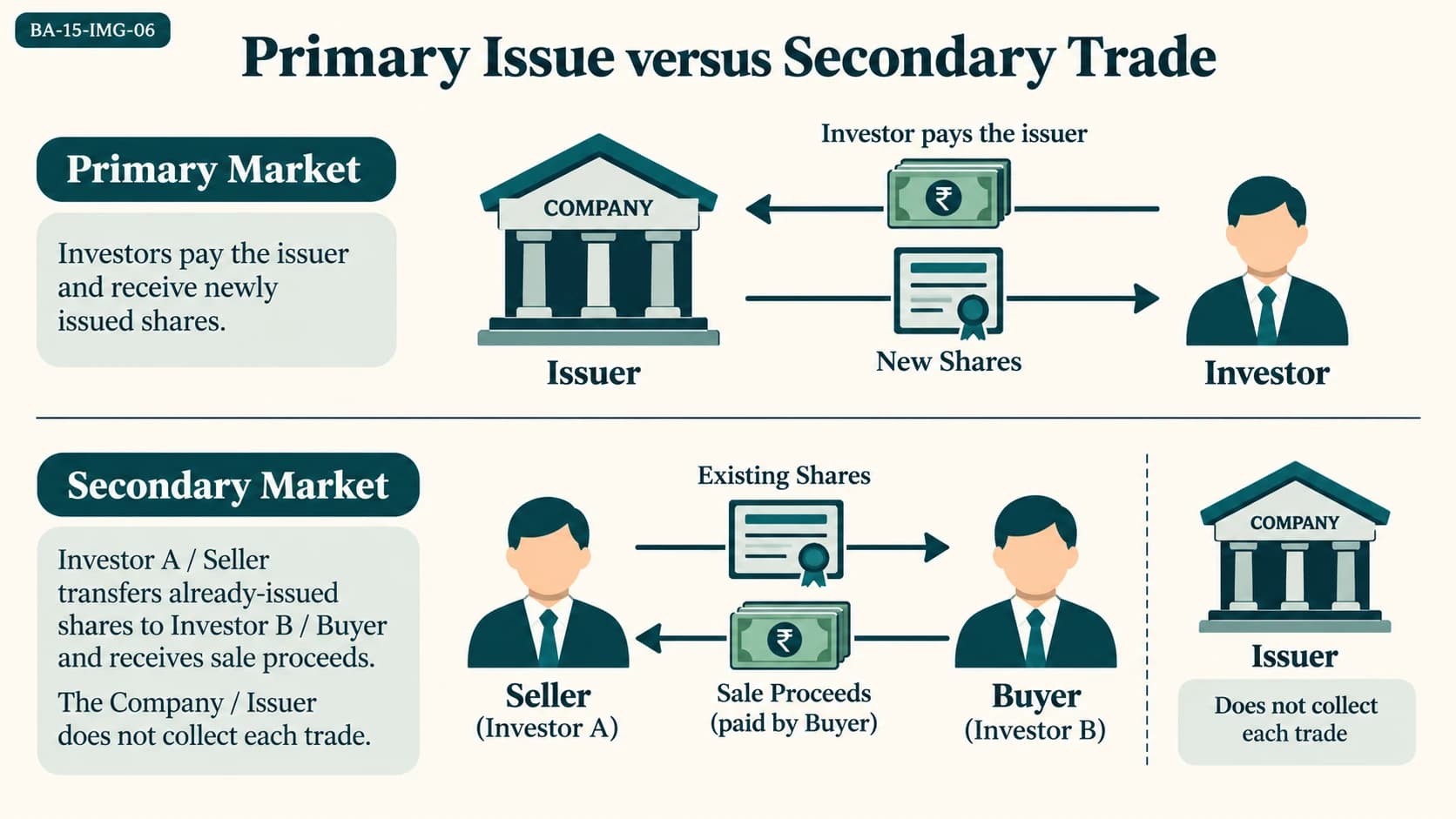
The primary market is where new securities are issued and issuers raise capital. It includes corporate equity and debt issues as well as primary Government debt issuance in the broader securities context.
When a company offers newly issued shares and receives subscription proceeds, that is the primary capital-raising event.
5. Secondary market: resale between investors
The secondary market is where already-issued securities trade among holders. A stock-exchange trade can transfer shares from Investor A to Investor B; the company normally does not receive the sale price just because its shares changed hands.
Why it matters: A liquid resale market makes it easier for investors to commit funds when securities are first issued. It provides price discovery but not a guaranteed exit price.
One company, two different transactions
- Monday: Company X issues new shares to raise ₹100 crore — primary issue.
- Friday: An investor sells those shares to another investor for ₹20,000 — secondary trade.
The Friday ₹20,000 generally goes to the seller, not Company X.
6. IPO
An Initial Public Offering (IPO) is the first public offering/listing process by which an eligible company invites public investors to subscribe or purchase securities, subject to the issue structure. IPOs can involve:
- fresh issue of new shares, where proceeds flow to the company (before issue costs); and/or
- offer for sale (OFS) of existing shares by selling shareholders, where the selling holders receive sale consideration, subject to issue arrangements.
A frequent misconception is that every rupee in an IPO becomes fresh money for the issuing company. An OFS is not the same as a fresh issue.
7. Follow-on Public Offer (FPO)
An FPO is a public offering by a company that has already made its initial public offer / is already listed under relevant conditions. It differs from an IPO primarily in the company's prior public-market status.
8. Rights issue
A rights issue offers eligible existing shareholders the opportunity to subscribe to additional securities, typically in proportion to holdings subject to the issue terms. The shareholder may exercise, renounce/transfer where permitted or let rights lapse depending on the structure.
A rights issue is not the same as a bonus issue. Rights generally involve a subscription decision/payment; bonus shares are allotted through capitalisation of reserves under applicable law without an equivalent new cash subscription.
9. Bonus shares and stock split
Bonus issue: More shares issued to existing shareholders from eligible reserves under legal conditions; it does not by itself inject new external funds into the company.
Stock split: Existing shares are subdivided into a larger number of shares with proportionately smaller face value; it does not itself create corporate wealth.
Example: one ₹10 face-value share split into two ₹5 face-value shares. The investor holds more units representing the same proportional ownership immediately after a mechanical split, ignoring market movements.
10. Market capitalisation
Example: 2 crore shares × ₹150/share = ₹300 crore market capitalisation.
This is not annual sales, earnings, total assets or the amount raised in an IPO. It changes as the market price changes.
11. Face value vs market price vs book value
- Face value: nominal share value for corporate/accounting purposes.
- Market price: current trading price agreed by buyers and sellers.
- Book value: accounting equity value after liabilities, as reflected in statements.
A ₹10 face-value share may trade at ₹600. There is no contradiction.
12. Price-to-earnings ratio (P/E)
If the share trades at ₹200 and annual EPS is ₹20, P/E = 10. P/E is a valuation metric, not an assured annual return; negative earnings can make a conventional positive P/E meaningless.
13. Primary-market price discovery
An issuer and its merchant bankers decide on the issue structure under relevant rules. A book-building issue gathers bids within an eligible price band and determines the final offer price according to the process. A fixed-price issue declares the price in advance.
Cut-off bid in a retail IPO (where the framework permits it) signals willingness to accept the final discovered offer price, not an investor's promise to receive allotment.
14. ASBA and blocked funds
ASBA — Applications Supported by Blocked Amount — allows an eligible applicant's funds to be blocked in their bank account during an issue application rather than immediately transferred as a standard full debit. Debits and unblocking follow allotment/issue rules.
UPI-based IPO application flows can also interact with blocking/mandate infrastructure under the applicable investor category and process.
A blocked amount is not equivalent to confirmed allotment. The investor must satisfy application validity, availability and allotment procedures.
15. What does a stock exchange do?
A recognised stock exchange provides organised trading arrangements for listed securities under the regulatory framework. It supports transparent orders, prices and surveillance through its systems and associated institutions.
India's familiar exchanges include BSE and NSE. An exchange is not a depository, a clearing corporation or SEBI itself.
16. Basic order types
- Market order: execute against available market orders at prevailing executable prices; no guarantee of a specific price.
- Limit order: set a maximum buy price or minimum sell price; may remain unexecuted.
- Stop-loss/trigger arrangement: instruction activated at a specified condition, subject to order type and exchange/broker rules.
The risk of a market order during low liquidity is price slippage. A limit order reduces price uncertainty but increases non-execution risk.
17. Price index vs total-return index
A stock-market index summarises the performance of a defined basket using a stated methodology. Examples include broad equity indices such as Nifty 50 and SENSEX.
- Price index: mainly tracks security-price changes.
- Total-return index (TRI): incorporates reinvested distributions under the calculation methodology.
Exam candidates should not confuse index levels with the market capitalisation of all listed companies.
18. Corporate bonds and credit ratings
Corporate debt investors assess the issuer's business cash flows, repayment obligations, security and credit rating. Ratings express a credit opinion under a methodology; they are not RBI guarantees and may be revised.
A bond with a higher yield than a comparable Government bond may carry extra credit, liquidity or other risk. The extra yield is not automatically a 'free bonus'.
19. Equity versus bonds versus bank deposits
| Feature | Equity | Corporate bond | Bank deposit |
|---|---|---|---|
| Holder status | Owner | Creditor | Depositor/creditor of bank |
| Typical income | Optional dividend | Contractual coupon/other terms | Contractual deposit interest under terms |
| Value variation | Potentially large | Rate/credit fluctuations | Usually not marked to market like listed bonds |
| Repayment certainty | No fixed par redemption | Depends on issuer and terms | Depends on bank obligations and applicable deposit protection |
| Primary regulator | SEBI/company law | SEBI and relevant debt regulations | RBI banking regime; DICGC protection for eligible insured deposits |
20. Settlement: T and later delivery
"T" represents trade date; "T+1" means settlement on the next prescribed business day under the applicable market calendar. It is not necessarily tomorrow if today is followed by a holiday. India broadly uses T+1 for normal equity cash settlement while optional T+0 exists for eligible transactions under SEBI's framework.
Keep eligibility, phase and deadlines as updateable rules. Do not claim that every security and every participant can instantly settle all trades.
21. Exam case — identify the market
A company sells newly issued shares to raise funds: Primary equity market. Two investors subsequently trade the same shares on a stock exchange: Secondary equity market. A company issues a three-month eligible commercial paper: Money market, not equity capital market.
Quick check — BA-15-03
- IPO fresh issue vs OFS? Company receives fresh proceeds in fresh issue; selling shareholder receives OFS proceeds.
- Does secondary trading normally raise new funds for issuer? No.
- Is a shareholder a creditor simply by owning equity? No.
- Face value ₹10, market price ₹400 possible? Yes.
- Bonus issue injects outside capital? No, not by itself.
- T+1 includes calendar holidays? No, prescribed settlement-business days govern.
- What does ASBA block? Application funds in the account pending process.
- Can a market order execute away from last traded price? Yes.