
SEBI and Securities-Market Infrastructure
SEBI and Securities-Market Infrastructure. A detailed chapter in Financial Markets & Investment Awareness, with explanations and examples for Indian banking examinations.
By Akhilesh Saini · Reviewed 8 Oct 2026
Importance: VERY HIGH
Prerequisites: BA-15-03 and BA-14-02
Exam lens: SEBI Act, investor protection, stock exchanges, depositories, intermediaries, clearing corporations, grievances.
1. What is SEBI?
SEBI stands for Securities and Exchange Board of India. It is the statutory regulator of India's securities market under the SEBI Act, 1992 (it was originally established in 1988 and became statutory in 1992).
Its broad mandate is to:
- protect the interests of investors in securities;
- promote development of the securities market; and
- regulate the securities market.
A useful memory device is Protect – Develop – Regulate.
2. RBI and SEBI: complementary, not identical
RBI regulates banks and important monetary, money-market, Government-debt and foreign-exchange areas under its mandate.
SEBI regulates the securities market and specified securities-market intermediaries and issuers under its mandate.
A bank can be regulated by RBI for banking business while SEBI rules apply to its public securities issuance, listed obligations, merchant-banking activities or investments where relevant. Indian financial regulation is activity- and entity-specific.
3. What counts as securities-market regulation?
SEBI's framework covers areas such as:
- public issue and listing of securities;
- market trading and disclosures;
- recognised exchanges and other market infrastructure institutions;
- brokers and investment intermediaries;
- mutual funds;
- insider-trading and market-abuse prevention;
- investor complaints and protective measures.
SEBI does not manage every investor's portfolio. Regulating products and conduct does not guarantee investment profits.
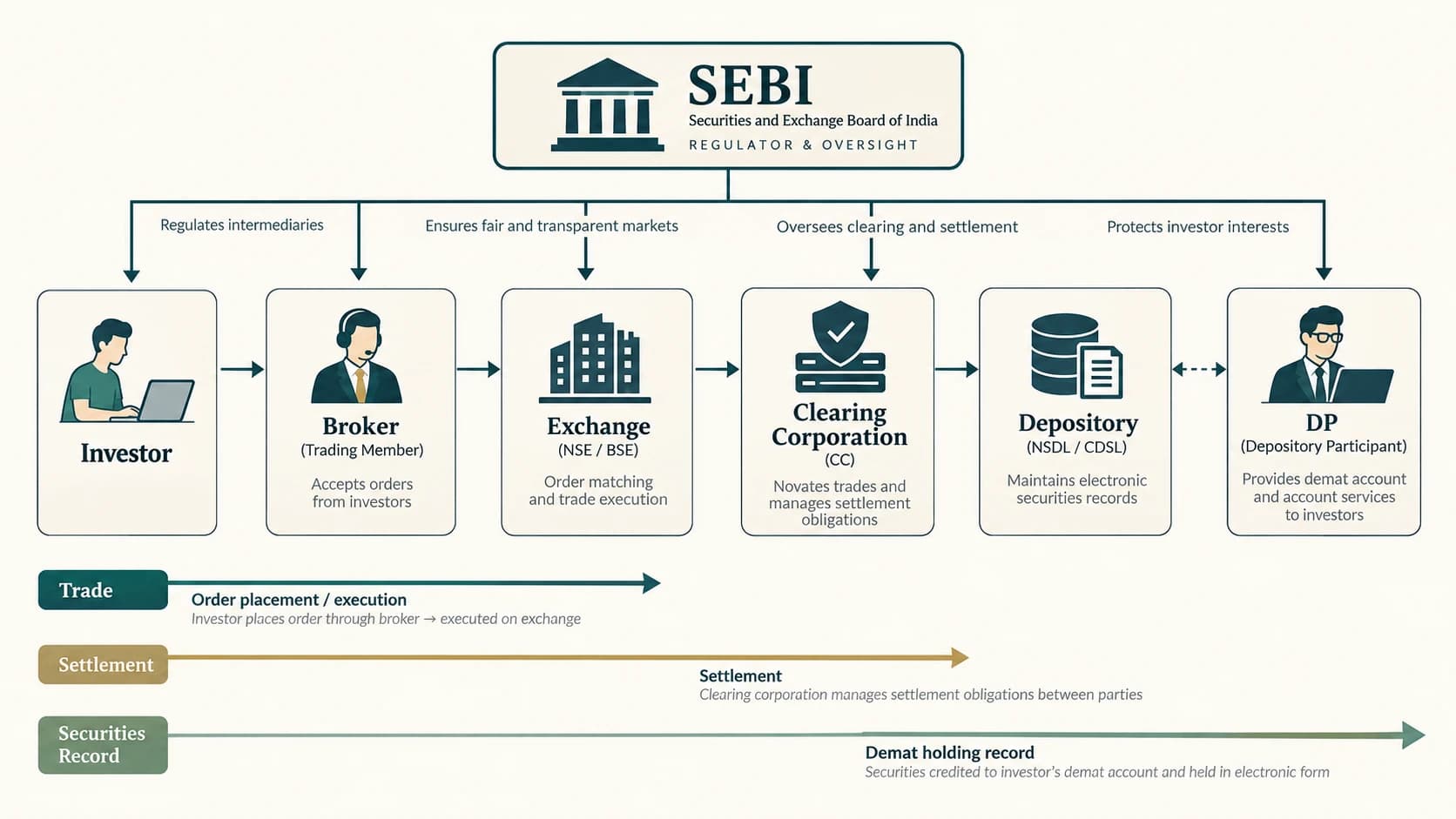
4. Market infrastructure institutions (MIIs)
A functioning exchange market needs more than a trading screen. Important infrastructure includes:
- Stock exchange — executes/matches eligible buy-sell orders under rules.
- Clearing corporation — computes obligations and manages clearing, risk and settlement mechanisms.
- Depository — maintains eligible securities in dematerialised/electronic form.
These are different legal and operating functions. A trading exchange cannot be assumed automatically to hold every investor's securities directly.
5. Brokers and trading members
A stockbroker/trading member provides eligible investor access to an exchange under applicable registration and rules. The broker may:
- onboard and conduct KYC;
- receive orders;
- execute trades through the exchange;
- collect lawful margins/charges;
- provide contract notes and records.
Investors should verify intermediary registration and use authorised channels. SEBI's current broker regulations and exchange circulars define detailed requirements; these can change.
6. Dematerialisation
In a demat system, securities are held and recorded electronically rather than as old-style paper certificates. A demat account is not a savings bank account and is not itself a stock exchange trading account.
In India, the familiar depositories are:
- NSDL — National Securities Depository Limited;
- CDSL — Central Depository Services (India) Limited.
They provide depository infrastructure; the investor commonly interacts through a Depository Participant (DP).
7. DP vs depository vs broker
A depository provides the electronic securities-holding infrastructure. A DP is an authorised intermediary through which the investor accesses the depository. A broker enables trade execution, though the same financial group may offer trading and demat services under different registrations.
Everyday analogy: A bank's central system records deposits; a securities depository's system records beneficial holdings. But deposits and securities are legally different assets and governed differently.
8. How one share trade gets completed
A simplified sequence:
Investor submits buy order → broker/stock exchange matches trade → clearing corporation determines obligations → funds and securities settle → depository/DP updates investor holdings.
Operational controls, margin requirements and settlement timing exist to mitigate failures. The exact plumbing differs by instrument and segment.
9. Clearing corporation and settlement guarantees
A clearing corporation may act as a central counterparty according to the market framework and manage risk through margins, collateral and default procedures. Its purpose includes reducing settlement risk and making obligations orderly.
Do not conclude that a clearing corporation guarantees the investment's price will rise or that no party can ever default.
10. Custodian
A custodian holds and services client assets under applicable agreements and regulation. Institutional investors may appoint custodians for securities settlement, safekeeping and corporate actions. A custodian differs from the portfolio manager who makes investment decisions.
11. Depository receipt vs demat account
A depository receipt (for example, an international depository receipt structure) is a security representing an interest in underlying assets/shares under defined legal terms. A demat account is an account mechanism for recording securities holdings. The similarity of the words "depository" does not make them identical.
12. Merchant banker and issue intermediaries
A merchant banker/lead manager can manage functions in capital raising such as due diligence, issue preparation, documentation and regulatory compliance. Registrars and transfer agents manage investor and allotment records under relevant rules.
They facilitate an issue but do not guarantee that the share's market price will increase after listing.
13. Credit rating agencies
SEBI regulates credit-rating agencies within the securities-market framework. Ratings represent the agency's opinion about the issuer/instrument's credit risk; ratings can be downgraded and are not a promise of repayment.
AAA vs risk-free: A high rating is not sovereign immunity, and even high-grade bonds can fluctuate in market value.
14. Insider trading and price-sensitive information
Trading securities using material unpublished price-sensitive information (UPSI) in violation of applicable rules threatens market fairness. Regulations require controls around insiders, disclosures and trading where applicable.
Example: a senior employee secretly learns of an impending major corporate result and trades before public disclosure. Whether a legal violation occurred requires applying the actual definitions, relationships and regulatory rules, not a headline guess.
15. Market manipulation
Manipulation can include creating misleading market activity, fake volumes, deceptive orders or artificial price signals. SEBI and exchanges use surveillance and enforcement frameworks.
Financial education must differentiate normal price movement caused by news from intentional deceptive conduct.
16. Investor disclosures
A securities investor should assess relevant documents such as:
- prospectus/offer document;
- financial statements;
- risk factors;
- listed-company disclosures;
- scheme information document for a mutual fund;
- key information/risk indicators where required.
Disclosure rules are designed to support decisions; disclosure does not turn a risky product into a guarantee.
17. Investor grievances
SEBI has complaint/grievance systems such as SCORES, alongside exchange, depository and online dispute-resolution arrangements governed by current framework. The investor should first check the appropriate intermediary/issuer grievance procedure and escalation rules.
Do not confuse: Bank-service grievance under the RBI Ombudsman framework (BA-12) and securities-market grievance under SEBI-related systems. The entity and complaint subject determine the route.
18. SEBI versus stock exchange
| Role | SEBI | Recognised exchange |
|---|---|---|
| Main identity | Statutory regulator | Trading/market institution |
| Creates/regulates market framework | Yes, under law | Implements exchange rules under regulatory oversight |
| Matches investor orders | Not its ordinary function | Yes, through trading system |
| Investigates market misconduct | Has regulatory/enforcement powers | Conducts surveillance/disciplinary functions under rules |
| Guarantees investment returns | No | No |
19. What is an index provider?
An index provider creates and maintains an index methodology and its composition. SEBI's Index Providers Regulations, 2024, under their applicable scope, are separate from the rules governing brokers or funds. An index is a benchmark/basket calculation; it is not a share certificate by itself.
20. Why this lesson matters for bank recruits
Banks can distribute investment products, issue bonds, act as custodians/settlement banks and interact with exchanges/depositories. An officer must understand where the bank's authority ends and another regulator's authority begins.
A customer asking about an insurance/mutual fund investment is not necessarily asking about a bank deposit. Sales suitability, risk disclosure and complaint routes depend on the actual product.
Quick check — BA-15-04
- Full form of SEBI? Securities and Exchange Board of India.
- Governing statutory Act? SEBI Act, 1992.
- Three core SEBI purposes? Protect investors, develop and regulate market.
- Is SEBI a stock exchange? No.
- Two Indian depositories? NSDL and CDSL.
- Who matches stock orders? Recognised exchange trading systems.
- Who maintains investor electronic securities accounts through DPs? Depositories.
- Does SCORES equal RBI Ombudsman? No.
- Does a high credit rating guarantee repayment? No.