
Mutual Funds, ETFs and NAV Basics
Mutual Funds, ETFs and NAV Basics. A detailed chapter in Financial Markets & Investment Awareness, with explanations and examples for Indian banking examinations.
By Akhilesh Saini · Reviewed 8 Oct 2026
Importance: HIGH
Prerequisites: BA-15-03 and BA-15-04
Exam lens: pooled investing, AMC/trustees, NAV, open-ended/close-ended, ETF versus index fund, risk and SIP.
1. What is a mutual fund?
A mutual fund pools investors' money into a scheme and invests according to disclosed objectives and the governing regulations. Investors own units of the scheme, not a promise that the fund manager will pay a fixed interest rate like a term deposit.
A fund may invest in:
- equities;
- debt instruments;
- money-market assets;
- gold/other eligible assets;
- a combination permitted by the scheme.
The value of its underlying investments changes, so the value of units changes.
2. Why investors use pooled investments
It is difficult for a retail investor to research hundreds of individual companies and bonds. Pooling provides:
- professional investment management;
- diversification within scheme constraints;
- operational convenience;
- access to particular strategies or markets;
- periodic disclosure and regulatory oversight.
However, diversification reduces some specific risks but does not eliminate market-wide loss.
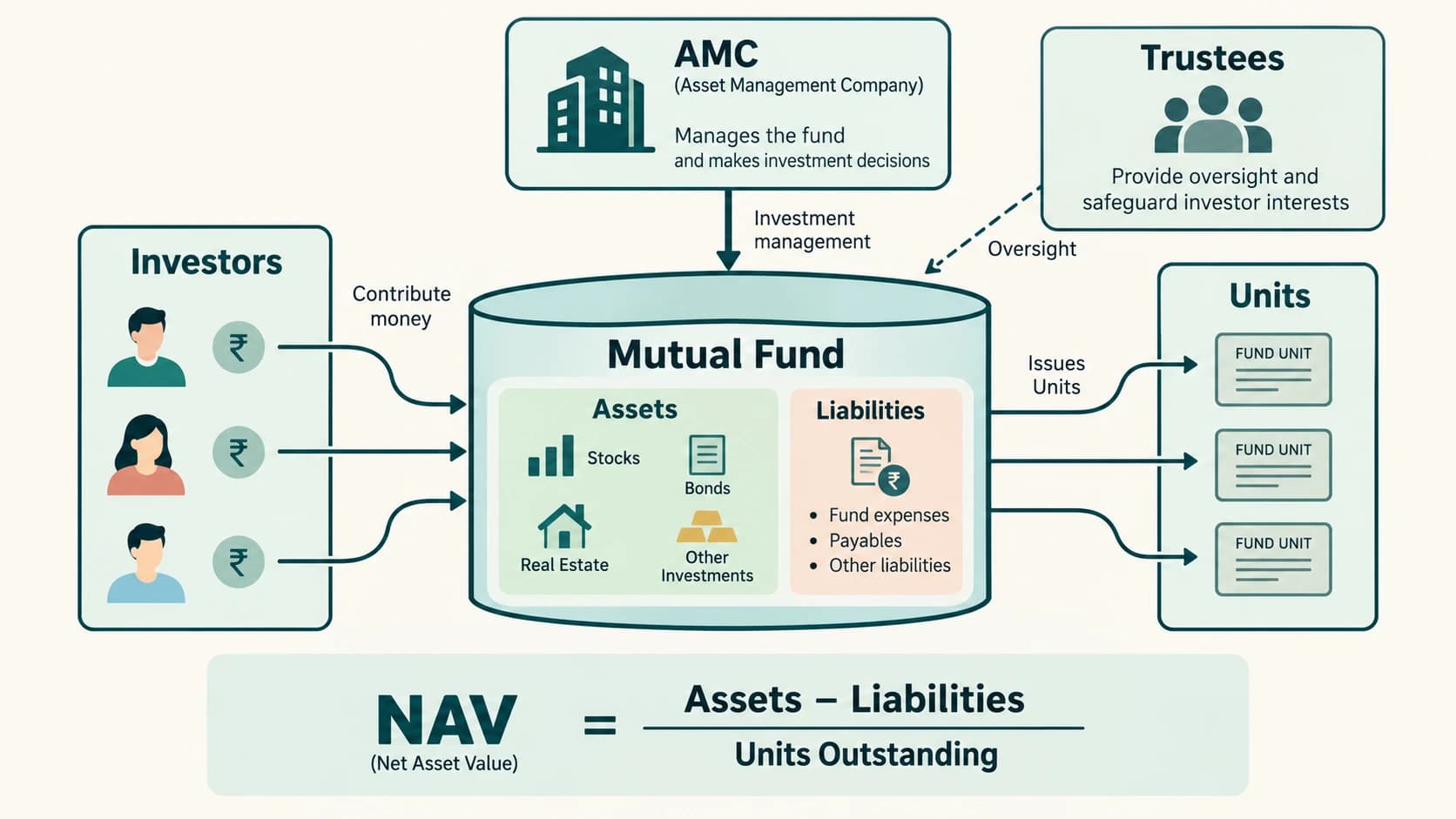
3. Mutual-fund structure
Important entities and roles:
- Sponsor: establishes/promotes the mutual fund under applicable rules.
- Trustees / trustee company: hold fiduciary/oversight responsibility under the framework.
- Asset Management Company (AMC): makes investment and portfolio decisions within scheme mandate.
- Custodian: performs custody/safekeeping and related asset-servicing roles.
- Registrar/Transfer Agent (RTA): maintains unit-holder records and processes under arrangement.
- Unit holder: investor who owns scheme units.
The precise duties and governance standards are legal/regulatory matters and can be updated; this functional separation is enduring.
4. Important current legal distinction
SEBI (Mutual Funds) Regulations, 2026 came into force on 1 April 2026, replacing the preceding framework from 1996. When researching current rules, use the 2026 regulations and subsequent amendments, not archived statements from an old 1996 rule as if they remain live.
That update belongs in the website's current-regulation reference, while the pooled-investment concepts below can remain stable in an evergreen book.
5. Units and scheme value
If a fund has net assets of ₹100 crore and 5 crore units are outstanding, each unit's NAV is ₹20 under the simplified illustration.
A scheme's unit value is not an arbitrary recommendation and does not by itself tell whether the scheme is cheap.
6. Worked NAV example
Illustrative fund data:
| Component | Amount |
|---|---|
| Investments at current valuation | ₹52 crore |
| Cash and receivables | ₹3 crore |
| Liabilities and accrued expenses | ₹5 crore |
| Net assets | ₹50 crore |
| Outstanding units | 2.5 crore |
If the portfolio valuation falls while units outstanding remain unchanged, NAV generally falls. Expenses also affect NAV.
7. A ₹10 NAV fund is not automatically cheaper than a ₹100 NAV fund
Suppose two funds hold essentially identical portfolios. One has ₹10 NAV because it started later or has a different unit history. Another has ₹100 NAV. Buying ₹10,000 worth of either gives you different numbers of units but not automatically a different percentage growth rate.
Compare strategy, risk, portfolio, costs and performance methodology — not merely low NAV.
8. Equity funds
Equity mutual funds primarily invest in stocks under defined category/mandate. Returns depend on stock valuations, earnings, liquidity and broader markets. Their short-term price volatility can be material.
Category rules and minimum allocation thresholds should be fetched from current SEBI classifications rather than fixed into permanent prose.
9. Debt funds
Debt funds invest in instruments such as bonds, Government securities and money-market instruments within their strategy. They can face:
- interest-rate risk;
- credit risk;
- liquidity risk;
- reinvestment risk.
A debt fund is not the same as a bank fixed deposit and normally does not carry a guaranteed fixed maturity value unless an unusual legally enforceable product structure says otherwise. 'Debt' does not mean 'zero risk'.
10. Hybrid funds
Hybrid strategies combine more than one asset class, often equity and debt, under a specified mandate. Allocation influences both potential return and volatility.
11. Open-ended versus close-ended
Open-ended mutual fund: Allows purchases/redemptions in accordance with scheme rules at applicable NAV/pricing and cut-off arrangements. The number of outstanding units can change.
Close-ended fund: Generally has a fixed initial offering and term, with secondary-market trading/listing or other redemption rights as specified. The market price of listed units can differ from NAV.
12. Active versus passive management
- Active fund: Manager selects securities in an effort to meet/beat a stated objective or benchmark. Costs and outcomes vary.
- Passive index fund: Attempts to track a specified index through eligible holdings/replication methods, rather than consistently choosing winners.
Passive funds can still incur expenses, tracking differences and market losses. Tracking an index is not tracking guaranteed profit.
13. Exchange-Traded Fund (ETF)
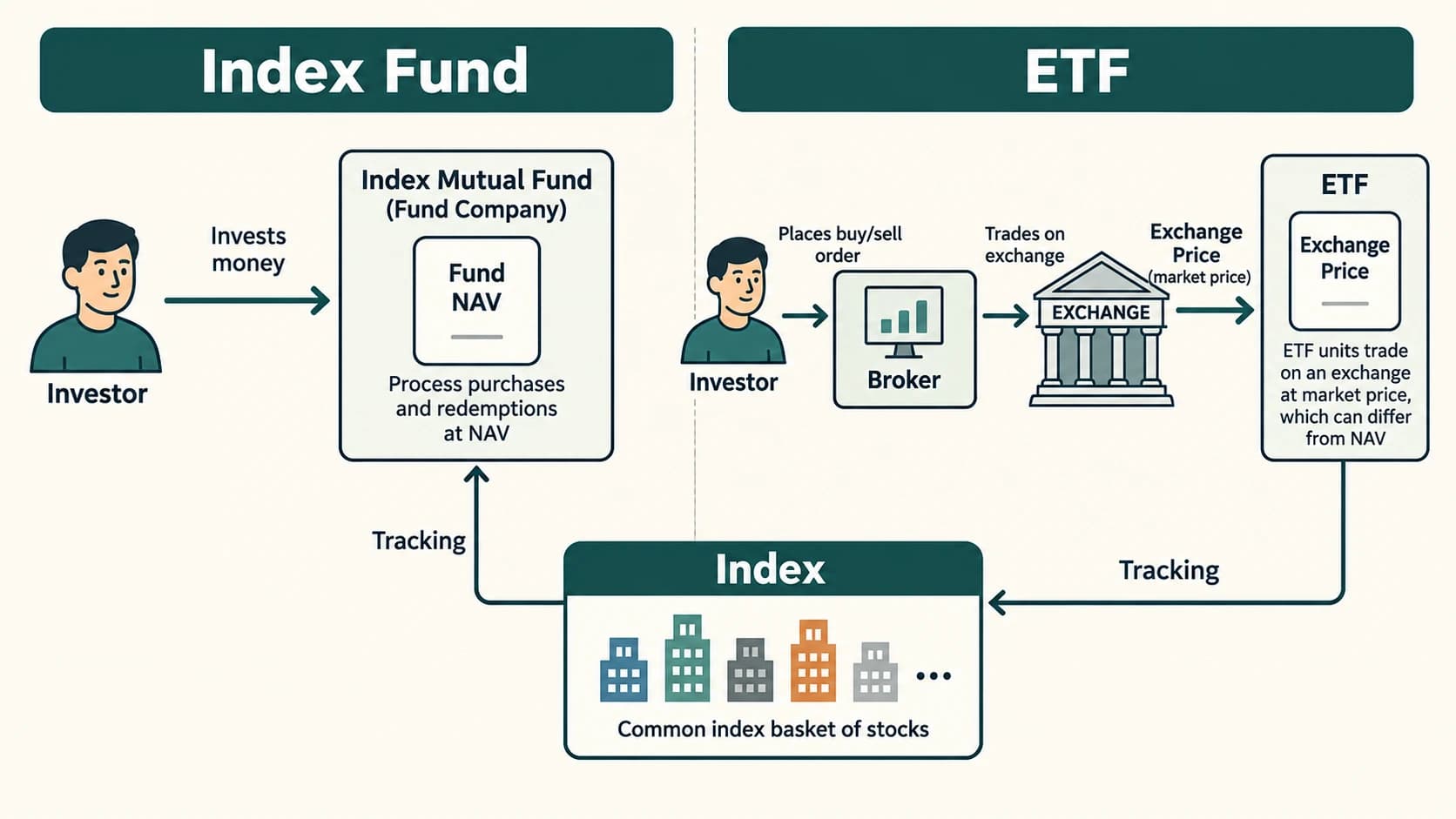
An ETF is a fund whose units are traded on a recognised stock exchange during market hours. ETFs may track stock indices, bonds, gold or other eligible benchmarks/assets.
The investor generally buys/sells ETF units through market trading arrangements. Its market price can differ from the latest computed NAV depending on demand, supply, liquidity and arbitrage.
14. ETF versus conventional index mutual fund
| Feature | Index mutual fund | Index ETF |
|---|---|---|
| Main investment approach | Tracks benchmark | Often tracks benchmark |
| Retail transaction route | Typically fund/AMC/platform under applicable rules | Exchange through broker/trading access |
| Pricing | Applicable scheme NAV and rules | Exchange execution price; reference NAV/iNAV where available |
| Demat/trading account | Depends on route and product | Generally exchange-traded holding/trading infrastructure |
| Trading time | At applicable fund processing/cut-off rules | During exchange trading hours |
| Costs | Scheme expenses and transaction terms | Scheme costs plus possible brokerage/spread |
An ETF is not automatically cheaper after all costs in every investor's situation.
15. Tracking error and tracking difference
Tracking difference describes the fund's return minus benchmark return over a period. Tracking error describes variability of that difference over time, often using statistical measures.
Example: Index returns 10%; fund returns 9.5% over the same period → tracking difference of −0.5 percentage point, before any additional methodological qualifications.
Tracking can diverge because of:
- expenses;
- cash holdings;
- rebalancing and transaction costs;
- sampling methodology;
- corporate actions and operational effects.
16. SIP is an investment method, not an asset class
A Systematic Investment Plan (SIP) invests at scheduled intervals into a mutual-fund scheme. A SIP can impose saving discipline and spread purchases across market prices.
If prices vary, a fixed contribution buys more units at lower prices and fewer at higher prices. This is often called rupee-cost averaging, but it does not guarantee a profit, remove market risk or always outperform lump-sum investing.
17. Simple SIP illustration
An investor contributes ₹1,000 monthly for two months:
- Month 1 NAV ₹10 → 100 units.
- Month 2 NAV ₹8 → 125 units.
- Total ₹2,000 buys 225 units.
- Average acquisition cost per unit ≈ ₹8.89.
The portfolio still suffers if the future NAV stays below the investor's average cost.
18. SWP and STP
- SWP: Systematic Withdrawal Plan — scheduled redemptions; units are sold to generate withdrawals.
- STP: Systematic Transfer Plan — scheduled movement from one scheme to another under rules, usually involving redemption and purchase, with potential taxes/charges.
A SWP payout is not guaranteed interest; it may consume principal by redeeming units.
19. Expense ratio
A fund incurs management and operational costs under regulatory limits. These expenses reduce net investment returns and are reflected in NAV calculations. Compare the scheme's total expense ratio (TER) and disclosure; precise fee limits and charging rules are time-sensitive.
20. Direct versus regular plan
Where applicable, a direct plan avoids certain distributor-commission arrangements reflected in cost structure, while a regular plan includes distribution services/costs. Investment portfolio and scheme objective may be similar, but ongoing expenses and resulting NAV/performance can differ.
The appropriate route depends on the investor's circumstances and quality of advice received; lower fees are valuable but not the only consideration.
21. Growth versus income distribution
A growth option generally leaves earnings/investment value reflected in scheme NAV. An income distribution cum capital withdrawal (IDCW) arrangement can make permitted distributions; payment reduces the assets and hence can affect NAV and is not free incremental wealth.
Exam confusion: A mutual-fund distribution is not identical to a company paying a guaranteed bank-deposit coupon.
22. Riskometer and scheme suitability
SEBI's riskometer and disclosures help describe broad scheme risk levels within current rules. A low-risk label does not mean deposit insurance or a guaranteed return. Higher-return aspirations usually require accepting relevant kinds of risk and time horizon.
23. Exchange-traded funds and arbitrage
ETF trading prices are linked to portfolio value partly through authorised institutional creation/redemption and market arbitrage mechanisms, but spreads and deviations can persist, especially in thinly traded funds.
ETF market price and NAV are related concepts—not synonyms.
24. NAV and returns: total return matters
A fund's reported performance may account for distributions in a particular way. Comparing a Growth-option NAV path with an IDCW option's NAV alone can mislead. Compare consistent total-return measures, dates and expenses.
25. Investor protections and warnings
Mutual funds are market-linked investments. Funds and distributors must follow applicable regulations on suitability, transparency and disclosure. A fund advertisement or a bank offering the fund does not convert fund units into an insured bank deposit.
Quick check — BA-15-05
- What do investors in a fund own? Units of the scheme.
- NAV formula? Net assets divided by units outstanding.
- Does ₹10 NAV mean fund is cheap? No.
- Debt fund equal FD? No.
- ETF traded where? Recognised stock exchange.
- ETF market price always equals NAV? No.
- SIP means guaranteed return? No.
- SWP generates cash by what process? Redemption of units.
- Current SEBI MF regulations are from which year? 2026 (historical effective fact for website regulatory context).