
Foreign Exchange Market and Exchange-Rate Basics
Foreign Exchange Market and Exchange-Rate Basics. A detailed chapter in Financial Markets & Investment Awareness, with explanations and examples for Indian banking examinations.
By Akhilesh Saini · Reviewed 8 Oct 2026
Importance: HIGH
Prerequisites: BA-01, BA-03 and BA-15-01
Exam lens: USD/INR quotations, rupee depreciation, spot and forward, authorised dealers and FEMA.
1. Why foreign exchange exists
International transactions require currencies. An Indian importer may owe dollars to an overseas supplier; an exporter may receive euros; a traveller may need currency for permitted spending abroad. The foreign-exchange (forex or FX) market enables currencies to be exchanged and currency risk to be managed.
The market includes banks, authorised dealers, importers/exporters, investors, central banks and other eligible entities. Much activity occurs through dealer networks and electronic markets rather than one universal stock exchange.
2. Currency pair notation
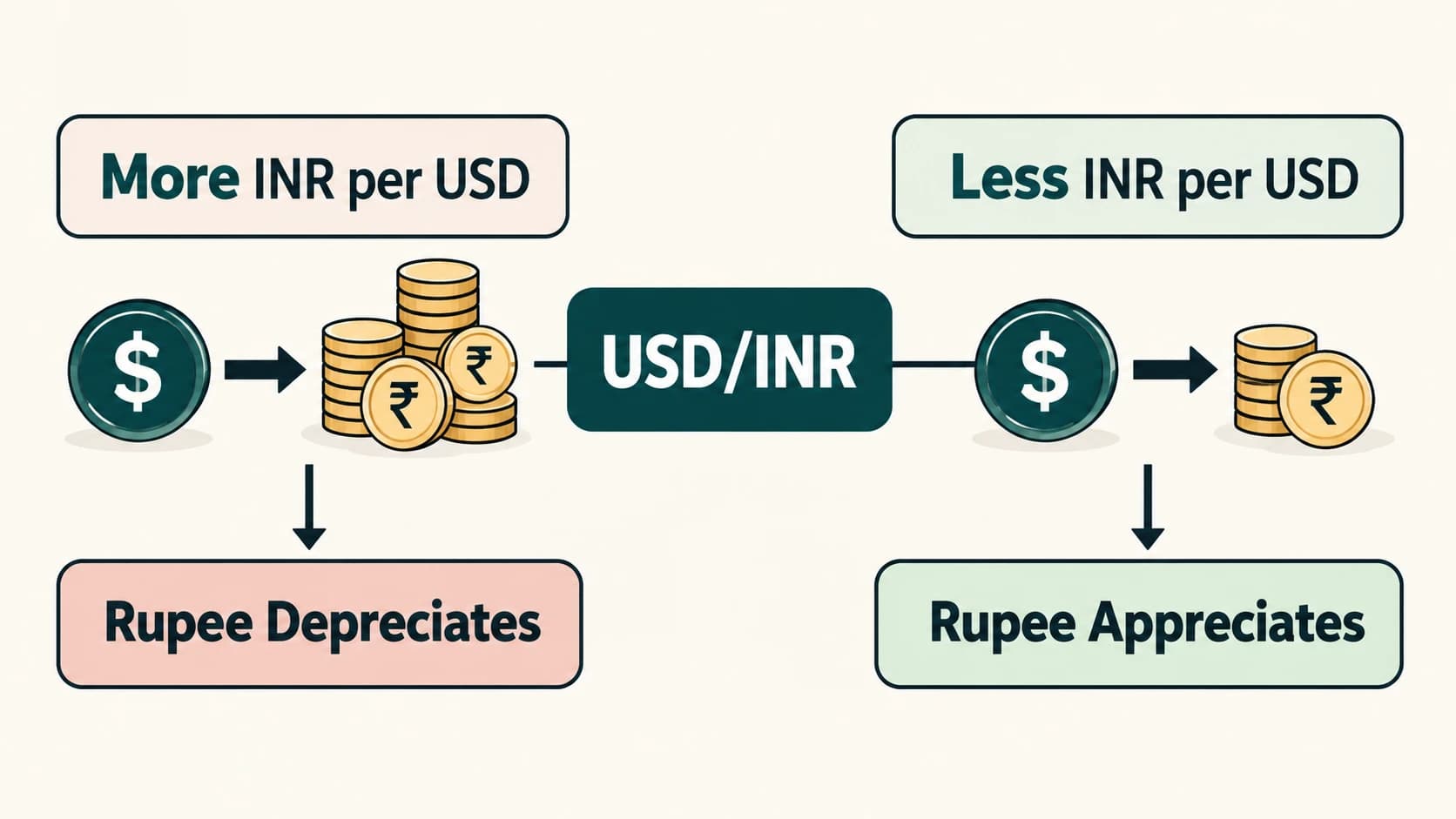
USD/INR = 85 means one US dollar costs ₹85 in that quote convention. USD is the base currency; INR is the quoted/terms currency.
If USD/INR moves 85 → 88, more rupees are required to buy one dollar:
- rupee depreciates against USD;
- dollar appreciates against INR.
If USD/INR moves 85 → 82, fewer rupees are needed for one dollar: the rupee appreciates against the dollar.
All examples here are hypothetical, not actual exchange-rate quotations.
3. Direct versus indirect quotation
For an India-based example:
- Direct INR quote: ₹ per unit of foreign currency, e.g., ₹85 per USD.
- Reciprocal quote: USD per rupee, e.g., 1/85 ≈ 0.01176 USD for ₹1.
Do not take the reciprocal without changing the currency units and interpretation.
4. Currency appreciation versus depreciation
Appreciation means a currency becomes more valuable relative to another. Depreciation means less valuable. They are relational; both currencies can change simultaneously against third currencies.
Example: USD/INR 80 to 84 means rupee depreciates against USD by that quote change; it does not mean the purchasing power of rupees for every domestic product falls by exactly 5%.
5. Impact on importer and exporter
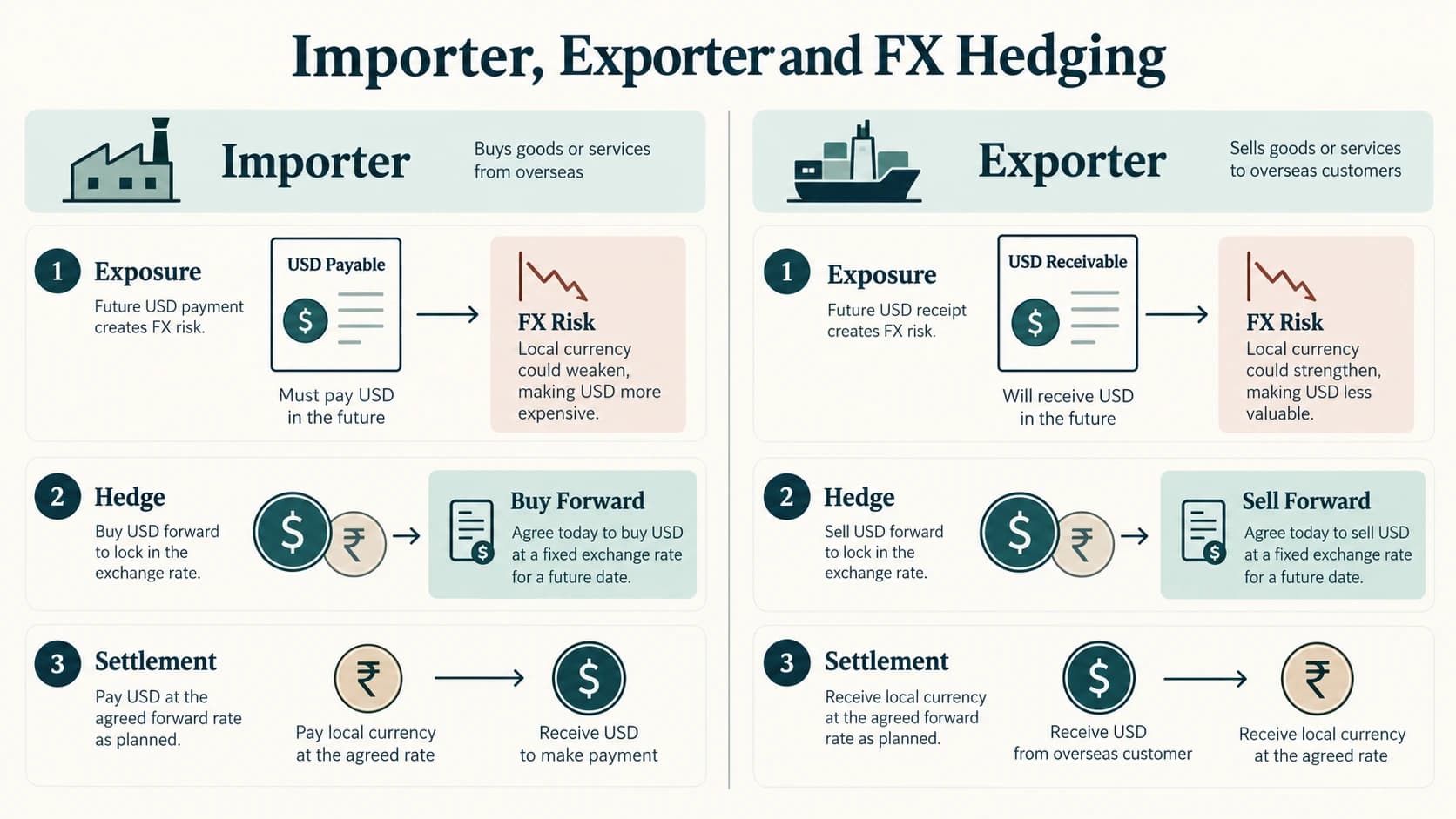
An Indian importer must pay USD 10,000 in three months.
- If spot at payment becomes ₹85/$, rupee cost is ₹8,50,000.
- If it becomes ₹90/$, rupee cost is ₹9,00,000.
The importer faces higher INR cost if rupee weakens, other conditions equal.
An exporter receiving USD may receive more rupees when USD/INR rises, but overall profits also depend on input costs, competition, hedge positions and volumes.
6. Bid, ask and spread
A dealer might quote an illustrative USD/INR market of 85.00 / 85.08:
- bid: dealer's buying price for USD (₹85.00);
- ask/offer: dealer's selling price for USD (₹85.08);
- spread: ₹0.08 per USD in the example.
Fees and actual customer rates can differ. A wide spread often reflects transaction costs, liquidity or market risk.
7. Spot FX
A spot FX transaction exchanges currencies under the standard spot value-date/settlement conventions of the relevant currency pair and market. Spot does not always mean cash physically changes hands instantly at the dealing screen.
8. FX forward
An FX forward locks an agreed exchange rate for a future settlement date under contract terms. It is commonly used to hedge payment/receipt uncertainty.
Example: An Indian importer knows it must pay USD 100,000 in three months. Instead of waiting for the future spot rate, it enters an eligible USD forward purchase at ₹86 per dollar. Under the simplified illustration, the INR cost is fixed at ₹86 lakh for the contracted amount, ignoring charges and counterparty/contract details.
A hedge reduces uncertainty but can mean missing a favourable later spot movement. It is not a no-cost profit guarantee.
9. Forward premium and discount
If the forward USD/INR rate is higher than current spot USD/INR, the USD trades at a forward premium in INR-quote terms (and INR at a corresponding forward discount). Differences reflect interest-rate differentials, funding and market conditions, not just predictions of the future spot rate.
A forward rate is not a forecast guaranteed to happen.
10. Currency swaps and options — basic awareness
- FX swap: exchange of currencies now plus a reverse exchange later, or related paired currency legs under agreed terms.
- Currency option: provides a contractual right (not an obligation for the option holder) to exchange currencies under specified terms in return for an option premium.
- Futures: standardised exchange-traded contracts where eligible markets offer such products.
Derivative access, hedging documentation, settlement and margin rules depend on RBI/SEBI and market context. Speculative use can produce large losses.
11. RBI and the forex market
RBI operates within the legal and monetary framework affecting foreign exchange. Its responsibilities include:
- regulating authorised foreign-exchange transactions under FEMA;
- managing India's foreign-exchange reserves;
- overseeing key aspects of FX market functioning;
- intervening in FX markets as required by its policy judgment.
India does not promise a single immutable USD/INR rate under the contemporary market-determined exchange-rate framework. RBI's actions can seek orderly market conditions without eliminating exchange-rate variation.
12. FEMA
FEMA stands for the Foreign Exchange Management Act, 1999. It establishes the basic legal framework for foreign-exchange management in India.
RBI authorises specified entities such as Authorised Dealers (ADs) and other authorised persons to undertake permitted FX business. Banks may act as Authorised Dealer Category-I institutions where duly authorised.
Do not confuse FEMA with FERA—the older Foreign Exchange Regulation Act that FEMA replaced in India's reform-era framework.
13. Current-account and capital-account transactions
Broad conceptual distinction:
- Current account: transactions such as trade in goods/services, ordinary payments/income and certain transfers under legal definitions.
- Capital account: transactions that alter assets/liabilities outside India or of nonresidents in India under FEMA definitions.
Both require applying current permissions, conditions and reporting rules. The labels do not imply that every conceivable transaction in that category is automatically permitted without conditions.
14. Authorised dealer vs money changer
An AD bank may facilitate a range of trade, remittance and permitted investment FX services within its approval. A money changer has different authorised scope. An unlicensed private party cannot simply declare itself a foreign-exchange dealer.
15. Exporter hedging example
An Indian exporter expects USD 50,000 in two months. If the rupee strengthens, the INR value received may fall.
- At 86 INR/USD: ₹43 lakh.
- At 82 INR/USD: ₹41 lakh.
A permitted forward sale of USD can reduce this uncertainty. The exporter exchanges potential extra gains from depreciation for greater certainty, subject to contract terms.
16. Cross rate calculation
Suppose hypothetical quotations are:
- USD/INR = ₹84 per USD;
- EUR/USD = $1.10 per EUR.
Then illustrative EUR/INR ≈ ₹84 × 1.10 = ₹92.40 per EUR, before bid-ask spreads and costs.
Always track the currency units: (INR/USD) × (USD/EUR) = INR/EUR.
17. Nominal and real exchange rate
The nominal exchange rate is a price of one currency in terms of another. A real exchange rate adjusts for relative price levels; it helps evaluate competitiveness in economic analysis.
The nominal effective exchange rate (NEER) combines movements against a basket of currencies with weights. The real effective exchange rate (REER) also considers relative prices/costs. Exact index construction and base-year values belong in official current-data/research notes.
18. Forex reserves
A central bank's foreign-exchange reserves can include foreign-currency assets and other prescribed reserve components such as gold and SDR holdings. Reserves help support external-payment stability and policy operations, but the headline value fluctuates with transactions and valuation effects.
Do not confuse: RBI forex reserves with the amount of foreign-currency cash held by one bank branch.
19. Exchange rates and the economy
Exchange rates interact with:
- inflation, especially imported prices;
- crude oil and other imported commodity costs;
- external debt servicing;
- tourism and remittances;
- export price competitiveness;
- portfolio and direct investment flows.
The effects depend on hedging, invoicing currency, imported input content, elasticity of demand and monetary/fiscal conditions. A weaker currency is not automatically beneficial or harmful for everyone.
20. International payment messaging is not the FX market
SWIFT is widely used for secure financial messaging. It does not by itself set the exchange rate, replace a bank's account ledger or hold all global funds for settlement. Banking correspondent relationships and payments systems execute the actual funds movement.
This links back to BA-13-04's distinction among CBS, SWIFT/BIC and settlement arrangements.
21. Forex versus currency derivatives on exchanges
The broader OTC FX market serves many trade and banking purposes. Exchange-traded currency derivatives are a specific standardised market segment subject to applicable regulations and participant eligibility. The two should not be conflated.
22. Practical fraud caution
A promise of guaranteed daily profit from "forex trading" is not evidence of lawful authorisation or low risk. Investors should verify regulatory authorisation, platform legitimacy and product rules rather than assuming an app displaying USD/INR is an authorised dealer.
Quick check — BA-15-06
- USD/INR rises from 83 to 87 — which currency depreciates? INR against USD.
- Who benefits directly from more INR per fixed USD receivable? Exporter with unhedged fixed USD receipt, other things equal.
- A forward is identical to a prediction? No.
- What is FEMA? Foreign Exchange Management Act, 1999.
- Is SWIFT a foreign-currency settlement bank? No, it is a messaging network.
- What is spread? Difference between dealer ask and bid.
- What are NEER/REER? Effective exchange-rate indices; REER accounts for relative prices.
- Is an FX hedge a guaranteed investment profit? No.