
BIS, Basel Committee, FSB and FATF
BIS, Basel Committee, FSB and FATF. A detailed chapter in International Financial Institutions, with explanations and examples for Indian banking examinations.
By Akhilesh Saini · Reviewed 8 Oct 2026
1. Why international standard-setting matters
An Indian bank can borrow in global markets, lend to exporters, settle payments internationally and hold foreign assets. A financial shock overseas may affect its funding or counterparties. Countries therefore benefit from cooperation on bank supervision, systemic-risk monitoring, financial infrastructure and anti-money-laundering practices.
Four important names appear repeatedly in banking exams:
- BIS — Bank for International Settlements;
- BCBS — Basel Committee on Banking Supervision;
- FSB — Financial Stability Board; and
- FATF — Financial Action Task Force.
All four contribute to a safer financial system, but they do not exercise identical powers. In particular, writing global standards does not automatically create domestic criminal law or a directly enforceable RBI regulation.
2. BIS: a bank for central banks
The Bank for International Settlements (BIS) is an international institution headquartered in Basel, Switzerland. It opened in 1930. It provides a forum for central banks to cooperate, research and discuss financial-system and monetary issues, and it offers certain financial services to central-bank and official-sector clients.
The BIS is commonly described as the “bank for central banks.” This is an explanatory shorthand, not a claim that every individual can open a normal BIS salary account or that BIS is the central bank of all countries.
3. What BIS does in practice
BIS activities include:
- facilitating international central-bank cooperation;
- producing research on monetary policy, financial markets and systemic risks;
- supporting global meetings and committees;
- offering banking services to central banks and certain international official institutions; and
- supporting innovation-related cooperation within its mandate.
It provides an institutional home for several internationally influential committees, including the Basel Committee. This does not make every committee a separate BIS retail bank or a supranational legislature.
4. BIS versus a domestic central bank
| Question | BIS | RBI |
|---|---|---|
| Who is its principal constituency? | Central banks and official monetary authorities | India's monetary/banking system and statutory stakeholders |
| Can a typical customer open a retail savings account? | No | The RBI itself is not a normal retail savings bank |
| Does it issue India's legal-tender banknotes? | No | RBI issues Indian banknotes under applicable law, with statutory exceptions |
| Main cooperation role | International central-bank coordination and services | India-centred monetary/financial policy plus international participation |
| Headquarters | Basel | Mumbai |
BIS analysis can influence global discussions without substituting for domestic policy decisions by the RBI, Government or Parliament.
5. Basel Committee: full name and identity
BCBS is the Basel Committee on Banking Supervision. It was established in 1974 by central-bank governors of the Group of Ten countries following international banking disturbances. It is hosted by the BIS in Basel and serves as the primary global standard setter for prudential bank regulation and supervision.
The name “Basel” refers to the Swiss city associated with BIS and BCBS—not to a separate country, currency or a commercial banking group.
6. BCBS is a committee, not a supranational regulator
This is one of the most important distinctions in international banking awareness:
BCBS develops international prudential standards and supervisory guidance. Its decisions do not, by themselves, have legal force in a country's domestic banking system.
National authorities adopt or implement standards through their own regulatory and legal arrangements. In India, relevant Basel-related prudential requirements are reflected through the RBI's regulatory framework. The Basel Committee cannot simply telephone an individual Indian branch and levy a penalty under a new global law of its own.
7. Basel I: the foundational capital approach
Basel I, associated with the 1988 capital accord, established an influential common approach to minimum capital requirements based on risk-weighted assets. The core idea is that a bank should maintain a financial cushion against losses, and the required cushion should reflect the riskiness of its activities.
Exam concept: capital adequacy is not the same as the cash reserve ratio or statutory liquidity ratio. CRAR compares eligible regulatory capital with risk-weighted assets; CRR/SLR have different purposes and denominators.
8. Basel II: risk sensitivity and three pillars
Basel II refined the bank-capital framework and is associated with three pillars:
- Pillar 1 — Minimum capital requirements: capital for relevant measured risks.
- Pillar 2 — Supervisory review: regulators evaluate banks' risk management and capital adequacy more broadly.
- Pillar 3 — Market discipline: disclosures to help market participants evaluate a bank's position.
The pillars complement one another. A well-capitalised bank can still be unsafe if its internal controls are deficient or disclosures hide important risks.
9. Basel III: more resilient banking
Following lessons from the global financial crisis, Basel III strengthened the emphasis on high-quality bank capital, capital buffers, leverage constraints and liquidity-risk standards. Common terms are:
- CET1: Common Equity Tier 1 — high-quality going-concern capital;
- AT1: Additional Tier 1 — certain eligible capital instruments;
- Tier 2: further eligible loss-absorbing capital;
- CRAR: capital-to-risk-weighted-assets ratio;
- LCR: Liquidity Coverage Ratio;
- NSFR: Net Stable Funding Ratio; and
- Leverage ratio: a non-risk-weighted exposure backstop.
This list describes concepts, not current percentages. Specific requirements, implementation dates, buffers and national exceptions may change and should remain in the site’s updated RBI/BIS data.
10. Simple CRAR illustration
Suppose a hypothetical bank holds eligible regulatory capital of ₹120 crore and risk-weighted assets of ₹1,000 crore.
This is an arithmetic example, not an assertion that 12% is the current requirement for every Indian bank. Credit risk, market risk and operational risk feed into the broader risk and capital framework according to applicable methods.
11. Liquidity is not identical to capital
A bank can own sound long-term assets but lack ready cash for sudden withdrawals. Liquidity concerns meeting cash outflows when due, while capital is the financial cushion against losses. Leverage concerns the extent of exposures relative to capital. These three guardrails address related but distinct risks.
Example: a well-capitalised bank may still suffer a sudden liquidity run; a very liquid bank may still have poor-quality assets or insufficient capital. Basel-type standards consider several dimensions of resilience.
12. From BCBS standards to Indian rules
A simplified pathway is:
International BCBS standard → review/adaptation by Indian authorities → RBI directions or other domestic implementation → compliance by applicable Indian banks.
The process is not always one single circular or simultaneous adoption across all jurisdictions. National regulators may make specific choices consistent with their mandate. A bank should follow the currently applicable RBI regulatory instrument, not assume that a global consultation paper became binding Indian law overnight.
13. BCBS supervisory principles
Beyond numeric ratios, the Basel Committee publishes supervisory principles and guidance on topics such as risk governance, stress testing, liquidity, operational resilience and risk management. A standard can establish a minimum international expectation; guidelines and sound practices can help supervisors and banks develop processes.
An international standard alone is insufficient if a bank lacks an effective board, audit controls, reliable data or an ethical culture.
14. FSB: the global system perspective
FSB means Financial Stability Board. It was established in 2009, succeeding the earlier Financial Stability Forum. The FSB is an international body that monitors and makes recommendations about the global financial system and coordinates work among national financial authorities and standard-setting bodies.
The FSB looks at the interconnected system rather than only one bank's capital formula. It can analyse cross-border vulnerabilities, non-bank financial intermediation, financial innovation and systemic risks, while encouraging coherent national implementation of agreed reforms.
15. Why system-wide risks need coordination
Imagine several large institutions in different countries hold similar assets and use the same short-term funding channels. Falling asset prices could create margin calls and forced sales across the system. Even if each bank follows ordinary rules, a correlated shock could spread through markets and across borders.
The FSB helps identify and coordinate international responses to such vulnerabilities. It cannot by itself replace the domestic central bank's emergency liquidity decisions or a national legislature's rule-making powers.
16. Systemically important financial institutions
A systemically important financial institution (SIFI) can create broader damage if it fails because of its size, complexity or interconnectedness. International bodies and national regulators pay particular attention to these risks. Global and domestic systemic-importance designations depend on criteria and are subject to periodic updates.
A “large bank” is not automatically and permanently on every global list. Keep the methodological idea in the lesson and the current lists in maintained regulatory data.
17. FSB vs BCBS
| Comparison | FSB | BCBS |
|---|---|---|
| Primary focus | Financial-system vulnerabilities and international coordination | Prudential regulation and supervision of banks |
| Scope | Cross-sector/system-wide | Banking-sector standards |
| Typical work | Risk monitoring, reform coordination, implementation reviews | Basel capital/liquidity standards and supervisory principles |
| Direct domestic legal powers? | National authorities implement applicable policies | Standards have no automatic domestic legal force |
| Key confusion | Not a central bank | Not the BIS itself |
Both can contribute to global stability without being identical organisations.
18. FATF: fighting illicit finance
FATF stands for Financial Action Task Force. Established in 1989, it is an intergovernmental standard-setting and monitoring body focused on combating:
- money laundering (ML);
- terrorist financing (TF); and
- proliferation financing (PF).
Proliferation financing concerns financing connected to the proliferation of weapons of mass destruction under the applicable international framework. FATF seeks effective prevention, detection, reporting and international cooperation to reduce misuse of the financial system.
19. What is money laundering?
Money laundering is the process by which criminals disguise the illicit origin of proceeds. Textbook teaching often describes the stages as:
- Placement: introducing illicit funds into the financial system;
- Layering: moving funds through transactions to obscure origins; and
- Integration: making funds appear to belong to lawful economic activity.
These three stages are a teaching model, not a guarantee that every case proceeds in the same order. Modern criminal networks may move through digital channels, corporate structures or cross-border transactions in ways that do not fit a simple linear path.
20. AML/CFT/PF in banking
Banks and other covered institutions implement domestic AML/CFT requirements under their applicable legal and regulatory frameworks. Practical controls can include:
- customer identification and verification;
- understanding beneficial ownership and business purpose;
- customer risk assessment;
- ongoing transaction monitoring;
- screening against applicable sanctions or restrictions;
- reporting required suspicious transactions;
- record retention and internal governance; and
- training, audit and compliance oversight.
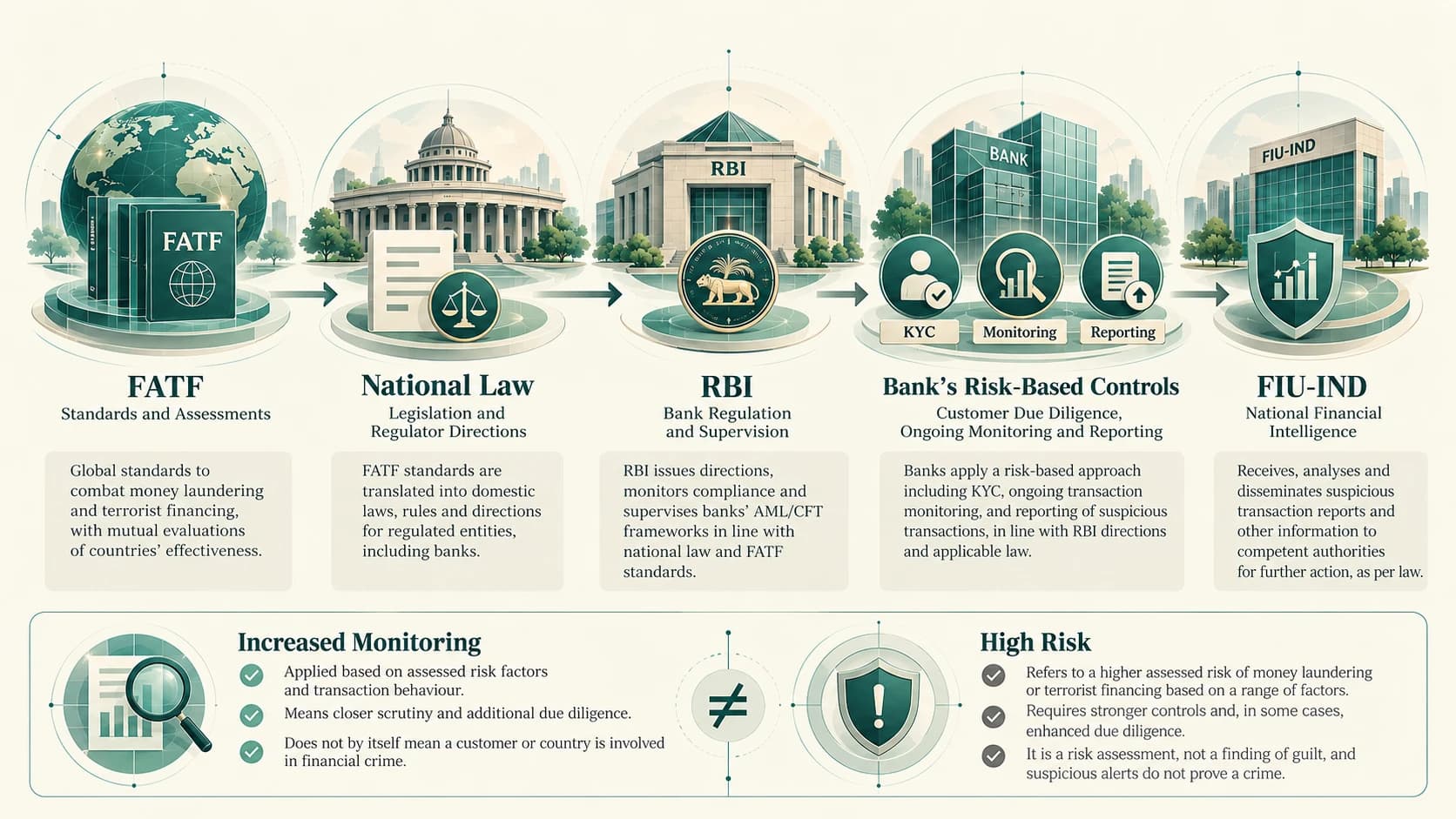
FATF provides international standards, while India implements binding requirements through laws such as the Prevention of Money-laundering Act (PMLA) and relevant rules/directions administered by competent authorities including RBI and FIU-IND.
21. Risk-based approach
A risk-based approach asks institutions to apply controls proportionate to the risks identified. Higher-risk activity may require deeper enquiry, enhanced due diligence and closer monitoring. Lower-risk situations may allow simplified measures where permitted by law and regulation.
Risk-based does not mean “no KYC for small balances” without legal basis. A product's eligibility, account opening obligations and enhanced due diligence are governed by the applicable rules.
22. FATF Recommendations
The FATF's well-known framework consists of 40 Recommendations, accompanied by interpretive notes, methodology and periodically revised guidance. Together with assessment processes, these provide a global benchmark for effective AML/CFT/PF systems.
For a bank exam, recall 40 Recommendations, and understand their purpose: countries should criminalise relevant offences, empower authorities, supervise institutions, identify beneficial ownership and cooperate internationally. The exact text and revisions must be checked from FATF's official standards page.
23. FATF evaluations
Mutual evaluations examine whether a country's laws, institutions and enforcement arrangements align with FATF standards and work effectively. Assessment may distinguish technical compliance (how rules correspond to the Recommendations) from effectiveness (whether those rules produce useful outcomes).
A country can have detailed AML legislation yet face effectiveness weaknesses if investigations, reporting or asset recovery are inadequate. Conversely, a strong result in one area does not guarantee an entire system has no vulnerabilities.
24. Increased monitoring: the “grey list”
A jurisdiction under increased monitoring has identified strategic AML/CFT/PF deficiencies and has committed to work within an agreed process to address them. Informally this is called the FATF grey list. It does not mean that every person or transaction from that jurisdiction is criminal or automatically prohibited.
Banks must follow the applicable domestic rules and institutional risk policies. Lists and country assessments can change following FATF plenary decisions; they belong in a living compliance reference, not in a permanent PDF list.
25. High-risk jurisdictions: the “black list”
FATF separately identifies high-risk jurisdictions subject to a call for action, often called the black list informally. FATF may call on countries to apply enhanced due diligence and, for the most serious cases, countermeasures in accordance with its statements and local legal implementation.
The terms increased monitoring and high risk subject to a call for action are not interchangeable. A grey-list designation does not automatically produce every consequence associated with a high-risk designation.
26. Why FATF matters to Indian banks
Indian banks may receive remittances, process international trade, onboard foreign-linked businesses or maintain correspondent banking relationships. If a jurisdiction's controls are weak, banks may face a higher risk of laundering or sanctions evasion. Strong KYC, suspicious-transaction detection and lawful reporting protect the banking system's integrity.
FATF does not receive every Indian bank's suspicious transaction reports directly. Under India's system, reporting requirements and reporting entities are determined by domestic law, with roles for FIU-IND and competent regulators.
27. FATF vs RBI vs FIU-IND
| Organisation | Principal role |
|---|---|
| FATF | International AML/CFT/PF standards, assessment and monitored-jurisdiction identification |
| RBI | Indian banking regulation and applicable KYC/AML directions for regulated entities |
| FIU-IND | National financial-intelligence functions including receiving and analysing prescribed financial reports |
| Bank compliance team | Applying applicable rules and internal controls to customers and transactions |
Exam trap: FATF is not India's sole domestic AML law-enforcement agency and does not itself replace FIU-IND.
28. FATF vs BCBS
Both affect banks, but the subjects differ:
- BCBS: bank prudential capital, liquidity, risk management and supervisory quality.
- FATF: money laundering, terrorist financing and proliferation-financing controls.
A bank can be well capitalised yet have serious AML weaknesses; it can also maintain strong AML procedures while needing to improve capital adequacy. Compliance with one framework does not automatically satisfy the other.
29. International standard setters and legal force
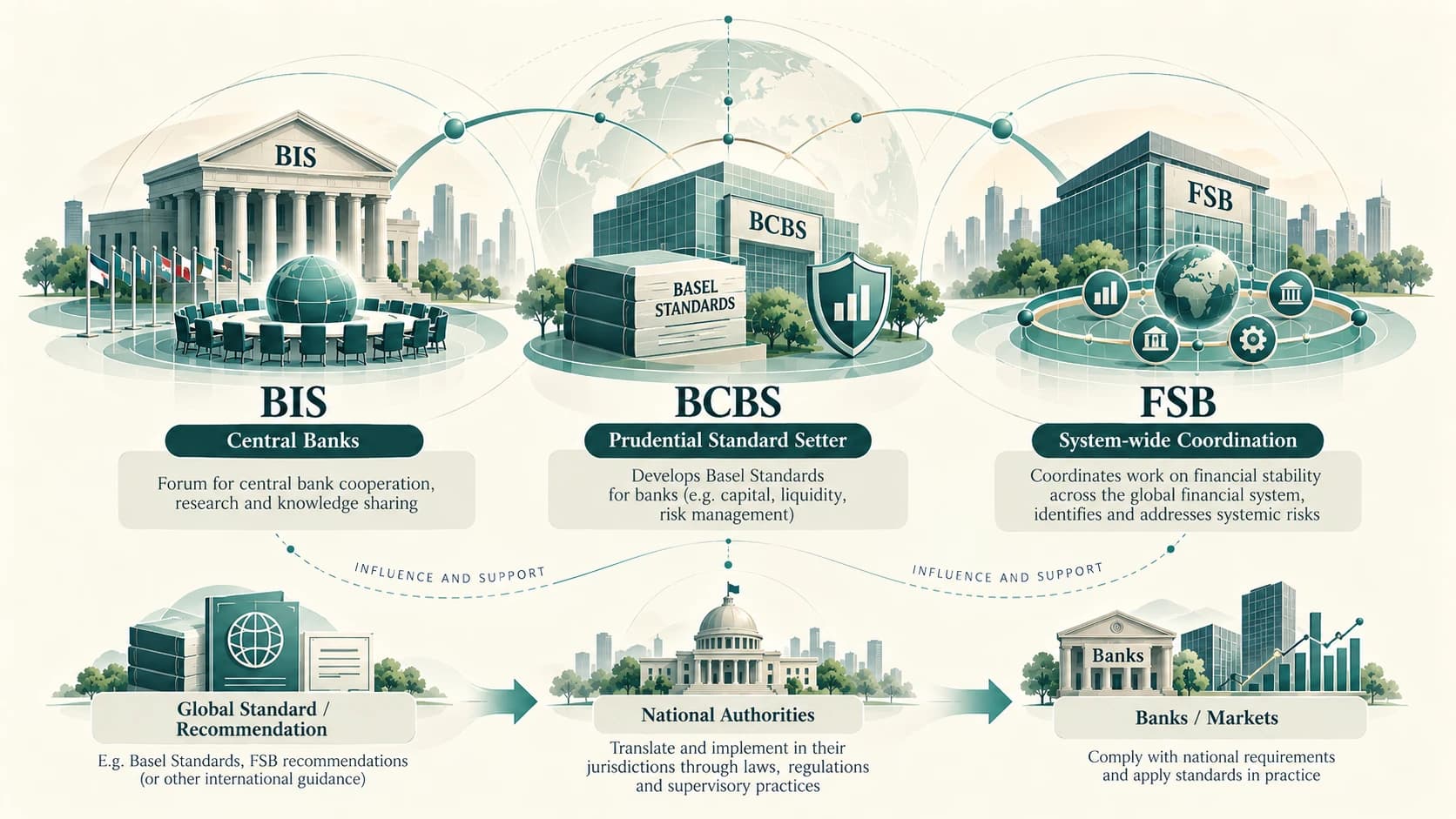
A sensible three-layer diagram is:
Global recommendations or standards (BCBS/FSB/FATF as applicable)
↓ review and national policy decisions
Domestic law, rules and directions (Indian authorities)
↓ implementation and supervision
Banks and financial institutions (operational controls).
This does not imply every institution has the same international legal status or that every standard requires a new act of Parliament. The general point is that implementation in India depends on India's legal and regulatory mechanisms.
30. International cooperation and the G20
The G20 is an international forum for major economies. It is distinct from the FSB, FATF, BIS and IMF. Some institutions cooperate closely with G20 processes, but an FSB standard is not a domestic banking law merely because it is discussed by G20 leaders.
Avoid treating all international economic institutions as “United Nations agencies.” Their legal origins and governance structures differ.
31. Practical case: cross-border payment concern
A bank notices a customer sending unusually structured payments through several jurisdictions. The bank should follow internal monitoring, customer due diligence and reporting obligations under applicable Indian law. FATF's standards influence the international expectations around these systems, but the bank's immediate procedural duties come from domestic requirements and its documented compliance framework.
The example shows a risk indicator, not proof of criminal conduct. Transaction-monitoring alerts require appropriate review and a lawful, fair process.
32. Practical case: international bank failure concern
A global bank develops losses on complex exposures. A supervisor assesses capital and liquidity requirements shaped in part by Basel standards. Other international bodies examine broader contagion and system-wide weaknesses. The affected country's authorities retain the powers needed for supervision, intervention and resolution under their laws.
This example explains why BCBS and FSB can both be relevant to the same crisis without having the same job.
33. Headquarters and origins — durable facts
| Body | Historical milestone | Headquarters / institutional location |
|---|---|---|
| BIS | Opened in 1930 | Basel, Switzerland |
| BCBS | Established in 1974 | Hosted at BIS, Basel |
| FSB | Formed in 2009 from the earlier Financial Stability Forum | Secretariat hosted by BIS in Basel |
| FATF | Created in 1989 | Secretariat in Paris, hosted at OECD |
Officeholder names, present membership counts and live monitored-jurisdiction lists require regular review.
34. Common confusions in this lesson
- BIS is a normal savings bank: false.
- BCBS is a separate country regulator with automatic legal power over Indian banks: false.
- FSB writes every bank's daily capital rules: false.
- FATF is a central bank: false.
- FATF's grey list and high-risk call-for-action list are identical: false.
- Basel III is the same as CRR/SLR: false.
- International recommendations automatically override Indian law: false.
- A FATF risk warning proves a particular customer is guilty: false.
Quick check — BA-17-04
- What is the common description of BIS?
- What is BCBS's role, and where is it hosted?
- Name the Basel II pillars.
- Why does FSB focus on the broader system?
- What financial abuses does FATF aim to combat?
- Why must countries implement global standards through their own frameworks?
Answers: (1) Bank for central banks. (2) Bank prudential standard setter, hosted at the BIS in Basel. (3) Minimum capital, supervisory review, market discipline. (4) Risks spread across institutions, markets and borders. (5) Money laundering, terrorist financing and proliferation financing. (6) International recommendations do not automatically become domestic law with identical legal effect.