
ADB, AIIB and New Development Bank
ADB, AIIB and New Development Bank. A detailed chapter in International Financial Institutions, with explanations and examples for Indian banking examinations.
By Akhilesh Saini · Reviewed 8 Oct 2026
1. Why several multilateral development banks exist
No single institution can finance every road, port, hospital, renewable-energy project and climate-resilience programme. Regions have different development priorities, shareholder structures and financing gaps. Alongside the World Bank Group, regional and multilateral development banks pool capital and expertise to support development across countries.
This chapter studies three especially common banking-exam names:
- ADB — Asian Development Bank;
- AIIB — Asian Infrastructure Investment Bank; and
- NDB — New Development Bank, originally established by the five founding BRICS countries.
They share a development orientation, but they are three separate legal institutions, with different charters, headquarters, governance and priorities.
2. What an MDB does
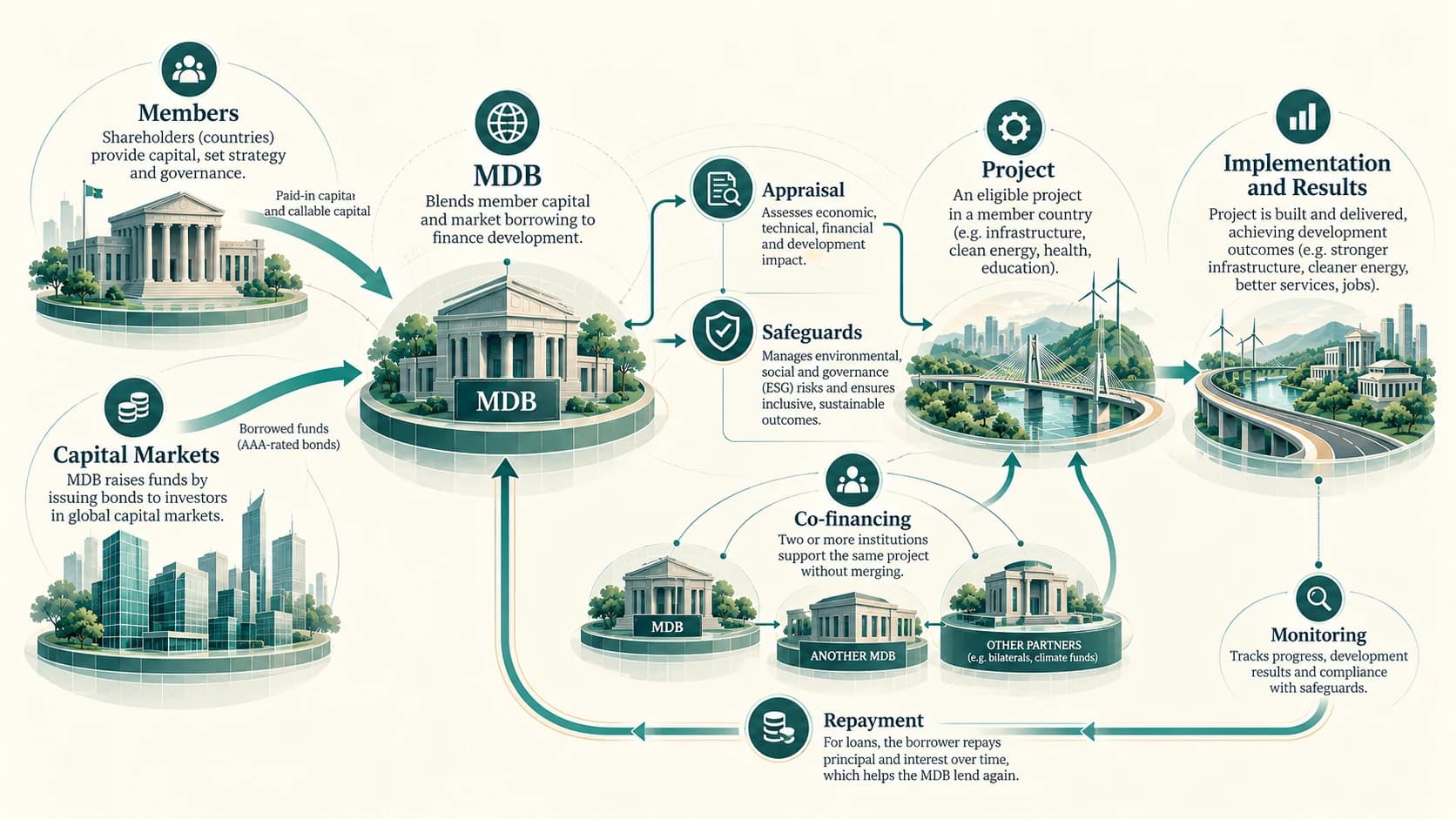
A multilateral development bank is owned by multiple member countries and provides development-oriented financing and associated expertise. An MDB may raise finance in international capital markets; member subscriptions, callable capital and other financial arrangements support its ability to operate. It may offer loans, guarantees, equity investments, grants in applicable programmes and technical assistance.
It is not merely a charity distributing free money. Like any prudent financial institution, an MDB must assess project quality, risk, funding and repayment capacity. Its development mandate can justify financing horizons or risk sharing unavailable from many ordinary commercial lenders.
3. Asian Development Bank (ADB): identity
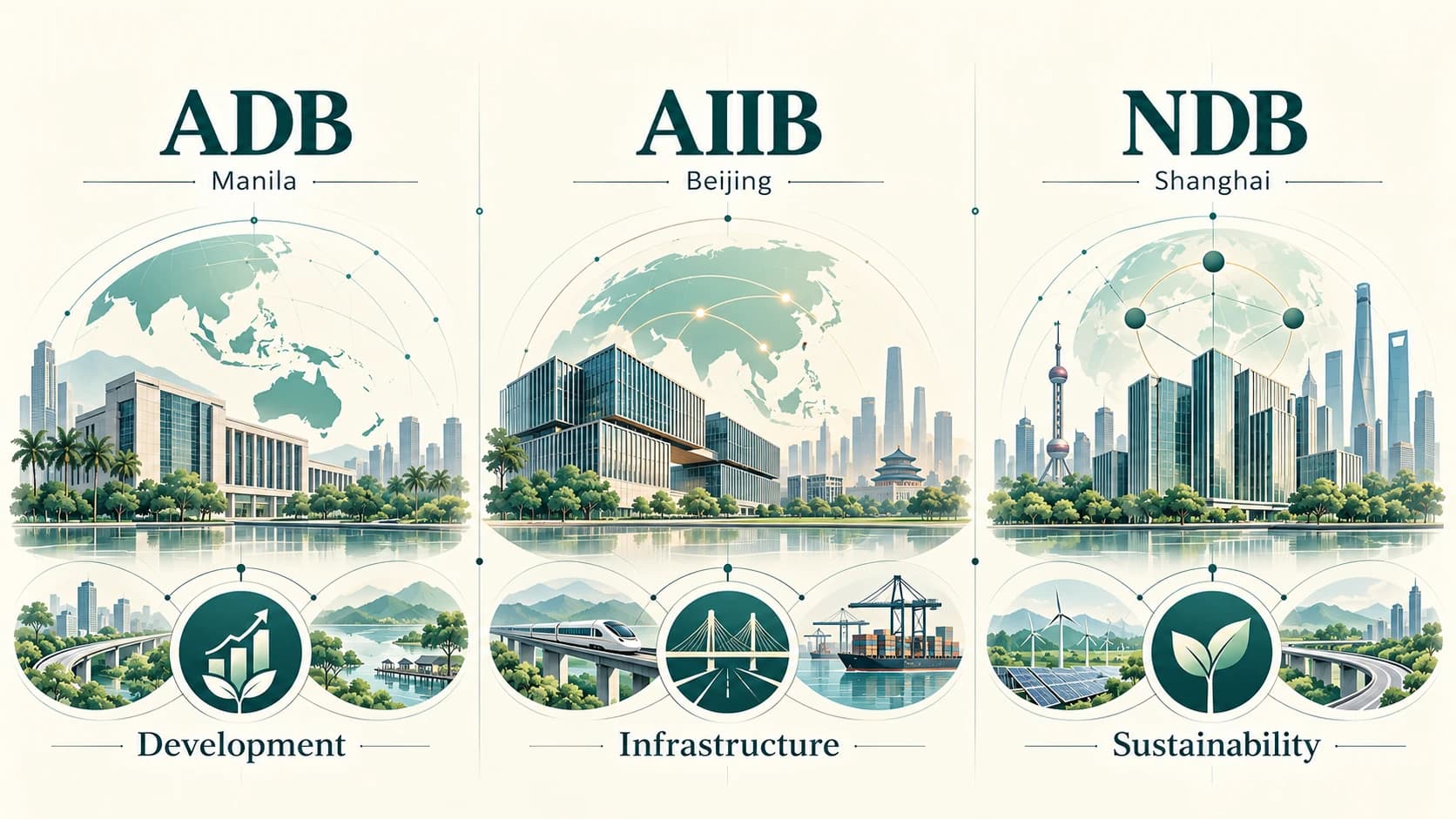
The Asian Development Bank began operations in 1966. Its headquarters is in Manila, Philippines. Its mission centres on a prosperous, inclusive, resilient and sustainable Asia and the Pacific, including efforts to reduce poverty and improve living standards.
The Asia-Pacific focus does not mean all of its shareholders must be located in Asia. ADB has both regional and non-regional members. It works with member governments, businesses and partners through programmes addressing infrastructure, energy, health, education, climate, trade and institutional capacity.
4. How ADB helps developing economies
Consider an island region facing frequent storms. Strengthening ports, drainage systems, power distribution and early-warning capacity may require substantial long-term finance. ADB can help develop and finance projects, structure technical support, and coordinate co-financing with governments and other development partners.
An ADB loan is not necessarily a grant. ADB financing products and terms differ by borrowing member and programme; concessional funding can be available under specific facilities.
5. ADB sovereign and private operations
ADB supports sovereign operations involving governments and public-sector priorities. It also carries out non-sovereign operations, which may support eligible private businesses, financial institutions or other organisations without a sovereign guarantee under applicable rules.
This flexibility is important. ADB is not simply a “government-only road bank.” Development objectives may be achieved through private-investment mobilisation, financial-sector lending, risk sharing and public policy reform as well as direct government projects.
6. ADB and India
India is a long-standing ADB member and works with it across sectors including transport, energy, urban services, skills, health and finance. A project announced in India is not automatically financed entirely by ADB: financing packages may include Government and State contributions and other lenders. Current loan figures and the latest named projects are living awareness topics.
For exams, remember the stable pair: ADB — 1966 — Manila — Asia/Pacific development.
7. AIIB: the full form
AIIB stands for Asian Infrastructure Investment Bank. It began operations in 2016, with headquarters in Beijing, China. Its institutional mission is often described as “Financing Infrastructure for Tomorrow.”
AIIB focuses on infrastructure in Asia and beyond, especially sustainable, connected and technology-enabled infrastructure and mobilisation of private capital. The word Asian signals a regional mission but not exclusively Asian shareholders: it has regional and non-regional member economies.
8. Why AIIB is not ADB
The two are distinct multilateral banks:
- ADB: older institution with a broad Asia-Pacific development mandate and headquarters in Manila.
- AIIB: began operations in 2016, headquartered in Beijing, with a pronounced infrastructure-investment mission.
Both can finance infrastructure, and either may co-finance projects with partners. Similarity in project sectors does not imply they are branches of one organisation.
9. AIIB's infrastructure priorities
Infrastructure may include:
- transport connectivity and logistics;
- energy and clean power;
- water and urban systems;
- digital connectivity;
- climate-resilient public infrastructure; and
- cross-border regional connectivity.
An AIIB project can seek financial and economic returns while meeting applicable environmental and social requirements. Building infrastructure “for tomorrow” means considering long asset life, climate risk, technological change and links between economies.
10. AIIB lending example
Suppose two countries seek a lower-emission logistics corridor linking production centres to a port. Such an investment has regional spillovers: lower transport costs can help multiple economies. An eligible AIIB-financed project might combine capital for the physical link with safeguards and implementation support. The Bank does not become the national road regulator merely because it participates in funding.
11. AIIB governance and memberships
AIIB is governed by its shareholders under its Articles of Agreement, through a Board of Governors, Board of Directors and management structure. The governance model includes regional and non-regional members. Publicly reported “approved members” should not always be equated without qualification to members that have completed accession formalities.
Current-membership count, president, major shareholdings and project totals are living data. The permanent exam facts are name, mandate, headquarters, institutional opening and nature as a multilateral development bank.
12. New Development Bank (NDB): introduction
The New Development Bank was established in 2015 by the original five BRICS countries:
- Brazil;
- Russia;
- India;
- China; and
- South Africa.
Its headquarters is in Shanghai, China. NDB's core objective is mobilising resources for infrastructure and sustainable development projects in BRICS and other emerging-market and developing countries (EMDCs).
13. BRICS and NDB membership are not identical
BRICS is a grouping of economies whose composition may change over time. NDB is a separate treaty-based multilateral bank with its own accession, capital and governance rules. A country becoming part of the broader BRICS grouping does not automatically establish its formal membership in NDB.
This nuance matters in current-affairs questions: an institution's “prospective member” or “member approved for admission” may not yet have completed all accession requirements. The official NDB membership register should be checked before updating the website's current count.
14. Why NDB was created
Emerging-market and developing economies need large amounts of long-term finance for infrastructure and sustainable-development goals. The original BRICS founders sought a multilateral financing vehicle that could support those priorities, complementing rather than necessarily replacing existing MDBs.
NDB can finance eligible projects and raise money in capital markets, with sovereign and non-sovereign instruments under its mandate. Its presence gives member economies an additional source of financing and institutional cooperation.
15. NDB financing example
Imagine a country seeking a climate-resilient urban water system. It might plan financing through its government, domestic lenders and an MDB. An NDB loan could support the investment under agreed terms. The project can create long-lived public assets, but the financing still has a contractual repayment structure if it is a loan.
Current loan volumes, project approvals and local-currency shares change and therefore belong in the BA-18/current-data system.
16. Local-currency financing
Some MDB operations can be financed in local currency, depending on the institution, market conditions and project structure. Such lending may reduce certain currency mismatches for borrowers with local-currency revenues, although funding and financial risks still have to be managed.
For example, if a municipal service collects revenues in rupees but owes debt in dollars, a rupee depreciation could increase its debt-service burden in rupee terms. Borrowing in rupees, where suitable, may reduce that direct exchange-rate mismatch. It does not make the underlying project risk-free.
17. Comparing the three institutions
| Topic | ADB | AIIB | NDB |
|---|---|---|---|
| Full form | Asian Development Bank | Asian Infrastructure Investment Bank | New Development Bank |
| Started | 1966 | 2016 | 2015 |
| Headquarters | Manila, Philippines | Beijing, China | Shanghai, China |
| Main orientation | Broad Asia-Pacific inclusive and sustainable development | Sustainable infrastructure, connectivity and future-oriented infrastructure | Infrastructure and sustainable development in BRICS and other EMDCs |
| Ownership | Multilateral regional and non-regional shareholders | Multilateral regional and non-regional shareholders | Founding BRICS shareholders plus admitted additional members |
| Typical products | Development loans, grants/concessional support where applicable, investment and advice | Infrastructure loans, investments and related support | Infrastructure/sustainable-development loans and other financing |
| Common confusion | Not the same as AIIB | Not a subsidiary of ADB | Not identical to the BRICS grouping itself |
18. ADB vs AIIB vs NDB: how to reason from a question
Look for the most distinctive clue:
- “Manila” → ADB.
- “Infrastructure for Tomorrow” and “Beijing” → AIIB.
- “Founded by the five original BRICS members” and “Shanghai” → NDB.
A project on renewable energy by itself may not distinguish the three because all can support sustainable infrastructure. Headquarters, origin, mandate and formal name are safer clues than one common sector.
19. Which bank is older?
In this set the order by start of operations is:
ADB (1966) → NDB (2015) → AIIB (2016).
These are historical milestones. They do not prove which bank is larger by present loan portfolio, capital or membership; those figures change and use different measurement rules.
20. Multilateral bank capital structure
MDBs are not funded solely by grants. Many rely on combinations of member capital subscriptions, retained earnings, market borrowing, reflows from loans and special funds. A useful distinction is between:
- paid-in capital, which is contributed under the relevant arrangement; and
- callable capital, which may be called under specified conditions rather than being cash already lying in the bank's operational account.
An MDB with large authorised capital does not necessarily have the same amount in immediately available cash. In current affairs, always check whether a number is authorised, subscribed, paid-in or callable capital.
21. Co-financing
One large infrastructure programme may include a national budget contribution, one or more MDB loans and private investors. Co-financing means several organisations help fund one programme or linked investment, according to their agreements. It is not necessarily the same as joint ownership or a merger of the financing institutions.
The World Bank, ADB, AIIB and NDB may coordinate in some contexts, while remaining distinct entities.
22. Climate finance and environmental safeguards
MDBs increasingly consider climate mitigation, adaptation and resilience when evaluating projects. Sustainable-development finance must also weigh social displacement, procurement integrity, ecosystem damage and project affordability. A green label or climate target is not a substitute for rigorous appraisal or actual performance monitoring.
For exams the concept is development finance plus risk appraisal and safeguards, not a promise that every “green” project makes money or that climate-risk screening eliminates all uncertainty.
23. Regional versus global institutions
The IMF and World Bank Group have broadly global memberships and mandates. ADB focuses on Asia and the Pacific, AIIB prioritises infrastructure in Asia and beyond, while NDB's founding identity and project mission are linked to BRICS and other emerging/developing economies. Regional emphasis does not always mean a bank has no non-regional members or can never finance activity beyond its principal region.
24. Common confusions in this lesson
- ADB = AIIB: incorrect; separate banks.
- AIIB headquarters is Manila: incorrect; Beijing.
- NDB headquarters is New Delhi: incorrect; Shanghai.
- NDB members equal all BRICS participants automatically: incorrect.
- All MDB support is a grant: incorrect; many operations are loans.
- Callable capital is already paid in cash: incorrect.
- Climate infrastructure automatically has no credit risk: incorrect.
- ADB never works with the private sector: incorrect.
Quick check — BA-17-03
- What does ADB stand for, and where is it headquartered?
- In what year did AIIB begin operations?
- Name the original five NDB founders.
- Where is NDB headquartered?
- Why are BRICS and NDB membership not necessarily identical?
- What is the difference between paid-in and callable capital?
Answers: (1) Asian Development Bank; Manila. (2) 2016. (3) Brazil, Russia, India, China and South Africa. (4) Shanghai. (5) NDB has its own formal membership/accession rules. (6) Paid-in capital is contributed; callable capital is a commitment subject to defined calls rather than money already deposited.