
World Bank Group
World Bank Group. A detailed chapter in International Financial Institutions, with explanations and examples for Indian banking examinations.
By Akhilesh Saini · Reviewed 8 Oct 2026
1. Why a development bank is different
A village needs a safe water supply, a state needs a better transmission network, and a growing business needs financing for a low-carbon factory. The benefits of such investments may appear over many years. Commercial lenders may not provide sufficiently long repayment periods or may find the risks difficult to evaluate. Multilateral development banks (MDBs) combine shareholder support, technical expertise and financing instruments to address development needs.
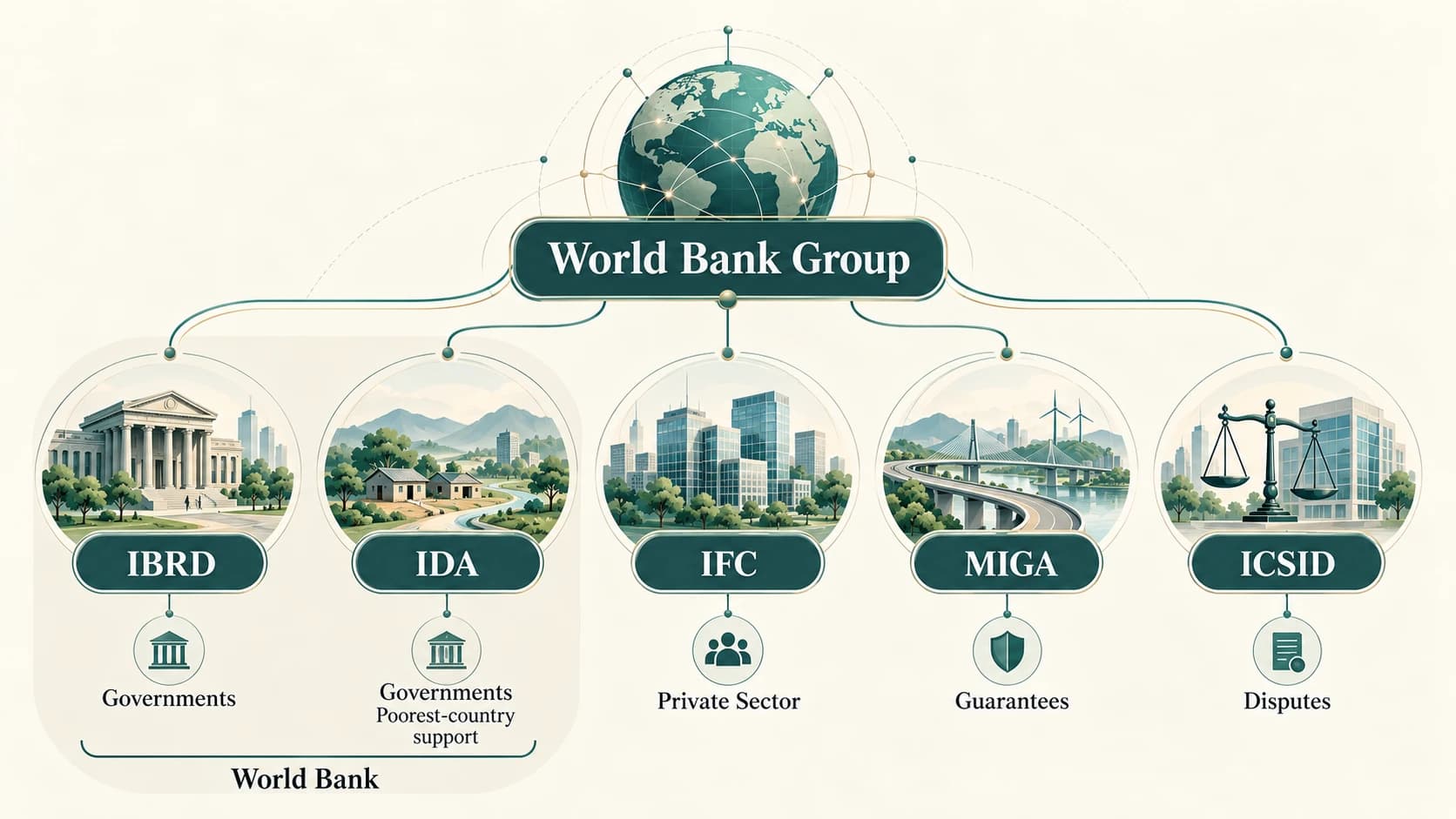
The World Bank Group is a family of five institutions working on development, poverty reduction, private investment, risk mitigation and investment disputes. It is neither a country's central bank nor the same as the IMF.
2. Bretton Woods and the original World Bank
The institution now called the International Bank for Reconstruction and Development (IBRD) was designed in the Bretton Woods period in 1944. Its early purpose included reconstruction after World War II; development financing subsequently became central. The World Bank Group is headquartered in Washington, D.C.
The term World Bank commonly refers specifically to IBRD and IDA together, whereas World Bank Group includes five distinct organisations. This difference is one of the most frequently tested conceptual facts.
3. The five World Bank Group institutions
| Institution | Full form | Primary role | Typical counterpart |
|---|---|---|---|
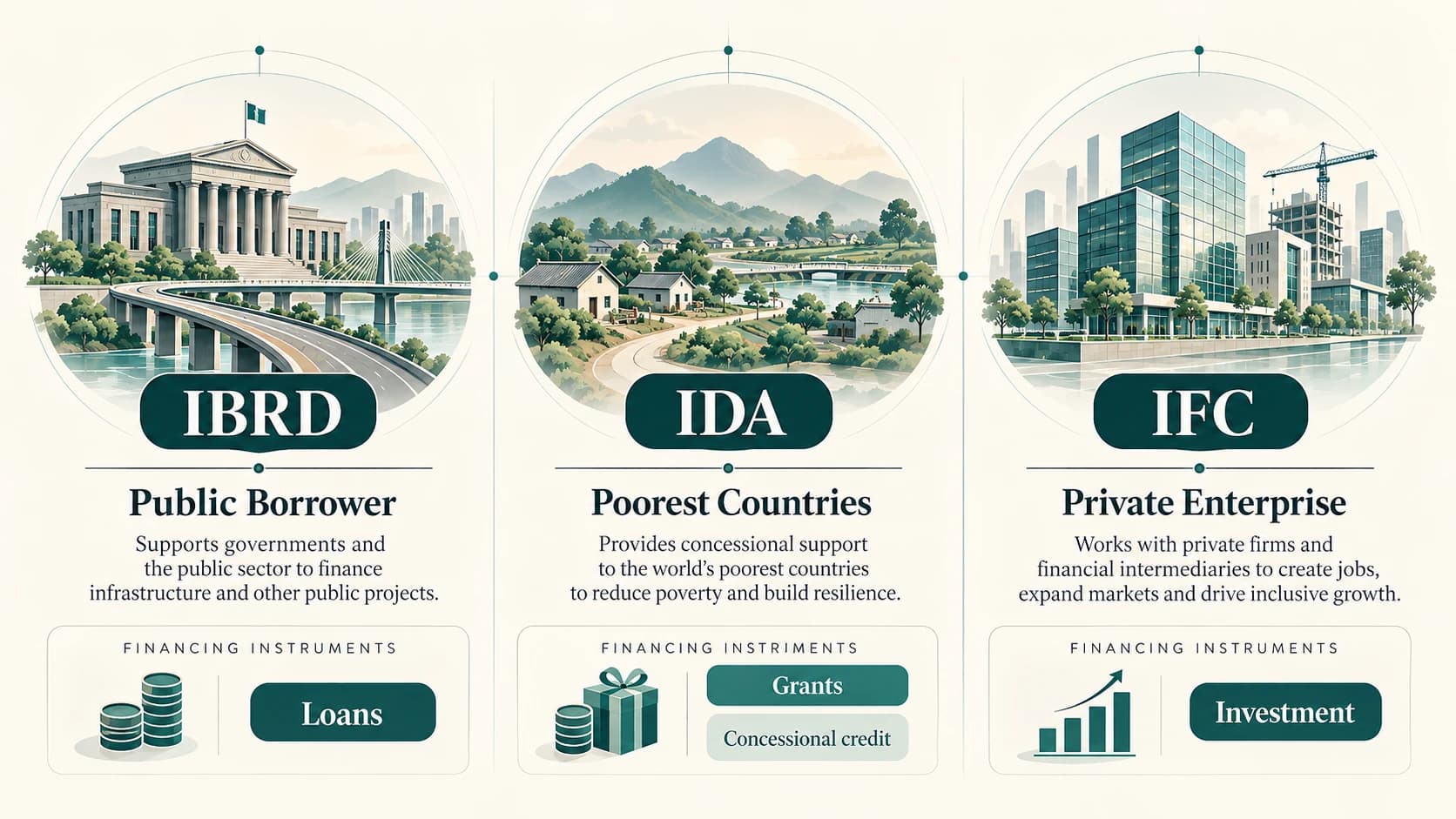
| IBRD | International Bank for Reconstruction and Development | Loans, guarantees, risk management and advice to middle-income and creditworthy lower-income countries | Governments/public-sector programmes |
| IDA | International Development Association | Grants and concessional finance for the poorest eligible countries | Low-income-country governments |
| IFC | International Finance Corporation | Private-sector investment, mobilising capital and advisory work | Private businesses and financial institutions |
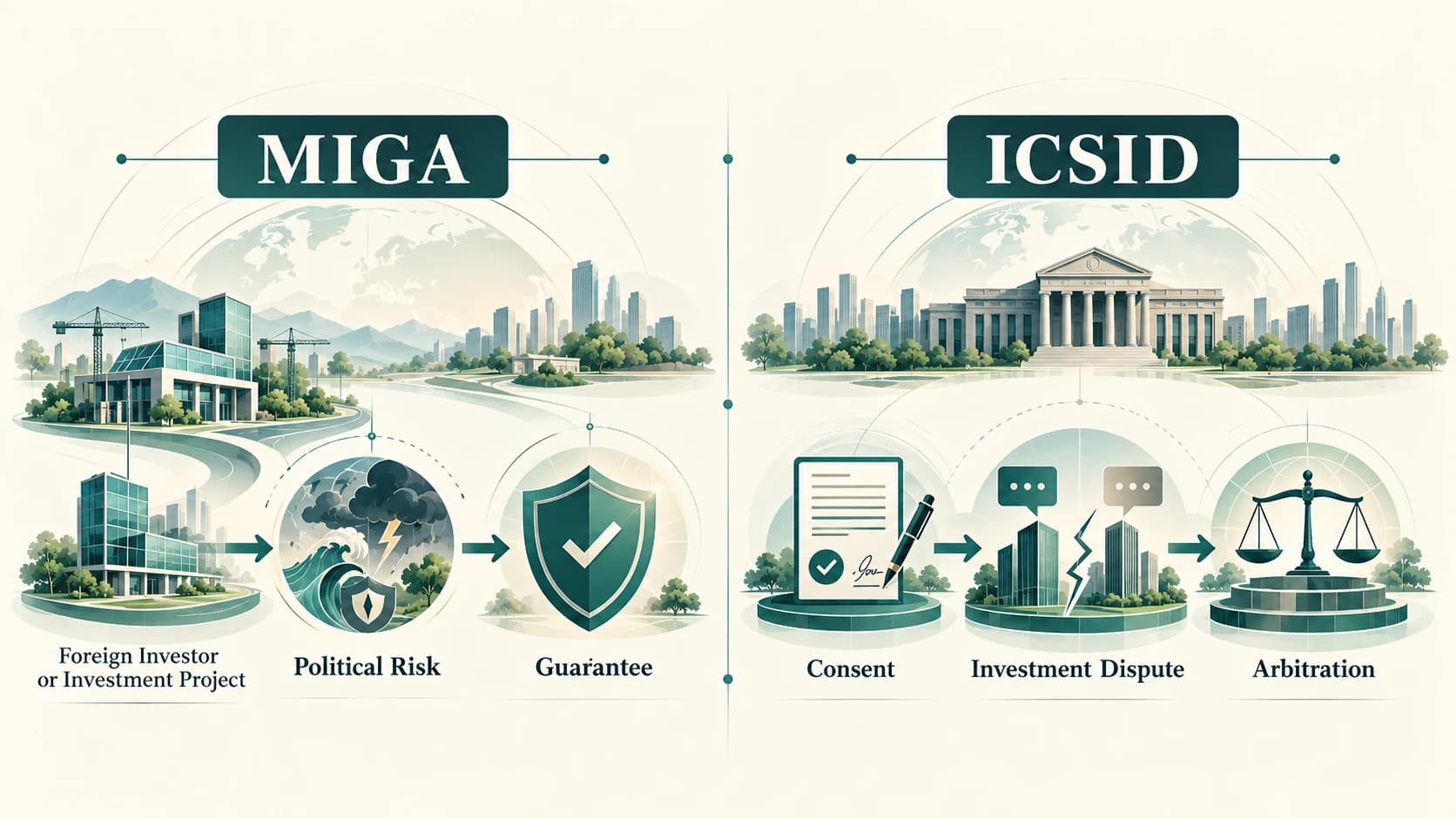
| MIGA | Multilateral Investment Guarantee Agency | Political-risk insurance and credit-enhancement guarantees | Investors/lenders in cross-border projects |
| ICSID | International Centre for Settlement of Investment Disputes | Facilities for investment-dispute conciliation and arbitration | Parties to eligible investment disputes |
A memory aid is Governments–Poorest–Private Firms–Guarantees–Disputes. Match those five purposes to IBRD, IDA, IFC, MIGA and ICSID respectively. This is more robust than memorising only their abbreviations.
4. What does IBRD finance?
IBRD offers financing and advisory support principally to middle-income countries and creditworthy poorer countries. It can support infrastructure, healthcare, public services, education, climate adaptation and other development priorities. Some projects are financed through governments or public agencies; private contractors may carry out work but the sovereign or public borrower remains responsible for the debt where applicable.
IBRD's capital-market borrowing capacity is important. It can borrow in international markets backed by the strength of its capital and shareholder structure, then lend to eligible member countries on terms designed for its development mandate. IBRD does not finance itself through retail savings accounts of ordinary households.
5. IBRD lending example
Imagine a state plans a flood-resistant road network. Project cost is illustratively 800 units. Domestic budget funding covers 250 units; an IBRD-supported programme helps cover part of the remaining financing, subject to appraisal, safeguards and an agreement with the sovereign borrower. The development benefit is safer transport and lower disaster disruption over many years.
The Bank is not necessarily purchasing the road or operating a highway toll. It is financing a development programme; implementation responsibilities and repayment obligations are set out in the relevant agreements.
6. What is IDA?
IDA focuses on countries with substantial poverty and limited ability to access affordable capital markets. It offers concessional credits and grants to eligible countries. Its financing helps deliver services and invest in development where ordinary commercial borrowing may be too costly or unavailable.
Not every IDA credit is interest-free under every window and every period. IDA financing terms vary by country status, financing window and policy. Remember the development role and concessional nature, and maintain changing rates/terms only in a current-data source.
7. IDA vs IBRD
| Feature | IBRD | IDA |
|---|---|---|
| Main clients | Middle-income and creditworthy lower-income countries | Poorest eligible countries, subject to current criteria |
| Typical funding | Bonds/capital markets plus capital and retained earnings | Donor contributions, internal transfers, repayments and other programme resources |
| Products | Loans, guarantees, risk-management products and advice | Highly concessional credits, grants and other instruments under rules |
| Repayment | Usually repayable IBRD loans | Grants are not ordinary repayable loans; credits are repayable on concessional terms |
| Primary idea | Development access to financing for creditworthy public borrowers | Extra-concessional support for the poorest |
Exam trap: The presence of the word “development” in both names does not make them the same institution.
8. IDA replenishment
IDA resources are periodically replenished through negotiations with donor and partner governments and other financing sources. A replenishment is not a retail deposit and not an IMF SDR allocation. Funding packages may include grants, loans, guarantees or other resources, depending on the replenishment architecture.
For current awareness, the latest replenishment number and donor commitments are living statistics. The evergreen concept is recurring collective support for concessional development finance.
9. How World Bank loans differ from IMF loans
A World Bank loan may support a specific multi-year development objective or public-policy programme. IMF financial assistance generally responds to a member's external financing and macroeconomic stability needs. Both may involve government policy reforms, review conditions and institutional accountability; the distinction is in primary mandate and financing context, not a crude statement that one institution never requires reforms.
10. What does IFC do?
The International Finance Corporation (IFC) is the World Bank Group's private-sector-oriented development institution. Its financing can include loans, equity and other investments, and it can mobilise private investment and provide advice. It may work with businesses and financial intermediaries whose activities produce development benefits.
Imagine a bank plans to expand responsibly underwritten loans to small enterprises. IFC may invest in or lend to an eligible financial institution, helping mobilise longer-term capital while encouraging suitable risk management and environmental/social standards.
11. IFC vs ordinary venture capital
IFC can invest in private enterprise, but it has a development mandate beyond the financial return sought by an ordinary private investor. The rationale can include expanding employment, increasing financial access, improving infrastructure or mobilising capital where private markets are constrained.
IFC is not a domestic stock exchange; it does not assign mutual-fund NAVs or regulate all Indian public companies. Such claims confuse investment finance with securities regulation.
12. What does MIGA do?
The Multilateral Investment Guarantee Agency (MIGA) helps encourage cross-border investment through political-risk insurance and other qualifying guarantees. Investors may worry about events such as expropriation, currency-transfer restrictions, political violence or certain contract breaches, depending on policy terms.
A MIGA guarantee can help make an investment feasible by sharing specific risks. It does not guarantee that a project's revenue will be profitable or that every normal business loss is covered.
13. MIGA example
Suppose an overseas investor is considering a clean-energy installation in a developing market. The business case is commercially reasonable, but an unpredictable political event could prevent payments being transferred or affect the investment. A relevant political-risk guarantee may reduce that risk under a defined contract and help investors or lenders proceed.
MIGA does not normally pay for every shortfall caused by poor demand, bad management or an ordinary fall in energy prices. Political-risk cover is contract-specific and distinct from a general-purpose bank deposit guarantee.
14. MIGA vs DICGC
Both names involve insurance or protection, but their purposes differ dramatically:
- MIGA: political-risk or other qualifying investment/credit guarantees associated with development investment.
- DICGC: statutory deposit-insurance protection for eligible deposits in covered Indian banks, subject to Indian law.
A question that asks for the insurer of Indian savings-bank deposits is not asking for MIGA.
15. What does ICSID do?
ICSID, the International Centre for Settlement of Investment Disputes, provides facilities and procedural frameworks for conciliation and arbitration of qualifying international investment disputes. It is part of the World Bank Group, but it is not a development loan window.
Example: a qualifying foreign investor and host state disagree about obligations under an investment framework. If the necessary jurisdictional basis and consent exist, an ICSID process may provide a forum for resolving the dispute. ICSID does not automatically hear every disagreement between two ordinary retail banking customers.
16. Arbitration vs lending
Lending moves finance from lender to borrower under credit terms. Arbitration is a dispute-resolution procedure. The fact that ICSID belongs to the World Bank Group does not turn an arbitral award into a World Bank loan. Similarly, the existence of ICSID does not mean that every country or investor has automatically agreed to all its proceedings.
17. Loans, guarantees, equity and grants
| Financial instrument | What the institution provides | What remains to be checked |
|---|---|---|
| Loan/credit | Money that the borrower generally repays | Interest/charges, maturity, eligibility, safeguards |
| Grant | Funds without ordinary loan repayment | Eligible uses, reporting and conditions |
| Guarantee | Defined risk sharing or repayment protection | Guarantee event, coverage, exclusions and claim procedure |
| Equity investment | Ownership stake and potential returns/losses | Governance and exit/valuation risk |
| Technical assistance | Knowledge, training or implementation advice | Scope, recipients and impact measurements |
This table applies across several MDBs; it does not imply that each World Bank Group member offers every instrument in every country.
18. Sovereign and non-sovereign financing
A sovereign loan is backed by the borrowing government under the programme terms. A non-sovereign operation can involve a private entity or public enterprise without that kind of sovereign guarantee, depending on institutional rules. Students should not equate “development bank” with “only government ministries may borrow.” IFC and various MDB non-sovereign programmes contradict that oversimplification.
19. Development project cycle
A conceptual MDB project process can involve:
- identifying a development problem;
- appraising technical, financial, economic and environmental/social feasibility;
- designing financing and risk arrangements;
- approval through the relevant governance system;
- implementation and procurement under applicable rules;
- monitoring results and repayment or programme performance; and
- evaluation and learning.
These are general stages, not one mandatory identical workflow for every institution. Some policies support a broad budget or sector-reform programme rather than financing a single construction project.
20. Why safeguards matter
Infrastructure can create jobs and connect markets but can also displace residents, affect forests or expose workers to hazards. Environmental and social requirements, consultation, procurement safeguards and accountability mechanisms attempt to prevent or manage these harms. Development outcomes should be measured beyond the amount of money approved.
21. World Bank reports and data
The World Bank Group also publishes research, data and development reports. Common study sources include the World Development Indicators database and flagship analysis such as the World Development Report. A dataset or report is not itself a lending institution; distinguish the authoring organisation from its publications.
A report's rankings or national poverty estimates can be revised when methods and source data change.
22. India and the World Bank Group
India has long engaged with IBRD and other World Bank Group institutions on development challenges such as roads, water, education, health, clean energy, agriculture and financial-sector inclusion. Participation varies by institution, financing structure and eligibility. Do not infer that one group's projects represent identical support from every one of its five members.
India's World Bank relationship also illustrates an exam-relevant principle: financing for a large developing economy can combine sovereign/public-sector programmes and separate private-sector engagements.
23. Headquarters and historical milestones
The World Bank Group is based in Washington, D.C. Historical establishment dates sometimes asked in general awareness include IBRD's Bretton Woods origin in 1944, IFC's establishment in 1956, IDA's in 1960, ICSID's in 1966 and MIGA's in 1988. These dates are historical facts, unlike current presidents, loan volumes or member counts.
When asked “World Bank established in 1944,” the question is normally pointing to IBRD/Bretton Woods origins. If asked about IDA or MIGA specifically, the answer differs.
24. Common confusions in this lesson
- World Bank = all five institutions: imprecise; formally World Bank usually means IBRD + IDA.
- IDA grants and loans are identical: incorrect.
- IFC mainly lends to sovereign finance ministries: incorrect; its central orientation is private-sector development.
- MIGA insures bank savings: incorrect.
- ICSID provides investment loans: incorrect.
- IBRD is the same as the IMF: incorrect.
- Every World Bank loan has identical repayment terms: incorrect.
- Every World Bank operation is a new physical infrastructure project: incorrect; policy, knowledge and financial operations also matter.
Quick check — BA-17-02
- Name the five World Bank Group institutions.
- Which two normally constitute the World Bank?
- Which institution principally serves the poorest eligible countries?
- Which institution promotes private-sector investment?
- Which specialises in political-risk guarantees?
- Which provides investment-dispute arbitration facilities?
Answers: (1) IBRD, IDA, IFC, MIGA and ICSID. (2) IBRD and IDA. (3) IDA. (4) IFC. (5) MIGA. (6) ICSID.