
International Monetary Fund
International Monetary Fund. A detailed chapter in International Financial Institutions, with explanations and examples for Indian banking examinations.
By Akhilesh Saini · Reviewed 8 Oct 2026
1. Why would the world need an IMF?
Imagine Country A imports fuel and machinery and must pay foreign suppliers in dollars. Its import payments increase suddenly while export receipts and foreign investment weaken. The country's foreign-currency reserves come under pressure; investors become nervous; its exchange rate may fall sharply. A domestic bank can offer credit to a firm, but the problem described here concerns the country's external financing and confidence.
The International Monetary Fund (IMF) exists to support cooperation and stability in this international monetary system. It does not replace a country's central bank or Ministry of Finance. It provides analysis, policy advice, technical support and, subject to its rules, financing to member countries experiencing external financial pressures.
Remember: IMF = international monetary stability, surveillance and balance-of-payments support—not an ordinary development-project bank.
2. Origin of the IMF
The IMF was conceived at the Bretton Woods Conference of 1944 in the United States, along with the institution that became the World Bank's IBRD. The IMF began operations after its Articles of Agreement entered into force; its headquarters is in Washington, D.C. The historical Bretton Woods monetary system involved fixed but adjustable exchange rates; the IMF has continued after that original system ended.
A multiple-choice question may pair an institution with the wrong founding year or city. Differentiate conception at Bretton Woods, legal establishment, and start of operations when a question is worded precisely. The purposes of IMF surveillance and lending remain relevant even under flexible exchange rates.
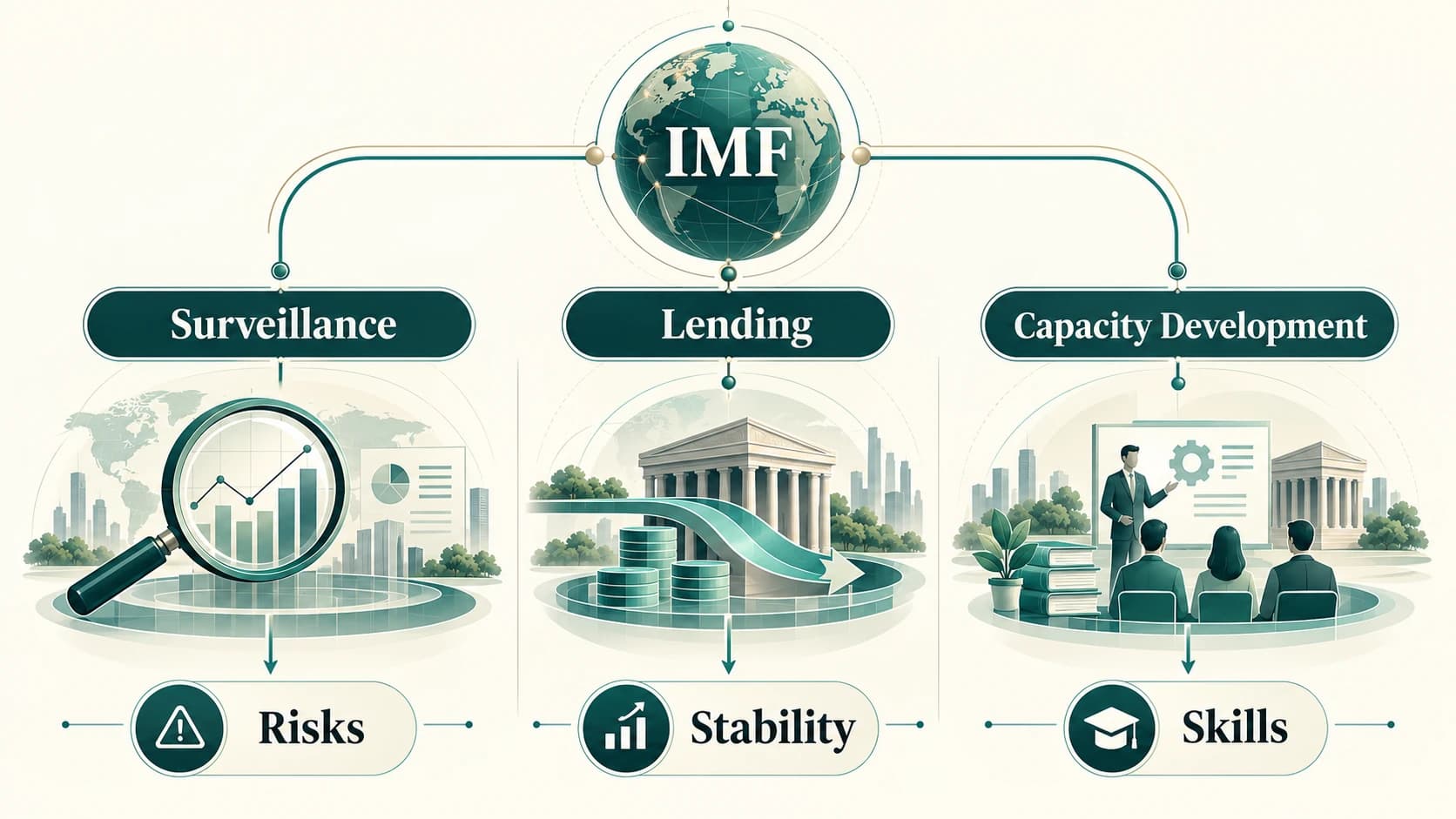
3. IMF's three main lines of work
| Work | What it means | Example |
|---|---|---|
| Surveillance | Examining countries' and the world's economic and financial policies and risks | Reviewing growth, inflation, government debt, banking stability and external balances |
| Lending | Providing temporary financial support to members under available facilities | Supporting a government facing a balance-of-payments financing need |
| Capacity development | Technical assistance and training to improve economic institutions | Helping a central bank strengthen statistics or a tax authority improve revenue systems |
These three functions reinforce one another. Surveillance identifies risks, financing can create breathing room during an external crisis, and capacity development helps institutions manage their policies more effectively.
4. Surveillance is not a banking inspection
An IMF team may examine a country's fiscal deficit, inflation, external debt, foreign exchange market and financial-sector vulnerabilities. That is macroeconomic surveillance. The IMF does not directly inspect every local branch's cash book as a domestic bank regulator would. Country regulation is carried out by domestic authorities under domestic law.
A helpful analogy: the IMF looks at the economic and financial health of the system while a bank supervisor checks whether individual institutions meet applicable prudential requirements. Their work can overlap when banks create systemic risks, but the legal powers are not interchangeable.
5. Article IV consultation
Regular IMF discussions with a member country about its economic and financial policies are commonly known as Article IV consultations, referring to the IMF Articles of Agreement. IMF staff evaluate trends and risks, meet national authorities and prepare an assessment considered by the Executive Board.
Typical questions include: Is inflation under control? Is public debt sustainable? Are foreign reserves adequate? Is the financial sector stable? Are policies likely to create imbalances? The output is analysis and advice, not an automatic instruction with the same legal status as an RBI circular.
6. Bilateral vs multilateral surveillance
Bilateral surveillance focuses on one member economy. Multilateral surveillance looks across economies: global growth, financial spillovers, capital flows, trade relationships and interconnected banking risks. A crisis in one major economy can affect exchange rates and capital flows in several others, so country-by-country analysis alone is insufficient.
International reports associated with IMF analysis include:
- World Economic Outlook (WEO): global and country growth, inflation and economic prospects.
- Global Financial Stability Report (GFSR): global financial-system risks and vulnerabilities.
- Fiscal Monitor: public finance, deficits, debt and fiscal policy.
- External Sector Report: broad global external positions and imbalances.
Do not memorise a current GDP forecast as an evergreen principle. Forecasts belong in current economic awareness and must be tagged with publication edition and forecast year.
7. Balance of payments: the IMF link
A country's balance of payments (BoP) records international economic transactions. Its current account includes exports/imports of goods and services and primary/secondary incomes; the financial account records investments, borrowing, lending and reserve transactions.
A BoP need can arise when required external payments cannot be financed on sustainable terms. For example, a sudden withdrawal of foreign capital can coincide with weak export receipts and a high external debt repayment burden. IMF financial support is designed to help a member address the external financing need while it restores a sustainable position.
A current-account deficit by itself is not proof that a country must borrow from the IMF. Countries with steady foreign investment and sound financing can run current-account deficits without a crisis. The complete funding position matters.
8. An example of external pressure
Suppose a country expects foreign-currency outflows of 60 units over a short period but reliably expects inflows and usable financing of only 45 units. Its illustrative external financing gap is 15 units. It could use reserves, reduce imbalances, obtain new financing or pursue some combination. If the problem is serious and the country is eligible, IMF financing may become one component of its strategy.
The arithmetic demonstrates a financing gap; it is not a universal formula for an IMF loan amount. In real programmes debt sustainability, repayment capacity, policy choices and facility-specific access conditions matter.
9. IMF loans and policy conditionality
IMF financing is often linked to a policy programme agreed with the borrowing member. Programme conditions can aim to restore financial stability and protect the IMF's resources. They may concern fiscal planning, monetary frameworks, exchange-market management, banking reforms or governance, depending on the country's needs.
Conditionality does not mean the IMF mechanically orders identical spending cuts for every borrower. Programme design differs across countries and facilities and may include social spending protections. Exam answers that claim “all IMF loans are unconditional” or “all IMF loans have exactly the same conditions” are both wrong.
10. Emergency financing and longer programmes
A country may need rapid assistance after a sudden shock; another may need financing over a longer adjustment period. IMF facilities have different purposes, eligibility criteria, pricing and repayment arrangements. For example, the General Resources Account (GRA) supports members through non-concessional facilities, while eligible low-income countries may receive concessional support through the Poverty Reduction and Growth Trust (PRGT).
You do not need to memorise every current facility's access ceiling at this stage. Instead ask: What problem does this facility address? Who can qualify? Is its support concessional? What are the policy and repayment expectations?
11. Meaning of concessional finance
Concessional means financing on more favourable terms than would otherwise be available, such as lower interest, longer maturity or grace periods. It does not automatically mean a grant. A concessional IMF credit may still create a repayment obligation.
A grant is generally not repayable under ordinary terms; a loan/credit is repayable under agreed terms. Financial-awareness questions frequently exploit this distinction.
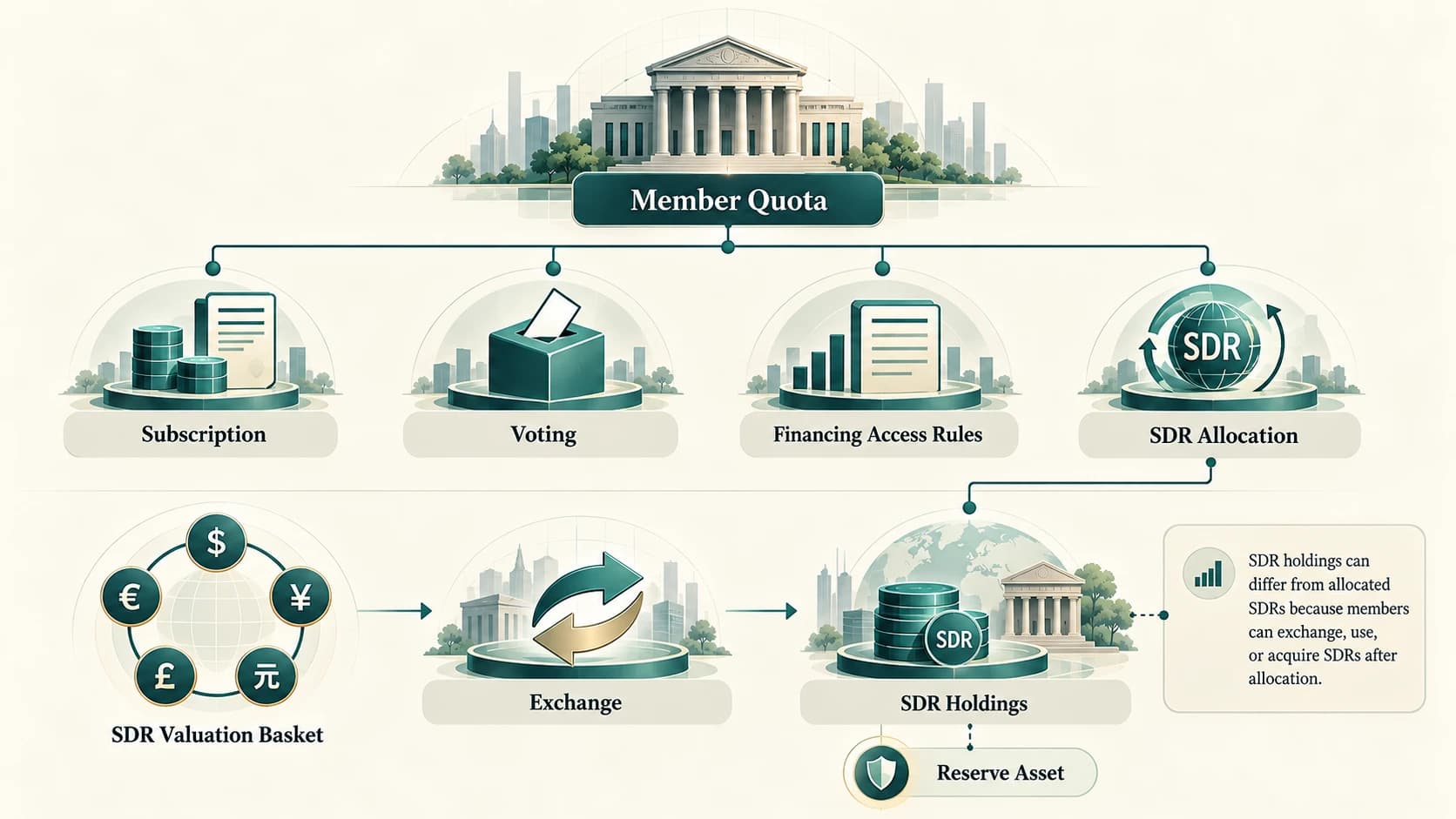
12. IMF quotas: a foundational concept
Each IMF member is assigned a quota, related broadly to its position in the world economy. The quota is a central component of IMF finances and governance.
It influences, within the Fund's rules:
- the member's financial subscription/resources provided;
- its relative voting power, together with basic votes;
- access to IMF financing under relevant rules; and
- its share in general SDR allocations.
These relationships are not all simple one-to-one equations. For example, IMF voting power includes basic votes, and access to financing is governed by separate rules and exceptional-access policies.
13. Subscription versus loan
A member's quota subscription is part of the IMF resource structure. It is not the same thing as the IMF granting that country a crisis loan. Think of the subscription as the country's participation in the institution; a loan is financial assistance obtained under the institution's lending arrangements.
The Fund also has borrowing arrangements and dedicated trust resources. For banking exams the useful classification is quotas and supplementary borrowing resources, not a claim that all IMF funds come from one country's taxes or from ordinary retail deposits.
14. Voting and governance
The IMF is owned and governed by its members. Its governance involves a Board of Governors, an Executive Board and management headed by the Managing Director. Voting is weighted under the Fund's governance structure, so it is not simply one country, one identical vote.
The Board of Governors is the highest governing body; day-to-day institutional business is overseen by the Executive Board.
15. What is an SDR?
Special Drawing Right (SDR) is an international reserve asset created by the IMF in 1969 to supplement members' official reserves. It also functions as the Fund's unit of account.
An SDR is not a currency printed for the public, not a rupee/dollar note and not a claim on the IMF itself. It is potentially a claim on freely usable currencies of IMF members: under the SDR system participants can exchange SDR holdings for usable currencies according to applicable arrangements.
16. Why the SDR basket exists
SDR value is derived from a basket of major international currencies, rather than being pegged to a fixed amount of one currency. The basket currently includes:
- US dollar (USD);
- euro (EUR);
- Chinese renminbi (CNY/RMB);
- Japanese yen (JPY); and
- pound sterling (GBP).
The basket is reviewed periodically. Do not turn its current weights, exchange value or review timetable into unchanging textbook facts. For the stable lesson, it is more important to know that a valuation basket is not itself five separate SDR currencies.
17. Allocation versus holding
A country's SDR allocation is the amount assigned under IMF allocation decisions; its SDR holdings are what it currently holds after exchanges and transactions. They may differ. A country can exchange some of its SDRs for freely usable currency; it has not thereby erased the original allocation.
This explains why an IMF table may show separate columns for SDR allocation and SDR holdings. Students should not mistake the two columns for duplicate totals.
18. Why SDRs matter to the RBI and India's external sector
SDRs form a recognised reserve asset category and therefore connect to national reserve management, external liquidity and the IMF relationship. India's foreign-exchange reserves are not composed solely of US dollars; the overall reserve-assets discussion also includes foreign-currency assets, gold, SDR holdings and the reserve position in the IMF.
Two distinctions matter: SDRs are reserve assets; an IMF reserve position is a separate reserve-related claim on the Fund under the applicable definitions. Neither is the same thing as ordinary rupee bank deposits.
19. IMF reserve tranche position
A member may have a reserve tranche position in the IMF, arising from its quota and IMF resource transactions under the Fund's accounting framework. This is an internationally recognised reserve asset. A reserve tranche drawing is not identical to a normal conditional IMF credit arrangement. For banking exams, identify it as a component of external liquidity rather than as a domestic commercial-bank asset.
20. IMF vs RBI
| Dimension | IMF | RBI |
|---|---|---|
| Jurisdiction | International membership organisation | India's central bank |
| Core role | Global monetary cooperation, surveillance and external financial support | Domestic monetary policy, currency issuance, bank regulation and payments oversight |
| Lending | To member countries under available IMF arrangements | Liquidity and banking-system facilities under Indian law |
| SDR role | Creates/allocates SDRs according to IMF rules | Holds/manages national reserve assets, which can include SDR holdings |
| Powers over an Indian commercial bank | Not its ordinary direct prudential regulator | Domestic regulator/supervisor under applicable law |
21. IMF vs World Bank: preview
The IMF typically addresses macroeconomic/external stability, while the World Bank Group largely supports development, long-term investment and poverty reduction. Both emerged from Bretton Woods and may cooperate on a country's challenges, but they are not duplicate lending offices.
Example: a country needing immediate support for its external payments might seek IMF financing; the same country may work with a development bank on a multi-year drinking-water or transport programme.
22. Why IMF estimates change
The IMF updates forecasts and reports because economic data are revised and new shocks occur. A “GDP projection” is not a historical GDP fact. Distinguish a forecast's country, variable, forecast year, report edition and release date when preparing current-affairs questions.
23. India's connection with the IMF
India was among the founding members of the IMF and is both a participant in global monetary cooperation and a user of the Fund's analytical and technical publications. The RBI, finance authorities and statistical institutions interact with the broader international monetary architecture. There is no implication that IMF membership requires taking a loan every year.
24. Common misconceptions in this lesson
- IMF gives only grants: incorrect; lending is a major IMF function.
- SDR is a digital currency for retail payments: incorrect.
- Every current-account deficit requires an IMF bailout: incorrect.
- Quota means the same thing as GDP: incorrect; quota is a Fund governance/resource concept.
- Article IV consultation is an RBI audit: incorrect; it is IMF country surveillance.
- IMF fixes every country's exchange rate: incorrect; exchange-rate arrangements differ.
- SDR allocation = SDR holding: incorrect after transactions.
Quick check — BA-17-01
- Name the three core IMF functions.
- What is meant by an Article IV consultation?
- Why is a quota important?
- Is an SDR a currency?
- How do SDR allocation and holding differ?
- Is an IMF loan identical to a World Bank infrastructure loan?
Answers: (1) Surveillance, lending and capacity development. (2) Country economic-policy surveillance under the IMF framework. (3) It connects resources, governance, financing access and SDR allocations. (4) No; it is an international reserve asset and unit of account. (5) An allocation is assigned, while holdings reflect subsequent use and exchanges. (6) No; purposes and terms differ.