
Balance of Payments, Forex Reserves and the External Sector
Balance of Payments, Forex Reserves and the External Sector. A detailed chapter in Indian Economy, Fiscal Policy & External Sector, with explanations and examples for Indian banking examinations.
By Akhilesh Saini · Reviewed 8 Oct 2026
Importance: HIGH overall; VERY HIGH for current economy and RBI/general financial-awareness questions.
Prerequisites: BA-15-06, BA-16-01 and BA-16-02
Learning focus: International transactions, external financing, reserve assets and exchange-rate exposure.
1. What is the external sector?
An economy buys and sells goods and services across borders; its citizens and businesses earn investment income abroad; people send remittances home; foreign investors finance local firms; and banks settle cross-border payments. These transactions form the external sector.
The exchange rate is an important price, but it is only one part of the story. To understand whether the economy requires external financing, students must read the Balance of Payments (BoP).
2. Balance of Payments — BoP
The BoP is a structured record of economic transactions between residents and non-residents over a defined period. It is a flow statement—usually presented for a quarter or year—not the same thing as a stock of foreign-exchange reserves.
Residency is an economic and statistical concept; it does not always equal citizenship. Official compilation follows accounting and classification conventions, so simplifications in this lesson should not be substituted for the RBI's detailed BoP tables.
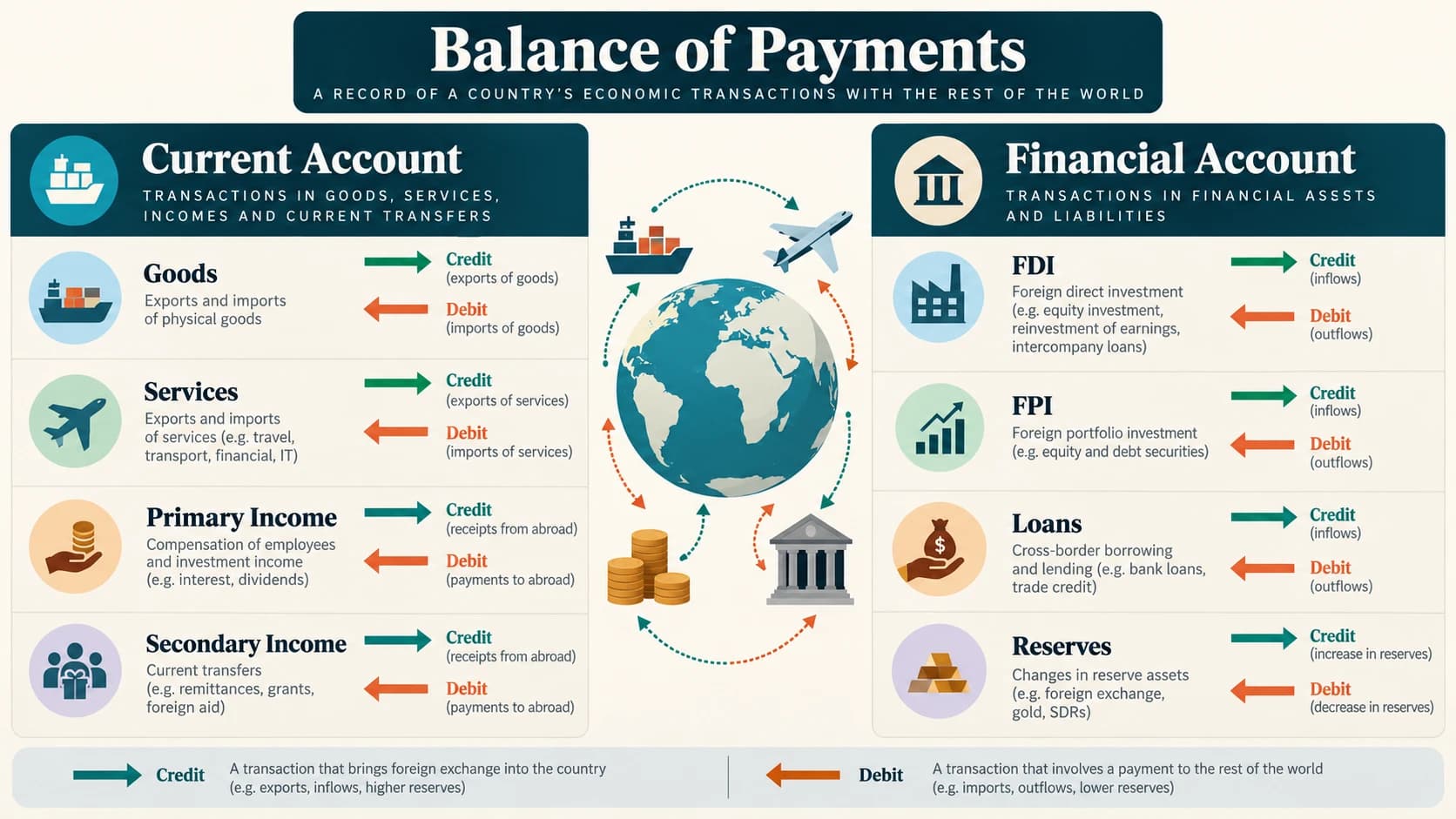
3. The current account
A useful modern breakdown contains:
- Goods: merchandise exports and imports;
- Services: IT, business, travel, transport and other services;
- Primary income: compensation of employees and investment income flows;
- Secondary income: current transfers such as many personal remittances.
Current Account Balance = Net goods + Net services + Net primary income + Net secondary income.
The current-account deficit (CAD) is negative net balance under this convention. A positive current-account balance is a surplus.
4. Merchandise trade deficit versus CAD
Merchandise trade balance is goods exports less goods imports. A country can have a merchandise deficit but a much smaller current-account deficit because of net service exports and remittances.
Illustrative current-account calculation
| Component | Credits less debits, arbitrary US$ billions |
|---|---|
| Goods | −120 |
| Services | +80 |
| Primary income | −20 |
| Secondary income | +45 |
| Current account | −15 |
Here the goods trade deficit is 120, while the current-account deficit is 15. The two are not interchangeable. All numbers are educational, not India's current figures.
5. Why India's services and remittances matter
Software, IT-enabled and professional services can produce export receipts even when no physical shipping container crosses the border. Indian residents working abroad may transfer funds to family members; under relevant BoP classifications these are recorded within secondary income or other appropriate items.
These inflows can help offset part of a merchandise trade deficit, although they do not make every trade deficit irrelevant.
6. Exports and imports: banking connections
An importer may obtain a letter of credit or a trade loan. An exporter may discount eligible export receivables or use export-credit arrangements. Banks perform documentation, permitted currency conversion, settlement and compliance checks.
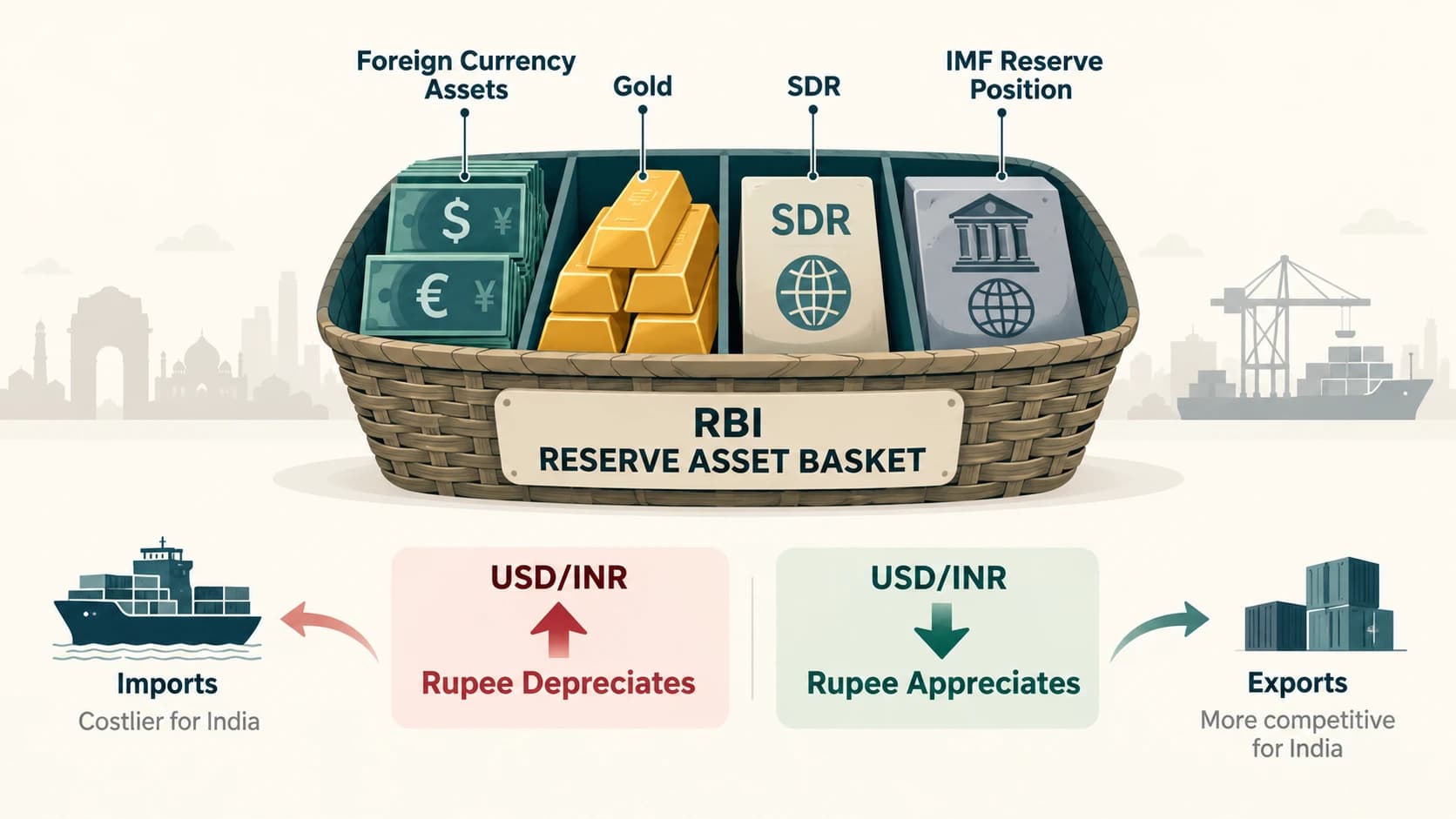
A depreciation of the rupee generally increases the rupee cost of a fixed US-dollar import invoice, all else equal. For an exporter with US-dollar receivables it can increase rupee proceeds, but imported inputs, hedges and other business factors can offset the effect.
7. Financial account and cross-border capital
The BoP also records cross-border acquisitions of assets and incurrence of liabilities, such as:
- FDI (foreign direct investment): direct investment reflecting a lasting relationship or influence as defined statistically;
- FPI (foreign portfolio investment): investment in securities without meeting direct-investment criteria;
- external borrowing and lending (including eligible corporate or bank borrowing);
- banking capital, deposits and other financial flows;
- reserve assets in the comprehensive financial-account presentation.
Official RBI tables can present 'capital account' and 'financial account' groupings according to the historical series and compilation format. For exam accuracy, follow the label used in the source rather than claiming every FDI item is always part of the narrowly defined BPM6 capital account.
8. BoP capital account: a subtle definition
Under the international BPM6 classification, the capital account is narrower than the broad everyday phrase 'capital flows'. It covers capital transfers and certain acquisitions/disposals of non-produced, non-financial assets. FDI and FPI are normally financial-account transactions in BPM6.
Older Indian summaries and coaching notes sometimes call FDI, FPI and external commercial borrowing 'capital account' entries in a broader historical presentation. Understand the difference in terminology before answering a question; check whether the exam or table is using the broad historical or strict international accounting classification.
9. Does the BoP always 'balance'?
BoP bookkeeping uses double-entry conventions. Transactions recorded as credits have offsetting entries somewhere in the accounts, and statistical errors and omissions may be required. Therefore, a current-account deficit is not the same as an impossible-to-balance accounting book. The deficit is financed through corresponding net financial transactions, changes in reserves and other balancing items.
A simplified identity is: a net current-account position must be matched by net capital/financial-account movements and statistical adjustments, under the source's sign convention. Do not memorise a plus/minus identity without checking definitions of net acquisition of assets, net incurrence of liabilities and reserve-asset signs.
10. CAD financing: illustrative case
Suppose the country runs a current-account deficit of US$20 billion in an educational scenario. Net incoming financing from foreign direct investment, portfolio flows and borrowing can help fund it. If financing differs from the current-account deficit, reserve transactions and other adjustments may arise. An FDI inflow is not a tax receipt, and an external loan is not free income.
11. FDI versus FPI
| Dimension | FDI | FPI |
|---|---|---|
| Nature | Direct investment relationship, typically durable influence | Holding securities as a portfolio investment |
| Typical instrument | Equity in an enterprise, qualifying reinvested earnings, intra-company debt where applicable | Listed equities and debt securities, subject to classification |
| Main distinction | Direct-investment relationship under official tests | No direct-investment relationship |
| Common misconception | 'FDI is always a greenfield factory'—not necessarily | 'FPI means foreign Government aid'—incorrect |
Neither FDI nor FPI guarantees economic benefit on identical terms. Their composition, stability, financing cost and uses matter.
12. External commercial borrowing and external debt
External commercial borrowings (ECBs) refer to a defined category of eligible commercial borrowing from non-resident lenders under RBI/FEMA rules. They may provide funding opportunities but expose borrowers to currency and refinancing risks. External debt is a stock of debt liabilities owed to non-residents; it is not the same as one year's net BoP flows.
A borrower earning rupees but owing dollars can face repayment stress if the rupee weakens, unless hedged or naturally offset by foreign-currency revenues.
13. Foreign-exchange reserves: what are they?
India's official reserve assets provide foreign-currency liquidity, help meet external obligations and support orderly functioning of currency markets. Published headline reserves comprise major components such as:
- Foreign Currency Assets (FCA);
- Gold;
- Special Drawing Rights (SDRs);
- Reserve Position in the IMF (RTP/related terminology).
The RBI releases the headline position in its Weekly Statistical Supplement. Reserve values can change due to transactions, valuation changes in currencies and gold prices, and other factors.
Important: Foreign-exchange reserves are assets on a balance sheet, not every dollar the Government may spend without cost. They are not identical to the trade surplus, current-account surplus, or currency notes held by citizens.
14. Foreign Currency Assets
FCA can include permitted reserve-asset holdings denominated in foreign currencies, such as securities and deposits, under the RBI's reserve-management framework. Their US-dollar reported value can change even when there is no net purchase or sale, because a non-dollar currency's exchange rate may change against the dollar.
This is valuation effect, not necessarily intervention. Therefore, a weekly reserve fall does not prove the RBI sold that exact amount of dollars to defend the rupee.
15. Gold, SDR and IMF reserve position
Gold is part of official reserves and has market-valuation risk. SDR is an international reserve asset created by the IMF; it is not a commercial bank deposit or an ordinary global currency printed as banknotes. Reserve position in the IMF reflects part of a member's readily available claim on the IMF under the relevant framework. Distinguish these official assets from commercial banks' private foreign-currency holdings.
16. Why maintain reserves?
Reserves can serve purposes including:
- supporting external-payment confidence;
- providing liquidity in times of market stress;
- accommodating disorderly exchange-market conditions, consistent with policy;
- improving resilience against sudden interruptions in capital flows;
- meeting eligible international obligations.
Reserves have carrying costs and valuation risks. 'More reserves are always better, without limit' is not a sound economic rule.
17. Reserve adequacy measures
Analysts consider reserves in relation to:
- import cover: how many months of imports reserves could notionally finance;
- short-term external debt: near-term foreign-currency payment exposure;
- broader external liabilities and capital-flow risks;
- IMF and other reserve-adequacy frameworks.
No single ratio guarantees protection from every crisis. Import cover depends on how imports are measured and which reserve figure is used.
18. Exchange rate, depreciation and appreciation
For a USD/INR quotation showing rupees per US dollar:
- If the quote rises from 80 to 84 INR/USD, the rupee depreciates against the dollar.
- If it falls from 84 to 80 INR/USD, the rupee appreciates.
These are hypothetical rates used only to illustrate quotation direction. A depreciation does not mean all exports rise instantly; contractual prices, imported inputs and world demand matter.
19. Nominal and real effective exchange rates
NEER (Nominal Effective Exchange Rate) is a trade-weighted or otherwise defined composite of bilateral nominal exchange rates. REER (Real Effective Exchange Rate) adjusts an effective exchange-rate measure for relative prices or costs, depending on methodology. They help describe competitiveness more broadly than one USD/INR quote.
Interpretation of an index increase depends on how the series is constructed and quoted. Read the RBI's index definition rather than assuming every index uses an identical appreciation direction.
20. Trade balance, CAD and exchange-rate pressure
All else equal, high imports increase demand for foreign currency; exports and remittances can bring foreign currency into the economy. But exchange rates also respond to interest-rate differentials, global risk appetite, capital flows, expectations and central-bank operations.
One quarter's CAD does not mechanically predict next day's USD/INR direction. Financial flows can dominate short-term currency moves.
21. Terms of trade
Terms of trade compare an index of export prices with an index of import prices. An improvement means export prices rise relative to import prices under the chosen measure, potentially increasing purchasing capacity for a given export volume. However, terms of trade alone do not tell you the absolute level of exports or the full current-account outcome.
Oil-dependent importers can face adverse terms-of-trade effects when global oil prices surge, depending on other traded goods.
22. Open economy and GDP
Recall the expenditure-side identity GDP = C + I + G + (X − M). The net-export term captures how international trade affects the accounting of domestic production. It is not the same thing as the BoP current account, which also includes income and transfers.
GDP can grow even with a trade deficit if consumption, investment and Government spending are large; conversely a trade surplus is not proof that everyone in the economy is prosperous.
23. How a bank manages external exposure
Banks assess:
- trade documentation and permitted foreign-exchange regulations;
- counterparty and country risk;
- currency mismatch and forward hedging;
- external-liability maturities and liquidity;
- correspondent-banking relationships and payment controls;
- AML/sanctions compliance where relevant.
A bank's SWIFT message is secure financial messaging and does not itself settle funds. International settlement involves the participating banks and accounts, a concept covered in BA-13.
24. Important exam distinctions
| Term A | Term B | Difference |
|---|---|---|
| Trade deficit | Current-account deficit | Goods only versus goods, services, primary and secondary income |
| BoP | Reserves | Transaction flows versus reserve-asset stock |
| Foreign direct investment | Foreign portfolio investment | Direct-investment relationship versus portfolio securities |
| ECB | FDI | Repayable external debt versus direct investment |
| Currency depreciation | Inflation | Exchange-rate movement versus change in domestic price level |
| SDR | US dollar | IMF-created reserve asset versus national currency |
| Reserves increase | BoP surplus | Valuation and other effects can also change reported reserves |
| Nominal exchange rate | REER | Bilateral currency price versus inflation-adjusted effective measure |
25. Worked numerical examples
A — Trade deficit: Goods exports 350; imports 500 → merchandise trade balance −150.
B — Current account: Goods −150; services +90; primary income −10; secondary income +55 → current account −15.
C — Import cover: Reserves 600, annual goods imports 800 (same US$ units) → import cover = (600/800)×12 = 9 months. Simplified; real published calculations may use different import conventions.
D — Currency cost: Importer owes US$10,000. At ₹80/$ cost ₹8,00,000; at ₹84/$ cost ₹8,40,000. The rupee depreciation raises the unhedged rupee cost by ₹40,000.
E — Export receipts: Exporter receives US$10,000; rupee conversion at ₹84/$ gives ₹8,40,000 versus ₹8,00,000 at ₹80/$, before hedge, fees and other factors.
Quick check — BA-16-05
- Is a goods trade deficit the same as CAD? No.
- Where do most portfolio-investment movements belong in a modern BoP framework? Financial account.
- Can reserves change through valuation alone? Yes.
- Name two reserve components besides FCA. Gold, SDRs or IMF reserve position.
- For USD/INR, does more INR per USD mean rupee appreciation? No, depreciation.
- Are migrant-worker remittances identical to domestic production? No.
Lesson recap: The current account records goods, services, income and transfers. The financial account records important cross-border asset and liability flows. The RBI manages published reserve assets; their value can change because of markets as well as transactions. This matters to trade finance, exchange rates and banking stability.