
Union Budget and Economic Survey for Bank Exams
Union Budget and Economic Survey for Bank Exams. A detailed chapter in Indian Economy, Fiscal Policy & External Sector, with explanations and examples for Indian banking examinations.
By Akhilesh Saini · Reviewed 8 Oct 2026
Importance: VERY HIGH
Prerequisite: BA-16-03
Learning focus: How to read a Budget, interpret estimates and understand its relevance to banking and finance.
1. What is the Union Budget?
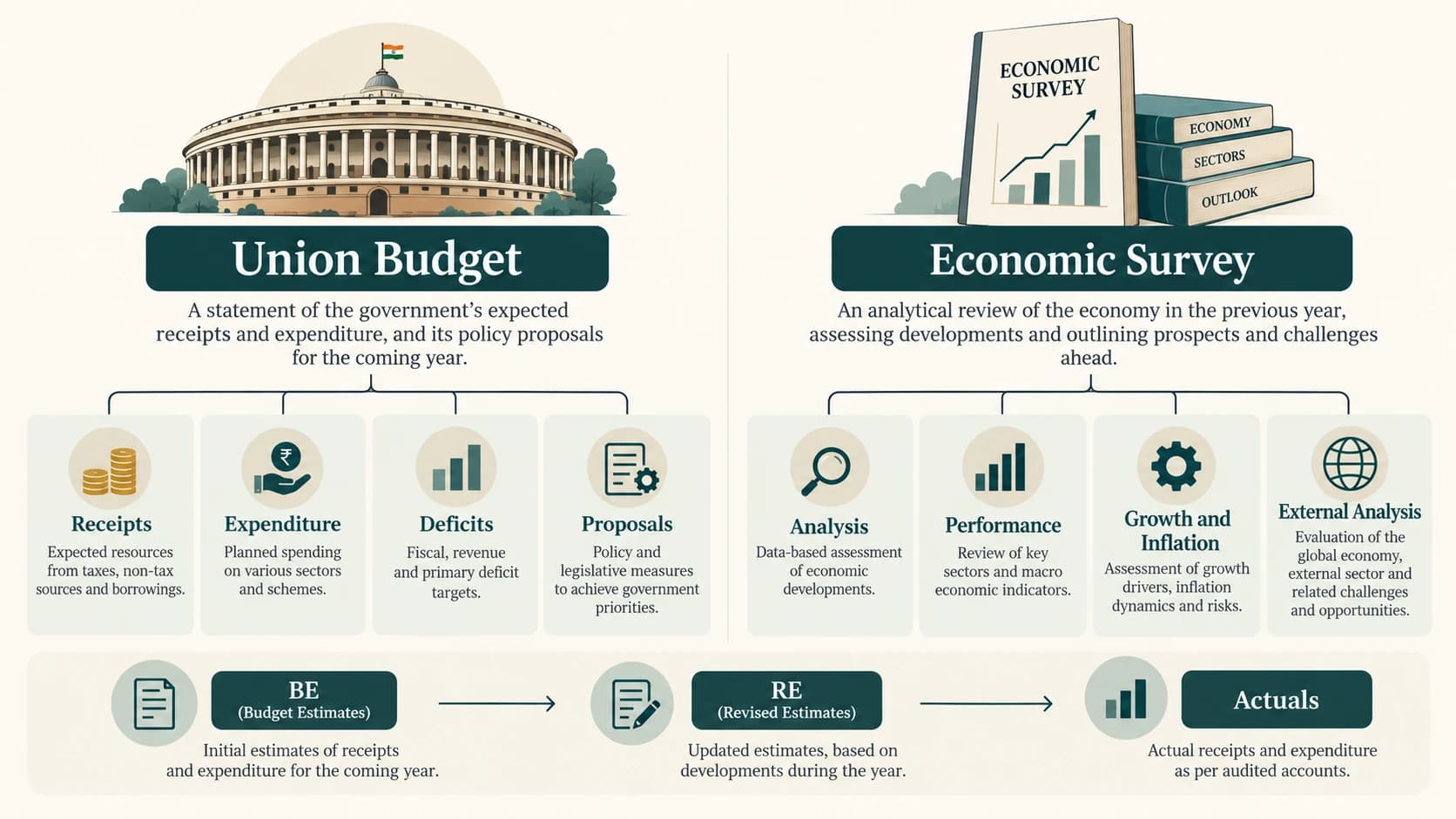
The Union Budget is the Government of India's annual financial plan and a set of associated constitutional, legislative and explanatory documents. It presents estimated receipts and expenditure, proposed fiscal measures and policy priorities for the relevant financial year. India's standard financial year runs from 1 April to 31 March.
A frequent exam misconception is that the Budget is merely a speech listing income-tax rates. The Budget speech is prominent, but the full Budget package includes financial statements, demands for grants, tax proposals and supporting material.
2. Annual Financial Statement — Article 112
Article 112 of the Constitution requires an Annual Financial Statement (AFS) showing the estimated receipts and expenditure of the Government of India for a financial year. It is a central constitutional budget document. Other parliamentary stages and documents relate to the voting of grants, appropriation and taxation.
The AFS distinguishes expenditure charged on the Consolidated Fund from expenditure voted by Parliament, alongside relevant revenue and capital accounts. 'Charged' does not mean hidden or unexamined expenditure; it means it is not submitted to vote in the same way as voted expenditure.
3. Three Government funds to recognise
Consolidated Fund of India
The Constitution provides for the Consolidated Fund, into which key Government revenues and borrowings are credited and from which authorised expenditure is made. Withdrawal is subject to constitutional and legal procedures.
Contingency Fund of India
An imprest for specified urgent/unforeseen expenditure pending the appropriate parliamentary authorisation and subsequent recoupment, subject to applicable rules.
Public Account of India
Certain receipts are held by Government in a capacity where it is accountable for them but they do not belong to the Consolidated Fund as ordinary Government revenues—for example, classes of provident-fund and deposit money under the applicable accounting framework.
Exam rule: Do not label every Government-held rupee 'tax revenue' or put all public-account receipts in the fiscal-deficit calculation without understanding their classification.
4. Budget Estimates, Revised Estimates and Actuals
A Budget uses several different types of numbers:
- BE (Budget Estimate): estimate made when proposing the forthcoming year's Budget.
- RE (Revised Estimate): updated estimate for an ongoing year based on emerging execution information.
- Actuals: recorded amounts from completed accounting periods, subject to the status of the published accounts.
Suppose an infrastructure Ministry's spending is shown as ₹120 crore (BE) but later ₹108 crore (RE). This does not prove that the project was cancelled; actual implementation may differ, and one must inspect the detailed explanations.
Why exam questions become confusing
A news headline may quote 'fiscal deficit 4.3% of GDP' but not tell you whether this is BE, RE, provisional actual or an announced target. Those are different statements. A good answer includes the year, type of estimate, numerator/denominator and official source.
5. The Budget process, simplified
- Ministries prepare resource and expenditure requirements.
- Ministry of Finance develops estimates and a fiscal framework.
- The Government presents the Budget documents in Parliament.
- Parliament considers demands for grants and related proposals.
- Appropriation and finance legislation are processed under constitutional procedures.
- Budget execution, reporting and audit follow.
Presentation of a tax proposal does not by itself prove every legal provision is already effective. The Finance Act and relevant commencement/notification rules matter.
6. Key Budget documents
| Document | Main question it answers |
|---|---|
| Annual Financial Statement | What receipts and expenditure are estimated constitutionally? |
| Budget Speech | What are the Government's priorities and key proposals? |
| Budget at a Glance | What are broad receipts, spending, transfers and deficit aggregates? |
| Receipt Budget | Where do receipts come from? |
| Expenditure Budget/Profile | Where and how is money planned to be spent? |
| Demands for Grants | What voted expenditure is sought? |
| Finance Bill | What tax/legal fiscal proposals are introduced? |
| FRBM fiscal-policy statements | What macro-fiscal assumptions and fiscal policy strategy are presented? |
| Output/Outcome framework | How are relevant spending programmes connected to intended outputs/outcomes? |
Exact labels and document formats can evolve; check the current Key to Budget Documents on the official Union Budget website.
7. Budget at a Glance
For banking examinations, Budget at a Glance is usually the most accessible document for getting the logic of:
- Revenue and capital receipts;
- Revenue and capital expenditure;
- Fiscal, revenue, effective revenue and primary deficit;
- Interest payments;
- Capital expenditure and effective capital expenditure;
- Transfers to States and financing sources.
The document provides both amounts and selected ratios to GDP. Learn the relationships before memorising a year's value.
8. Reading a receipts-expenditure chart
When a chart says '₹1 of receipts', first check whether the shares include borrowings and other financing sources. A simple classroom pie chart may combine non-debt receipts and borrowings for illustration, but borrowing is not revenue income. The same applies to a '₹1 of expenditure' chart: a large interest-payment segment is not the same as new productive capital formation.
A robust study method is to split revenue receipts, non-debt capital receipts and borrowing rather than relying entirely on memorised infographic percentages.
9. Direct and indirect taxes in Budget news
Banking exams commonly ask about broad tax categories and the implications of tax measures for household savings and businesses. Distinguish:
- income tax from corporate tax;
- taxes from fees and dividends;
- taxation proposals from enacted provisions;
- headline tax collections from net tax revenue after devolution or other adjustments.
Current slabs, exemption limits and cess rates are volatile. They belong in the separate living Budget reference page rather than in an evergreen lesson diagram.
10. Capital expenditure and infrastructure
Capital expenditure is often discussed because roads, railways, irrigation, energy and digital infrastructure can raise productive capacity and generate business activity. But the quality, timing and execution of spending matter; an allocation is not the same as a completed bridge or delivered public service.
Banks may finance associated contractors, suppliers and supply chains. A rise in allocations can create opportunities but does not make every contractor creditworthy.
11. Government borrowing and the bond market
Fiscal-deficit financing connects the Union Budget to Treasury bills and dated Government securities. The Government announces a borrowing programme; the RBI and market infrastructure facilitate issuance and settlement according to applicable rules. Bank treasury desks monitor expected supply and yields.
An announcement of more Government borrowing is not a direct command that market yields must rise. Demand for securities, RBI liquidity conditions, growth prospects and risk preferences all matter.
12. Subsidies, credit guarantees and bank-linked schemes
A subsidy is a budgeted fiscal support under a programme. A credit guarantee is a promise to cover specified lender losses if conditions are met. A loan remains repayable even when a subsidy or guarantee is involved. Bank candidates should learn the distinction between:
- direct benefit payment;
- interest subvention;
- capital subsidy;
- credit guarantee;
- Government equity or loan to an institution.
A Budget may revise programme allocations or announce new designs. Announcement alone does not establish the operational eligibility rules; final Government and regulator notifications determine implementation.
13. What is the Economic Survey?
The Economic Survey is an annual analytical review of the Indian economy prepared under the Department of Economic Affairs, Ministry of Finance. It surveys growth, inflation, investment, external conditions, public finance and sectoral developments, typically with a wider analytical perspective than the Budget.
The Survey is not itself the constitutional Annual Financial Statement and does not by itself enact tax laws. Its value to a learner lies in explaining why economic indicators moved and what broad policy questions matter.
14. Budget versus Economic Survey
| Question | Union Budget | Economic Survey |
|---|---|---|
| Nature | Financial plan, estimates and policy/tax proposals | Economic analysis and review |
| Legal status | Includes constitutionally mandated statements and related legislation | Analytical publication; recommendations do not automatically become law |
| Main focus | Receipts, expenditure, borrowing and fiscal measures | Performance, trends, risks and policy analysis |
| Banking relevance | Borrowing, capex, schemes, tax measures | Growth, inflation, financial sector, external developments |
It is a mistake to attribute an Economic Survey projection to a final Budget appropriation. A forecast is also not the same as an observed outcome.
15. How the Budget affects interest rates
The effects are indirect and complex. More borrowing can influence G-Sec supply and the yield curve; changes in demand and output affect inflation expectations; taxation changes may influence savings; and RBI policy responds to its own statutory objectives. Budget and monetary policy are connected but institutionally separate.
16. The banking awareness 'five-number' framework
For each new Union Budget, maintain an annual current-data sheet containing:
- Budget-year nominal GDP assumptions and growth context;
- Fiscal deficit (amount and % GDP);
- Total capital expenditure and effective capex;
- Government gross/net borrowing and interest payments;
- Major banking/financial-sector programmes or regulatory proposals.
Also keep revenue deficit, primary deficit, tax/devolution details and revisions as second-level fields. Never hard-code current numbers into the timeless explanations.
17. How to read the Economic Survey for exams
Use this sequence:
- Executive summary/overview: main messages and risks;
- Macroeconomic chapter: real growth, inflation and employment;
- Fiscal chapter: debt and public-finance conditions;
- Monetary/financial chapter: credit, bank health and markets;
- External chapter: exports, imports, foreign capital and reserves;
- Sector chapters: agriculture, industry, services and infrastructure.
Extract exact observations, not speculative coaching predictions. Cross-check a Survey claim against its tables and the referenced official statistical release where important.
18. Budget headlines: exam traps
- Allocation vs expenditure: An allocation is a plan, not proof funds were spent.
- BE vs RE: Year-on-year comparisons using unlike estimate types can be misleading.
- Fiscal vs revenue deficit: Distinct concepts.
- Tax proposal vs law: A proposal may require enacted legislation or notification.
- New scheme vs operational scheme: Eligibility begins under formal guidelines, not necessarily on speech day.
- Central vs State spending: A Union allocation is not every rupee of public spending in India.
- % GDP vs % growth: A fiscal deficit of 4% of GDP is not a GDP growth rate of 4%.
- Current-price vs constant-price GDP: Fiscal ratios typically refer to nominal GDP; real GDP measures volume growth.
19. Mini-case: evaluating a public infrastructure announcement
A Budget proposes additional investment in freight corridors and local roads. A bank's credit team might assess transport contractors, cement suppliers, equipment manufacturers and regional businesses. Yet it should check tender execution, contracts, payment timelines, borrowers' leverage, project completion risk and margins. The Government's budgeted allocation is one piece of evidence, not a substitute for loan appraisal.
Quick check — BA-16-04
- Which article concerns the AFS? Article 112.
- What does BE mean? Budget Estimate.
- Is the Economic Survey itself a tax law? No.
- What is the difference between an allocation and actual spending? A plan versus realised expenditure.
- Where are fiscal-deficit aggregates readily summarised? Budget at a Glance.
- Does a Budget speech automatically operationalise every announced scheme? No.
Lesson recap: The Union Budget is a constitutional and fiscal document set; the Economic Survey provides analysis. Exam accuracy depends on identifying the correct financial year, estimate type and official source while understanding how borrowing and spending affect banking.