
Fiscal Policy, Government Receipts and Deficits
Fiscal Policy, Government Receipts and Deficits. A detailed chapter in Indian Economy, Fiscal Policy & External Sector, with explanations and examples for Indian banking examinations.
By Akhilesh Saini · Reviewed 8 Oct 2026
Importance: VERY HIGH
Prerequisite: BA-16-01
Learning focus: Government taxation, expenditure, borrowing, deficits, public debt and the banking connection.
1. What is fiscal policy?
Fiscal policy is the use of Government taxation, spending, transfers and borrowing decisions to influence economic activity, deliver public services and pursue broader policy objectives. It is primarily associated with Government and the Ministry of Finance; monetary policy is conducted by the RBI within its legal framework.
Fiscal policy affects demand in the economy, but it also finances roads, health care, education, defence, public administration and welfare programmes. Evaluation therefore goes beyond whether Government expenditure rose or fell.
2. Fiscal policy versus monetary policy
| Topic | Fiscal policy | Monetary policy |
|---|---|---|
| Primary decision-makers | Government and legislature through budget and law | RBI/MPC and RBI operations within their remits |
| Main instruments | Taxes, spending, transfers, borrowing | Policy rates, liquidity operations and monetary tools |
| Transmission | Budget spending, disposable incomes, public investment | Market rates, bank lending, demand and expectations |
| Typical exam trap | 'Repo rate' is not a tax instrument | 'Income-tax rates' are not set by RBI |
They interact: large public borrowing can affect bond yields and bank portfolios, while interest-rate changes can alter the Government's debt-service cost.
3. Expansionary versus contractionary fiscal stance
An expansionary stance may increase spending or lower taxes to support demand and employment. A contractionary stance may reduce deficits or restrain demand through the opposite mix. The economic effect depends on the composition, financing, state of the economy and time horizon.
Infrastructure investment can increase demand immediately and productive capacity over time. A tax change may alter consumption or private investment; its effect depends on who receives the benefit and whether they spend or save it.
4. Automatic stabilisers and discretionary measures
Automatic stabilisers change with the economic cycle without a fresh one-off decision—for example, some tax receipts fall as incomes weaken. Discretionary fiscal policy requires active policy choices such as a new programme or tax change.
Do not confuse an announced long-term infrastructure project with the full year's expenditure actually realised in accounts.
5. Government receipts: revenue or capital?
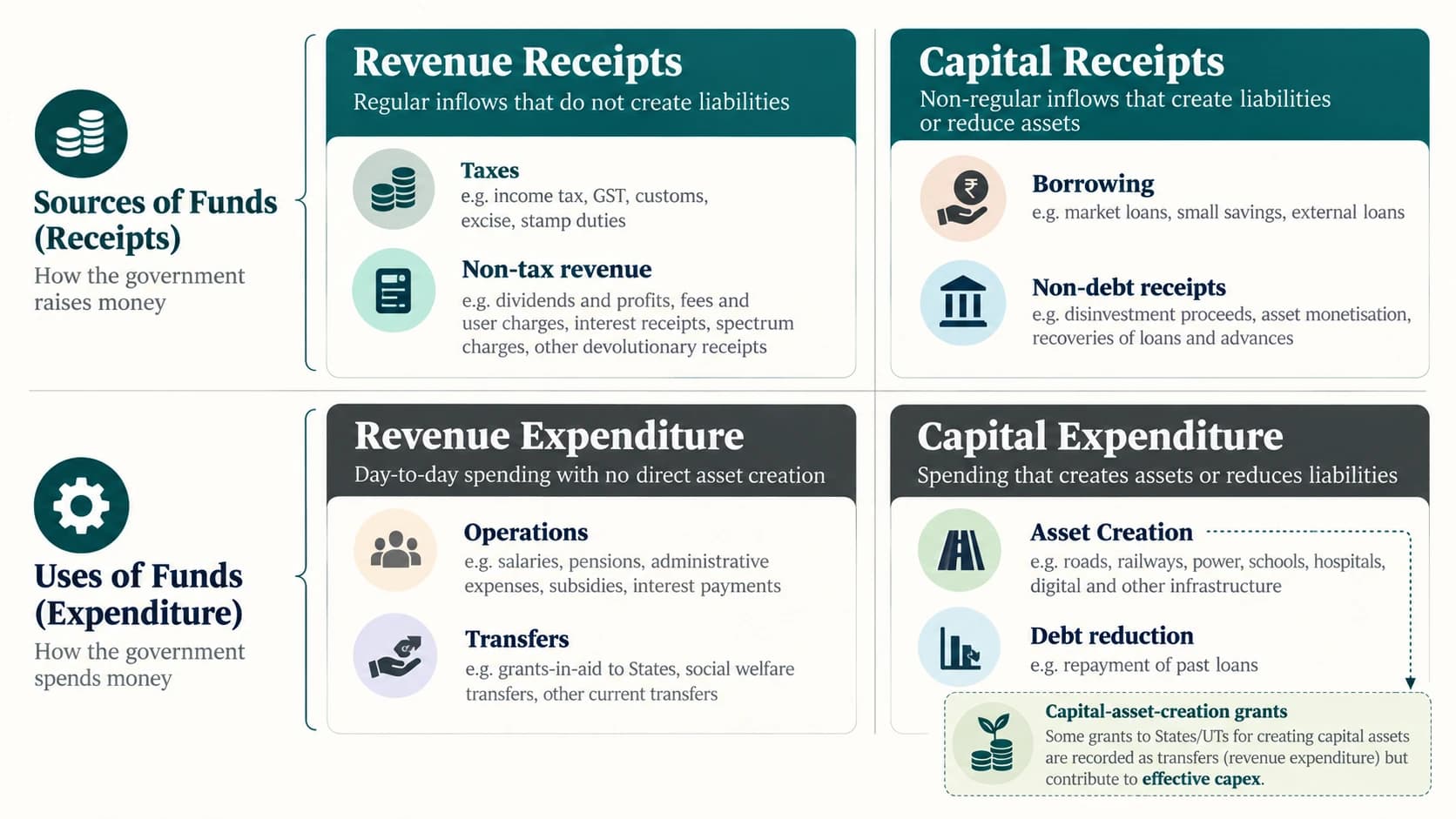
Revenue receipts
These generally do not create a new liability to be repaid and do not arise from reducing a Government asset in the budget classification. They include:
- tax revenue: income taxes, applicable indirect taxes, customs and other levies;
- non-tax revenue: dividends, fees, certain interest receipts and other Government income.
Capital receipts
These include:
- debt receipts: borrowings and other liabilities that must be repaid;
- non-debt capital receipts: recovery of loans, receipts from asset disinvestment and similar items that do not create new debt.
A Government loan receipt is not revenue income just because cash enters the treasury. Borrowing finances expenditure but creates future obligations.
6. Government expenditure: revenue or capital?
Revenue expenditure usually supports ongoing operations or transfers without directly creating a Government-owned capital asset. Examples include salaries, interest payments, ordinary operating expenditure and many grants/subsidies.
Capital expenditure generally creates assets or reduces liabilities—for example, capital outlay on a Government-owned road or investment in infrastructure equipment, as budget-classified.
Care is needed: a grant to a State to construct a school may appear as revenue expenditure in the Union Government's accounts even though the State creates an asset. The Indian Budget therefore also reports grants-in-aid for creation of capital assets and effective capital expenditure as a supplementary analytical measure.
7. Revenue deficit
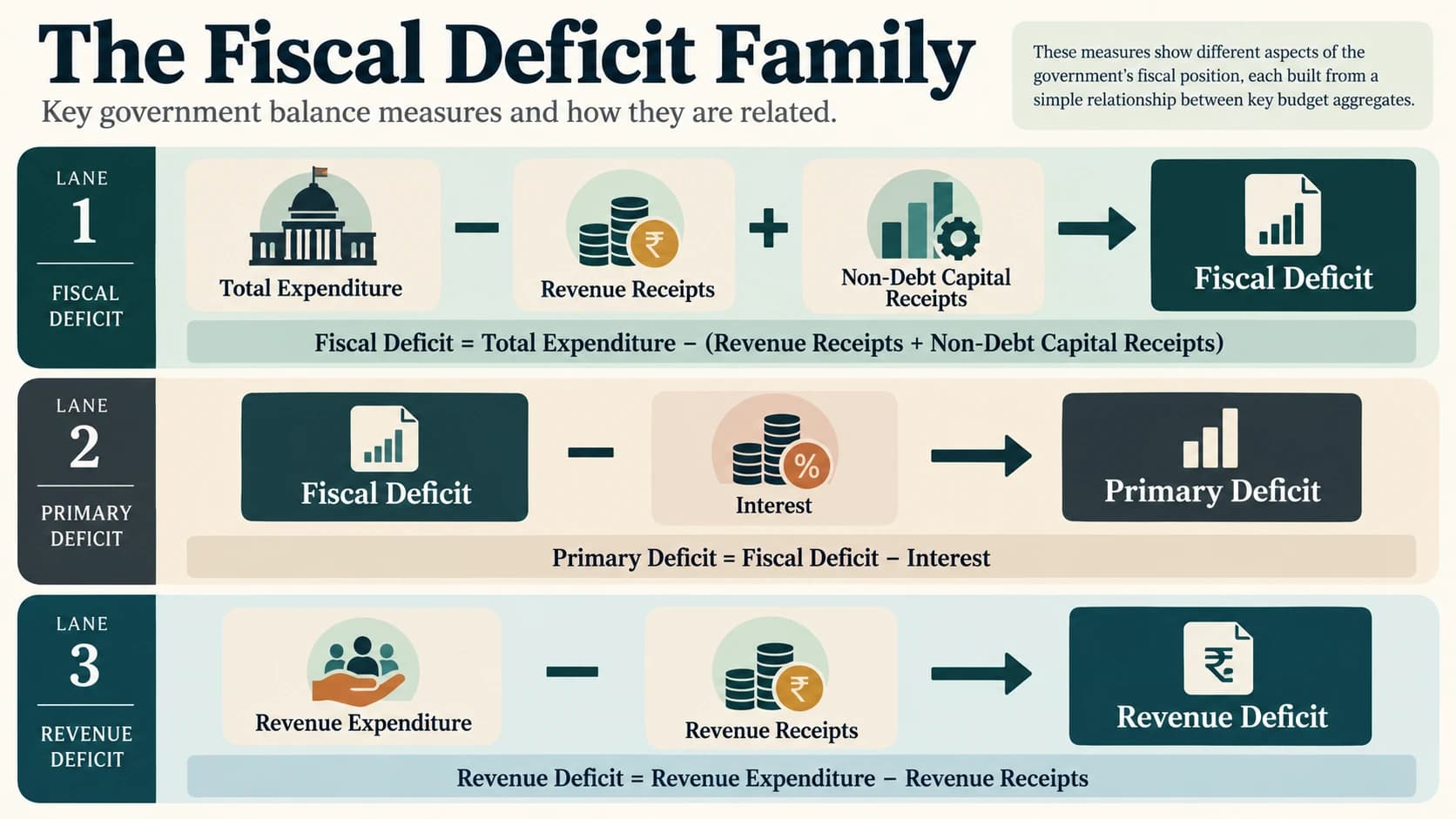
Revenue Deficit = Revenue Expenditure − Revenue Receipts.
A positive revenue deficit means the Government's recurring revenue receipts do not cover its revenue expenditure. A revenue surplus exists when the difference is negative. It is incorrect to define revenue deficit as 'total borrowing'.
Example: revenue receipts ₹900 crore, revenue expenditure ₹1,050 crore → revenue deficit ₹150 crore.
8. Fiscal deficit
Fiscal Deficit = Total Expenditure − (Revenue Receipts + Non-Debt Capital Receipts).
This expresses the Government's total borrowing requirement for the period in a broad budget sense, before accounting for financing arrangements. It is NOT simply 'expenditure minus tax revenue' and NOT the same as public debt stock.
Example:
| Item | Illustrative amount |
|---|---|
| Total expenditure | ₹2,000 crore |
| Revenue receipts | ₹1,300 crore |
| Non-debt capital receipts | ₹100 crore |
| Fiscal deficit | ₹600 crore |
The ₹600 crore gap must be financed by borrowing and other financing arrangements specified in the budget. These are example numbers, not a live Government Budget.
9. Primary deficit
Primary Deficit = Fiscal Deficit − Interest Payments.
If the fiscal deficit above is ₹600 crore and interest payments are ₹350 crore, the primary deficit is ₹250 crore. This helps separate the current-period borrowing gap from the cost of servicing past debt.
A primary surplus is possible even when the overall fiscal deficit is positive, if interest payments exceed the total fiscal deficit.
10. Effective revenue deficit
Effective Revenue Deficit = Revenue Deficit − Grants-in-Aid for Creation of Capital Assets.
This indicator recognises that some expenditure booked as Union revenue expenditure helps create capital assets elsewhere. The measure does not change the legal accounting classification of the grants. For example, revenue deficit ₹200 crore with ₹60 crore of qualifying capital-asset grants yields effective revenue deficit ₹140 crore.
11. Effective capital expenditure
Effective Capital Expenditure = Capital Expenditure + Grants-in-Aid for Creation of Capital Assets.
Suppose direct capital expenditure is ₹450 crore and capital-asset grants are ₹60 crore. Effective capex is ₹510 crore. This measure complements rather than replaces the conventional capital-expenditure series. It must not be treated as an unrestricted add-on to total expenditure; the grants are already included in the budget classification.
12. Fiscal deficit versus public debt
- Deficit is a flow during a year.
- Debt is a stock of outstanding obligations at a point in time.
A deficit can add to debt, although debt dynamics also reflect refinancing, currency effects, accounting adjustments, asset transactions and other factors. Debt-to-GDP compares the outstanding stock of debt to annual output. Fiscal-deficit-to-GDP compares the year's financing gap with annual output. The two are not interchangeable.
13. Why fiscal deficit is often expressed as a percentage of GDP
₹1 lakh crore means something different for a very large economy than for a small one. Ratios improve comparison across time and economic scale. Formula:
Fiscal deficit ratio (%) = Fiscal deficit / Nominal GDP × 100
A deficit of ₹6 lakh crore with nominal GDP ₹200 lakh crore is 3% of GDP. Both numerator and denominator must refer to compatible coverage and periods.
14. How Governments borrow
The Government can finance part of its deficit through dated Government securities, Treasury bills, small-savings and other legally permitted sources. The RBI acts as banker and debt manager for the Government subject to applicable arrangements. Financial institutions, banks, funds and investors may hold sovereign debt.
A public-sector bank buying a Government security is not the same transaction as the Government collecting tax. Securities create repayment obligations and provide financial assets to holders.
15. Crowding out and crowding in
If Government borrowing competes strongly with private borrowing for scarce funds, interest rates can face upward pressure, potentially crowding out some private investment. But productive public investment in transport, power or digital infrastructure can encourage private activity—crowding in investment.
Neither effect is automatic. Economic slack, central-bank policy, investor demand and expected growth matter.
16. Debt sustainability
Sustainability concerns whether the Government can service obligations over time without unacceptable adjustment or default. Analysts examine debt relative to output, interest costs, nominal growth, primary balances, maturity profile and contingent liabilities.
A high deficit is not always equally harmful: financing a temporary emergency differs from persistent borrowing for low-productivity expenditure. A low fiscal-deficit ratio is not proof that all spending is efficient.
17. FRBM and fiscal rules
India's Fiscal Responsibility and Budget Management (FRBM) Act, 2003 provides an institutional framework for fiscal-policy reporting and responsibility. Targets, glide paths, exemptions, amendments and related fiscal policy statements can change; preserve the concept in the evergreen lesson and keep operative numbers in current-data modules.
Exam distinction: FRBM is a fiscal-policy statute, not a banking capital-adequacy or monetary-policy statute.
18. The tax structure in broad outline
Taxes may be:
- Direct taxes: broadly levied on income, profits and similar bases (e.g., income tax).
- Indirect taxes: levied on transactions/supplies, with incidence potentially passed through (e.g., GST and customs duty).
Not every payment to Government is a tax; fees and dividends are non-tax receipts. Exact tax brackets, rates and exemptions are annual living data, not evergreen memorisation.
19. Centre, States and fiscal federalism
India has Union and State budgets, as well as local bodies and public enterprises. The Finance Commission makes recommendations within its constitutional remit on specified fiscal transfers, including tax devolution and grants. The GST Council has a separate constitutional role in recommending important GST matters. Do not confuse the Finance Commission with RBI or the Monetary Policy Committee.
A Union fiscal-deficit figure does not automatically include every State Government's deficit. When comparing, identify whether data are Union-only, combined Government, or general Government.
20. Revenue and fiscal deficits: a household analogy, used carefully
Consider a household that earns ₹50,000 monthly but spends ₹52,000 on routine needs and another ₹8,000 renovating a home. Borrowing ₹10,000 can finance both. In Government accounting, a different, formal classification applies; the analogy teaches that routine income shortfall and total financing shortfall are different ideas. It should not replace official fiscal definitions.
21. Inflation, taxes, growth and the deficit
Strong nominal economic activity can raise tax receipts even when tax rates do not change. Higher inflation can raise nominal spending and interest costs. A recession can reduce revenue while increasing demand for support. Deficit numbers therefore reflect not only announced policy but also economic outcomes.
22. Banking impact of fiscal policy
Public infrastructure can create demand for construction, steel, logistics and project finance. Government bond issuance affects liquidity and bank treasury portfolios. Tax rules influence household saving and corporate investment. Budget subsidies and guarantees may affect formal lending to target sectors. Banks should distinguish authorised public guarantees from an assumption that every Government-supported loan is fully risk-free.
23. Common confusions
| Mistake | Correction |
|---|---|
| Borrowings are revenue receipts | They are debt capital receipts. |
| Revenue deficit equals fiscal deficit | Revenue deficit covers revenue account; fiscal deficit covers total borrowing need. |
| Primary deficit equals fiscal deficit plus interest | Primary deficit is fiscal deficit minus interest. |
| A Government grant always counts as direct capital expenditure | Some grants for capital assets are booked as revenue expenditure. |
| Fiscal deficit and debt are stocks | Fiscal deficit is a flow; public debt is a stock. |
| Large fiscal deficit always means insolvency | Sustainability requires contextual debt and macroeconomic analysis. |
| RBI decides tax rates | Government/legislature decide taxation within law. |
| Government spending always creates inflation | Effects depend on financing, capacity, timing and the economic cycle. |
Worked examples
A — Fiscal deficit: Total expenditure ₹1,500; revenue receipts ₹1,000; non-debt capital receipts ₹150 → fiscal deficit ₹350.
B — Primary deficit: Fiscal deficit ₹350; interest payments ₹220 → primary deficit ₹130.
C — Revenue deficit: Revenue expenditure ₹900; revenue receipts ₹1,000 → revenue surplus ₹100 (deficit −₹100).
D — Effective revenue deficit: Revenue deficit ₹180; qualifying capital-asset grants ₹70 → ₹110.
E — Deficit/GDP: Fiscal deficit ₹12, nominal GDP ₹300 (same currency units) → 4% of GDP.
F — Effective capex: Capital spending ₹400 plus grants for creation of capital assets ₹75 → ₹475.
Quick check — BA-16-03
- Who makes fiscal policy? Government, through fiscal decisions and law.
- Which deficit subtracts interest payments? Primary deficit.
- Is recovery of a Government loan a tax receipt? No; it is generally a non-debt capital receipt.
- Why express deficit as a share of GDP? For scale/comparability.
- Is public debt measured over a year or at a date? As a stock at a point in time.
- Does borrowing itself make the Government richer? It creates cash and a liability, not net income.
Lesson recap: Government budgets classify revenue and capital flows; fiscal deficit measures the financing gap, revenue deficit the revenue-account shortfall, and primary deficit the financing gap after removing interest costs. Fiscal decisions influence borrowing, bonds, taxes and banks.