
AML, CFT, PMLA and FIU-IND Basics
AML, CFT, PMLA and FIU-IND Basics. A detailed chapter in KYC, AML, Cybersecurity & Customer Protection, with explanations and examples for Indian banking examinations.
By Akhilesh Saini · Reviewed 8 Oct 2026
1. Why banks need anti-money-laundering controls
Banks transfer and store money. Criminals may attempt to use legitimate-looking accounts to move illicit proceeds, disguise ownership or obscure a money trail. Anti-Money Laundering (AML) controls aim to prevent, detect and report such misuse.
An important distinction: banks monitor risk indicators, while competent authorities investigate and determine criminal liability under law.
2. What is money laundering?
Money laundering broadly involves dealings with the proceeds of crime in a manner covered by the Prevention of Money-laundering Act, 2002 (PMLA). In everyday language, it is the attempt to present illicitly derived money or property as legitimate.
Do not confuse: ordinary high-value spending, an unusual transaction, a tax dispute and a proven money-laundering offence. They are not identical.
3. Three classic stages: placement, layering, integration
These are a useful teaching model, not a checklist that every real offence must follow in order.
- Placement: moving illicit proceeds into the financial system.
- Layering: obscuring their origin through transactions or transfers.
- Integration: presenting them as apparently legitimate wealth/business proceeds.
Illustration: Assume illicit funds are deposited, moved through accounts and then made to resemble ordinary business income. Monitoring seeks inconsistencies across this chain. Real cases are often much less tidy.
4. AML vs CFT
AML = Anti-Money Laundering.
CFT = Countering the Financing of Terrorism.
The objectives overlap, but there is a subtle distinction: terrorism financing can involve funds raised from lawful as well as unlawful sources. Its harmful purpose matters, not only the origin of money.
5. The core legal/institutional map
| Institution / law | Primary role |
|---|---|
| PMLA, 2002 | Principal legislation on money laundering, offences and related obligations |
| PML (Maintenance of Records) Rules, 2005 | Customer identification, records and reporting framework for reporting entities |
| RBI | KYC/AML directions and supervision of regulated financial entities |
| FIU-IND | Central national agency that receives, processes, analyses and disseminates financial intelligence |
| ED | Enforcement Directorate: investigates/enforces specified money-laundering provisions |
| FATF | International standard setter for AML/CFT/PF; not an Indian police agency |
6. FIU-IND
FIU-IND stands for Financial Intelligence Unit–India. It acts as the central national agency for receiving, processing, analysing and disseminating information about suspect financial transactions, under the applicable framework.
A reporting bank sends prescribed reports to FIU-IND. FIU-IND is not a retail grievance helpline and does not perform the functions of a local bank branch.
7. Reporting entities and Principal Officers
Banks and other covered entities must meet PMLA reporting obligations. A Principal Officer is designated under the reporting framework for furnishing prescribed information. A Designated Director has responsibility for overall compliance as prescribed.
These roles are distinct from a customer's branch relationship manager.
8. Cash Transaction Report — CTR
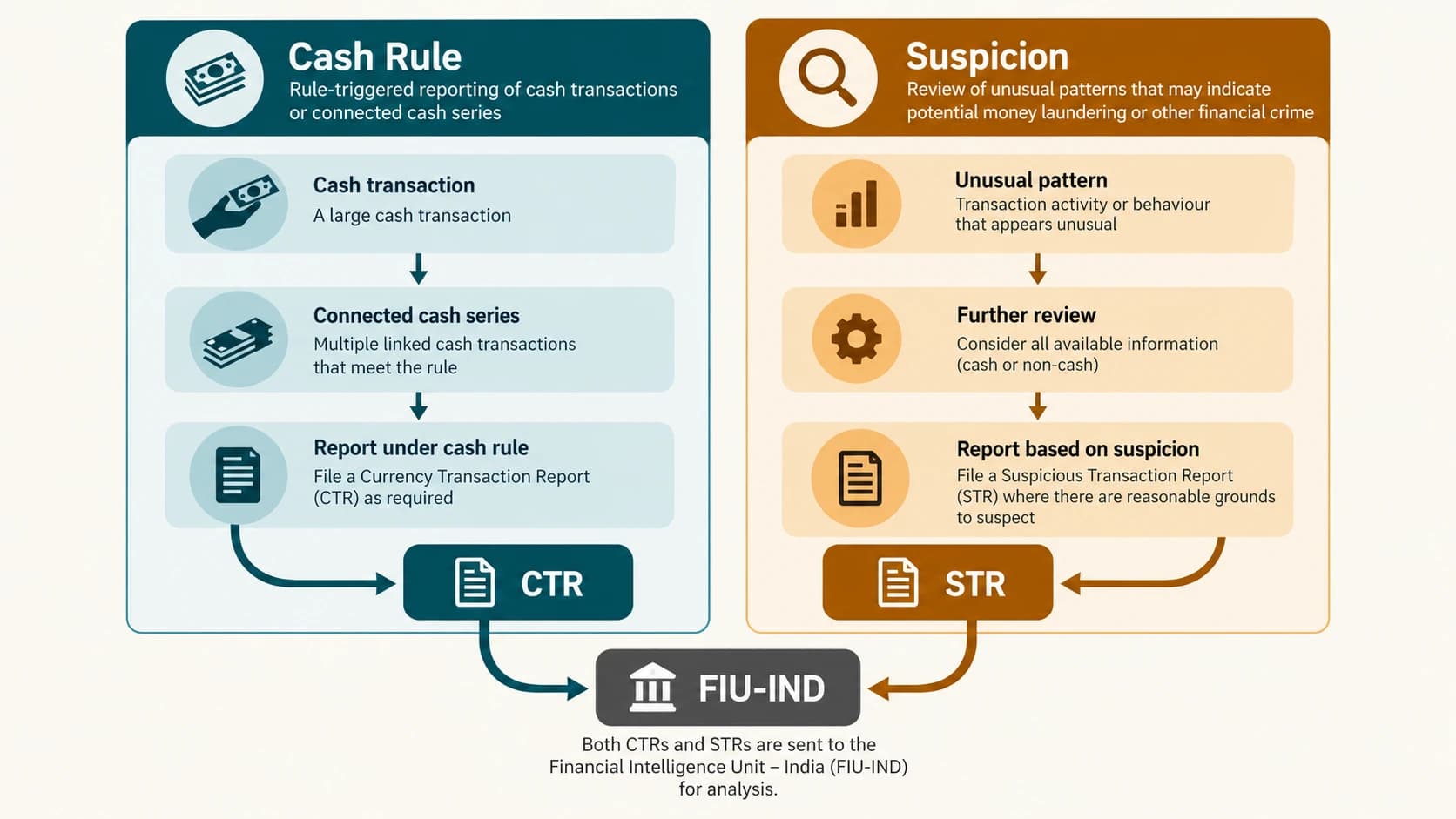
A CTR relates to cash transactions/connected series meeting the prescribed reporting criteria. A cash transaction can be perfectly lawful and still reportable because CTR is substantially rule/threshold driven.
Example: A business deposits legitimate cash collections above the prescribed threshold. Reporting alone does not establish an offence.
9. Suspicious Transaction Report — STR
An STR is triggered by suspicion based on facts, patterns, reasonable grounds or other applicable indicators. It is not confined to cash transactions and has no universal minimum monetary threshold.
Example: Multiple incoming transfers immediately routed to unrelated accounts may require assessment when inconsistent with the customer's profile. A high-value one-off transaction with a clear source may not be suspicious.
10. CTR vs STR
| Feature | CTR | STR |
|---|---|---|
| Main trigger | Prescribed cash-reporting rule/threshold | Reasoned suspicion |
| Cash-only? | Centred on cash reporting | No |
| Automatic evidence of crime? | No | No |
| Can a small transaction matter? | Depends on connected-series rule | Yes |
| Who receives bank reporting? | FIU-IND under reporting framework | FIU-IND |
Exam memory: CTR is about a cash-reporting rule; STR is about suspicion.
11. Other FIU report concepts
Depending on law and prescribed forms, reporting types include:
- counterfeit currency reports (CCRs);
- transactions involving non-profit organisations (NTRs);
- cross-border wire-transfer reporting (CBWTRs);
- other mandated categories.
These have separate definitions and reporting rules. Do not assume every payment to a charity is suspicious or that every inward remittance is unlawful.
12. No tipping off
Confidential reporting is fundamental. An institution should not disclose an STR or related investigation in a manner prohibited by law.
If a customer asks, "Have you filed an STR against me?", the institution must follow lawful communication restrictions rather than revealing protected intelligence.
13. Retention and audit trail
Records enable authorities to reconstruct transactions and establish identity when necessary. PMLA rules distinguish retention periods for transaction records and customer identity records after the relationship ends.
For exam study, remember the principle of traceability and verify the current statutory retention periods rather than treating general data minimisation as permission to erase mandated records immediately.
14. Detecting unusual transactions
Transaction-monitoring scenarios may flag:
- repeated transactions inconsistent with customer profile;
- complex transfers with unclear economic purpose;
- activity involving sanctions-listed entities or riskier locations;
- rapid pass-through patterns;
- unusual use of multiple accounts;
- sudden material change in activity with no explanation.
An alert begins review, not automatic guilt. Systems require human judgement, documentation and escalation.
15. Structuring / smurfing
Structuring describes splitting activity into smaller transactions to conceal its nature or avoid reporting controls. Smurfing is an informal term for using multiple people/accounts to distribute activity.
The concept matters for recognising why a series of individually small transactions can require attention. It is not a reason to assume that every customer who makes several small deposits is evading controls.
16. Money mule accounts
A money mule receives or moves funds for someone else, often after being recruited through a false job offer or easy-commission promise. Mule accounts may be used in cyber fraud and laundering.
A person who permits strangers to use their account can suffer serious financial, regulatory and legal consequences. A customer should not lend or rent an account, payment app, credentials or KYC identity to another person.
17. FATF and international standards
The Financial Action Task Force (FATF) develops standards and evaluates jurisdictions' AML/CFT/proliferation-financing frameworks. Its Recommendations influence domestic policies and risk controls.
FATF does not issue Indian bank account numbers or directly resolve an Indian customer's failed UPI payment.
18. Sanctions vs AML transaction monitoring
Sanctions screening checks for persons/entities subject to legally applicable restrictions. Transaction monitoring looks at transaction behaviour and other risk indicators.
Both may use alerts, but they solve different compliance questions. Screening a customer's name does not replace investigating suspicious transaction patterns.
19. AML and financial inclusion
Overly burdensome onboarding can exclude legitimate low-income customers. RBI's risk-based CDD framework therefore requires controls that are effective and proportionate.
A small account may have simplified access under rules yet remain subject to safeguards. "Simplified" is not "unmonitored".
20. Case study — legitimate cash vs suspicious behaviour
Case A: A trader has a known cash-intensive business, proper records and deposits aligned with sales. Some transactions may cross a CTR threshold, without a crime having occurred.
Case B: A newly opened account with no identifiable business starts receiving unrelated credits and immediately disperses funds. That may warrant a risk review and possible STR assessment regardless of transaction size.
BA-12-02 — Quick check
- What distinguishes money laundering from ordinary spending?
- Is CFT only about criminal-origin money?
- What is the difference between FIU-IND and ED?
- Can a lawful cash transaction be CTR-reportable?
- Must an STR involve cash or exceed a fixed amount?
- Is an STR proof that the customer has committed a crime?
Answers: (1) Involvement of proceeds of crime and applicable offence elements. (2) No. (3) Financial-intelligence reporting/analysis versus investigation/enforcement. (4) Yes. (5) No. (6) No.