
Cheque Clearing and Cheque Truncation System
Cheque Clearing and Cheque Truncation System. A detailed chapter in Negotiable Instruments & Core Banking Operations, with explanations and examples for Indian banking examinations.
By Akhilesh Saini · Reviewed 8 Oct 2026
1. A simple question: how does a cheque reach the paying bank?
When a person deposits a cheque drawn on another bank, their bank cannot treat it exactly like cash already received. The cheque needs to be presented, examined by the drawee bank, and processed through a clearing and settlement arrangement.
In earlier systems, physical cheques travelled between banks/clearing houses. Modern systems use cheque images and associated data, reducing movement, costs and delays.
The key shift is paper journey → electronic image journey, while underlying banking/legal obligations remain.
2. Clearing vs settlement vs customer credit
These three words are related but different:
- Clearing: Exchange, processing and determination of payment claims/instructions between participating banks.
- Settlement: Discharge of obligations between banks through an authorised settlement mechanism.
- Customer credit: Final (or appropriately conditional) posting/availability of proceeds to the depositor's account according to system and bank rules.
Example: Bank A presents a cheque drawn on Bank B. The clearing system conveys the image to Bank B. Bank B confirms payment. Interbank settlement occurs. Bank A makes the proceeds available to its customer under applicable rules. These are connected stages, not one word for the same action.
3. Who participates in cheque clearing?
| Participant | Role |
|---|---|
| Drawer | Wrote the cheque; payment comes from drawer's account |
| Payee / depositor | Receives/places cheque for collection |
| Presenting / collecting bank | Captures and presents cheque for collection |
| Clearing house/system operator | Exchanges cheque images/data and confirmations |
| Drawee / paying bank | Checks and pays or returns the instrument |
| Settlement mechanism | Posts interbank obligations based on clearing decisions |
The presenting and paying bank can be different branches or banks; same-bank/local operational workflows may differ.
4. Cheque Truncation System — CTS
Cheque Truncation System (CTS) is an image-based cheque-clearing system. Truncation means the physical cheque's onward travel is stopped, and its electronic image plus required information travels to the paying bank via the clearing infrastructure.
RBI's CTS FAQ explains the core process and the reduction in physical handling.
Why use truncation?
- Faster collection and response.
- Lower physical transport cost and loss risk.
- Better electronic audit trail.
- Image-based review and fraud controls.
- More standardised national clearing operations.
CTS does not transform a cheque into UPI, nor does it remove the cheque's legal character.
5. Image-based cheque vs electronic cheque
The NI Act recognises both a truncated cheque and a cheque in electronic form, but they are conceptually different:
- Truncated cheque: Typically began as a paper cheque; its image/data are transmitted after truncation.
- Cheque in electronic form: Originates in electronic form as defined by the Act and authenticated using its prescribed electronic process.
A photograph sent over a messaging app by a customer is not automatically a legally operative electronic cheque or a valid CTS presentation. The authorised creation, authentication and system standards matter.
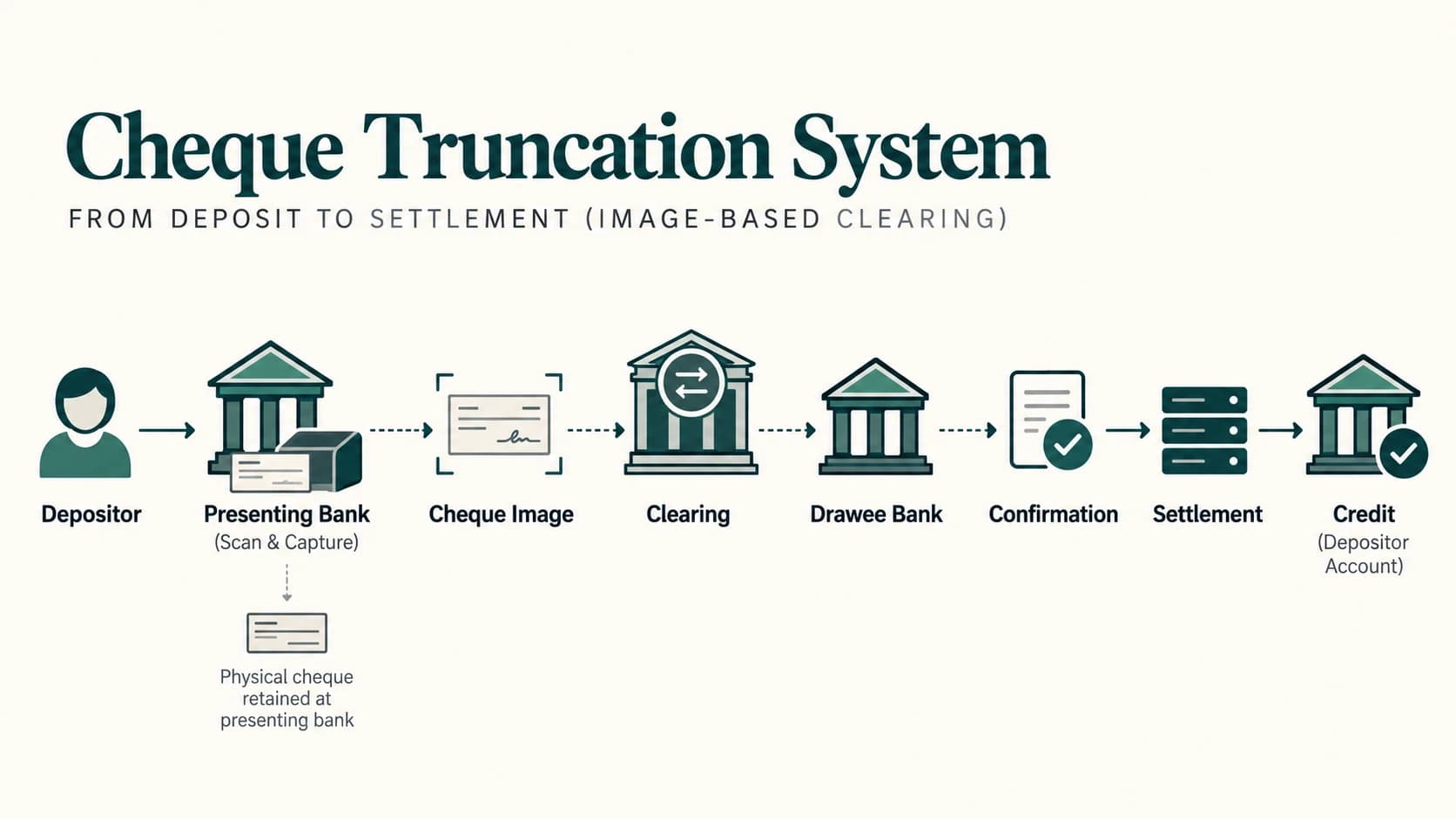
6. How a paper cheque gets into CTS
Step 1 — Deposit: Payee deposits the original cheque with their bank through permitted channels.
Step 2 — Capture: Presenting bank scans the front/back as required and captures cheque details, including MICR-line information and other prescribed data.
Step 3 — Quality control: System/bank checks readability, image standards and required fields.
Step 4 — Presentation: Image and data are delivered to the clearing system.
Step 5 — Paying-bank examination: Drawee bank checks mandate, funds, status, instrument particulars and applicable controls.
Step 6 — Positive or negative response: Paying bank confirms or returns as the current clearing framework requires.
Step 7 — Settlement: Interbank positions are settled through the applicable process.
Step 8 — Customer credit: Collecting bank credits and makes funds available subject to the rule/policy and completion status.
This is the stable conceptual flow. Exact operating windows, item deadlines and whether settlement is batch-based or continuous are determined by the latest RBI/NPCI operational instructions.
7. MICR and cheque data
MICR means Magnetic Ink Character Recognition. The MICR line printed at the bottom of cheques historically helps automated recognition of bank/branch/account/transaction information. In Indian study material, the nine-digit MICR code is conventionally explained as:
- first 3 digits: city;
- next 3: bank;
- final 3: branch.
This is a useful traditional examination convention. Modern image-processing and migration can change how actual clearing operations use and interpret information; MICR is not the same as IFSC, which is explained in Lesson 13-04.
8. CTS-2010 standard
RBI/NPCI introduced standardised cheque design/security features commonly described as CTS-2010. Standardisation makes the location and machine-readability of key fields more consistent and helps reduce tampering.
Features include standardised field placement and cheque-security features. Study the purpose of CTS-2010 rather than assuming every security mark is visible or easy to reproduce.
9. Why permanent writing and clean instruments matter
RBI's CTS FAQ advises customers to use clear, permanent, image-friendly writing. Changes to:
- payee name;
- amount in figures;
- amount in words
may require issue of a fresh cheque, rather than overwriting/correction. RBI does not prescribe one mandatory ink colour for every cheque; claims such as “only black ink is legal” should not be taught as a general RBI rule.
10. Positive Pay System — PPS
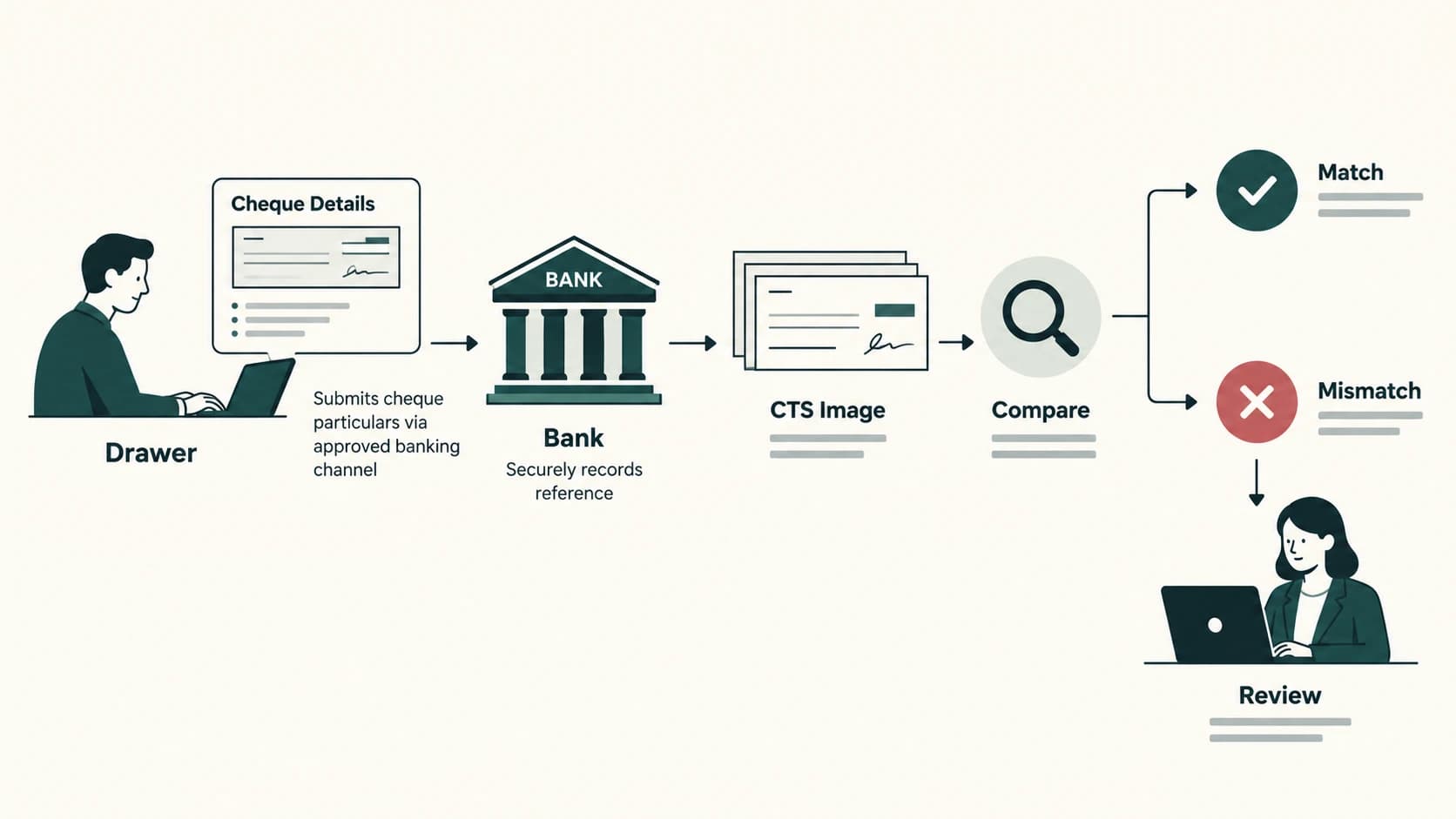
Positive Pay is an additional control for higher-value CTS cheques. The drawer may share key cheque details in advance through bank-provided channels, such as:
- cheque number;
- issue date;
- payee name;
- amount.
When the cheque arrives in clearing, the provided details are compared with the presented details and discrepancies can be flagged for handling.
Example: Rohan issues a cheque for ₹2 lakh to a supplier. He reconfirms the cheque particulars through his bank's authorised service. If a fraudster alters the amount or beneficiary, the mismatch can trigger additional checks.
Facility vs mandate
RBI's 2020 direction required banks to make Positive Pay available for cheques of ₹50,000 and above. Customer participation was at the customer's discretion under that direction, although banks could consider mandatory use for cheques of ₹5 lakh and above. The latest bank-specific implementation and RBI circulars must be checked because banks may set operational requirements under the framework.
Positive Pay does not:
- guarantee funds are available;
- replace the bank's signature/mandate checks;
- turn an invalid instrument into a valid one; or
- promise automatic recovery of money after fraud.
11. Historical batch clearing vs continuous clearing
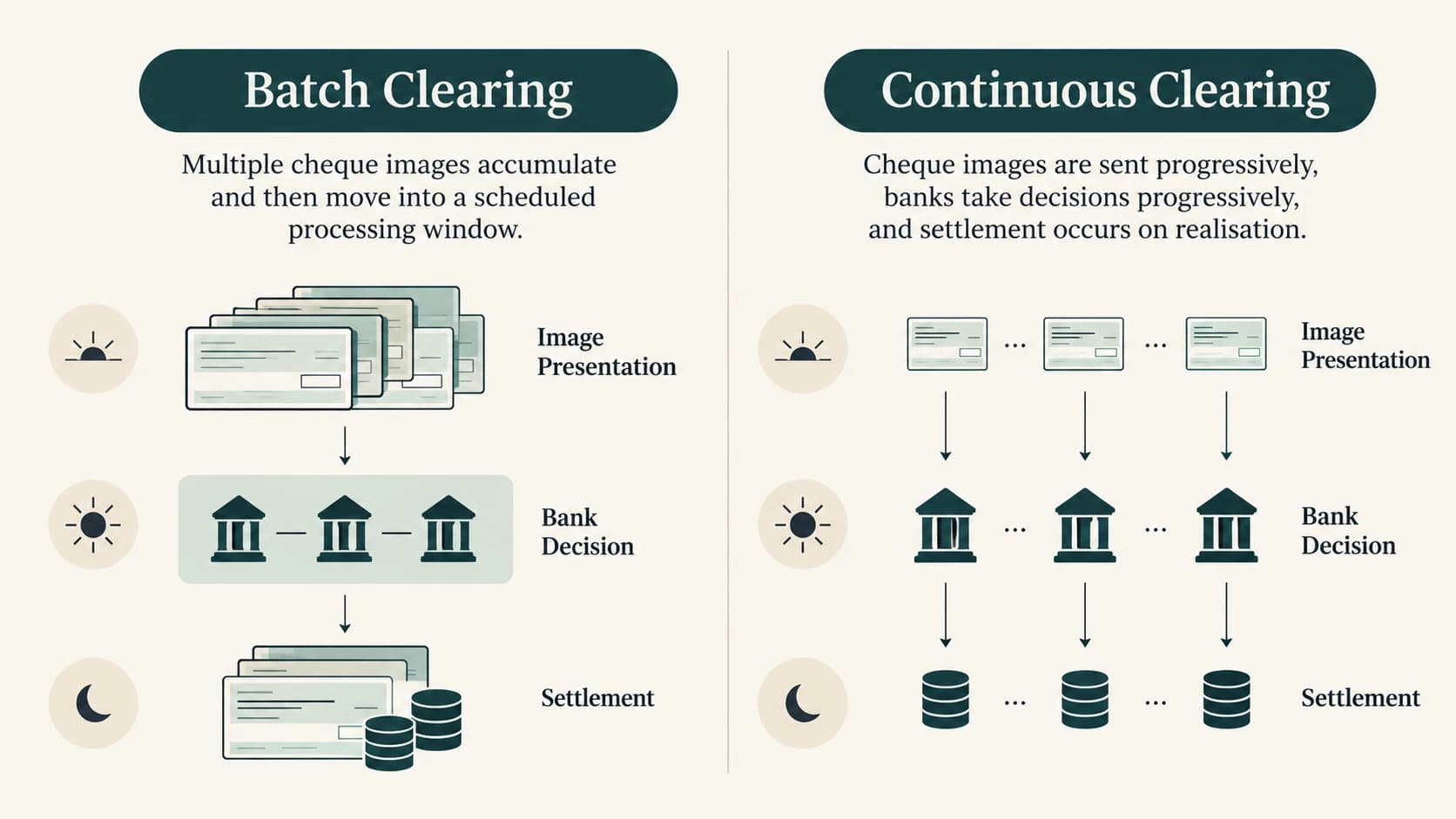
Older CTS processes used scheduled batch sessions and subsequent settlement cycles. RBI introduced a transition toward continuous clearing with settlement on realisation, so images and decisions can move across the system throughout the session rather than waiting for one large batch.
Durable concept
Batch: Presentments are aggregated for a scheduled cycle.
Continuous: Cheques are presented and considered progressively during the defined session.
Settlement on realisation: Settlement is tied to confirmed or otherwise validly considered items according to current operating rules.
Do not conflate continuous clearing with 24×7 cheque clearing. Even with continuous processing, operating sessions and bank holidays can matter.
12. Current rollout: Phase 1 and postponed Phase 2
RBI directed Phase 1 to begin on 4 October 2025. It initially planned Phase 2 for January 2026. But its later notice of 24 December 2025 expressly postponed Phase 2 until further notice and changed session times.
At the source-review point for this module: use the official Phase 1 implementation and Phase 2-postponement distinction; do not tell students Phase 2 automatically began on the previously scheduled January date. The dated timeline and exact operating hours live in the website snapshot, not in the permanent explanation or the planned images.
Why this matters in exams
A preparation article written before December 2025 may still say “three-hour deadline starts January 2026.” That would ignore RBI's postponement. Always prefer a later RBI amendment to an earlier rollout schedule when the two conflict.
13. Positive/negative confirmation and deemed approval
A drawee bank may issue:
- Positive confirmation: Cheque is honoured.
- Negative confirmation: Cheque is not honoured and is returned with a reason.
Under the continuous-clearing rollout, RBI's operational design also sets an item-expiry/deemed-approval approach when a response is not received by the applicable deadline. The exact time permitted to the drawee bank depends on the operative phase/instruction.
Do not teach “all banks must approve every cheque within exactly three hours” as a timeless fact: that statement is phase-dependent and affected by the postponement.
14. Cheque return and re-presentation
Cheques can be returned for:
- financial reasons (e.g., insufficient funds);
- technical reasons (e.g., image-quality or processing issue);
- mandate/legal reasons.
For certain technical returns not attributable to the customer, RBI has directed prompt re-presentation in the next applicable clearing session, subject to applicable circumstances. This is a bank-processing matter rather than a new legal debt created by the technical return.
Conceptual example: An image defect makes a valid cheque unreadable. The presenting bank investigates/re-presents in the manner allowed by current rules. It should not tell the payee that the drawer necessarily had no money.
15. Returned cheque memo
When a cheque is returned, the relevant bank communicates the return reason via a return memo/advise. This helps the presenting bank and payee know what happened and may serve as documentary evidence for a legitimate dispute, including legal proceedings where applicable.
But a return memo is not a court judgment. The legal meaning depends on:
- why it was returned;
- underlying obligation;
- cheque validity;
- notice and later action.
16. Cheque collection policy and customer rights
Banks have cheque-collection policies and regulatory obligations concerning:
- collection service;
- delays;
- compensation;
- returned cheques;
- loss of instruments in transit;
- proper customer communication.
If a cheque is lost in transit, the RBI customer-service framework addresses responsibility, obtaining a duplicate instrument and reasonable compensation as applicable. Consumers should use the bank grievance route and, when eligible, RBI's current Ombudsman framework (Module 12).
17. What happens to the physical cheque?
With CTS, the original physical instrument normally stays at the presenting bank, rather than making its entire journey to the drawee bank. RBI's CTS FAQ describes retention/archival requirements and the possibility of obtaining certified images or access to an original in appropriate cases. Records support audit and dispute resolution.
The physical cheque is not discarded immediately merely because a digital image exists.
18. Fraud risks in image-based clearing
Relevant threats can include:
- counterfeit/forged cheque leaves;
- altered payee/amount;
- forged drawer signature;
- fake account / money-mule collection;
- reuse or duplicate presentment;
- social engineering and false instructions.
A bank's safeguards include image checks, instrument validation, Positive Pay, customer verification, audit trails and legal/regulatory controls.
19. Worked examples
A: CTS success
A pays Supplier B by crossed cheque. B deposits it at Bank Y; A banks with Bank X. Bank Y scans and presents; Bank X honours after checking. Interbank settlement occurs; B receives the proceeds according to the applicable schedule.
B: Technical return
The scan is unreadable. The cheque may need correction of capture or re-presentation. It does not prove that A lacked funds.
C: Positive Pay discrepancy
Drawer-entered payee is “B Traders,” but presented image reads “C Traders.” A mismatch needs handling. It is a preventive control, not automatic proof of fraud.
D: Outdated news article
An article says Phase 2 fully started in January 2026; the later official RBI circular postponed it. Prefer the later official notice until superseded.
20. Common confusions — Lesson 13-03
- Cheque scan vs legally created electronic cheque: Different concepts.
- CTS vs NEFT: CTS processes cheque-based instructions; NEFT is a separate electronic funds-transfer system.
- Clearing vs settlement: Exchange/validation vs discharge of interbank obligations.
- Batch vs continuous: Processing method, not the customer's right to unlimited 24-hour clearing.
- PPS vs full guarantee: Positive Pay is an extra validation safeguard.
- MICR vs IFSC: Different identifiers/use cases.
- Technical return vs lack of funds: Return reasons differ.
Quick check — BA-13-03
- What is truncated?
Answer: The physical cheque's onward movement; its electronic image/data are used for clearing. - Does a phone photograph automatically constitute a CTS cheque?
Answer: No. - Is Positive Pay an additional fraud-control step or a credit guarantee?
Answer: Fraud-control step. - What changed in continuous clearing?
Answer: Progressive image presentation/confirmation and settlement on realisation under set operating sessions. - Did RBI's originally scheduled Phase 2 necessarily go live?
Answer: No; RBI postponed it until further notice. - Does a technical return necessarily mean a Section 138 offence?
Answer: No.