
Cheque Crossing, Endorsement, Dishonour and Payment
Cheque Crossing, Endorsement, Dishonour and Payment. A detailed chapter in Negotiable Instruments & Core Banking Operations, with explanations and examples for Indian banking examinations.
By Akhilesh Saini · Reviewed 8 Oct 2026
1. From a payment order to a safe payment
A cheque is a payment instruction, but the bank must decide whether the instruction can be honoured safely. The cheque may be crossed, endorsed, stale, altered, stopped or dishonoured. Each feature affects how payment should be made and who may receive it.
Imagine a business receives an account-payee cheque from a customer. The payee's bank will present the cheque through clearing; the drawer's bank will verify it. The payee should not expect the crossed cheque to become physical cash simply because it is handed over at a counter.
2. What is cheque crossing?
Crossing is a direction on the cheque affecting how the banker pays it. Under Chapter XIV of the NI Act, crossing is typically shown on the face of the cheque using two parallel transverse lines and, for some forms, additional wording or a banker's name.
The central purpose is to reduce the risk of cash payment to an unintended person and to direct funds through banking channels.
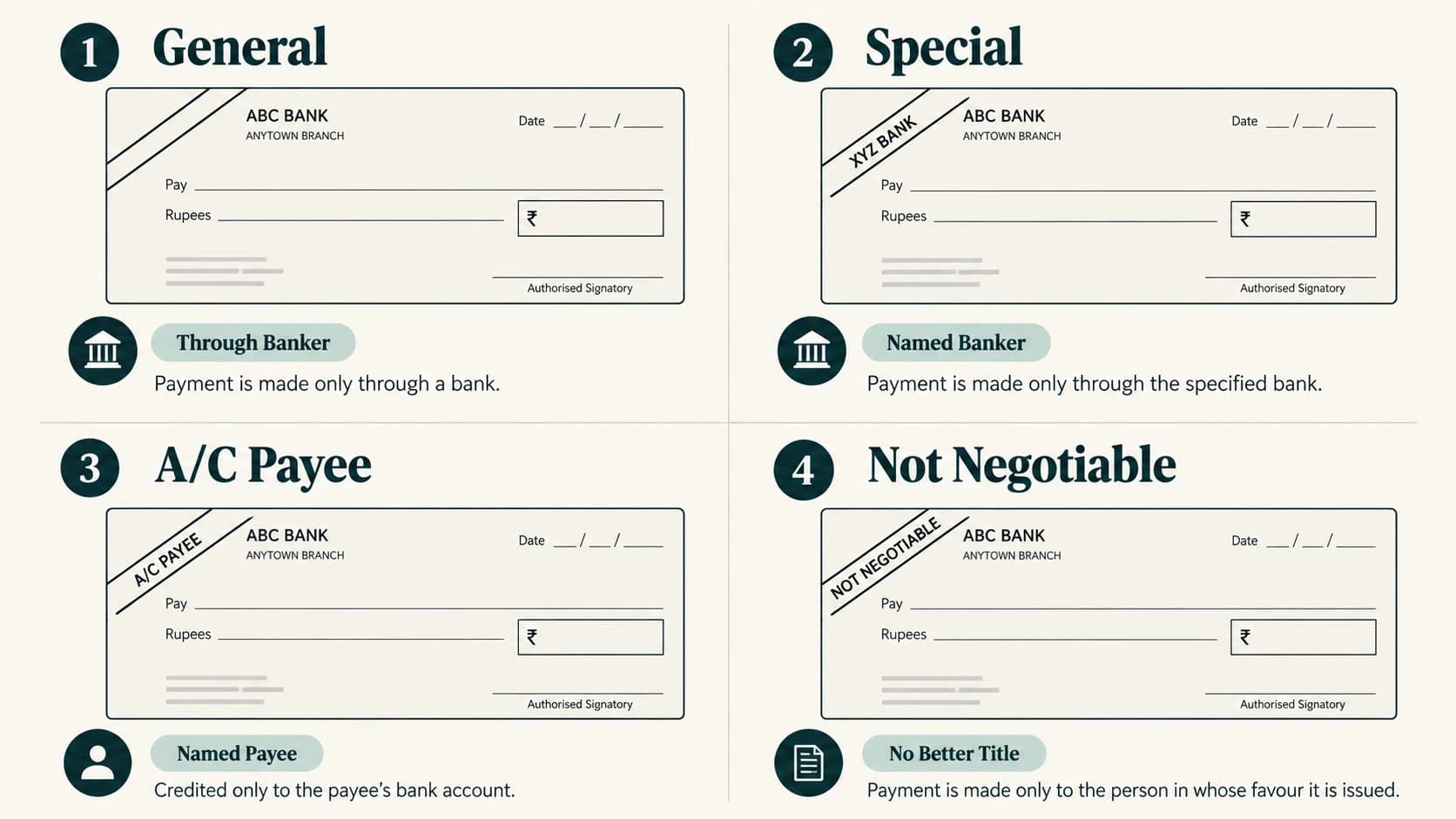
General crossing — Section 123
A cheque is crossed generally when it bears two parallel transverse lines, with or without “& Co.” or “not negotiable” as specified in the statute. General crossing tells the paying banker to pay to a banker, not across the counter in cash to an ordinary presenter.
Practical example: An employee receives a generally crossed salary reimbursement cheque. It should be collected through a bank.
Special crossing — Section 124
A cheque is crossed specially when it bears the name of a banker (with or without “not negotiable”) as specified. It directs payment to the named bank or, under the Act, its agent for collection.
Example: A cheque is specially crossed to “Bank A”. Bank B cannot simply present it as if no named banker existed; the statutory permitted payment route matters.
General vs special crossing
| General | Special |
|---|---|
| Two parallel lines | Name of a particular banker |
| Pay only to a banker | Pay to named banker or permitted collection agent |
| No particular bank named | Specific banker named |
| Reduces counter-cash risk | Adds directed collection route |
3. “Account Payee” crossing
In banking practice, A/C Payee or Account Payee Only instructs collection credit for the named payee's account. It is a strong operational safeguard recognised in RBI customer-service guidance, although it should not be misdescribed as a separately defined Section 123 statutory type of crossing.
The collecting bank normally should not deposit the proceeds of an account-payee cheque into an unrelated third-party account. Limited regulatory exceptions, if any, depend on specific current instructions.
Example: A cheque reads “Pay Mira” and carries “A/C Payee.” It should not ordinarily be credited to Mira's friend's account merely because the friend endorsed it.
4. “Not Negotiable” crossing — Section 130
The words Not Negotiable can be placed with a general or special crossing. A surprising exam fact is that the expression does not simply mean that ownership cannot pass at all. Rather, the person taking the cheque cannot obtain or give a better title than the transferor had, under Section 130.
Example: A fraudulent holder transfers a cheque bearing “Not Negotiable” to an unsuspecting person. That recipient cannot rely on good faith alone to acquire better title than the fraudulent transferor.
Memory rule: Not negotiable = no better title.
*Account payee = credit to named payee's account (banking collection control).
5. Can a cheque be crossed after issue?
Section 125 permits specified crossing actions by the holder and, in particular circumstances, by the banker receiving it for collection. The legal crossing must be distinguished from an unauthorised material alteration such as changing the payee or amount. Not all markings added after issue are automatically unlawful, but not all alterations are acceptable.
6. What is endorsement?
An endorsement is a signature placed on the instrument for negotiation, according to Section 15. It can transmit rights under an otherwise negotiable order instrument. A chain of endorsements can help show how an instrument passed between holders.
Common instructional categories
| Endorsement | Teaching meaning |
|---|---|
| Blank/general endorsement | Signature without specifying endorsee; can change negotiation character under applicable rules |
| Special/full endorsement | Specifies person to whom payment is to be made |
| Restrictive endorsement | Limits or directs further negotiation or collection |
| Conditional endorsement | Attaches a condition, with statutory consequences |
| Sans recourse / without recourse | Attempts to exclude endorser's personal liability under applicable law |
These categories are teaching labels; statutory effects depend on the exact wording and legal conditions.
Example: full endorsement
“Pay to the order of Kiran” followed by the endorser's signature. The named endorsee is Kiran.
Example: restrictive endorsement
“Pay Kiran only” or an endorsement explicitly for collection can restrict onward negotiability or indicate the purpose of transfer.
Bank collection endorsement
A collecting bank may stamp/endorse instruments for clearing; this operational bank endorsement is not the same as a customer signing away ownership of every account-payee cheque.
7. Alterations and the cheque safety checklist
Banks commonly verify:
- Date within presentment validity;
- Drawer’s signature against mandate and specimen/electronic records;
- Amount in words and figures;
- Payee and any crossing;
- Available funds / sanctioned drawing arrangements;
- Stop-payment or freeze instructions;
- Material alteration / suspected forgery;
- Special controls such as Positive Pay where applicable;
- Image/readability and MICR details in CTS.
Banks should not imagine that every technical defect can be cured by a call to the presenter. When a cheque is materially changed, legal requirements, RBI directions and internal controls may require a fresh instrument.
8. Open cheque vs crossed cheque
An open (uncrossed) cheque, if otherwise payable, can be payable over a bank counter subject to safeguards and account rules. A crossed cheque is intended for payment through a bank. Crossing is not a magical guarantee against fraud: forged endorsements, account misuse and identity errors can still occur.
9. Bearer vs order cheque
A bearer cheque is generally payable to the bearer under the instrument wording and law; an order cheque is intended to be paid to the named party or properly endorsed party. Banks must follow current risk-control, account-mandate, KYC and presentment rules. The labels bearer, order, crossed and account payee answer different questions and may combine on the same cheque.
10. Special date situations
Post-dated cheque
A cheque carrying a future date is a post-dated cheque. It is ordinarily not payable before that written date. Once the date arrives, it can be presented subject to validity and other requirements.
Ante-dated cheque
A cheque carrying a date earlier than the actual issue date is ante-dated. It is not invalid solely because of that fact, but its validity and any suspicious circumstances need examination.
Stale cheque
A cheque presented beyond the valid presentment period is stale. RBI's banking rule is generally three months from the instrument date. The bank should not simply honour a stale cheque on the theory that the account has funds.
Undated cheque
An undated cheque is incomplete for normal processing. It should not be treated as a normally payable, fully valid dated cheque without proper completion and controls.
11. Cheque dishonour
Dishonour occurs when the paying bank does not pay the cheque as presented, and the cheque is returned with the relevant reason.
Possible return reasons include:
- insufficient funds;
- payment exceeds agreed arrangement;
- signature mismatch;
- account closed;
- stop-payment instruction;
- stale/post-dated instrument;
- material alteration;
- mismatch of mandatory cheque fields;
- instrument image/technical defect;
- legal or account restrictions.
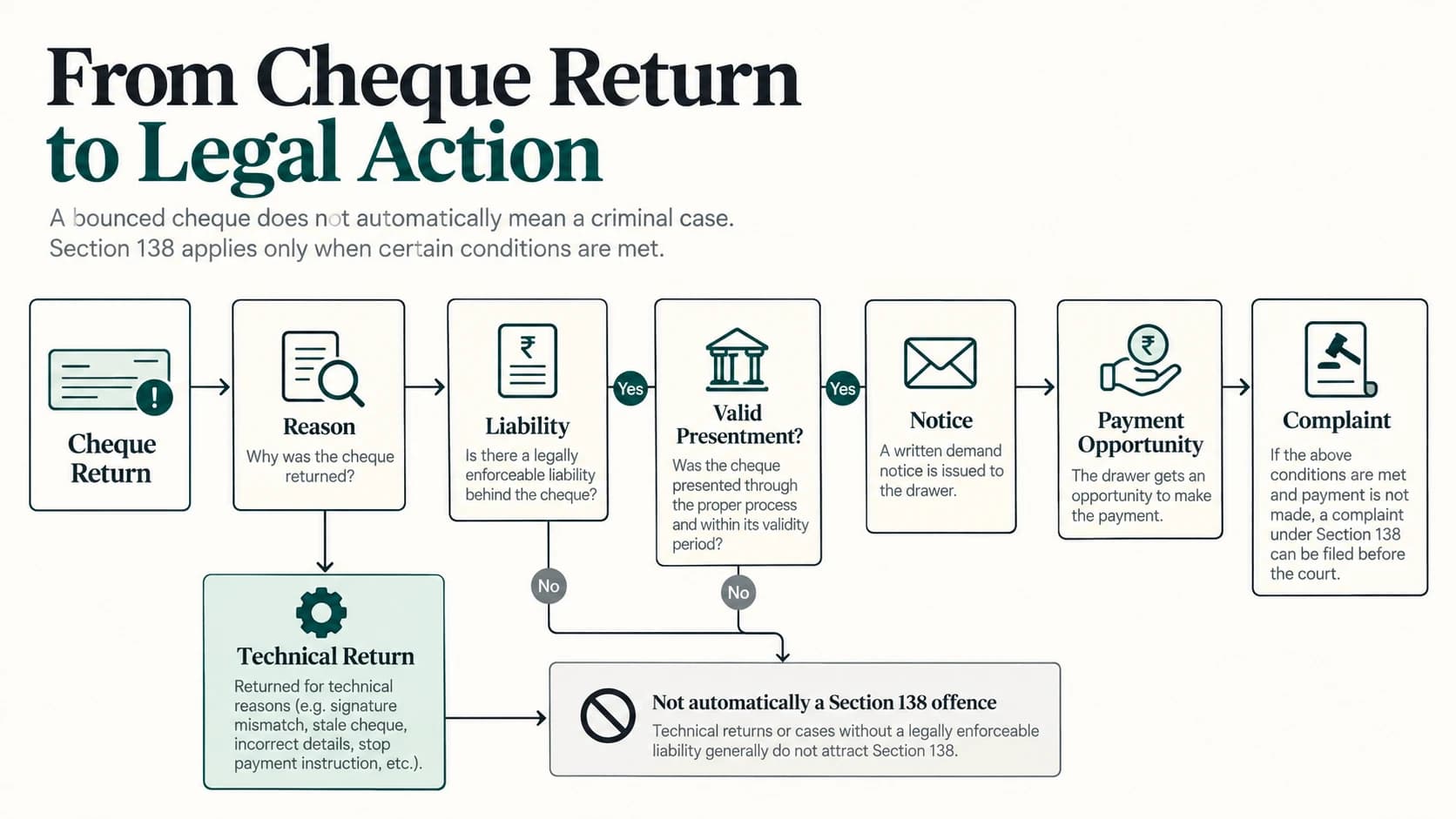
A returned cheque is not necessarily a criminal offence. A forged-signature or technically defective cheque is not automatically a Section 138 prosecution.
12. Section 138 — dishonour for insufficient funds and related situations
Section 138 of the Negotiable Instruments Act sets out an offence when a cheque issued for discharge in whole or part of a legally enforceable debt or other liability is dishonoured on the statutory grounds and the payee/holder follows the statutory steps.
The general chain is:
Cheque for legally enforceable debt/liability
→ present within applicable validity
→ dishonoured
→ written demand notice within statutory period
→ drawer fails to pay within statutory period
→ complaint under Section 142.
Under the Act, the notice is to be sent within 30 days of the payee/holder receiving information from the bank of dishonour, and the drawer has 15 days after receiving the notice to make payment. The complaint-filing window under Section 142 is normally one month after the cause of action, subject to the statutory scheme and court powers.
Why this is not instant criminal liability: The drawer is given a lawful chance to pay after formal notice. Not every bank return goes straight to court.
Key legal distinctions
- Legally enforceable debt: A gift or a payment without an enforceable underlying obligation may raise different issues.
- Presentation: Must be within the applicable validity, not an indefinite future period.
- Bank return: Proved through appropriate evidence, including cheque return memo where relevant.
- Notice: A clear legal demand must be made within the statutory window.
- Opportunity to pay: Failure after the applicable notice period creates the cause of action.
- Filing: Complaint must follow Section 142 and other relevant law.
Penal provision (statutory textbook fact): Section 138 permits imprisonment up to two years or fine up to twice the cheque amount or both, subject to adjudication and the applicable law. This is a maximum statutory possibility, not an automatic sentence for any returned cheque.
What about stop payment or closed accounts?
Judicial interpretation of Section 138 can cover some returns beyond the literal shorthand “insufficient funds,” depending on the underlying obligation and facts. A blanket statement “stop payment can never attract Section 138” is unsafe. Conversely, a bank return marked “stop payment” is not proof that the drawer committed the offence without examining the statute and evidence.
Educational notice: The process summary is for exam learning, not instructions for conducting litigation. Legal advice requires the actual documents and current case law.
13. Sections 139, 142, 143A, 147 and 148 — where they fit
| Section | Broad topic |
|---|---|
| 139 | Presumption in favour of the holder, subject to legal rebuttal |
| 142 | Conditions for court cognizance, complaint limitation/jurisdiction framework |
| 143A | Court power concerning interim compensation in specified proceedings |
| 147 | Compounding of offences under the Act |
| 148 | Appellate-court power concerning deposit in appeals against conviction |
For ordinary banking exams, Section 138 is the high-priority anchor; Sections 139 and 142 are useful extensions. Avoid memorising complex procedural issues through one-line coaching mnemonics alone.
14. Collecting banker vs paying banker
Paying banker
The bank on which the cheque is drawn. It must act according to the cheque mandate and legal/regulatory conditions. Section 31 and the crossed-cheque provisions are relevant to the payment duty and potential liability.
Collecting banker
The bank that accepts the cheque for collection on behalf of the payee/customer, presents it and seeks credit of proceeds.
The NI Act includes statutory protection for bankers collecting payment of crossed cheques in good faith and without negligence (Section 131, subject to its conditions). This is not an unconditional immunity.
Example: A collecting bank deposits a crossed cheque into an unrelated person's account without making reasonable checks. Merely labelling itself “collecting banker” does not ensure protection in every dispute.
15. Material alteration and fraud
Section 87 can render an instrument void against a party who did not consent to a material alteration, subject to legal qualifications. Changes affecting amount, payee, date or obligation can be material. Forgery of the drawer's signature is a separate fundamental authorisation problem.
Banking controls such as Positive Pay, signature verification, image checking and account-payee collection restrictions reduce risks but cannot guarantee every forged or fraudulent transaction will be prevented.
16. Worked example: three cheque returns
Case A — insufficient balance: Arun issues a cheque in payment of a genuine business invoice. It is returned for insufficient funds. The payee may have the potential Section 138 route if all statutory conditions are met.
Case B — cheque dated next month: An employee deposits it today. Return/non-processing relates to the future date; it is not automatically a Section 138 offence merely because the bank did not pay today.
Case C — image too faint in clearing: Bank requests a clearer instrument/re-presentation. This is a technical cheque-processing issue, not evidence of a legally enforceable debt being dishonoured for want of funds.
17. Common confusions — Lesson 13-02
- Account Payee vs Not Negotiable: Restricting collection-credit destination differs from limiting title available to a transferee.
- General vs Special crossing: General directs payment through a banker; special names one.
- Endorsement vs crossing: Endorsement deals with transfer; crossing deals with paying-bank channel/destination.
- Stale cheque vs post-dated cheque: Stale = too old; post-dated = future-dated.
- Bank return vs Section 138 offence: Not equivalent.
- Positive Pay vs guaranteed payment: Confirmation details are an anti-fraud measure, not an assurance of sufficient funds.
- Cheque bounce vs loan default: May overlap factually but governed by different legal concepts.
Quick check — BA-13-02
- What is the signature purpose in an endorsement?
Answer: Negotiation/transfer under NI law. - Does “Not Negotiable” invariably mean the cheque can never be transferred?
Answer: No; Section 130 limits title acquired. - Who collects the cheque for the payee?
Answer: Collecting banker. - What is the normal RBI cheque-validity period?
Answer: Three months from the cheque date (verify current instructions). - Is a cheque return memo alone a conviction under Section 138?
Answer: No. - Why does Section 138 contain a notice period?
Answer: It provides a formal demand and opportunity for the drawer to pay.