
Negotiable Instruments: Promissory Notes, Bills of Exchange and Cheques
Negotiable Instruments: Promissory Notes, Bills of Exchange and Cheques. A detailed chapter in Negotiable Instruments & Core Banking Operations, with explanations and examples for Indian banking examinations.
By Akhilesh Saini · Reviewed 8 Oct 2026
1. Why banks study negotiable instruments
A commercial transaction can involve delivery of goods today and payment tomorrow. Both buyer and seller need a reliable record of who must pay, whom, how much and under what conditions. Negotiable instruments make payment obligations easier to express, transfer and enforce.
Consider a wholesaler who supplies goods on credit to a shopkeeper. The wholesaler might use a written promise to pay, draw a bill requiring acceptance or receive a cheque. All three are related but create different legal relationships.
The Negotiable Instruments Act, 1881 is the principal Indian statute dealing with these instruments. It defines and governs their important features, liabilities and remedies. The Act came into force in 1882, but its legal principles still support modern banking operations.
2. Meaning of a negotiable instrument
An instrument is a document embodying a monetary right. Negotiability refers to the ability to transfer it in a legally recognised way, normally so the transferee can enforce the instrument in the transferee’s own name.
Section 13 recognises promissory notes, bills of exchange and cheques payable to order or bearer as negotiable instruments. A document labelled “negotiable instrument” is not necessarily one; the requirements of the applicable law matter.
Simple illustration: A debtor writes on paper, “I may pay ₹10,000 someday if business improves.” This is not the same as an unconditional promise to pay a certain sum. The uncertainty matters legally.
Features commonly tested
- Written form: It records an obligation or instruction.
- Money: The payment concerns a sum of money, not delivery of goods instead of money.
- Certainty: Parties, amount and obligation must satisfy the relevant definition.
- Transferability: Where payable to order or bearer and otherwise valid, it can pass by the relevant method.
- Holder’s rights: The lawful holder can claim payment subject to the applicable legal rules.
Do not convert these features into an unsupported claim that every bank document is negotiable. Deposit receipts, ordinary invoices, payment screenshots and bank-account balances are not automatically negotiable instruments merely because they involve money.
3. Promissory note — Section 4
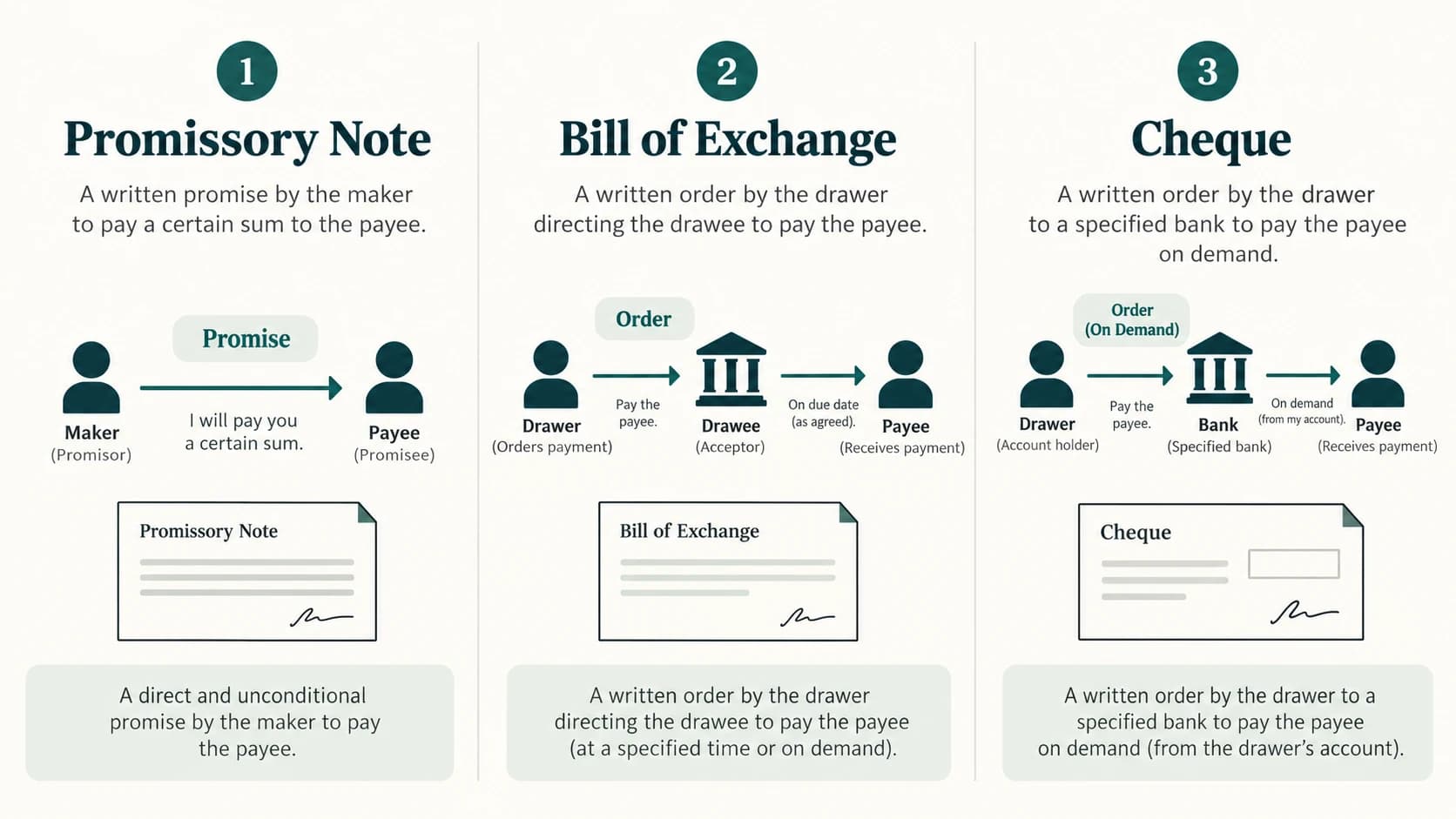
A promissory note is a written instrument (other than a banknote or currency note), containing an unconditional undertaking, signed by the maker, to pay a certain sum of money only to, or to the order of, a certain person, or to the bearer of the instrument, subject to the statutory wording and relevant restrictions in Indian law.
Every word is purposeful:
| Ingredient | Meaning |
|---|---|
| Writing | The obligation is expressed in a document. |
| Unconditional undertaking | The maker promises to pay, not merely acknowledges a debt. |
| Maker’s signature | Identifies the person undertaking payment. |
| Certain amount | The amount is determinable. |
| Money only | The promised performance is payment of money. |
| Identifiable payee/payee arrangement | Must satisfy statutory requirements. |
Example (teaching illustration): “I promise to pay Neha or her order ₹25,000 on demand,” signed by Ravi. Ravi is the maker; Neha is the payee.
Compare: “I owe Neha ₹25,000.” A bare acknowledgement of debt is not necessarily an unconditional undertaking to pay; drafting matters.
Another contrast: “I promise to give Neha one motorcycle worth ₹25,000.” The obligation is to deliver goods, so it is not a promissory note satisfying the money-only requirement.
Parties
- Maker: Gives the promise; bears the primary obligation.
- Payee: Person to be paid.
- Endorser/endorsee: May arise if a legally negotiable instrument is transferred by endorsement.
Memory hook: Promissory note = “I promise to pay.”
4. Bill of exchange — Section 5
A bill of exchange is a written instrument containing an unconditional order, signed by the maker/drawer, directing a certain person to pay a certain sum of money only to, or to the order of, a certain person, or to the bearer, subject to the Act.
Example: A wholesaler, Asha, sells goods worth ₹80,000 to Bharat on credit. Asha draws a bill ordering Bharat to pay ₹80,000 to Asha (or her order) after a specified period. Bharat may accept the bill by signing an acceptance.
Parties
- Drawer: Person issuing the order, e.g., Asha.
- Drawee: Person directed to pay, e.g., Bharat.
- Acceptor: Drawee who accepts the bill; becomes primarily liable under the accepted bill.
- Payee: Person to receive the money.
These roles may overlap depending on the instrument; not every bill has three different human beings.
The crucial word is “order”
A bill says to another person: “You pay.” The drawer does not merely promise personal payment in the way a promissory-note maker does.
Acceptance of a bill
The drawee becomes the acceptor after giving a valid acceptance under the Act. Acceptance is fundamental to a time bill that is to be paid by an acceptor. A holder cannot assume that the named drawee has accepted merely because the drawer wrote the person’s name.
Trade use
Bills can be useful in trade finance because the seller’s receivable can be documented, accepted and, subject to banking rules and credit assessment, sometimes discounted by a bank. This links to bills purchased/discounted in Module 06.
Memory hook: Bill of exchange = “You pay.”
5. Cheque — Section 6
A cheque is a special type of bill of exchange drawn on a specified banker and not expressed to be payable otherwise than on demand. The statutory definition also encompasses specified electronic and truncated forms.
Example: A customer of Bank X writes a cheque directing Bank X to pay ₹12,000 to Priya.
- Drawer: Customer issuing the cheque.
- Drawee: Bank X.
- Payee: Priya.
The bank is the drawee; a cheque is not a promise by the customer to personally hand over cash at the payee’s home.
Why a cheque differs from an ordinary bill
- Its drawee must be a specified banker.
- It is payable on demand as a type of instrument.
- It is normally paid out of the drawer’s account or permitted facility with the bank.
- Acceptance by the drawee banker is not the normal commercial acceptance process used for time bills.
- The bank follows signature, mandate, funding, validity and fraud-control checks before payment.
6. Promissory note vs bill vs cheque
| Point | Promissory Note | Bill of Exchange | Cheque |
|---|---|---|---|
| Form | Unconditional promise | Unconditional order | Order on specified bank |
| Basic phrase | “I promise to pay” | “Pay this person” | “Bank, pay this person” |
| Primary parties | Maker, payee | Drawer, drawee, payee | Drawer, bank, payee |
| Need for drawee acceptance | Not applicable | Often relevant, especially time bills | Not ordinarily required as bill acceptance |
| Demand/future payment | Depends on lawful terms | Demand or after time | Payable on demand |
| Banking use | Debt documentation | Trade credit / bills | Payment from bank account |
Exam trap: Every cheque is a bill of exchange, but not every bill of exchange is a cheque. A bill drawn on a trader rather than a banker is not a cheque.
7. Holder and holder in due course
Holder — Section 8
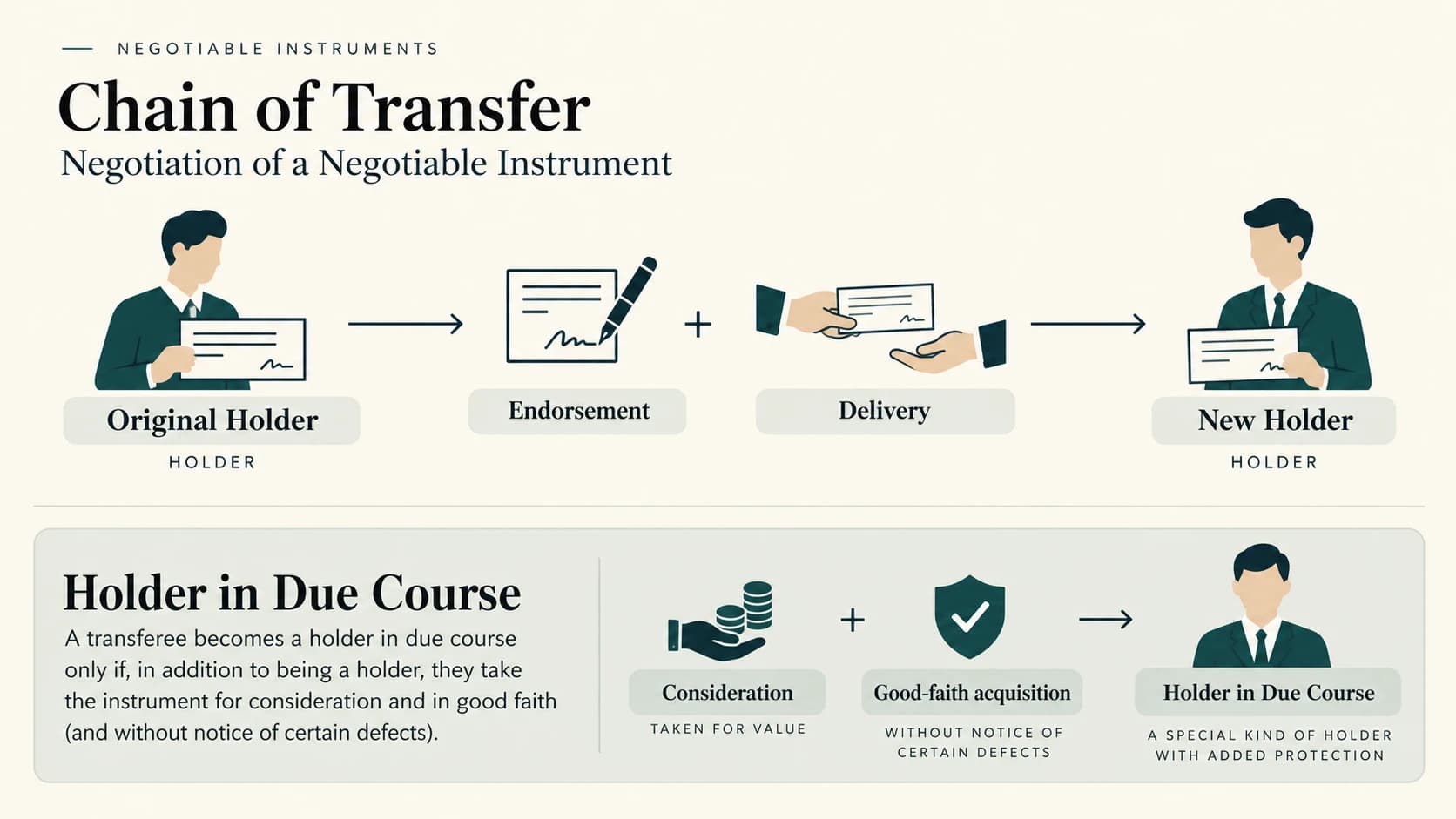
A holder is a person entitled in their own name to possession of the instrument and to receive or recover the amount due. Physical possession alone does not automatically make a thief the legal holder.
Holder in due course — Section 9
A holder in due course (HDC) acquires a qualifying negotiable instrument for consideration, before it becomes overdue and without sufficient cause to believe there was a defect in the transferor’s title, as defined by the Act.
The HDC concept helps commercial confidence by protecting a qualifying good-faith acquirer in ways an ordinary holder may not enjoy.
Example: A bill lawfully negotiable by endorsement is transferred for value to a genuine business supplier before maturity. If that person meets all Section 9 conditions, HDC protection can arise. The label “HDC” is not automatic merely because the person received the paper.
Holder vs HDC
| Holder | Holder in due course |
|---|---|
| Has legal entitlement to possession/payment | Must satisfy extra statutory conditions |
| Need not necessarily acquire for consideration | Must acquire for consideration |
| May take with awareness of title defects | Must lack sufficient cause to suspect defective title |
| Ordinary rights | Potential enhanced protection under NI Act |
8. Order vs bearer instruments
Payable to order
An order instrument is payable to a named person or their order, depending on statutory terms. Its usual negotiation requires endorsement plus delivery.
Payable to bearer
A bearer instrument is payable to the person in possession under the applicable definition; its negotiation generally occurs by delivery. Indian statutory restrictions and banking rules affect actual issue and use; do not infer that any person can freely issue all forms of bearer instruments.
Exam shortcut: Order → endorse + deliver; bearer → deliver.
9. Negotiation vs assignment
Negotiation is the special statutory transfer of a negotiable instrument so that the transferee becomes its holder.
Assignment is the general legal transfer of contractual/property rights, ordinarily subject to the applicable assignment law, documentation and defences.
The difference matters because negotiation may confer the distinctive NI-Act rights of a holder in due course. Not every assignment has those consequences.
10. Endorsement basics — Section 15
An endorsement is signing the instrument (or an attached slip/allonge as legally permitted) for the purpose of negotiation. The person signing is the endorser; the recipient is the endorsee.
We will examine types of endorsement in Lesson 13-02.
11. Maturity and time concepts
A demand instrument is payable when lawfully demanded/presented. A time bill or note can be payable after a specified period. The NI Act contains rules about maturity, days of grace in eligible cases, and how maturity is calculated. These rules do not mean ordinary cheques receive three days of grace like some time instruments.
Important separation: The maturity of a time bill is a legal payment due-date concept; the three-month cheque validity under RBI’s banking instructions is a presentment/operational validity rule. They are not the same.
12. Incomplete, ambiguous or altered instruments
A banker may encounter:
- missing signature;
- mismatch of amount in figures and words;
- overwritten payee name;
- incomplete material terms;
- suspected forged signature;
- date issues.
These are not merely cosmetic details. The Act includes provisions on ambiguous instruments, inchoate stamped instruments where relevant, and material alteration (Section 87). The legal effect of an alteration depends on consent and statutory exceptions; banking processing may separately require a fresh cheque rather than an edited one.
Words vs figures — Section 18
Where the amount is stated differently in words and figures, the NI Act provides an interpretive rule favouring the amount stated in words. Operationally, a bank may still return a discrepant cheque under its clearing/verification controls rather than manually repairing the instrument. Never teach that Section 18 forces the bank to pay a suspicious mismatch.
13. Hundi and other instruments
Traditional Indian trade practices include hundis. The NI Act acknowledges local usages relating to instruments in oriental languages, subject to its provisions. A hundi is worth recognising as a historical commercial-credit instrument, but banking-exam fundamentals concentrate on the three named statutory types.
14. Worked example: choosing an instrument
Situation A: A person wants to make a clear written undertaking to repay ₹30,000.
Likely concept: Promissory note (if appropriately drafted).
Situation B: A wholesaler instructs the buyer to pay the wholesaler after 60 days and buyer accepts.
Likely concept: Accepted bill of exchange.
Situation C: The buyer tells their bank to pay ₹30,000 from their bank account now.
Likely concept: Cheque.
What changes is who promises/orders, who must pay and how the instrument is processed.
15. Common confusions — Lesson 13-01
- Promissory note vs IOU: Acknowledging debt is not automatically an unconditional promise to pay.
- Bill vs cheque: Both are orders, but a cheque is drawn on a specified banker and payable on demand.
- Holder vs bearer: A holder is legally entitled; not everyone physically carrying an instrument is entitled.
- Holder in due course vs ordinary holder: The former satisfies stricter conditions and can enjoy stronger rights.
- Endorsement vs signature verification: Endorsement helps transfer rights; drawer signature verification protects payment authorisation.
- Time-bill maturity vs cheque validity: Different concepts and rules.
Quick check — BA-13-01
- Which instrument says “I promise to pay”?
Answer: Promissory note. - Which instrument is drawn on a banker and payable on demand?
Answer: Cheque. - Who becomes principally liable after a valid acceptance of a time bill?
Answer: Acceptor. - Does all physical possession make someone a legal holder?
Answer: No. - What additional element is essential for HDC status?
Answer: Among other statutory conditions, acquisition for consideration without sufficient cause to suspect title defect. - Does Section 18 mean banks must honour every mismatched cheque?
Answer: No; operational controls may require return/investigation.