
RBI Integrated Ombudsman and Grievance Redressal
RBI Integrated Ombudsman and Grievance Redressal. A detailed chapter in KYC, AML, Cybersecurity & Customer Protection, with explanations and examples for Indian banking examinations.
By Akhilesh Saini · Reviewed 8 Oct 2026
1. Why banks need complaint escalation
A customer may face an unexplained debit, unfair charge, delayed refund, defective service or unanswered complaint. Institutions must first have an effective internal grievance redressal mechanism. If that fails, a covered complaint can move to an independent RBI-administered Ombudsman process.
The mechanism is designed to address deficiency in service, not replace every court or criminal investigation.
2. The current scheme: RB-IOS, 2026
The Reserve Bank — Integrated Ombudsman Scheme, 2026 (RB-IOS, 2026) came into force on 1 July 2026 and replaced the RB-IOS, 2021 for complaints governed by the new scheme.
Essential 2026 exam update: Older study material describing RB-IOS, 2021 as the active scheme, or quoting its filing periods/compensation as current, is outdated for newly governed complaints.
Existing complaints received before 1 July 2026, associated appeals and earlier Awards continue under transitional arrangements of the previous scheme.
3. Historical progression
Before consolidation, RBI operated separate Ombudsman schemes for:
- banking;
- NBFCs;
- digital transactions.
The 2021 Integrated Scheme combined them into the "One Nation One Ombudsman" model. The 2026 Scheme replaced and updated the framework while retaining the principle of centralised, cost-free redress for eligible complaints.
Historical dates help understand exam questions; they must not be mistaken for current rule versions.
4. Deficiency in service
A deficiency in service means a shortcoming or inadequacy in a service that the regulated entity is required to provide by law or otherwise, whether or not actual financial loss occurs.
Examples can include failures in account service, refund handling, required customer communication or complaint processing—subject to maintainability and evidence.
5. Which entities are covered?
The 2026 scheme covers specified categories, including:
- commercial banks and RRBs;
- specified co-operative banks (with prescribed coverage rules);
- qualifying categories of RBI-registered NBFCs, with exclusions and applicable thresholds;
- non-bank prepaid-payment-instrument issuers;
- Credit Information Companies.
Not every entity regulated by RBI is automatically covered. For example, some NBFC categories are expressly excluded. Verify the current scheme's appliesTo details when giving specific guidance.
6. Complain to the regulated entity first
The first complaint normally goes to the bank/regulated entity. Maintain evidence of submission and the complaint or acknowledgement number. The customer should ask for a reasoned response through the bank's designated grievance channel.
A branch visit or casual telephone conversation with no record may be hard to prove later. Use formal channels and preserve dates.
7. Internal escalation and Internal Ombudsman
Certain regulated entities are required to have an Internal Ombudsman (IO) under RBI's 2023 Directions. This is an independent apex-level reviewer within the institution's grievance framework.
The Internal Ombudsman can review complaints proposed for partial/full rejection as required. It is not the same as the external RBI Ombudsman and is generally not a separate walk-in public complaint desk to which every customer files directly.
8. When can a complaint reach RBI?
Under RB-IOS, 2026, the customer generally first approaches the regulated entity and may go to the RBI Ombudsman if:
- dissatisfied with the entity's reply/resolution; or
- no reply is received within 30 days or a longer applicable RBI/NPCI/card-network timeline, where specified.
The current scheme also states a time window for filing after that stage. Read the precise 2026 provisions rather than older one-year shorthand.
9. The new 90-day filing window
Under the 2026 scheme, an otherwise admissible complaint should generally be filed with the RBI Ombudsman within 90 days from the date the applicable waiting period expires or the date of the regulated entity's last communication, whichever is later.
The original complaint to the regulated entity must itself have been within the relevant statutory limitation period.
This is a major change to recognise in updated banking-exam notes.
10. RBI Complaint Management System — CMS
The main official online complaint channel is:
Other prescribed modes include:
- e-mail to the Centralised Receipt and Processing Centre (CRPC);
- a signed physical complaint to the CRPC using its current address/procedure.
RBI's contact centre can guide customers, but it does not itself lodge their complaint merely because they call it.
11. One Nation One Ombudsman
The complainant need not find a specific city-based Ombudsman corresponding to the bank branch. RBI allocates matters through its centralised system.
This is a jurisdiction-neutral complaint entry model, not a promise that every complaint will be upheld.
12. What evidence should a complainant prepare?
A useful complaint package includes:
- customer identity and contact details;
- name of bank/regulated entity;
- account/loan/card/transaction reference as relevant;
- chronology of events;
- proof and date of first complaint to the entity;
- the entity's response, if any;
- statements/screenshots/documents relevant to the deficiency;
- remedy sought and basis for loss/compensation.
Avoid publishing full account numbers, credentials or other sensitive data in public forums.
13. Which matters may be outside the scheme?
Examples of non-maintainable cases can include:
- failure to complain to the entity first;
- filing after applicable deadline;
- certain pending/decided matters in another judicial/quasi-judicial forum;
- issues involving pure commercial judgement rather than deficient service;
- disputes between an entity and its employee;
- a complaint against an entity outside the 2026 scheme's covered categories;
- incomplete, abusive, frivolous or otherwise excluded complaints.
A pending criminal investigation is not always the same as the exact service grievance before RBI; the scheme describes nuanced exclusions. Avoid simplistic claims that any police complaint automatically bars Ombudsman access.
14. Resolution methods
An eligible grievance may result in:
- Settlement through facilitation, advice or conciliation;
- Award directing action and/or compensation where warranted;
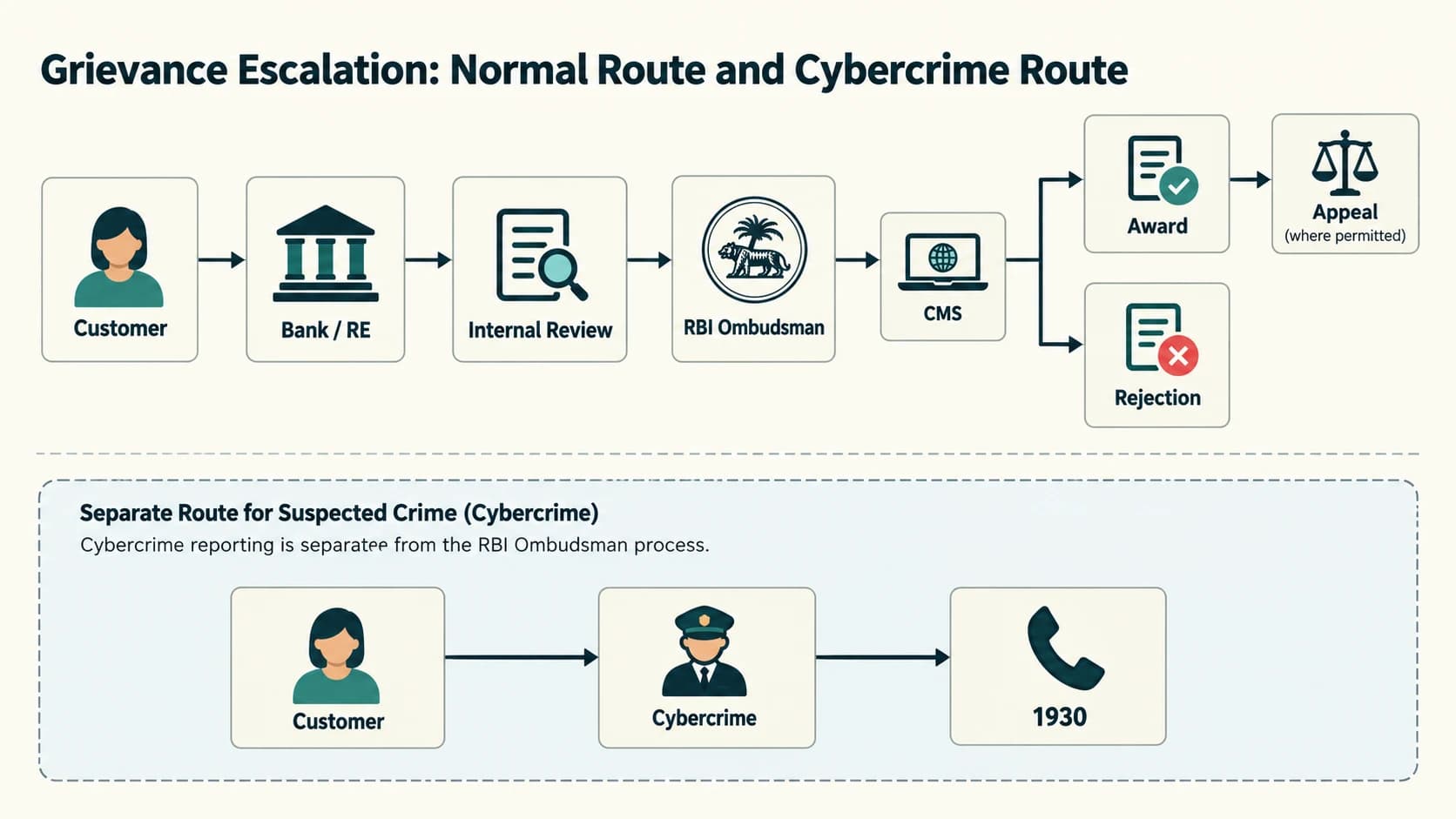
- Rejection under the scheme's grounds.
The process aims to be low-cost and non-adversarial. It is not a full substitute for civil trials that require extensive oral evidence.
15. Compensation under the 2026 scheme
The scheme distinguishes the disputed transaction amount from permissible compensation for loss.
- There is no blanket ceiling on the disputed transaction amount brought for Ombudsman settlement/Award.
- The Ombudsman may award compensation for consequential loss up to the prescribed ₹30 lakh limit.
- Separately, compensation for loss of time, expenses, harassment or mental anguish may be up to ₹3 lakh under the scheme.
The amount actually awarded depends on the facts and legal basis; the upper limit is not an automatic entitlement.
16. 2021 vs 2026 — critical comparison
| Feature | Former RB-IOS, 2021 | RB-IOS, 2026 (current for new cases) |
|---|---|---|
| Operational status | Superseded for new cases | In force from 1 July 2026 |
| General model | One Nation One Ombudsman | Centralised jurisdiction-neutral framework retained |
| Consequential-loss compensation cap | ₹20 lakh | ₹30 lakh |
| Additional time/harassment compensation cap | ₹1 lakh | ₹3 lakh |
| Filing window | Older one-year-style admissibility rules | New generally 90-day post-trigger filing window |
| Appeals | Included certain appealable rejections/Awards | Appeal structure focused on Awards under new scheme |
Publishing rule: Do not render both versions as simultaneously current.
17. Appeals in the 2026 framework
A complainant aggrieved by an Award may appeal within the prescribed 30 days, subject to possible extension up to another 30 days for sufficient cause. A regulated entity may appeal qualifying Awards subject to approvals/restrictions; not every outcome is appealable.
Do not repeat old 2021 notes saying all eligible rejected complaints have the same appeal route under 2026.
18. Acceptance and compliance with an Award
Under the scheme, an Award generally requires the complainant's acceptance in the prescribed manner within the applicable time, unless an appeal is filed. The regulated entity then complies or pursues a permitted appeal. These are procedural obligations separate from merely receiving the Award.
19. Complaint vs appeal vs cybercrime report
| Procedure | Core question | Main channel |
|---|---|---|
| Complaint to bank/RE | Has the institution handled the product/transaction properly? | Bank/RE grievance channel |
| RBI Ombudsman | Is there eligible deficiency in service after required escalation? | RBI CMS/CRPC |
| Ombudsman appeal | Should an Award be reviewed under permitted grounds? | RBI appellate process |
| Financial cybercrime report | Was a cybercrime committed and can funds/suspects be traced? | 1930 / cybercrime.gov.in |
| Consumer/court remedy | Other legal relief based on facts and forum jurisdiction | Applicable legal forum |
The channels may overlap, but each serves a different purpose.
20. What the Ombudsman cannot promise
The process is not a guarantee of:
- approval of a rejected loan;
- recovery of every scam transfer;
- success against an entity not covered by the scheme;
- criminal conviction;
- compensation without proof of a relevant deficiency/loss;
- appeal from every rejection.
A good complaint identifies a specific service obligation that the regulated entity failed to meet.
21. Practical sample chronology
Illustrative case: A customer reports a bank service failure and files a written grievance with reference number. The bank sends a reply that does not address the alleged deficiency. The customer reviews RBI's current coverage and timing conditions and submits a CMS complaint with the original complaint, reply and evidence.
RBI's Ombudsman process then examines maintainability and the merits of the service complaint. Outcomes can include settlement, Award or reasoned rejection.
22. Exam memory map
Bank grievance → Internal review/IO where applicable → RBI Ombudsman (2026) → Award and permitted appeal.
Cyber fraud emergency: Report to bank immediately + 1930/portal. Do not wait for the regular Ombudsman timetable before reporting suspicious debits.
BA-12-05 — Quick check
- Which RBI Integrated Ombudsman scheme applies to newly governed complaints now?
- Must customers first complain to the regulated entity?
- Is the Internal Ombudsman the same as the RBI Ombudsman?
- What is the new 2026 general filing-window concept?
- Is compensation automatically equal to the cap?
- Does calling the RBI contact centre itself file a complaint?
Answers: (1) RB-IOS, 2026. (2) Generally yes. (3) No. (4) Generally 90 days from the prescribed trigger/last communication, with detailed conditions. (5) No. (6) No.