
Basel I, Basel II and Basel III
Basel I, Basel II and Basel III. A detailed chapter in Banking Laws, Basel, Capital & Risk, with explanations and examples for Indian banking examinations.
By Akhilesh Saini · Reviewed 8 Oct 2026
1. What does 'Basel' mean?
Banks operate across national borders. A failure in one country can affect the payment, credit and funding systems of others. Supervisory authorities therefore cooperate internationally to agree minimum prudential standards.
The Basel Committee on Banking Supervision (BCBS) is the primary international standard-setting forum for bank prudential supervision. It is associated with the Bank for International Settlements (BIS) in Basel, Switzerland.
Important:
BCBS is a standard-setter, not the direct banking regulator of an Indian bank. RBI must implement relevant standards through India's legal/regulatory system.
2. Why international standards were needed
Banks can otherwise compete by taking more risk while holding very thin capital, particularly across jurisdictions with different rules. International minimums reduce this ‘race to the bottom’ and give supervisors a common risk language.
Standards are not identical to laws. Countries can adopt stricter domestic rules and have different implementation timelines.
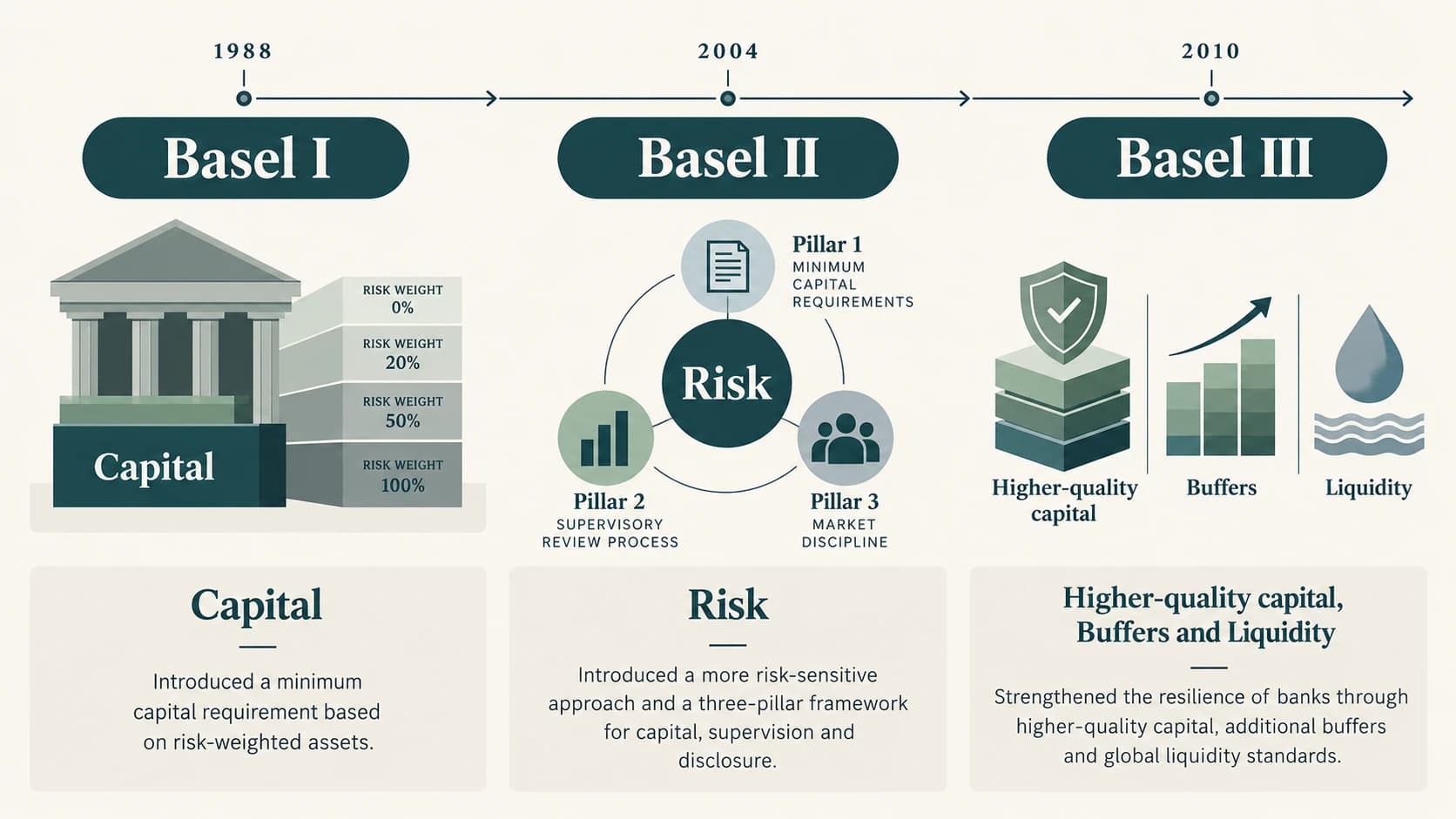
3. Timeline at a glance
| Framework | Milestone | Main concern |
|---|---|---|
| Basel I | 1988 | Common minimum capital framework, primarily credit risk |
| Basel II | 2004 | More risk-sensitive capital plus the three pillars |
| Basel III | Developed after the 2007–09 global financial crisis; initial reforms published 2010–11, with later finalisation | Better-quality capital, buffers, leverage, liquidity and resilience |
Do not conclude there is one single Basel III effective date for every rule in every country. Implementation is phased and jurisdiction-specific.
4. Basel I — the foundation
The 1988 accord introduced an international risk-based capital approach, strongly centred on credit risk. Its famous basic minimum was 8% of risk-weighted assets under international standards (this is not the same as India's current headline normal-commercial-bank total CRAR requirement).
Strength: simple, common language.
Weakness: broad risk categories and relatively crude distinctions within them.
5. What Basel I did NOT completely solve
Two corporate borrowers may have very different probabilities of default. If they are assigned broad similar treatment, a simple system may fail to reflect the difference. Basel I was also less comprehensive about some risks and modern activities.
That motivated a more risk-sensitive framework.
6. Basel II — three pillars
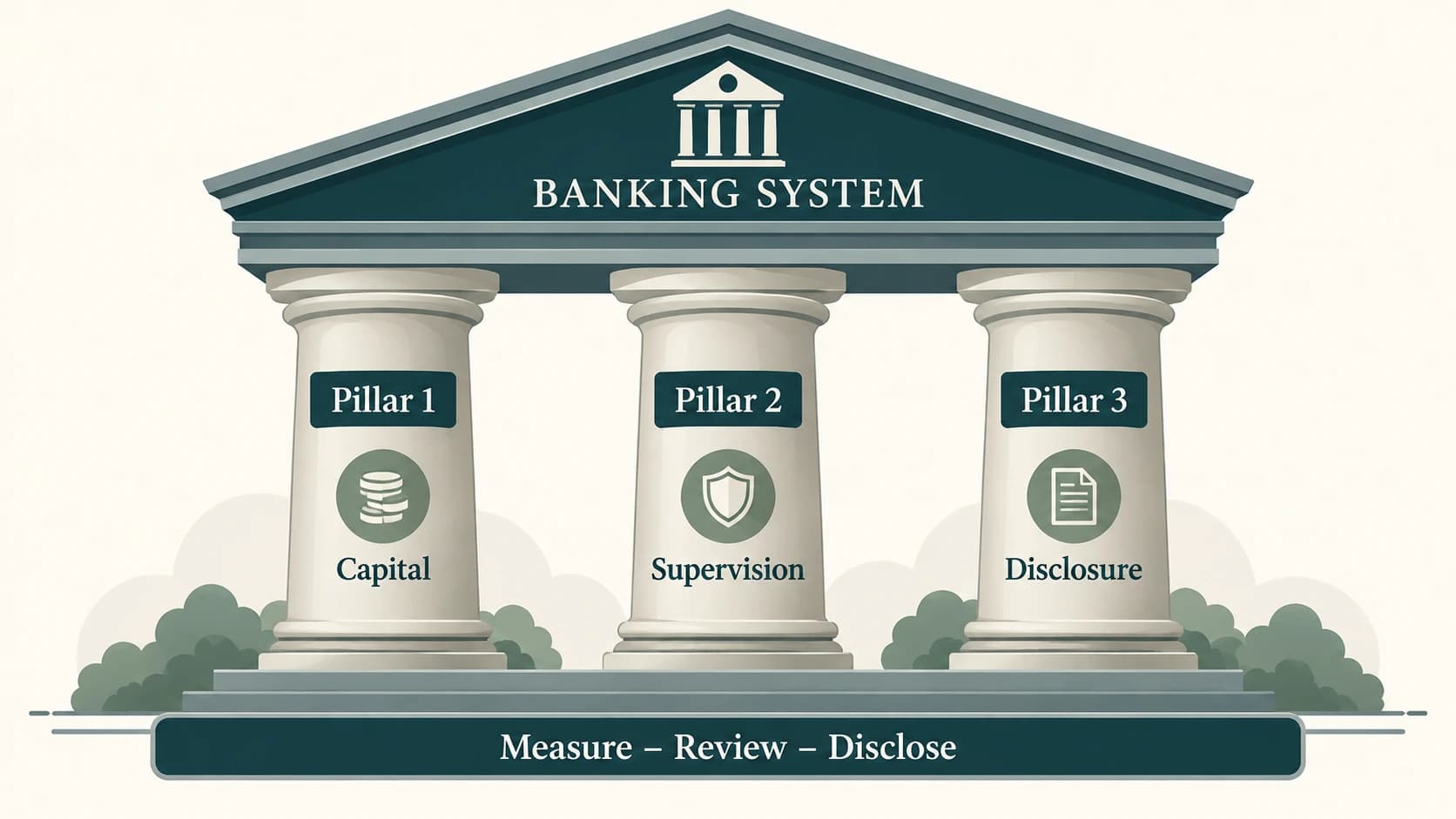
Basel II's defining learning point is the three-pillar structure.
Pillar 1 — Minimum Capital Requirements
Rules for measuring capital needs against specified risk categories, prominently:
- credit risk;
- market risk;
- operational risk.
Pillar 2 — Supervisory Review
A bank must assess whether its capital covers all material risks given its own business model. Supervisors review the adequacy of risk management and capital planning.
Pillar 3 — Market Discipline
Disclosures allow market participants to understand the bank's risks, capital structure and risk-management position.
Mnemonic: Measure – Review – Disclose.
7. Basel II and ICAAP
ICAAP is the Internal Capital Adequacy Assessment Process. A bank asks:
- What risks do we face beyond the minimum formula?
- How much capital do we need under a realistic adverse scenario?
- Are concentrations or emerging risks properly captured?
- Is our capital plan sustainable?
ICAAP is especially associated with Pillar 2. It is not a substitute for meeting Pillar 1 capital minima.
8. Basel II credit risk approaches
At an accessible level, banks may face standardised approaches and, in jurisdictions/conditions where permitted, models-based approaches. The actual use of approaches depends on national regulatory approval and requirements.
A learner does not need to calculate an internal credit-risk model to understand why risk-sensitive measurement improved on Basel I.
9. Basel III — why another reform?
The global financial crisis exposed major weaknesses:
- too little high-quality loss-absorbing capital in some banks;
- excessive leverage;
- short-term wholesale funding dependence;
- insufficient resilience to a liquidity shock;
- system-wide spillovers and hidden interconnectedness.
Basel III addressed these weaknesses by strengthening both individual-bank resilience and system-wide safeguards.
10. Core Basel III concepts
- Stronger CET1 and overall capital quality.
- Capital buffers, including conservation and countercyclical concepts.
- A supplementary leverage-ratio backstop.
- Liquidity standards such as LCR and NSFR.
- Additional requirements for systemically important institutions.
- Refinements to risk calculation, disclosures and supervision.
Later Basel III finalisation/implementation reforms contain further updates; not all take effect everywhere at the same time.
11. What is 'higher quality' capital?
Not all funds count equally in a crisis. Ordinary equity can absorb an unexpected loss without requiring the bank to pay it back to shareholders immediately. Borrowed funds with fixed contractual claims have very different loss-absorption properties.
Basel III emphasised CET1 so banks cannot appear adequately capitalised largely by using weak instruments.
12. Capital buffers are not a replacement for capital minimums
Think of a staircase:
Minimum core capital → other Tier 1/total capital conditions → capital conservation cushion → additional countercyclical/systemic buffers if applicable.
When the bank draws down its buffer under stress, regulators can constrain distributions to rebuild capital. A buffer's existence does not mean the bank can ignore minimum capital rules.
13. Basel III leverage ratio
Unlike CRAR's risk-weighted denominator, leverage ratio uses a broader exposure measure and Tier 1 capital. It is intended to help prevent overly aggressive balance-sheet growth even when computed RWAs look low.
Two banks with equal RWAs could have very different total exposure levels, depending on their asset mix and modelling. That is why the two indicators complement one another.
14. Basel III liquidity standards
LCR — Liquidity Coverage Ratio
Broadly compares high-quality liquid assets (HQLA) to expected net cash outflows over a prescribed short stressed horizon.
NSFR — Net Stable Funding Ratio
Broadly compares available stable funding with required stable funding across a longer time horizon.
Exam comparison: LCR tackles shorter-run stress liquidity; NSFR tackles structural funding stability. Neither is identical to CRR, SLR or CRAR.
15. Microprudential vs macroprudential
- Microprudential: resilience of a particular bank, its loans, capital and governance.
- Macroprudential: risks emerging across the financial system, such as excessive aggregate credit growth or interconnected failures.
Basel III includes both types of concern. The CCyB is a good example of systemic/cyclical thinking.
16. D-SIBs and contagion
A very large or interconnected bank's failure may affect many other institutions. Additional resilience for systemically important banks recognises the wider social cost of failure.
The term “too big to fail” is a description of systemic concern, not a guarantee that shareholders or capital-instrument investors will be protected against losses.
17. Basel I, II and III comparison
| Topic | Basel I | Basel II | Basel III |
|---|---|---|---|
| Central development | Common credit-risk capital standard | Risk-sensitive three-pillar framework | Strengthened resilience, capital quality, buffers and liquidity |
| Operational risk in capital | Not as distinct/comprehensive as later frameworks | Explicitly incorporated | Refined over time |
| Pillar 2 | Not its defining architecture | Defining | Retained/strengthened |
| Pillar 3 | Not its defining architecture | Defining | Retained/expanded |
| CET1 emphasis | Less developed | Capital-quality standards existed | Stronger core-capital emphasis |
| Leverage and liquidity | Not central in same form | Less central | Major complementary requirements |
| Nature | International standard | International standard | International standards with phased national implementation |
18. Basel standards are not a BIS lending scheme
A question may ask who issues Basel capital standards. Answer: the Basel Committee on Banking Supervision, which operates within the BIS institutional setting. BIS is not granting a personal loan or directly supervising a branch in India when a Basel standard is published.
19. India can set stricter rules
Basel III's global minimum total risk-based capital ratio and RBI's domestic minimum may differ. At the exam level, remember:
- international Basel standard is the internationally agreed baseline;
- RBI requirement is the applicable domestic rule for the bank type;
- buffer/surcharge can add further requirements.
20. Worked example: why 8% and 9% can both be seen
Suppose a preparation book says 8% and an RBI capital direction says 9%. Which is correct?
- 8%: familiar Basel international minimum for total risk-based capital in the basic framework.
- 9%: RBI's published domestic minimum total CRAR for banks in its applicable normal commercial-bank Basel III capital direction, before additional applicable buffer/surcharge.
They describe different levels of the standard; neither figure means that any bank with 9% has met all current capital requirements.
21. A crisis example
Bank X funds long-term loans mainly using deposits that can be withdrawn soon. Its capital ratio looks acceptable, but during a panic its deposits leave rapidly. Two problems may arise:
- loss-absorbing capital may be adequate or inadequate depending on credit losses;
- liquidity may still be insufficient to meet sudden outflows.
Capital rules and liquidity standards are complementary because a solvent bank can face liquidity pressure, and a liquid-looking bank can still be insolvent after large losses.
22. Common mistakes
- Basel II introduced the well-known three pillars, not Basel I.
- Basel III builds on the prior framework; it is not just “a new repo rate.”
- BIS and BCBS are related but not interchangeable.
- RBI does not implement every international proposal instantly.
- LCR/NSFR measure liquidity/funding, not eligible capital/RWA.
- An additional capital buffer is not automatically the same as a statutory reserve fund.
23. Quick revision facts
- Basel Committee created 1974 (historical background).
- Basel I capital accord 1988.
- Basel II framework 2004, three pillars.
- Basel III developed after global financial crisis, strengthening capital, liquidity and leverage safeguards.
- BCBS standards become binding domestically only through appropriate national adoption.
- CET1 is the core high-quality capital; CCB provides a loss-absorbing cushion above minima.
Quick check — BA-14-04
- What is Basel II's most famous organising framework?
- Does BCBS directly license Indian banks?
- Why was Basel III developed?
- What risk problem does LCR address?
- Can RBI impose a capital rule more stringent than a Basel minimum?
Answers: (1) Three pillars. (2) No. (3) Global-crisis lessons about capital, leverage, liquidity and systemic risk. (4) Short-term stressed liquidity. (5) Yes, under its domestic regulatory authority.