
Capital Adequacy, CRAR and Risk-Weighted Assets
Capital Adequacy, CRAR and Risk-Weighted Assets. A detailed chapter in Banking Laws, Basel, Capital & Risk, with explanations and examples for Indian banking examinations.
By Akhilesh Saini · Reviewed 8 Oct 2026
1. Why banks need capital
Consider a bank funded by:
- ₹900 crore of customer deposits and other liabilities; and
- ₹100 crore belonging to shareholders (a simplified equity figure).
The bank uses those funds to buy securities and make loans. Suppose a set of loans causes ₹70 crore of unexpected losses. The bank's shareholders can absorb the loss through equity before depositor obligations are impaired, assuming no other complications.
This illustrates the loss-absorbing role of capital. Deposit balances are owed to customers; they are not the same as owners' funds available to take losses.
Capital adequacy is the requirement that a bank hold enough qualifying loss-absorbing capital relative to risks it takes.
A bank with too little capital is vulnerable even if it looks profitable today.
2. Accounting equity versus regulatory capital
A balance sheet may show share capital, reserves and other items as equity. Regulatory capital is a rule-defined subset and set of adjustments: some items qualify fully, some receive deductions or caps, and certain debt-like instruments can qualify under specific conditions.
Do not assume all reserves are automatically eligible or that any perpetual bond qualifies as regulatory capital. The regulator considers permanence, subordination, ability to absorb losses and other terms.
3. The capital adequacy formula
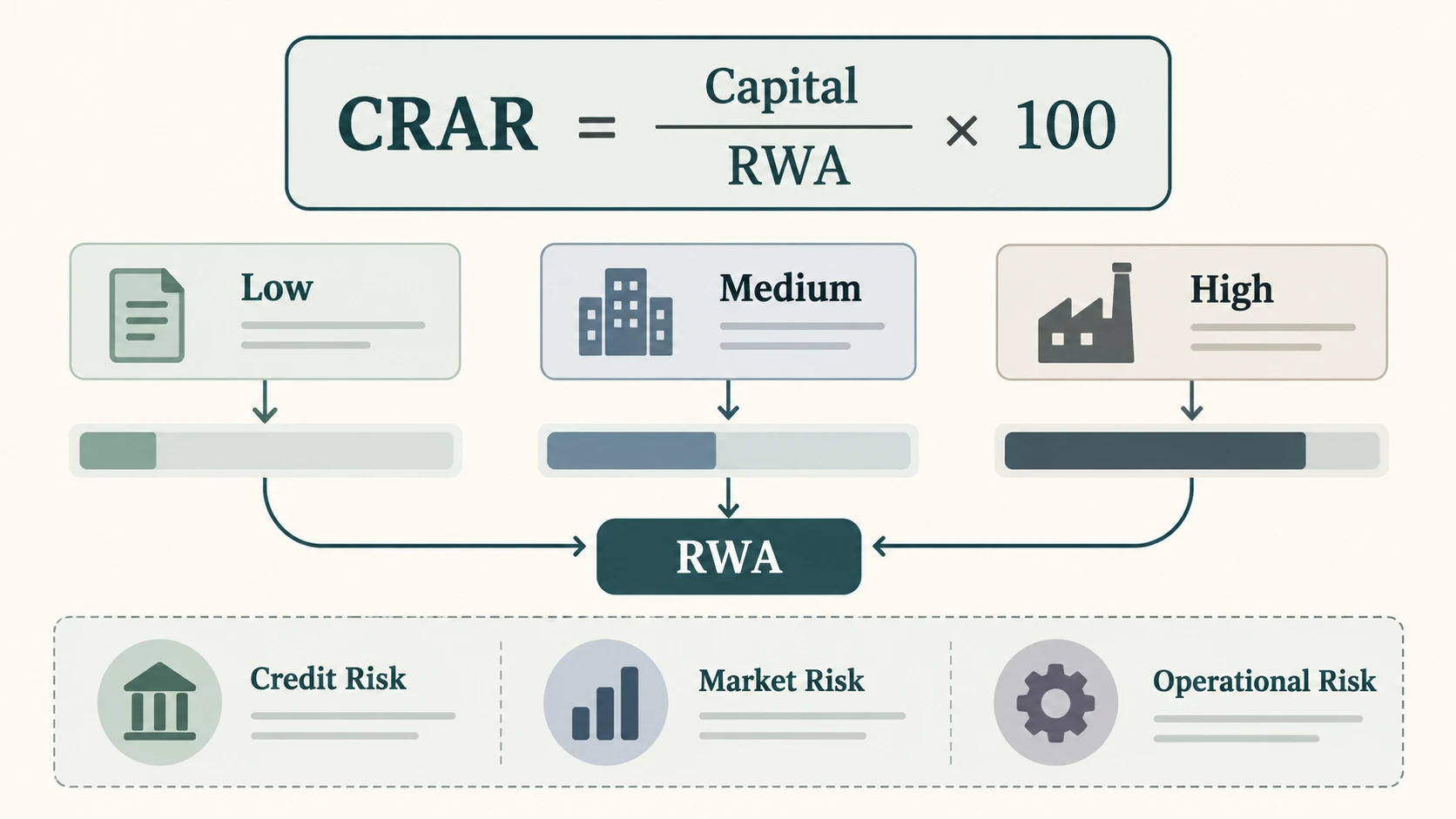
Capital to Risk-weighted Assets Ratio (CRAR) is also called Capital Adequacy Ratio (CAR).
In a Basel III-style framework, total eligible regulatory capital generally comprises Tier 1 plus Tier 2, subject to regulatory deductions and limits.
This is not: cash ÷ deposits. It is also not: total assets ÷ capital.
4. Worked example: a bank with 12% CRAR
Assume (illustrative figures):
- eligible regulatory capital = ₹120 crore;
- total RWAs = ₹1,000 crore.
Then:
If the minimum applicable total-capital requirement, including relevant buffers, were above 12%, the bank might still have a shortfall. Conversely, 12% could exceed a lower applicable minimum. A ratio cannot be called 'compliant' without identifying the correct regulatory requirement and scope.
5. Why the denominator is not total assets
Not every bank exposure has equal risk. A bank can hold:
- sovereign exposures subject to specific prudential treatment;
- corporate loans;
- retail loans;
- off-balance-sheet guarantees;
- market positions.
A ₹100 loan to a weak borrower may require greater capital support than an otherwise comparable exposure with lower regulatory risk weight. Regulators therefore use risk-weighted assets (RWAs) rather than raw asset totals.
6. Understanding risk weights
In a very simplified teaching example:
| Exposure | Face amount | Illustrative weight | Illustrative RWA |
|---|---|---|---|
| A | ₹100 crore | 20% | ₹20 crore |
| B | ₹100 crore | 100% | ₹100 crore |
| C | ₹50 crore | 150% | ₹75 crore |
| Total | ₹250 crore | — | ₹195 crore |
For a single exposure:
Important: the weights above are hypothetical calculation inputs. They do not claim that a named real-world asset always carries that weight under current RBI rules.
7. The three principal RWA categories
At conceptual level:
Total RWAs = Credit risk RWAs + Market risk RWAs + Operational risk RWAs.
- Credit risk: borrower or counterparty fails to perform.
- Market risk: trading-position losses from movements in interest rates, currency, equity and other market prices.
- Operational risk: loss from inadequate/failed people, processes, systems or external events, including specified legal risk.
Different regulatory approaches calculate each category. They should not be replaced with one arbitrary 100% weight for all risks.
8. Credit conversion of off-balance-sheet items
Guarantees and letters of credit may not initially appear as funded loans, but they create contingent obligations. Regulations can apply credit conversion factors and risk weights to arrive at capital requirements.
Example:
- a bank issues a ₹40 crore facility;
- for illustration only, conversion factor = 50%;
- converted exposure = ₹20 crore;
- assumed risk weight = 100%;
- resulting illustrative credit-risk RWA = ₹20 crore.
This shows why off-balance-sheet does not mean risk-free.
9. What makes capital 'Tier 1'?
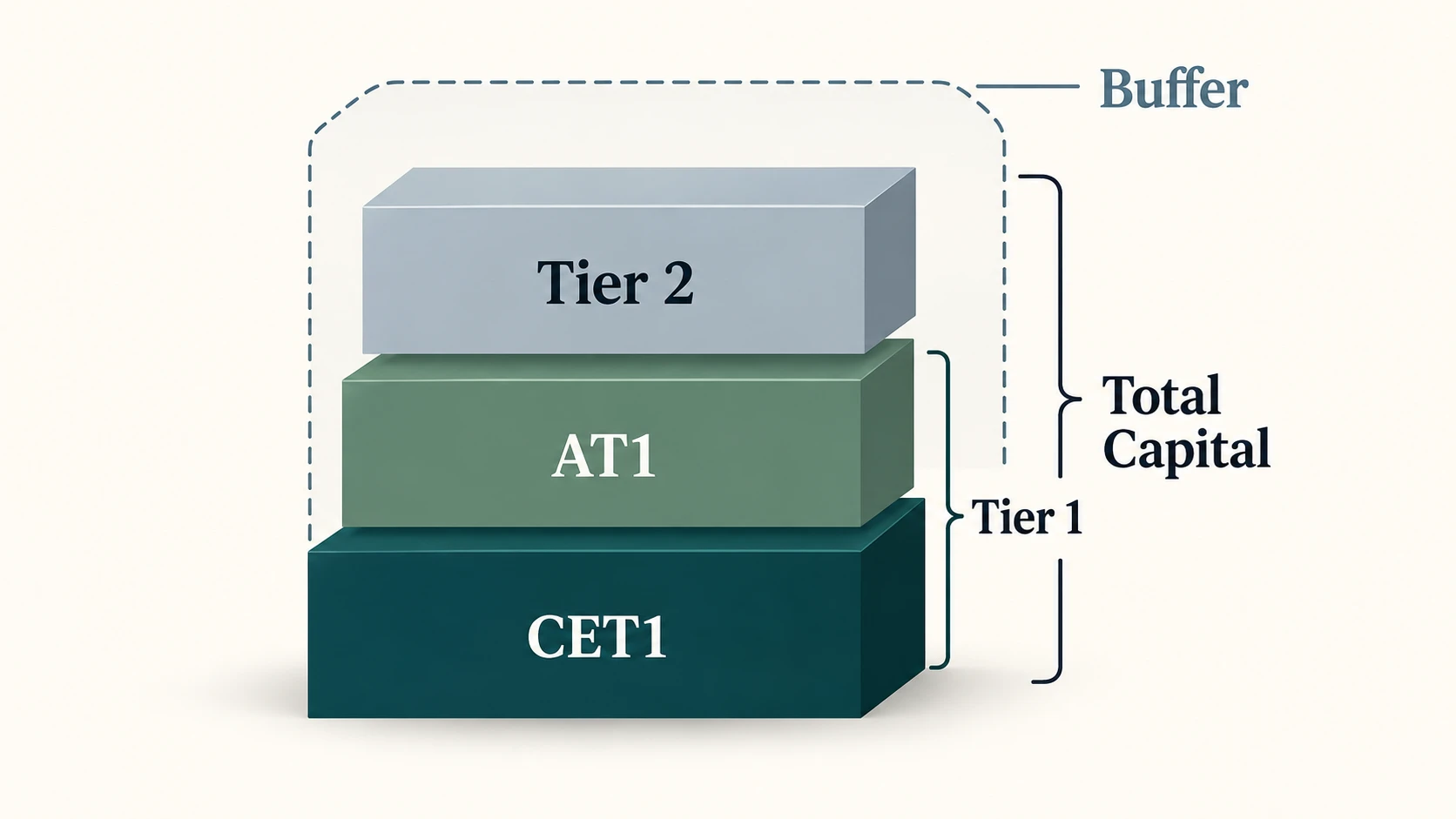
Tier 1 capital is meant to absorb losses while the bank is still a functioning enterprise (going concern). It generally contains:
- Common Equity Tier 1 (CET1) — highest-quality core capital;
- Additional Tier 1 (AT1) — qualifying instruments with stringent loss-absorption and subordination features.
Think:
Tier 1 is the frontline capital layer, with CET1 the strongest part of it.
10. CET1 — Common Equity Tier 1
CET1 may include eligible ordinary share capital, share premium, retained earnings and qualifying disclosed reserves, adjusted for mandatory regulatory deductions.
Why is it valued highly?
- It is normally permanent.
- It does not require fixed repayment like a deposit.
- Losses reduce equity directly.
- It supplies the highest-quality support for solvency.
However, capital calculations may deduct items such as goodwill and specified intangibles or other adjustments. CET1 is not simply the share-capital line from the balance sheet.
11. Additional Tier 1 (AT1)
AT1 instruments can have terms such as:
- subordination;
- perpetual nature;
- loss absorption via write-down/conversion under stipulated triggers;
- restrictions or discretion regarding distributions.
An AT1 instrument is not equivalent to a bank fixed deposit. Its risk, ranking and terms are materially different. Investors may suffer losses while the bank continues operations if contractual/regulatory conditions are met.
12. Tier 2 capital
Tier 2 is generally gone-concern loss-absorbing capital: it provides protection in resolution/non-viability scenarios, subject to the particular instrument and regulatory framework.
Examples can include qualifying subordinated debt and eligible provisions/reserves within regulatory limits. Tier 2 is not a substitute for unlimited amounts of CET1.
13. A compact capital stack
CET1 + AT1 = Tier 1
Tier 1 + Tier 2 = Total regulatory capital, after eligibility tests and adjustments.
Don't reverse the relation: CET1 is a subset of Tier 1, not an additional pool outside it.
14. Multiple capital ratios must be met
For banks covered by RBI's normal commercial-bank Basel III direction, the current published headline requirements include:
| Capital metric | Current minimum before additional buffers/surcharges |
|---|---|
| CET1 / RWA | 5.5% |
| Tier 1 / RWA | 7% |
| Total eligible capital / RWA (CRAR) | 9% |
| Capital Conservation Buffer (CCB), comprised of CET1 | Additional 2.5% |
| Total minimum CRAR + CCB | 11.5% |
These are living regulatory data, not universal standards for every category of bank. They are displayed in the website snapshot and must be refreshed against the latest applicable RBI direction.
15. Why total CRAR alone can deceive
A bank might hold considerable Tier 2 capital but insufficient CET1. Even if its total capital ratio appears high, it can still breach the quality requirement for core equity. Prudential regulation therefore tests capital quality, not just capital quantity.
16. Capital Conservation Buffer — CCB
The CCB is an additional CET1 cushion built above the required minimum in normal times. In stress, the bank can absorb losses through the buffer, but falling into the buffer range can result in restrictions on capital distributions, such as dividends, rather than necessarily causing immediate bank closure.
A good exam phrase:
The CCB is designed to encourage capital conservation before a bank becomes critically weak.
17. Countercyclical Capital Buffer — CCyB
Sometimes credit expands rapidly across an economy. The countercyclical buffer is designed to build extra resilience when system-wide cyclical risk is high. It can then be released as conditions change.
- CCB is a structural conservation cushion.
- CCyB responds to cyclical systemic conditions, under jurisdictional rules.
Do not assume CCyB is permanently active at a fixed percentage in India. Its activation status is a living policy fact.
18. Additional charges for systemically important banks
Some very large/interconnected banks may be designated Domestic Systemically Important Banks (D-SIBs) by RBI and face extra capital requirements. These requirements sit on top of the generally applicable rules. Which banks are designated and the current surcharge are living regulatory facts.
19. Leverage ratio — a second safety perspective
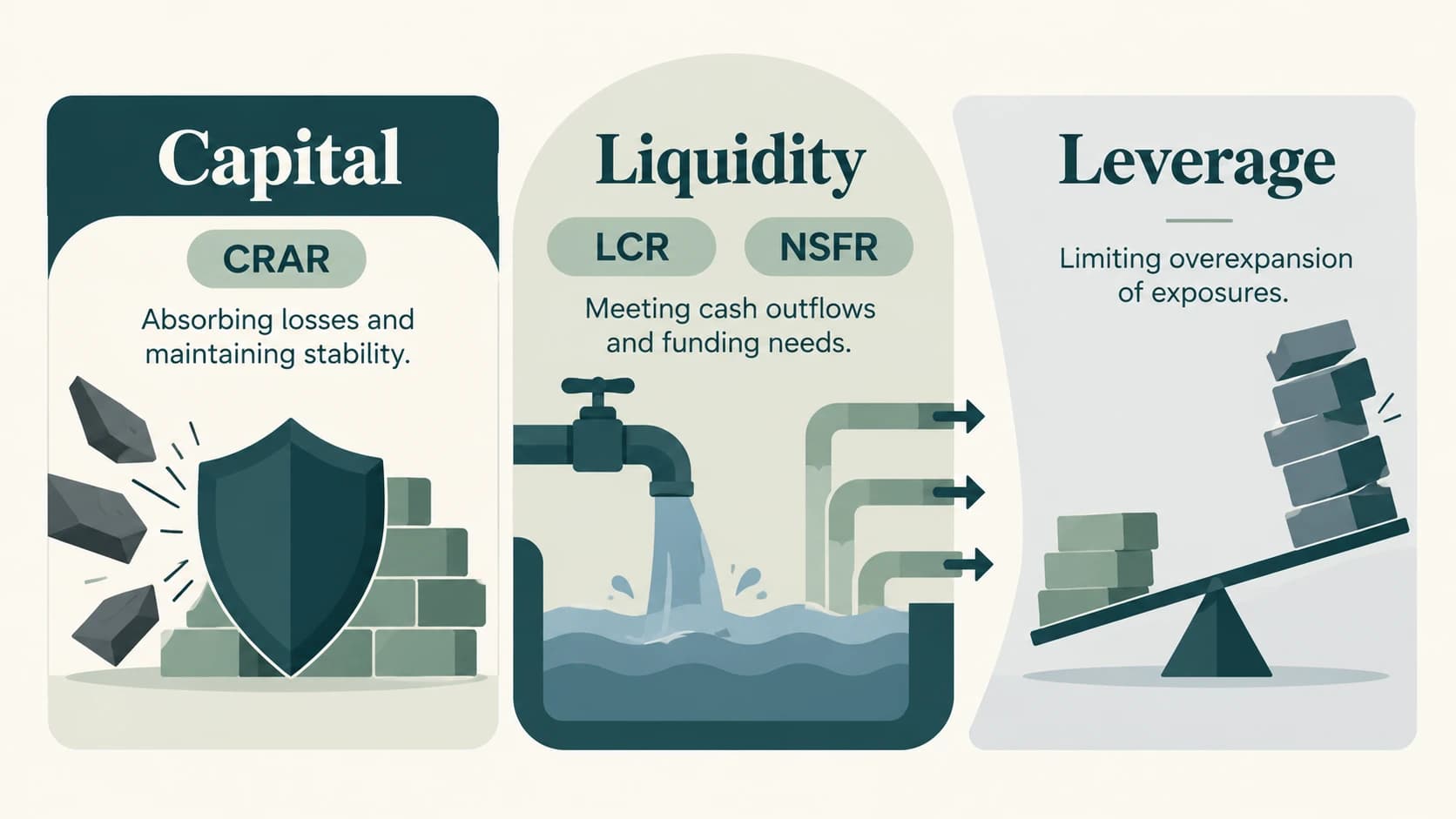
CRAR uses risk-weighted exposures. The leverage ratio is a complementary, relatively non-risk-weighted backstop comparing Tier 1 capital to a specified broad exposure measure.
Why useful? If internal or standardised risk weights understate the size of a balance sheet, leverage ratio limits excessive build-up of exposures.
20. Liquidity coverage and capital are different
Capital adequacy: Can the bank absorb losses?
Liquidity: Can it meet cash outflows when due?
A bank may have enough capital in the long run but run short of ready cash tomorrow. Conversely, a bank holding much liquid cash is not necessarily adequately capitalised against losses.
Basel III includes liquidity requirements such as:
- Liquidity Coverage Ratio (LCR): high-quality liquid assets relative to prescribed net cash outflows over a stress horizon;
- Net Stable Funding Ratio (NSFR): stable available funding relative to stable funding needed across a longer horizon.
Use these definitions in exams, then verify current minimums/exemptions from the appropriate RBI instrument.
21. Provisions are not the same as regulatory capital
Imagine a loan becomes doubtful and a bank books a provision for expected credit loss. That provision recognises anticipated deterioration in asset value. Regulatory capital is the eligible cushion for absorbing further losses, subject to prudential recognition rules. Some eligible general provisions may receive limited capital treatment, but it is wrong to treat every provision as fully available equity capital.
See Module 07 for NPA classification and provisioning.
22. Capital raising can support lending growth
If RWAs grow while capital remains unchanged, the ratio falls. Example:
- capital = ₹120 crore;
- RWAs initially ₹1,000 crore → CRAR 12%;
- RWAs increase to ₹1,200 crore with capital unchanged → CRAR 10%.
A growing bank must therefore plan for:
- retained earnings;
- equity issuance;
- eligible regulatory capital instruments;
- adjustments to asset mix/risk levels.
Improved loan volume is not always sustainable if capital cannot keep pace.
23. Capital is not deposited physically in a vault
A common misconception is that the bank must keep all CRAR capital as idle currency notes. Regulatory capital is a financing/loss-absorption concept, not necessarily a pile of cash stored separately. CRR and SLR have their own asset/liquidity requirements.
24. Different bank categories, different rules
Commercial banks, RRBs, SFBs, payments banks, UCBs, co-operative banks, NBFCs and AIFIs may face distinct capital regimes. Even when the terms “CRAR” and “Tier 1” are shared, minimum ratios, eligible capital and buffers can differ.
Exam discipline: First identify the institution type, then quote the relevant threshold.
25. Three worked MCQ-style exercises
Exercise A: Eligible capital ₹90 crore, RWAs ₹750 crore. CRAR = 90/750 × 100 = 12%.
Exercise B: CET1 ₹55 crore, AT1 ₹15 crore, Tier 2 ₹20 crore and RWAs ₹1,000 crore (all eligible, no deductions for illustration). CET1 = 5.5%, Tier 1 = 7%, total CRAR = 9%. Does that meet the full current commercial-bank CCB-inclusive threshold? No: these figures only meet basic minima and have no extra CCB. This example assumes the institution falls within that framework.
Exercise C: Two equal ₹100 crore assets have 20% and 100% illustrative weights. Their RWAs differ: ₹20 crore vs ₹100 crore; therefore a bank cannot infer capital needs solely from nominal loan size.
Quick check — BA-14-03
- State the CRAR formula.
- Does Tier 1 include CET1 or vice versa?
- If RWAs rise while capital does not, what happens to CRAR?
- Can a bank pass total CRAR but fail its CET1 requirement?
- Is an LCR the same thing as CRAR?
Answers: (1) Eligible capital/RWA ×100. (2) Tier 1 includes CET1 and eligible AT1. (3) Falls. (4) Yes. (5) No; LCR is liquidity-focused.