
Map of Key Banking and Financial Laws
Map of Key Banking and Financial Laws. A detailed chapter in Banking Laws, Basel, Capital & Risk, with explanations and examples for Indian banking examinations.
By Akhilesh Saini · Reviewed 8 Oct 2026
1. Do not memorise a law list without a map
Banking examination questions often give a real situation and ask for the governing law. The fastest way to solve these questions is to connect the event to the statute's purpose.
Examples:
- A cheque is dishonoured → Negotiable Instruments Act.
- A secured creditor enforces a security interest → SARFAESI Act.
- A company enters collective insolvency resolution → IBC.
- Suspicious transactions require AML compliance → PMLA and related rules/directions.
- A payment operator needs authorisation → Payment and Settlement Systems Act.
These events may involve more than one law; the map identifies the principal legal pathway.
2. Core laws at a glance
| Law | Year | Primary purpose in banking awareness | Linked module |
|---|---|---|---|
| Negotiable Instruments Act | 1881 | Promissory notes, bills, cheques, dishonour | BA-13 |
| Reserve Bank of India Act | 1934 | Central-bank establishment/powers, banknotes and other functions | BA-03 / BA-14 |
| Banking Regulation Act | 1949 | Banking business, licensing and supervision | BA-14 |
| State Bank of India Act | 1955 | SBI's statutory organisation | BA-02 |
| Deposit Insurance and Credit Guarantee Corporation Act | 1961 | Statutory basis of deposit insurance corporation | BA-05 |
| Regional Rural Banks Act | 1976 | Legal basis for RRBs | BA-08 |
| NABARD Act | 1981 | NABARD's statutory establishment and powers | BA-10 |
| Recovery of Debts and Bankruptcy Act | 1993 | DRT/DRAT framework for eligible recovery matters | BA-07 |
| FEMA | 1999 | Foreign-exchange management | BA-15 / BA-16 |
| Prevention of Money-Laundering Act | 2002 | Prevention of money laundering and compliance architecture | BA-12 |
| SARFAESI Act | 2002 | Enforcing qualifying security interests / asset reconstruction | BA-07 |
| Payment and Settlement Systems Act | 2007 | Payment systems regulation/authorisation | BA-11 |
| Insolvency and Bankruptcy Code | 2016 | Collective insolvency resolution and liquidation | BA-07 |
| Banking Laws (Amendment) Act | 2025 | Amendments to multiple banking Acts | BA-05 / BA-14 |
The table deliberately lists selected exam-relevant laws, not every financial statute in India. For exam purposes, remember the function before the date.
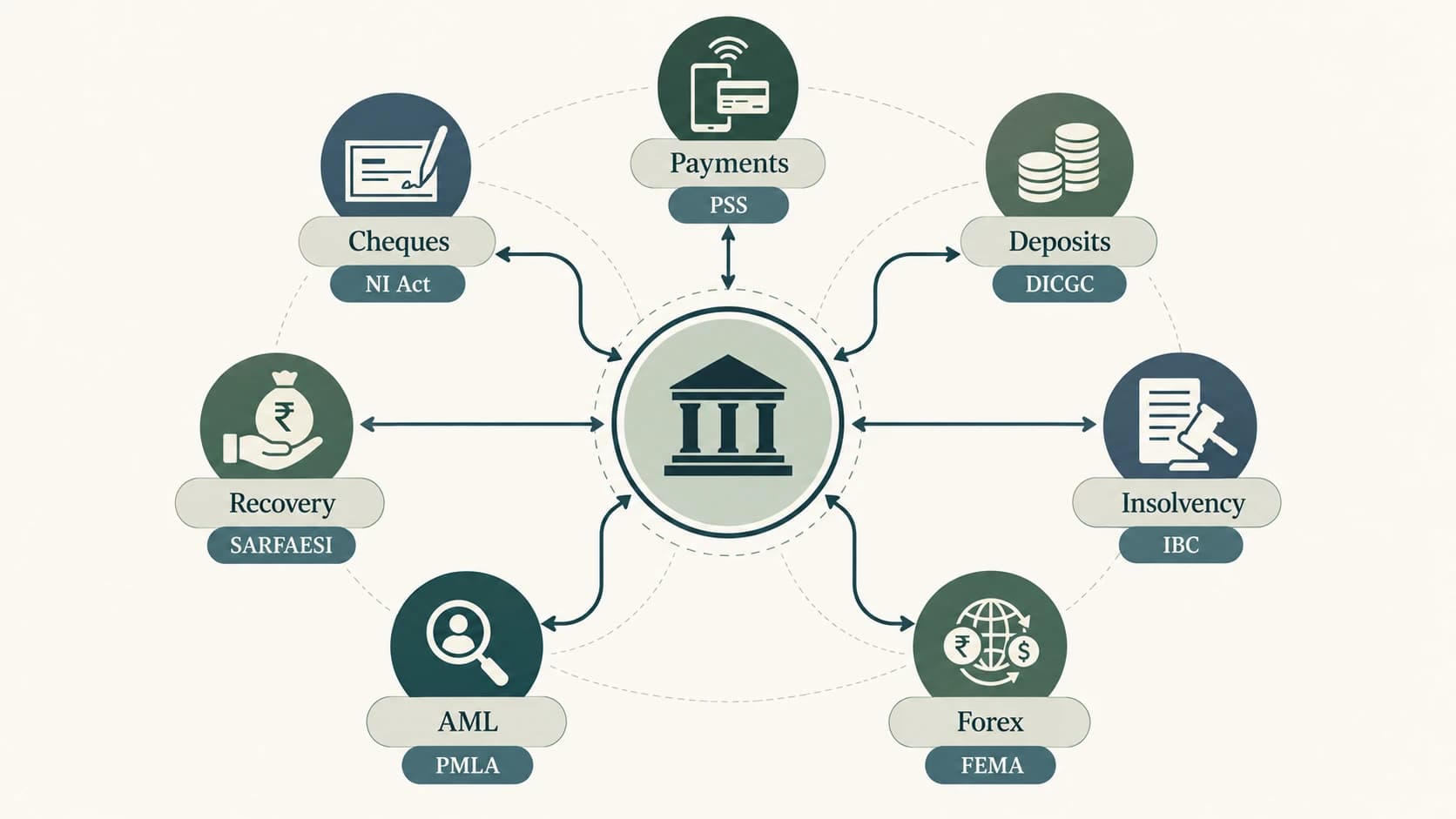
3. RBI Act vs Banking Regulation Act
RBI Act establishes and empowers the central bank. Banking Regulation Act primarily governs banking business. An RBI inspection of a licensed bank is linked to the latter, though RBI itself exists under the former.
4. Negotiable Instruments Act, 1881
This statute explains:
- promissory note;
- bill of exchange;
- cheque;
- drawer/drawee/payee;
- endorsement and negotiation;
- cheque dishonour and Section 138 legal consequences where statutory conditions are fulfilled.
Important: a cheque being returned for a technical reason does not automatically produce an offence under Section 138. Module 13 teaches the steps.
5. DICGC Act, 1961
DICGC is the statutory corporation for deposit insurance, subject to its Act and current scheme. Its protection applies to eligible bank deposits, not every financial product that looks deposit-like and not the market price of securities.
For example, bank savings and fixed deposits held with an insured bank are conceptually different from a debt mutual fund. The current coverage ceiling belongs in Module 05/current data.
6. FEMA, 1999
FEMA regulates cross-border foreign-exchange matters through a management framework. It succeeded the older FERA regime. Important FEMA questions involve:
- authorised persons/dealers;
- permitted current- and capital-account transactions;
- remittance and export/import rules;
- RBI directions and Government rules within the statutory architecture.
FEMA is not primarily the law for domestic cheque crossing or domestic loan recovery.
7. PMLA, 2002
The Prevention of Money-Laundering Act defines money-laundering offences and provides the foundation for record-keeping, beneficial ownership, due diligence and reporting by covered entities, alongside Rules and regulatory instructions.
Remember the institutional distinction:
- FIU-IND receives and analyses prescribed financial intelligence reports.
- Enforcement Directorate has investigative/enforcement roles under relevant law.
- RBI regulates banks and other covered RBI-regulated entities using delegated powers.
Do not assume FIU-IND decides every bank customer complaint.
8. SARFAESI Act, 2002
SARFAESI gives specified secured creditors statutory mechanisms to enforce eligible security interests, subject to applicable conditions and borrower remedies.
High-value concept: security enforcement is not identical to a civil suit for debt recovery.
A bank may use SARFAESI when legal conditions exist, but it cannot invoke it for every unsecured personal loan. The law and exemptions matter.
9. Recovery of Debts and Bankruptcy Act, 1993
This Act established the framework for Debt Recovery Tribunals (DRTs) and Debt Recovery Appellate Tribunals (DRATs) for matters within their jurisdiction. DRT is a forum for specified recovery matters; SARFAESI is a secured-creditor enforcement law. These concepts overlap operationally but are not the same.
10. Insolvency and Bankruptcy Code, 2016
IBC provides structured insolvency-resolution/liquidation processes for different debtor classes within its applicability. Corporate Insolvency Resolution Process (CIRP) aims at a collective resolution rather than one creditor individually taking all assets.
An NPA account in a bank does not automatically mean the borrower has entered CIRP.
11. Payment and Settlement Systems Act, 2007
Payment systems need an authorised supervisory framework. This Act gives RBI statutory powers in that field. It is central to understanding the legal framework around payment-system operators; NPCI, NEFT, RTGS and other infrastructure were studied in Module 11.
12. Company law, securities law and sector regulators
Financial activity is broader than banking. Some other laws worth placing correctly:
- Companies Act, 2013: corporate structure, accounts, directors, governance;
- SEBI Act, 1992: securities-market regulation;
- IRDA Act, 1999: insurance-sector regulator (IRDAI);
- PFRDA Act, 2013: pension-sector regulator;
- Credit Information Companies (Regulation) Act, 2005: credit-information companies;
- Information Technology Act, 2000: electronic records and certain cyber-law framework.
A bank can be subject to multiple statutes at once. The Banking Regulation Act does not supersede every other law.
13. A legal hierarchy to remember
Constitution / Parliamentary Act → rules/regulations under the Act → binding RBI direction/circular where empowered → bank board policy and operational instruction.
This hierarchy is simplified for learning. Valid delegated rules and directions derive authority from enabling legislation and may have different forms; the actual legal basis controls.
14. A RBI master direction is not an Act
The name Master Direction can sound like a law enacted by Parliament. It is not. It is a consolidated/formal regulatory instruction issued under RBI's statutory authority.
Likewise, a Master Circular commonly consolidates instructions in force at a certain date. It may later be replaced or updated. An old circular cannot safely override a newer applicable Master Direction.
15. Amendments and effective dates
A law can be passed, assented to and notified but come into operation in stages. Exam questions on a 2025 reform must distinguish the Act's enactment from the commencement of a particular section. RBI operational guidance may follow later.
Example: the Banking Laws (Amendment) Act, 2025 made several changes, but its nomination provisions took effect on a separately notified date. A serious student checks the effective date, not merely the year in the Act title.
16. Case exercises
Case A — Lost depositor's money after insured bank failure. Think DICGC Act, deposit insurance rules and Module 05.
Case B — A borrower refuses repayment on a secured loan. Think underlying contract, SARFAESI if applicable, DRT route and Module 07.
Case C — Suspicious layering of transactions. Think PMLA, rules, FIU reporting and Module 12.
Case D — Failed cross-border remittance. Think FEMA and applicable RBI remittance rules; SWIFT messaging is not the legal regime for foreign exchange.
Case E — Bank wants to run a payment system. Think PSS Act and applicable RBI authorisation/directions.
17. Exam memory table
| Keyword in question | First law to consider |
|---|---|
| Banknote issue | RBI Act |
| Licence to carry on banking | Banking Regulation Act |
| Cheque / promissory note | NI Act |
| Deposit insurance | DICGC Act |
| AML / suspicious transactions | PMLA |
| Foreign exchange | FEMA |
| Cheque-based debt enforcement | NI Act, if its conditions apply |
| Security interest enforcement | SARFAESI |
| DRT litigation | Recovery of Debts and Bankruptcy Act |
| Corporate insolvency resolution | IBC |
| Payment-system operator | Payment and Settlement Systems Act |
Quick check — BA-14-02
- Does RBI set binding banking rules entirely without legislation?
- Which law primarily governs money laundering?
- Which Act is associated with DRT?
- What is the difference between SARFAESI and IBC?
- Is an RBI Master Direction an Act of Parliament?
Answers: (1) No, powers are grounded in statutes. (2) PMLA, 2002. (3) Recovery of Debts and Bankruptcy Act, 1993. (4) SARFAESI concerns specified security enforcement; IBC concerns a collective insolvency process. (5) No.