
RBI Act, 1934 and Banking Regulation Act, 1949
RBI Act, 1934 and Banking Regulation Act, 1949. A detailed chapter in Banking Laws, Basel, Capital & Risk, with explanations and examples for Indian banking examinations.
By Akhilesh Saini · Reviewed 8 Oct 2026
1. Why a bank needs more than a general company law
A normal trading company can sell products using money raised from owners and lenders. A bank, however, typically accepts repayable deposits from the public and uses much of that funding for loans and investments. Depositors can demand withdrawal of funds even when those loans will not mature for years. If a bank becomes unsafe, the damage can spread to other institutions. Banking law therefore adds safeguards to ordinary corporate law.
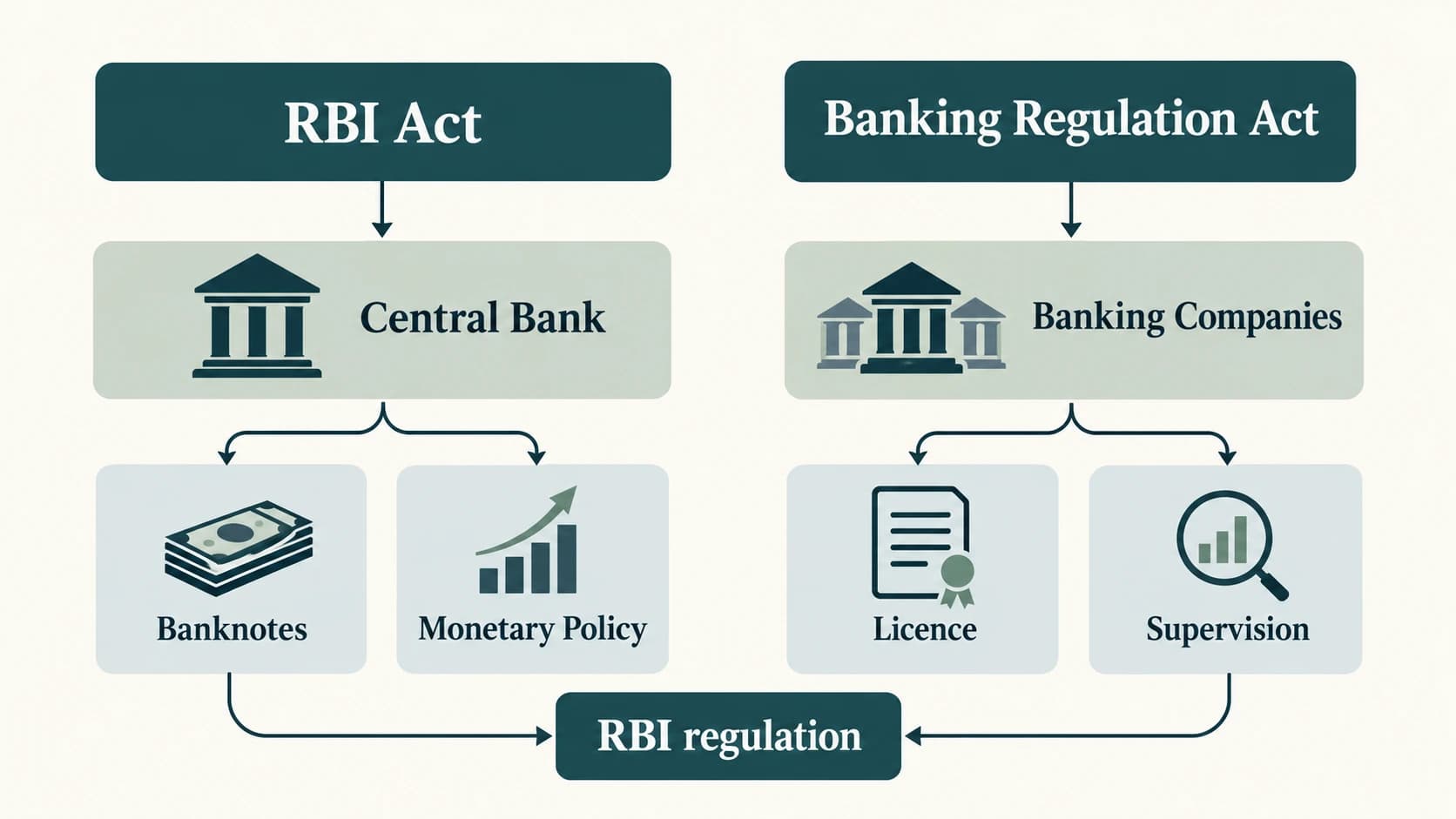
Two landmark Indian statutes answer different questions:
- RBI Act, 1934: What is the Reserve Bank, what functions does it perform, and what special powers are assigned to it?
- Banking Regulation Act, 1949: What constitutes banking business, who may carry on that business, and how are banking companies controlled and supervised?
The two statutes work together. They do not replace each other.
2. The RBI Act in context
The Reserve Bank of India Act was passed in 1934. RBI began functioning on 1 April 1935. The Act forms the statutory basis for the central bank, including its governance and many central-banking functions. RBI was later brought into public ownership from 1949; this change is not the same thing as creating RBI in 1949.
Important RBI Act themes:
- RBI's legal establishment, capital and management;
- issue of banknotes and currency management;
- banking to Central and, under arrangements, State Governments;
- scheduled-bank reserve requirements;
- monetary-policy framework and the Monetary Policy Committee;
- regulation of certain non-bank financial institutions and related activities.
3. Sections of RBI Act worth knowing
| Section | Broad topic | Concept to remember |
|---|---|---|
| 3 | Establishment and incorporation | RBI has statutory legal personality |
| 7 | Management | Government power to issue directions in the statutorily specified circumstances after consultation; distinct from routine operational independence |
| 8 | Central Board | RBI's management structure |
| 17 | Business RBI may transact | Central-bank powers within defined limits |
| 20–21 | Government banking | RBI's Government-banker role |
| 22 | Issue of banknotes | RBI has the statutory right to issue banknotes, subject to the legal framework |
| 42 | Cash reserves of scheduled banks | Legal basis for the scheduled-bank CRR framework |
| 45-IA | NBFC registration framework | RBI Act and associated directions govern specified NBFC registration |
| 45ZA–45ZB and connected provisions | Monetary policy and MPC | Inflation-targeting policy framework and the MPC |
The Act has been amended. The table is an educational map, not a substitute for consulting updated statutory text.
4. RBI Act Section 22 — not the only currency rule
The RBI Act confers the core banknote-issue power on RBI. The legal meaning of banknote and related currency rules can be modified through amendments. Coins and the one-rupee note have distinct Government-related legal arrangements. For competitive exams remember the high-level rule:
RBI is the primary issuing authority for banknotes in India; do not infer from that statement that every coin or every one-rupee instrument is issued by RBI.
5. RBI Act Section 42 — CRR
A scheduled bank maintains cash reserves according to the RBI Act and directions. Cash Reserve Ratio (CRR) is a required reserve based on applicable liabilities, typically described at exam level using NDTL.
Example (illustrative only): if the specified reserve requirement is 4% and the relevant liability base is ₹1,000 crore, required cash reserve = ₹40 crore. That cash is not the bank's regulatory capital and is not a substitute for CRAR.
Do not memorise the example's 4% as the present CRR rate.
6. RBI Act Section 45-IA — NBFC registration
The RBI Act provides the statutory framework under which eligible NBFCs require RBI registration, subject to detailed exemptions and criteria. An NBFC is not automatically a banking company merely because it makes loans. It must follow its own financial-sector framework, covered in Module 10.
7. RBI Act and Monetary Policy Committee
The modern monetary-policy framework was embedded in the RBI Act by legislative changes. The policy-setting architecture includes:
- monetary-policy objective/inflation targeting as prescribed;
- an MPC with internal and external members under the law;
- decisions on the policy rate;
- public accountability and communication.
The RBI Act establishes the legal framework, while the policy decisions and current rate belong in Module 04/current awareness.
8. The Banking Regulation Act — the basic idea
The Banking Regulation Act, 1949 governs how banking business may be undertaken and how licensed banks are regulated. Its historical name was the Banking Companies Act before renaming. The central question is how public deposit-taking and credit intermediation can be conducted safely.
A memorable legal definition is Section 5(b): banking involves accepting, for lending or investment, deposits of money from the public repayable on demand or otherwise and withdrawable by cheque, draft, order or otherwise (see actual section for the complete wording).
Deposits + lending/investment + public acceptance + repayment/withdrawal distinguish banking from an ordinary money-lending business.
9. Important Banking Regulation Act sections
| Section | Area | Exam takeaway |
|---|---|---|
| 5(b) | Definition of banking | Public deposits accepted for lending/investment and repayable/withdrawable under the statute |
| 6 | Permitted forms of business | Bank's legally permitted ancillary/related activities |
| 8 | Restriction on trading | Banking companies cannot ordinarily carry on trading in goods as a general business |
| 17 | Reserve fund | Statutory reserve obligations; different from CRR |
| 18 | Cash reserve | Applicable provisions, particularly important for non-scheduled banking-company context |
| 20 | Loans/advances restrictions | Includes restrictions relevant to directors and related interests |
| 21 | RBI control over advances | RBI may regulate advances in specified ways |
| 22 | Banking licence | Banking-company licence requirement |
| 23 | Places of business | Branch-opening or place-of-business framework |
| 24 | Statutory liquidity | Core SLR legal framework |
| 29 | Accounts and balance sheet | Statutory bank financial reporting |
| 35 | Inspection | RBI inspection of banking companies |
| 35A | Directions | RBI power to issue binding directions under specified conditions |
| 45 | Suspension of business / reconstruction / amalgamation | Special bank-resolution-related statutory machinery |
| 45ZA and related sections | Nomination | Rules regarding deposit/locker/safe-custody nomination, as amended |
| 56 | Co-operative banks | Application/adaptation of provisions to co-operative banks |
Exact text, exemptions and amendment commencement dates control real legal questions.
10. Section 22 appears in BOTH Acts
This is an excellent exam trap.
- RBI Act Section 22: power to issue banknotes.
- Banking Regulation Act Section 22: licensing of banking companies.
The same section number has different meanings because it belongs to a different Act.
11. RBI can inspect and issue directions
A banking licence is not a one-time permission to ignore supervision. RBI can inspect, seek information, issue regulatory directions, set prudential conditions and pursue legally authorised interventions.
A direction under Section 35A should not be confused with:
- an informal recommendation;
- a customer grievance reply;
- a statute passed by Parliament.
A binding direction gets its legal force from the enabling statutory power.
12. SLR vs CRR
CRR and SLR are commonly learned together but have different statutory roots and asset treatment:
| Feature | CRR | SLR |
|---|---|---|
| Broad purpose | Cash reserve / system liquidity tool | Required holdings of specified liquid assets |
| Main scheduled-bank legal anchor | RBI Act Section 42 | Banking Regulation Act Section 24 |
| Typical assets | Cash reserve maintained as required | Permitted liquid assets such as cash, gold and approved securities, subject to rules |
| Same as bank capital? | No | No |
| Same as capital conservation buffer? | No | No |
13. Recent Banking Laws (Amendment) Act, 2025
A reform statute enacted in 2025 amended five principal banking laws. Different provisions took effect on notified dates. The exam-relevant themes include:
- greater nomination flexibility for deposit/locker/safe-custody arrangements;
- changes relating to substantial interest and bank governance;
- certain co-operative-bank governance modifications;
- audit and administrative reforms for public-sector banks;
- operational/reporting adjustments.
Under notified nomination provisions effective from November 2025, an account holder may make up to four nominations, either simultaneously or successively, subject to the distinction between deposits and locker/safe-custody arrangements. Do not assume identical choices apply to all three asset types: refer to the current statutory rules and RBI direction for precise eligibility.
14. Why amendments matter even in an evergreen chapter
An Act number and broad function endure for decades. But the Act's operative text can change. A sound evergreen lesson teaches the institutional logic and leaves current definitions, limits and commencement dates to a verified structured record.
15. Worked situation: inspecting a weak bank
Imagine Bank A reports rising NPAs and weak capital. Which Act matters?
- RBI's central-bank identity and powers are grounded in the RBI Act.
- The banking licence, inspection and binding directions are largely addressed in the Banking Regulation Act.
- Detailed capital, provisioning and PCA criteria appear in RBI directions and other applicable instruments.
- Actual intervention must follow the proper law and procedure; RBI does not simply rewrite a bank's legal status by publishing a press headline.
The relationship is statute → delegated regulation → supervision → remedial action.
16. Exam fact box
- RBI Act: 1934; RBI began functioning 1935.
- Banking Regulation Act: 1949.
- RBI Act 22: banknotes.
- Banking Regulation Act 22: bank licence.
- Banking Regulation Act 35: inspection; 35A: directions.
- RBI Act 42: scheduled-bank cash reserve.
- Banking Regulation Act 24: SLR.
- Banking Regulation Act 45ZA onwards: nomination family, amended.
- Section 56 extends/adapts significant provisions to co-operative banking.
Quick check — BA-14-01
- Does the RBI Act license all commercial banks directly through its Section 22?
- What is Section 5(b) of the Banking Regulation Act about?
- Is CRR bank regulatory capital?
- Which Act contains the general banking licence provision?
- Are both the Acts still relevant after the creation of new RBI Master Directions?
Answers: (1) No: Section 22 of RBI Act concerns banknote issue. (2) The definition of banking. (3) No. (4) Banking Regulation Act, 1949. (5) Yes; directions derive their authority from law.