
Wired and Wireless Transmission Media
Wired and Wireless Transmission Media. Foundational Computer Awareness explanations, examples and explained practice questions for banking and recruitment exam preparation.
By Akhilesh Saini
What you will learn
- What a transmission medium is and how wired and wireless connections differ.
- Compare twisted-pair copper, coaxial cable, optical fibre and radio links.
- Understand basic terms such as interference, bandwidth, attenuation and line of sight.
- Recognize common transmission-media questions without memorizing vendor specifications.
Why this topic matters
If a question asks Which medium sends data as light? or Which cable is commonly used for copper Ethernet connections?, understanding the signal and physical link is enough. Modern networks mix copper cables, fibre backbones and wireless access; you should be able to identify each medium's typical job.
Transmission media: the path that carries a signal
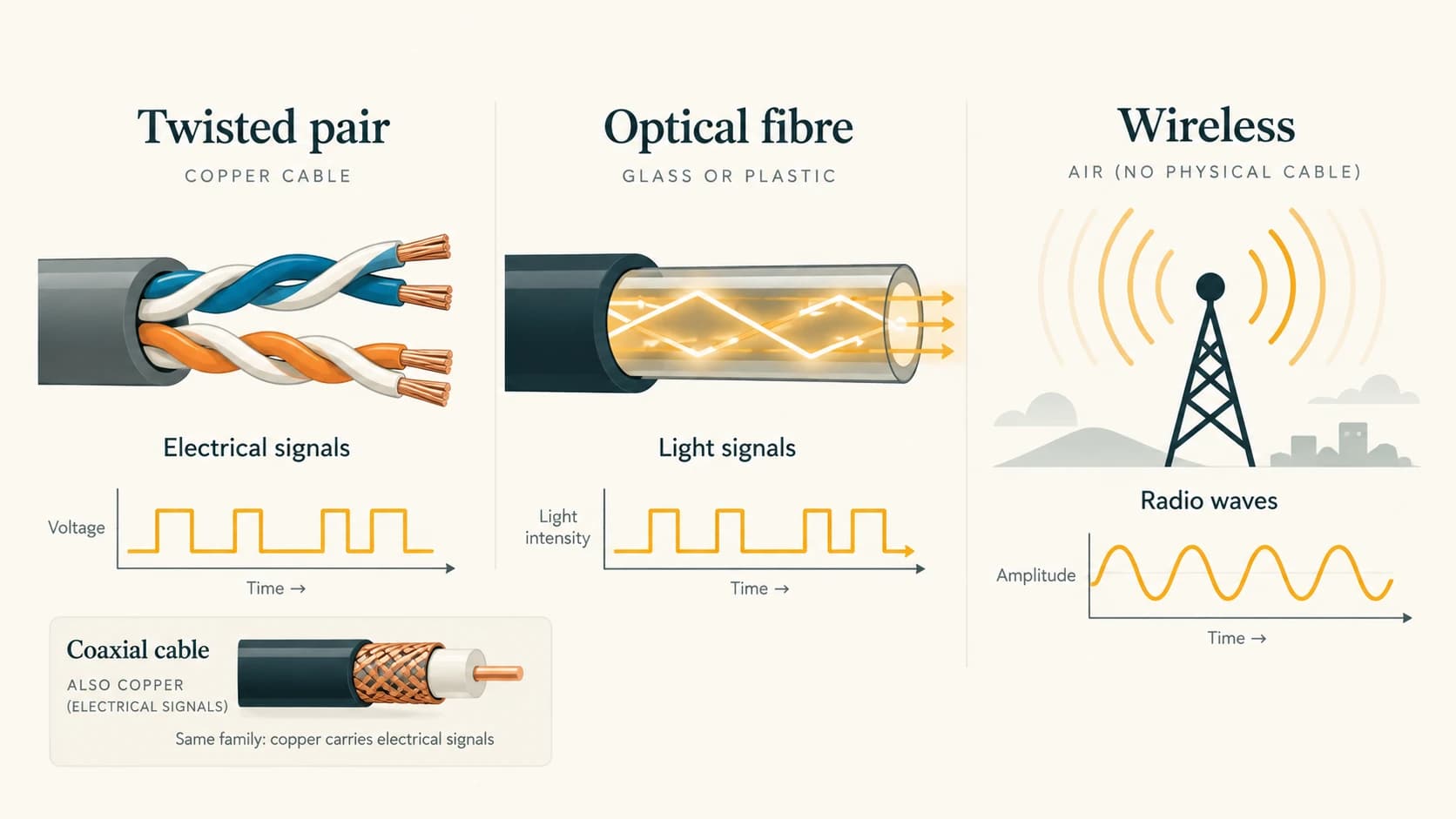
A transmission medium provides the physical or wireless path over which communication signals travel. Guided/wired media generally carry signals through a defined material path such as copper or optical fibre. Unguided/wireless media transmit electromagnetic waves through air or space.
The network's information is encoded into signals appropriate for the medium. Different media offer different trade-offs in distance, capacity, cost, electromagnetic interference and installation complexity. There is no single medium that is universally best for every situation.
Twisted-pair copper cable
A twisted-pair cable contains pairs of insulated copper conductors twisted together. Twisting helps reduce certain forms of electromagnetic interference and crosstalk. Twisted pair is widely used for Ethernet links in offices, branch buildings and homes.
- UTP (Unshielded Twisted Pair): Twisted pairs without an overall dedicated shield of the named type. Widely used in structured Ethernet cabling.
- Shielded twisted pair: Broad family of cable constructions using foil or braid shielding; specific naming varies among standards and vendors.
- Ethernet cable: Common name for suitable copper twisted-pair assemblies used with Ethernet equipment; not every Ethernet link must use copper or one connector.
- 8P8C modular connector: Common connector on copper Ethernet patch cords, often called RJ-45 in everyday exam terminology; strictly speaking, connector and registered-jack terminology are not identical.
Example: A desktop PC connects to a nearby switch using a network patch cord. This is typically a wired Ethernet link over twisted-pair copper.
Coaxial cable
A coaxial cable has a central conductor, insulation, shielding and an outer jacket arranged concentrically. It is used in cable-TV/broadband systems and certain legacy or specialised data connections. Historical bus-style Ethernet used coaxial cable in some installations.
Do not confuse: Coaxial is not the same structure as twisted pair, and modern LAN Ethernet does not require coaxial cable.
Optical-fibre cable
Optical fibre guides pulses of light through glass or plastic fibre. Light signals encode information, and suitable optical transmitters and receivers convert between electrical/digital equipment interfaces and the fibre signal.
Important strengths: high capacity, low signal loss over appropriately designed long links, and resistance to ordinary electromagnetic interference. Fibre does not conduct electrical current between its endpoints as a metal wire does.
Considerations: optical connectors, transceivers, installation quality and bend limits still matter. It is incorrect to claim that fibre can never fail or always has zero latency. Fibre is widely used for backbone links and long-distance connections, while copper remains common for short office links.
Wireless transmission
Radio waves carry common Wi-Fi, Bluetooth, NFC and mobile-network communications. Different technologies operate under different standards and frequencies. Some systems use microwave radio links, especially for point-to-point backhaul. Satellite communication sends signals through radio links involving satellites and ground stations. Infrared uses light beyond the visible red portion of the spectrum for certain short-range or line-of-sight applications.
Wireless links help where installing cables is impractical or mobility is necessary. Their performance can depend on distance, obstacles, interference, competing devices, radio spectrum and network design. A wireless link may be secure when properly configured, but wireless does not automatically mean insecure, just as wired does not automatically mean safe.
Compare wired and wireless links
| Attribute | Wired media | Wireless media |
|---|---|---|
| Physical path | Copper/fibre cable | Electromagnetic signals through air/space |
| Mobility | Usually constrained by cable | Often supports mobile devices |
| Common examples | Ethernet over twisted pair; optical fibre | Wi-Fi, Bluetooth, cellular |
| Interference | Varies; copper is susceptible to some EMI | Radio interference and obstacles can matter |
| Installation | Cabling required | Access points/base stations required; less cable to endpoints |
| Privacy/security | Depends on configuration and protection | Depends on configuration and protection |
EMI means electromagnetic interference. Attenuation is signal weakening as it travels. Line of sight means an unobstructed or sufficiently clear path needed or beneficial for certain links, not for every Wi-Fi network in every room.
Worked examples
Example 1 — EMI-sensitive factory: If a link must avoid the effects of nearby electromagnetic machinery, suitable optical fibre is a strong candidate.
Example 2 — Office desk: A fixed desktop next to a switch commonly uses a twisted-pair Ethernet patch cable.
Example 3 — Customer lounge: Visitors moving around with smartphones commonly use a Wi-Fi WLAN rather than plugging each device into Ethernet.
Example 4 — City buildings: Two distant buildings may use dedicated fibre or a carefully planned point-to-point radio link. “Wireless” is not synonymous with Bluetooth.
Example 5 — Satellite site: A distant location without practical terrestrial service may use a satellite access link. Delay, price, coverage and throughput depend on the specific satellite architecture.
Important terms
| Term | Meaning |
|---|---|
| Transmission medium | Path carrying communication signals |
| Guided medium | Signals carried in a defined material path |
| Unguided medium | Wireless propagation through air or space |
| UTP | Unshielded Twisted Pair |
| Coaxial | Cable with concentric conductor/shield structure |
| Optical fibre | Medium carrying encoded optical signals |
| EMI | Electromagnetic interference |
| Crosstalk | Unwanted coupling between neighbouring signal paths |
| Attenuation | Weakening of signal as it travels |
| Backhaul | Link connecting local access infrastructure to a wider network |
Common confusions and exam traps
- Fibre uses light, not electrical current along the fibre core. Its connected electronics still need power.
- Ethernet ≠ exclusively copper: Ethernet can run over fibre as well as copper.
- Wireless ≠ always Wi-Fi: Cellular, Bluetooth, satellite and NFC are different technologies.
- UTP ≠ coaxial: Their conductor construction differs.
- High nominal speed ≠ guaranteed delivered throughput: Equipment and congestion matter.
- Fibre ≠ no maintenance or limitations: Fibre can break, bend excessively or have connector faults.
Objective-exam facts to remember
| Clue | Medium/term |
|---|---|
| Data guided as light pulses | Optical fibre |
| Twisted copper pairs used in LAN cabling | Twisted pair / UTP |
| Central conductor and cylindrical shield | Coaxial |
| Signal carried through radio | Wireless/radio |
| Reduction of signal strength with distance | Attenuation |
| Unwanted electromagnetic disturbance | EMI |
Quick revision
- Wired media include twisted pair, coaxial and fibre.
- Optical fibre transmits optical signals; copper links carry electrical signals.
- Wireless systems use electromagnetic signals and support mobility.
- Installation choices depend on distance, environment, capacity and cost.
- Neither wired nor wireless media guarantee security without correct controls.
Practice questions — CA-07-05
1. Which medium carries data as guided light signals?
A. Coaxial copper
B. Ordinary telephone copper only
C. Optical fibre
D. Unshielded twisted pair
2. Which cable is commonly used for modern wired Ethernet connections at an office desk?
A. Twisted-pair copper
B. NFC tag
C. Magnetic tape
D. Optical disc
3. A cable with a central conductor surrounded by insulation and a concentric shield is:
A. Coaxial cable
B. HDMI by definition
C. UTP
D. Single optical fibre
4. Wi-Fi sends information over a common local link using:
A. Printed paper
B. Mechanical spinning disks
C. Only glass fibre
D. Radio waves
5. Which feature of optical fibre is especially useful in an electromagnetic-noise-heavy environment?
A. Guaranteed zero delay
B. Resistance to ordinary electromagnetic interference along the fibre
C. No possibility of damage
D. Need for no transceivers
6. What does UTP stand for?
A. Ultra Thin Processor
B. Universal Telephone Port
C. Unshielded Twisted Pair
D. User Transfer Protocol
7. The weakening of a signal as it travels is called:
A. Switching
B. Attenuation
C. Formatting
D. Routing
8. Which media classification correctly describes copper and optical fibre?
A. Guided/wired media
B. Only broadcast channels
C. Unguided radio media
D. Only cellular radio
9. A network link uses a radio path between two buildings. Its transmission medium is best classified as:
A. Coaxial by definition
B. Copper UTP by definition
C. Wireless/unguided
D. Optical disc
10. Which statement is accurate?
A. Every Ethernet network is wireless
B. Fibre always uses electrical signalling through its core
C. Wi-Fi always has a higher transfer rate than fibre
D. Ethernet may operate over copper or optical fibre
11. EMI stands for:
A. Email Message Index
B. Ethernet Memory Inspection
C. External Modem Interface
D. Electromagnetic Interference
12. Which statement about transmission-media security is most accurate?
A. Every fibre line is unbreakable
B. Both wired and wireless systems need correct security controls
C. All cables guarantee privacy
D. All wireless links are insecure
Answers and explanations — CA-07-05
1. C — Optical fibre. Optical fibre guides optical signals through fibre; the connected transmitter and receiver perform the needed conversions.
2. A — Twisted-pair copper. Twisted-pair copper patch cords are common between a desktop and an Ethernet switch.
3. A — Coaxial cable. Coaxial cable uses a concentric conductor and shield structure.
4. D — Radio waves. Wi-Fi is a wireless local networking technology using radio communication.
5. B — Resistance to ordinary electromagnetic interference along the fibre. Optical data propagation is not subject to ordinary electrical EMI on a metal conductor, although equipment and installation still matter.
6. C — Unshielded Twisted Pair. UTP is a common twisted-pair copper cabling category.
7. B — Attenuation. Attenuation is the reduction of signal strength over a transmission path.
8. A — Guided/wired media. Wires and fibres guide signals along physical paths.
9. C — Wireless/unguided. Point-to-point radio links transmit electromagnetic waves through air and do not require a cable between the buildings.
10. D — Ethernet may operate over copper or optical fibre. Ethernet technologies exist for both copper and fibre physical links.
11. D — Electromagnetic Interference. EMI refers to unwanted electromagnetic energy that can disturb some signal paths.