
Hub, Switch, Router, Repeater, Modem and Gateway
Hub, Switch, Router, Repeater, Modem and Gateway. Foundational Computer Awareness explanations, examples and explained practice questions for banking and recruitment exam preparation.
By Akhilesh Saini
What you will learn
- The basic tasks performed by common networking devices.
- Why a switch differs from a traditional hub and a router.
- How repeaters, modems, gateways and wireless access points fit into a network.
- Which device best matches an objective-exam scenario.
Why this topic matters
A networking MCQ often asks Which device connects different networks? or Which device learns MAC addresses and forwards frames within a LAN? The best way to answer is to follow the job performed by each device rather than rely on its appearance: household equipment commonly combines several jobs in one box.
Hub: repeats traffic to other ports
A traditional Ethernet hub is a simple multiport repeater. When it receives a signal, it repeats it to the other connected ports without making normal per-destination forwarding decisions based on MAC addresses. Connected devices share the medium's capacity and collision domain in the classic half-duplex Ethernet setting.
Hubs are mainly taught for historical comparison; modern Ethernet LANs normally use switches instead. An exam question contrasting hub and switch typically expects hub: repeats to all relevant other ports; switch: forwards according to learned MAC-address information.
Switch: connects devices within a LAN
An Ethernet switch connects network devices and normally forwards Ethernet frames using learned MAC addresses. It observes source addresses to build a forwarding table and uses this table to select the appropriate output port for known unicast destinations.
- A known unicast destination is normally forwarded only toward its learned port.
- Broadcast and some unknown-destination frames may be sent to multiple ports within the relevant broadcast domain/VLAN.
- Managed switches may support additional features such as VLANs, monitoring and security settings.
A switch is not simply a hub with more ports. A traditional switch makes selective forwarding decisions. Some Layer-3 switches also perform routing; the basic exam distinction refers to ordinary Layer-2 switches.
Router: connects IP networks
A router forwards packets between different IP networks using destination IP addresses and routing information. A home router commonly connects a private local network to a service provider; an organization may use routers to link branches and wide-area services.
Example: A PC sends data to a server on a different network. The local network's router or default gateway forwards the packet toward that outside network using its routing table and configured policies.
A router is not automatically a Wi-Fi radio. Many consumer boxes contain a router, Ethernet switch, Wi-Fi access point and sometimes modem or other gateway functions together.
Repeater: helps extend a signal path
A repeater receives and regenerates/relays signals so communication can travel over a greater distance or through a weak portion of a link. The details differ among copper, fibre and radio systems. A simple repeater is not responsible for IP route selection like a router.
Exam clue: Extending/regenerating signals, not choosing between IP networks.
Modem: converts signals for a communications link
A modem is historically short for modulator-demodulator. It adapts/translates digital information for transmission over a particular communications medium or system and converts received signals back into a usable digital form. Examples include older telephone-line modems and modern cable or cellular modem functions; fibre access systems also use purpose-built optical network equipment.
Do not assume every modern broadband connection uses an analog dial-up modem. The word describes a class of communications equipment with different physical technologies.
Gateway: entry point or translation function
The term gateway can mean the point/interface through which traffic leaves a local network (default gateway) or a device/software service connecting systems with different protocols or formats (protocol gateway). A router commonly acts as a default gateway in IP networking; protocol translation is not required for every router operation.
Example: A branch's default gateway sends packets toward off-site destinations. Separately, an application gateway may translate between incompatible application protocols.
Wireless access point: provides WLAN access
A wireless access point (AP) connects Wi-Fi clients to a local network. It may be standalone or integrated into a home router. Its basic purpose is to provide radio-based local network access. Wi-Fi access can work without Internet access if the local WLAN is configured and operating.
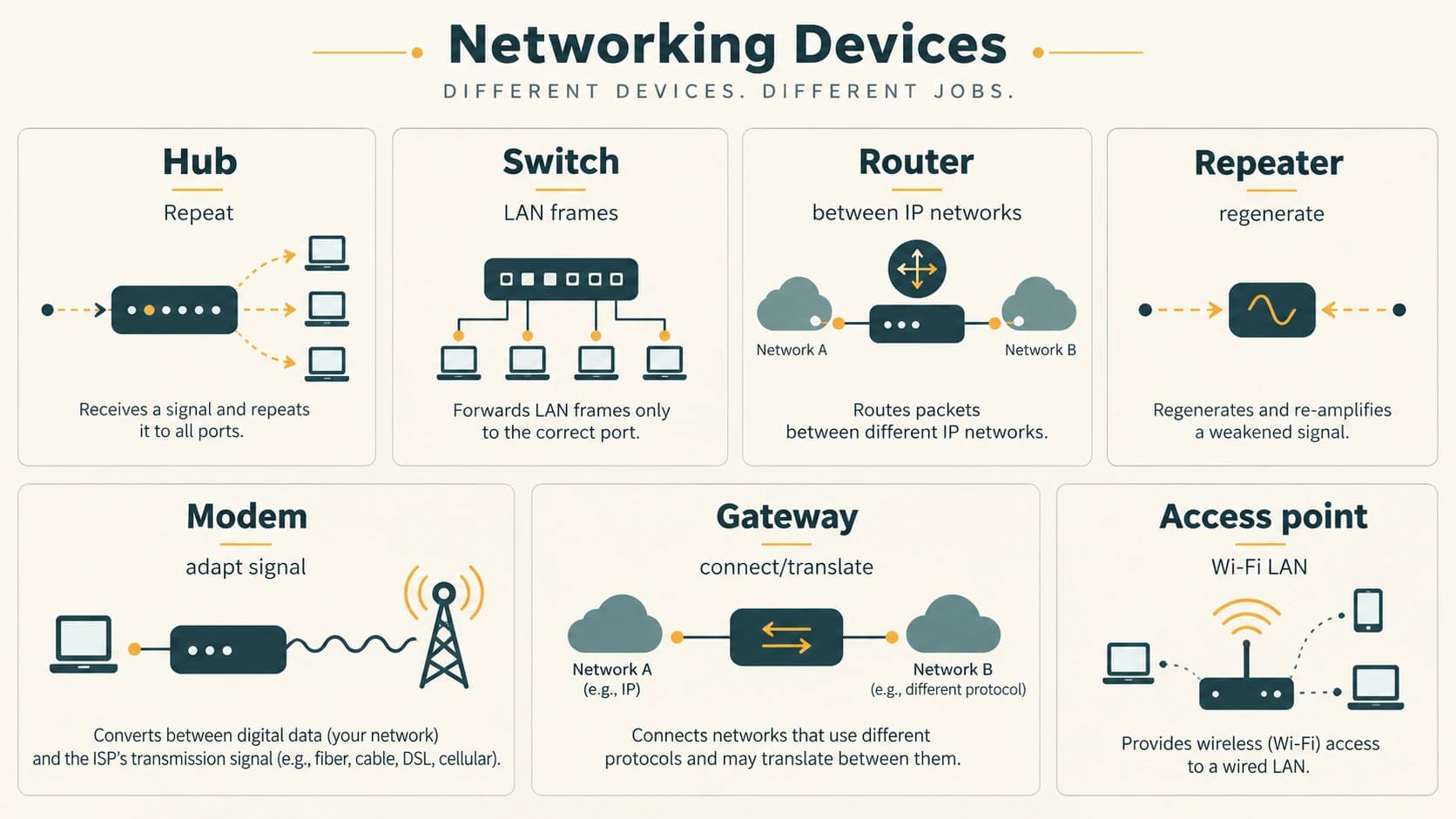
Devices compared
| Device | Main awareness-level function | Typical clue |
|---|---|---|
| Hub | Repeats incoming Ethernet signals to other ports | Shared legacy medium |
| Switch | Connects LAN devices; forwards frames by MAC information | Within one LAN |
| Router | Routes packets among IP networks | Connect different networks |
| Repeater | Regenerates/relays signals | Extend link/range |
| Modem | Adapts data signals for an access medium | Link to broadband/telecom medium |
| Gateway | Exit/translation function between networks/systems | Default next hop or protocol bridge |
| Access point | Supplies Wi-Fi connectivity to a LAN | Wireless client access |
Worked examples
Example 1: Computers and a network printer connect to a device that forwards a frame toward the correct port. That is a switch.
Example 2: A branch network communicates with another network using IP routing. That job belongs to a router.
Example 3: A long physical link needs signal regeneration. A repeater is the best awareness-level match.
Example 4: A building uses a Wi-Fi access point wired to a switch. The AP creates wireless access; the switch connects devices in the LAN. These roles do not contradict one another.
Example 5: An exam asks for a device that connects networks using different protocol translations. The term gateway is more appropriate than an ordinary Layer-2 switch.
Important terms
| Term | Meaning |
|---|---|
| Frame | Link-layer unit carried over media such as Ethernet |
| Packet | Network-layer unit, e.g. IP packet |
| MAC table | Switch's learned mapping from MAC addresses to ports |
| Routing table | Information helping a router choose a next hop/interface |
| Default gateway | Router/next-hop address used for nonlocal destinations |
| Collision domain | Area where classic shared-medium Ethernet transmissions can interfere |
| VLAN | Virtual LAN; logical separation supported by suitable network equipment |
| Access point | Device providing wireless LAN connectivity |
Common confusions and exam traps
- Hub vs switch: Classic hub repeats; switch makes forwarding choices for normal frames.
- Switch vs router: Basic Layer-2 switching primarily uses MAC information; IP routing uses destination IP addresses.
- Gateway vs router: Related but not identical words. A router may serve as the default gateway; a gateway may translate protocols.
- Modem vs Wi-Fi router: Common consumer boxes may contain both, or each may be separate.
- Repeater vs router: Extending a signal is not IP routing.
- Wireless AP vs Internet: Wi-Fi access does not by itself provide public Internet service.
Objective-exam facts to remember
| Clue | Device |
|---|---|
| Selective forwarding of Ethernet frames within a LAN | Switch |
| Connecting/routing between IP networks | Router |
| Repeats signals to legacy hub ports | Hub |
| Regenerates/extends a signal | Repeater |
| Modulation/demodulation / access medium interface | Modem |
| Default exit or protocol translation | Gateway |
| Wi-Fi access for wireless clients | Access point |
Quick revision
- Hubs are simple legacy repeaters; switches are selective frame-forwarding devices.
- Routers route between networks using IP information.
- Repeaters extend the signal path; modems adapt signals for transmission media.
- Gateways can be default next hops or translators, depending on context.
- A consumer networking box may combine several different device functions.
Practice questions — CA-07-04
1. What device typically forwards Ethernet frames using learned MAC information?
A. Printer
B. Modem only
C. Switch
D. Scanner
2. Which device routes packets between different IP networks?
A. Monitor
B. Traditional hub
C. Router
D. Keyboard
3. A classic Ethernet hub typically:
A. Performs DNS resolution
B. Repeats received signals to other ports
C. Encrypts every frame
D. Routes using an IP table
4. Which device best matches regenerating a weakened signal over a link?
A. Spreadsheet software
B. Switch only
C. Bank server
D. Repeater
5. Modem is historically derived from:
A. Modulator-demodulator
B. Mobile dictionary
C. Monitor-demonstrator
D. Module-device maker
6. In IP networking, a default gateway is normally:
A. The printer's paper tray
B. Any nearby Bluetooth headset
C. An Excel formula
D. A next-hop device/interface for nonlocal destinations
7. A device supplying Wi-Fi radio access to a wired LAN is commonly an:
A. Video codec
B. Optical disc drive
C. Access point
D. OCR engine
8. Which comparison is most accurate for conventional basic equipment?
A. Hub routes by IP; router prints files
B. Switch forwards LAN frames; router forwards among IP networks
C. Repeater learns domain names; switch modulates signals
D. Modem always provides Wi-Fi
9. A branch uses a device to connect systems that require protocol translation. The best general term is:
A. Gateway
B. Hub only
C. Mouse
D. Printer
10. Which statement is true about modern consumer network boxes?
A. They cannot connect local devices
B. They never use IP addresses
C. They can only perform one function
D. They may combine modem, router, switch and access-point functions
11. A conventional Layer-2 switch makes a normal known-unicast forwarding decision primarily from:
A. MAC-address forwarding information
B. The monitor refresh rate
C. A website's title
D. The user's name
12. Which statement avoids a common mistake?
A. All hubs are faster than switches
B. A switch may still flood certain broadcast or unknown traffic
C. Every switch behaves exactly like a hub
D. Every router requires a separate Wi-Fi device
Answers and explanations — CA-07-04
1. C — Switch. A basic Layer-2 Ethernet switch learns MAC-to-port mappings and forwards frames selectively.
2. C — Router. Routers use IP routing information to select a path toward other networks.
3. B — Repeats received signals to other ports. Traditional hubs are multiport repeaters; they do not selectively forward ordinary frames by destination MAC.
4. D — Repeater. A repeater regenerates or relays a signal; it does not primarily select IP routes.
5. A — Modulator-demodulator. The term combines modulation and demodulation, describing adaptation of data signals for a medium.
6. D — A next-hop device/interface for nonlocal destinations. A router often serves as the default gateway for traffic leaving a local IP network.
7. C — Access point. Wireless access points connect Wi-Fi clients to the LAN; they may be standalone or integrated into a router.
8. B — Switch forwards LAN frames; router forwards among IP networks. Switches and routers have different typical forwarding roles even though modern devices can combine features.
9. A — Gateway. A protocol gateway can translate communication formats or protocols between systems.
10. D — They may combine modem, router, switch and access-point functions. A single physical box may implement multiple separate network functions.
11. A — MAC-address forwarding information. Layer-2 switches rely on learned link-layer addresses for normal destination forwarding.