
Number-System Conversions at Awareness Level
Number-System Conversions at Awareness Level. Foundational Computer Awareness explanations, examples and explained practice questions for banking and recruitment exam preparation.
By Akhilesh Saini
What you will learn
- Convert small binary, octal and hexadecimal integers to decimal.
- Convert small decimal integers to binary by repeated division.
- Use three-bit groups for binary–octal and four-bit groups for binary–hexadecimal conversion.
- Check an answer by reversing the conversion.
Why this topic matters
A common objective question gives 1010₂ and asks for its decimal equivalent, or asks for the hexadecimal form of an eight-bit pattern. These are not difficult arithmetic problems if you identify the base and place values before calculating. This lesson intentionally stays with short, non-negative whole numbers; signed representations and floating-point formats belong to more technical courses.
Method 1: from another base to decimal
For any whole number written in base b, multiply each digit by the matching power of b and add. In hexadecimal, first replace letters with their numerical values (A=10 through F=15).
Worked example 1 — Binary 1101₂ to decimal
| Digit | 1 | 1 | 0 | 1 |
|---|---|---|---|---|
| Power of two | 8 | 4 | 2 | 1 |
| Contribution | 8 | 4 | 0 | 1 |
Total: 8 + 4 + 0 + 1 = 13₁₀.
Worked example 2 — Octal 35₈ to decimal: 3 × 8 + 5 = 24 + 5 = 29₁₀.
Worked example 3 — Hexadecimal 2B₁₆ to decimal: 2 × 16 + 11 = 43₁₀.
Worked example 4 — Hexadecimal 10₁₆ to decimal: 1 × 16 + 0 = 16₁₀. This is a frequent trap because the written digits resemble decimal ten.
Method 2: decimal integer to binary by repeated division
Divide the decimal integer by two, record each remainder (0 or 1) and repeat with the integer quotient. When the quotient becomes zero, read the remainders from bottom to top.
Worked example 5 — Decimal 13 to binary:
| Calculation | Quotient | Remainder |
|---|---|---|
13 ÷ 2 | 6 | 1 |
6 ÷ 2 | 3 | 0 |
3 ÷ 2 | 1 | 1 |
1 ÷ 2 | 0 | 1 |
Bottom-to-top remainders: 1101₂. Verify: 8 + 4 + 0 + 1 = 13.
Worked example 6 — Decimal 20 to binary: 20 = 16 + 4, so its pattern has 1 in the 16 and 4 positions: 10100₂. Using powers is often faster for small questions.
Worked example 7 — Decimal 0: Its representation is simply 0 in binary, octal, decimal and hexadecimal. Do not require several zero digits to represent the value, though a fixed-width format may pad with leading zeros.
Method 3: decimal to octal or hexadecimal
Use the same repeated-division idea but divide by 8 or 16, respectively. Convert hexadecimal remainders 10–15 into letters A–F.
Worked example 8 — Decimal 47 to hexadecimal:
47 ÷ 16gives quotient 2 and remainder 15 (F).2 ÷ 16gives quotient 0 and remainder 2.- Read remainders backwards:
2F₁₆.
Worked example 9 — Decimal 50 to octal:
50 ÷ 8gives quotient 6, remainder 2.6 ÷ 8gives quotient 0, remainder 6.- Result:
62₈; verify6×8+2=50.
Method 4: binary to octal by grouping into threes
Because one octal digit corresponds to exactly three binary bits, group the bits from right to left. Add leading zeros only where needed to fill the leftmost group.
Example: 110101₂ becomes 110 101, which gives octal digits 6 and 5: 65₈. Check: decimal 53 either way (32+16+4+1 = 53; 6×8+5 = 53).
For 10111₂, group as 010 111 → 2 7 → 27₈. The first zero is padding and does not change the value.
Method 5: binary to hexadecimal by grouping into fours
Group from right to left, using four binary bits per hexadecimal digit.
Worked example 10 — 00111010₂ to hexadecimal:
0011 | 1010 → 3 | A → 3A₁₆.
For 11111111₂, group 1111 | 1111 → F | F: FF₁₆. In decimal this is 255 (15×16+15).
The reverse direction is easy: replace each hexadecimal digit with its four-bit group and each octal digit with its three-bit group, then remove unnecessary leading zeros when the representation is not fixed-width.
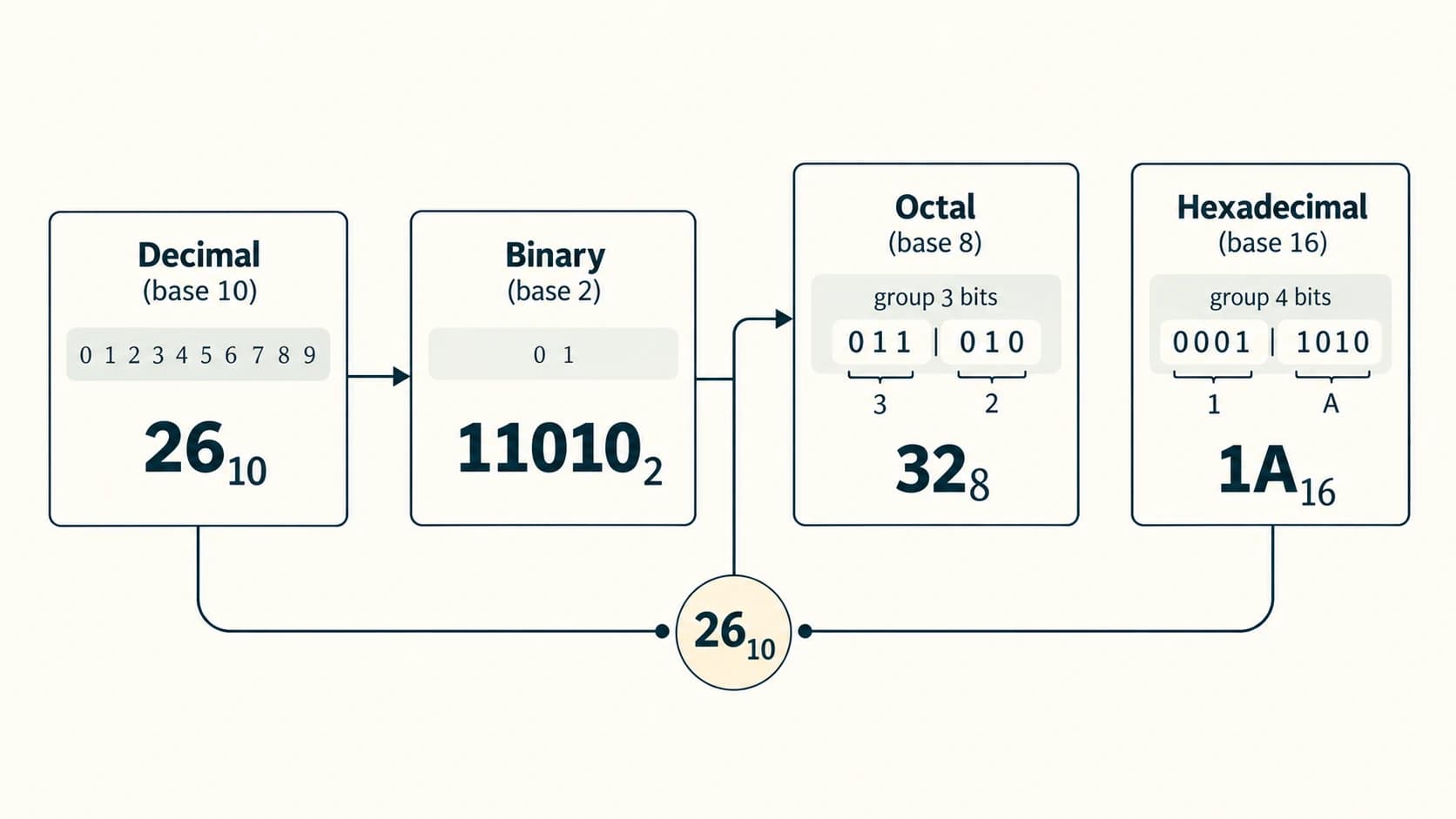
Quick conversion table
| Decimal | Binary | Octal | Hexadecimal |
|---|---|---|---|
| 0 | 0 | 0 | 0 |
| 1 | 1 | 1 | 1 |
| 2 | 10 | 2 | 2 |
| 7 | 111 | 7 | 7 |
| 8 | 1000 | 10 | 8 |
| 10 | 1010 | 12 | A |
| 13 | 1101 | 15 | D |
| 15 | 1111 | 17 | F |
| 16 | 10000 | 20 | 10 |
| 31 | 11111 | 37 | 1F |
A reliable answer-checking strategy
Suppose you converted 26₁₀ to 11010₂. To check, expand by place value:
11010₂ = 16 + 8 + 0 + 2 + 0 = 26₁₀.
If the check fails, first inspect these common errors: (a) reading division remainders top-to-bottom, (b) using decimal weights instead of base weights, and (c) grouping binary digits starting from the left rather than the right.
Common confusions and exam traps
- Conversion changes notation, not value:
10₁₀and1010₂represent the same quantity. - Do not confuse group lengths: Three bits → one octal digit; four bits → one hexadecimal digit.
- Read remainders in reverse order after repeated division.
- Padding: Leading zeros may be added when grouping, but they do not increase the value.
- No fractional conversion required here: Expressions such as
0.101₂need a different explanation and are outside this awareness lesson. - Binary grouping should start at the right for whole numbers; otherwise the resulting digits can be wrong.
Important terms
| Term | Meaning |
|---|---|
| Base conversion | Rewriting the same value in a different numeral system |
| Quotient | Whole-number result of division |
| Remainder | Amount left after division by the base |
| Bit grouping | Reading consecutive 3-bit or 4-bit groups as octal/hex digits |
| Leading zero | Zero to the left of the first nonzero digit, usually not changing whole-number value |
Objective-exam facts to remember
| Task | Fast method |
|---|---|
| Binary → decimal | Add place values of the 1 bits |
| Octal → decimal | Multiply by powers of 8 |
| Hexadecimal → decimal | Multiply by powers of 16, remembering A–F |
| Decimal → binary | Repeated division by 2, read remainders backwards |
| Binary → octal | Groups of 3 from the right |
| Binary → hexadecimal | Groups of 4 from the right |
Quick revision
- Every conversion preserves the value but changes its written form.
- When expanding a number, the rightmost digit has weight
base⁰. - Read repeated-division remainders from last to first.
- Use 3-bit groups for octal and 4-bit groups for hexadecimal.
- Verify a converted numeral by converting back to decimal.
Practice questions — CA-04-02
1. What is 1010₂ in decimal?
A. 8
B. 10
C. 12
D. 16
2. What is decimal 13 in binary?
A. 1011₂
B. 1100₂
C. 1101₂
D. 1110₂
3. What is 35₈ in decimal?
A. 29
B. 35
C. 40
D. 43
4. What is 2B₁₆ in decimal?
A. 27
B. 32
C. 42
D. 43
5. Which hexadecimal numeral represents decimal 47?
A. 1F₁₆
B. 2F₁₆
C. 3F₁₆
D. 4F₁₆
6. What is 1111₂ in hexadecimal?
A. A₁₆
B. B₁₆
C. E₁₆
D. F₁₆
7. When converting a whole binary number to octal, the bits should be grouped from the right in sets of:
A. 2
B. 3
C. 4
D. 8
8. What is decimal 16 in binary?
A. 1000₂
B. 1111₂
C. 10000₂
D. 11000₂
9. What is 110101₂ in octal?
A. 53₈
B. 65₈
C. 71₈
D. 75₈
10. What is 00111010₂ in hexadecimal?
A. 2A₁₆
B. 3A₁₆
C. A3₁₆
D. 3B₁₆
11. When converting an integer to another base by repeated division, the remainders are normally read:
A. From first to last
B. In the order of largest remainder
C. From last to first
D. After multiplying them all together
12. Which pair represents the same value?
A. 101₂ and 7₁₀
B. 10₈ and 10₁₀
C. F₁₆ and 15₁₀
D. 10₂ and 10₁₆
Answers and explanations — CA-04-02
| Q | Correct answer | Why it is correct |
|---|---|---|
| 1 | B. 10 | 1010₂ = 8 + 2 = 10. |
| 2 | C. 1101₂ | 8+4+1=13, so the four bits are 1101. |
| 3 | A. 29 | 3×8 + 5 = 29. |
| 4 | D. 43 | Hex B equals 11: 2×16+11=43. |
| 5 | B. 2F₁₆ | 2×16+15=47; F is decimal fifteen. |
| 6 | D. F₁₆ | Binary 1111 is 15, represented as F in hexadecimal. |
| 7 | B. 3 | Octal has eight digits and 2³=8. |
| 8 | C. 10000₂ | Sixteen is 2⁴, represented by one followed by four zeros. |
| 9 | B. 65₈ | Group 110 101: binary 110=6 and 101=5. |
| 10 | B. 3A₁₆ | Group 0011 1010 → 3 and A. |
| 11 | C. From last to first | Successive remainders give digits from least significant to most significant. |
| 12 | C. F₁₆ and 15₁₀ | F represents fifteen; each of the other pairs has unequal numeric values. |