
QR Codes, NFC and Digital-Payment Technology
QR Codes, NFC and Digital-Payment Technology. Foundational Computer Awareness explanations, examples and explained practice questions for banking and recruitment exam preparation.
By Akhilesh Saini
Learning objectives
Recognize QR and NFC as different information/communication technologies; understand how a digital payment moves from information capture to authorization and confirmation; distinguish receiving from sending money; recognize UPI at awareness level; and avoid common payment-security traps.
Why this topic matters
A merchant displays a black-and-white square code. A customer points a smartphone camera at it, sees a payment screen and confirms a transfer. Another customer taps a supported card or phone near a contactless reader. These actions may look similar because they occur near a payment counter, but QR is an optical code while NFC is a short-range radio communication technology. Neither is itself the complete payment system.
QR codes: visible data that a reader decodes
QR stands for Quick Response. A QR code is a two-dimensional machine-readable pattern that can carry data such as text, a URL or information used by a compatible payment app. A phone camera/optical scanner reads the visual pattern and software interprets the encoded data. The pattern is not a cellular network, not Bluetooth and not a radio signal.
A QR code can be static (the same encoded data is displayed for many interactions) or dynamic (generated for an individual request and possibly containing transaction-specific fields). A static merchant identifier alone does not prove that the displayed code belongs to the intended merchant; visually replaced/stickered codes are a known category of risk. A QR code can also point to a malicious website, so scan results must be reviewed rather than blindly trusted.
NFC: proximity radio communication
NFC stands for Near Field Communication, a technology using short-range radio interaction, commonly associated with a 13.56 MHz carrier. Supported cards, phones, tags and readers may exchange limited data or participate in a wider application such as transit access or contactless payment. NFC does not equal QR scanning; it does not require the phone camera to recognize a printed square image.
The short interaction distance is convenient, but short range alone is not a guarantee of payment security. A full payment system can involve card/phone credentials, tokenization, application rules, transaction limits and issuer/acquirer authorizations according to the system.
UPI and digital-payment roles
In India, Unified Payments Interface (UPI) is an instant interbank payment system developed and operated through the NPCI ecosystem. Users can initiate supported transfers using identifiers and payment-app flows. UPI is not merely a QR standard; a QR can be one way to supply payee information or start a payment.
A simplified payment flow is:
- Obtain payee/request information by entering an identifier, selecting a saved payee, scanning a genuine QR code or using another supported flow.
- Review recipient details and amount. Verify they match the intended transfer.
- Authorize an outgoing payment using the method required by the legitimate application (for example, a UPI PIN when applicable).
- Verify the result in the official app/bank transaction record rather than treating an editable screenshot or verbal claim as proof.
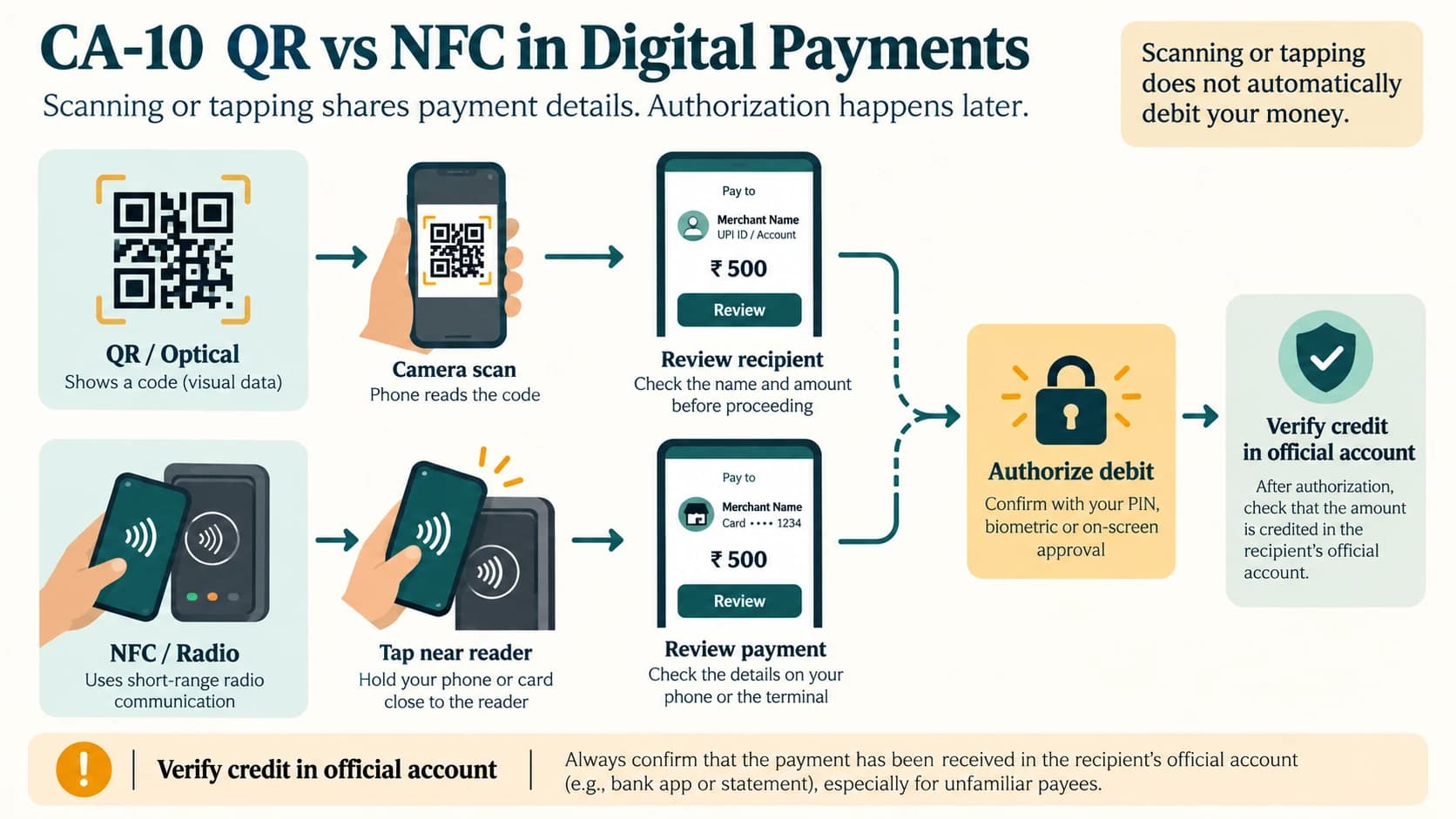
Receiving versus paying: an essential security distinction
To receive a normal incoming transfer, you do not need to disclose or enter a UPI PIN to approve that credit. A request asking someone to enter a PIN to 'receive' money may actually be attempting to authorize an outgoing transfer or collect request. Not all payment-app screens are identical, so users should review the direction of funds and the actual in-app request. A collect request is not the same as evidence that money has already been credited.
| Action or technology | Fundamental idea | Important limit |
|---|---|---|
| Scan QR | Camera reads a visual data pattern | The pattern may point to unsafe/misleading content |
| Tap NFC | Compatible devices exchange data by proximity radio | Needs supported device/application/reader |
| UPI transfer | Payment mechanism linking supported accounts/apps | Not all payment paths use QR |
| Authorize debit | User approves intended outgoing money movement | Review amount/payee; never disclose authorization secrets |
| Verify credit | Check official bank/app record | Screenshot alone is insufficient proof |
| Payment gateway | Technology/service that helps route/process payments | Not identical to an optical QR code |
Practical examples
Example A: A QR sticker pasted over a merchant's original code directs payments to another identifier. QR scanning still 'worked' technically; the merchant identity was wrong. The customer must confirm the displayed recipient and amount before authorization.
Example B: A contactless card is presented to an NFC-enabled reader. NFC supplies the proximity interaction; payment authorization and processing follow the card-network and issuer rules of the product. It is incorrect to say that NFC itself is a bank account.
Example C: An unknown caller says a refund is waiting and asks the customer to share a PIN or approve a collect request. The safer response is to decline, verify independently through trusted official channels, and report suspicious activity. No amount of attractive app design establishes that the request is genuine.
Important terms and objective-exam facts
| Clue | Answer |
|---|---|
| Two-dimensional optical code | QR code |
| Quick Response | QR full form |
| Close-range contactless radio | NFC |
| 13.56 MHz carrier often associated with | NFC |
| Common Indian instant payment system | UPI |
| UPI ecosystem operator | NPCI |
| PIN required solely to receive a normal credit | No |
| Proof of actual credit | Official verified account/transaction record |
Common confusions and quick revision
A QR code and NFC can appear in the same retail environment, but one is optically read information and the other is radio-based proximity communication. A merchant QR is not itself an authorization to debit a bank account; the supported payment app still follows its rules. Receiving, collecting and sending money are distinct actions. A secure-looking picture or a 'successful payment' screenshot can be forged or misunderstood.
- QR = optical data matrix; NFC = short-range radio.
- UPI is a payment system and QR is only one possible entry method.
- Always verify intended payee and amount before outgoing payment authorization.
- Never share payment secrets; ordinary incoming credit does not need UPI PIN approval.
- Validate success in official account/app records.
Practice questions — CA-10-05
1. What does QR stand for in QR code?
A. Quick Response
B. Query Router
C. Quality Reader
D. Queue Record
2. A phone camera scans a merchant QR code. Which technology directly reads the displayed pattern?
A. NFC radio alone
B. Bluetooth headphones
C. Virtual machine migration
D. Optical image recognition/decoding
3. NFC is best described as:
A. Near Field Communication by short-range radio
B. A two-dimensional printed pattern
C. A cloud virtual machine
D. A database primary key
4. Which frequency is commonly associated with NFC?
A. 2 Hz
B. 50 kHz
C. 13.56 MHz
D. 800 THz
5. A customer sees a UPI collect request from an unknown party asking for approval to receive a refund. What is safest?
A. Approve it with a PIN
B. Decline and verify using official channels
C. Send a PIN through SMS
D. Trust the accompanying screenshot
6. For a normal incoming UPI transfer, the recipient generally needs to:
A. Enter UPI PIN to accept the credit
B. Share their PIN with the sender
C. Approve any unknown collect request
D. Verify credit in the official account record
7. What must a payer check before authorizing an outgoing transfer?
A. Whether a screenshot is colorful
B. Only the smartphone brand
C. Recipient identity and amount
D. Whether a QR image contains a logo
8. Which Indian organization is associated with operating the UPI ecosystem?
A. ICANN
B. IEEE
C. NPCI
D. W3C
9. Which statement about static and dynamic QR codes is accurate?
A. Static code can never be replaced
B. Static code may encode persistent data; dynamic code may contain transaction-specific details
C. Dynamic QR always sends money automatically
D. Both are NFC-only signals
10. What is a contactless card tapping a reader most likely using?
A. NFC-compatible proximity communication
B. Camera OCR of a printed QR only
C. SMTP
D. An Excel formula
11. Someone shows a screenshot claiming that a payment succeeded. What is the best verification?
A. Treat the screenshot as a bank settlement record
B. Disclose the PIN to confirm
C. Approve a separate collect request
D. Check the official account/app transaction record
12. Which best distinguishes QR, NFC and UPI?
A. All are exact synonyms
B. QR is an optical code, NFC is proximity radio, UPI is a payment system
C. UPI is an optical scanner
D. NFC is a cloud billing model
Answers and explanations — CA-10-05
1. A — Quick Response. QR means Quick Response; it is a two-dimensional optical data code.
2. D — Optical image recognition/decoding. A printed QR code is decoded from an image captured by a camera or other optical scanner.
3. A — Near Field Communication by short-range radio. NFC is a short-range contactless radio communication technology; it is not optical QR scanning.
4. C — 13.56 MHz. NFC systems use a 13.56 MHz carrier frequency.
5. B — Decline and verify using official channels. A collect request can lead to an outgoing authorization. An ordinary incoming credit does not require approval with the receiver’s UPI PIN.
6. D — Verify credit in the official account record. Receiving money should be confirmed in official account records; ordinary credit does not require the recipient to disclose a PIN.
7. C — Recipient identity and amount. The payee and amount are central checks before authorizing a debit.
8. C — NPCI. NPCI develops and operates UPI arrangements in India.
9. B — Static code may encode persistent data; dynamic code may contain transaction-specific details. Static/dynamic describes generation/content behavior, not guaranteed payment success or authenticity.
10. A — NFC-compatible proximity communication. Contactless cards/readers commonly use NFC-related proximity radio standards.
11. D — Check the official account/app transaction record. Screenshots can be edited or stale; verify the status using the trusted bank/app channel.