
Blockchain and Distributed Ledger Basics
Blockchain and Distributed Ledger Basics. Foundational Computer Awareness explanations, examples and explained practice questions for banking and recruitment exam preparation.
By Akhilesh Saini
Learning objectives
Explain ledgers and distributed ledgers; identify blocks, hashes, linking and consensus in a simplified blockchain; distinguish public/private networks; recognize potential uses and the limits of immutability; and differentiate blockchain from cryptocurrency.
Starting with an ordinary ledger
A ledger is a record of transactions or entries. An organization may maintain a traditional centralized ledger whose authorized administrator controls the official record. A distributed ledger maintains copies of agreed records among multiple participating systems. The systems follow rules to propose, validate and synchronize updates. This does not mean every copy is open to every person; who may read or write depends on the design.
Blockchain is one design for a distributed ledger that groups records into sequential blocks linked by cryptographic information. Many blockchains use a cryptographic hash of a previous block in a later block. Such chaining helps make unauthorized historical changes evident and difficult to sustain when combined with consensus and system rules. However, not every distributed ledger uses a chain of blocks.
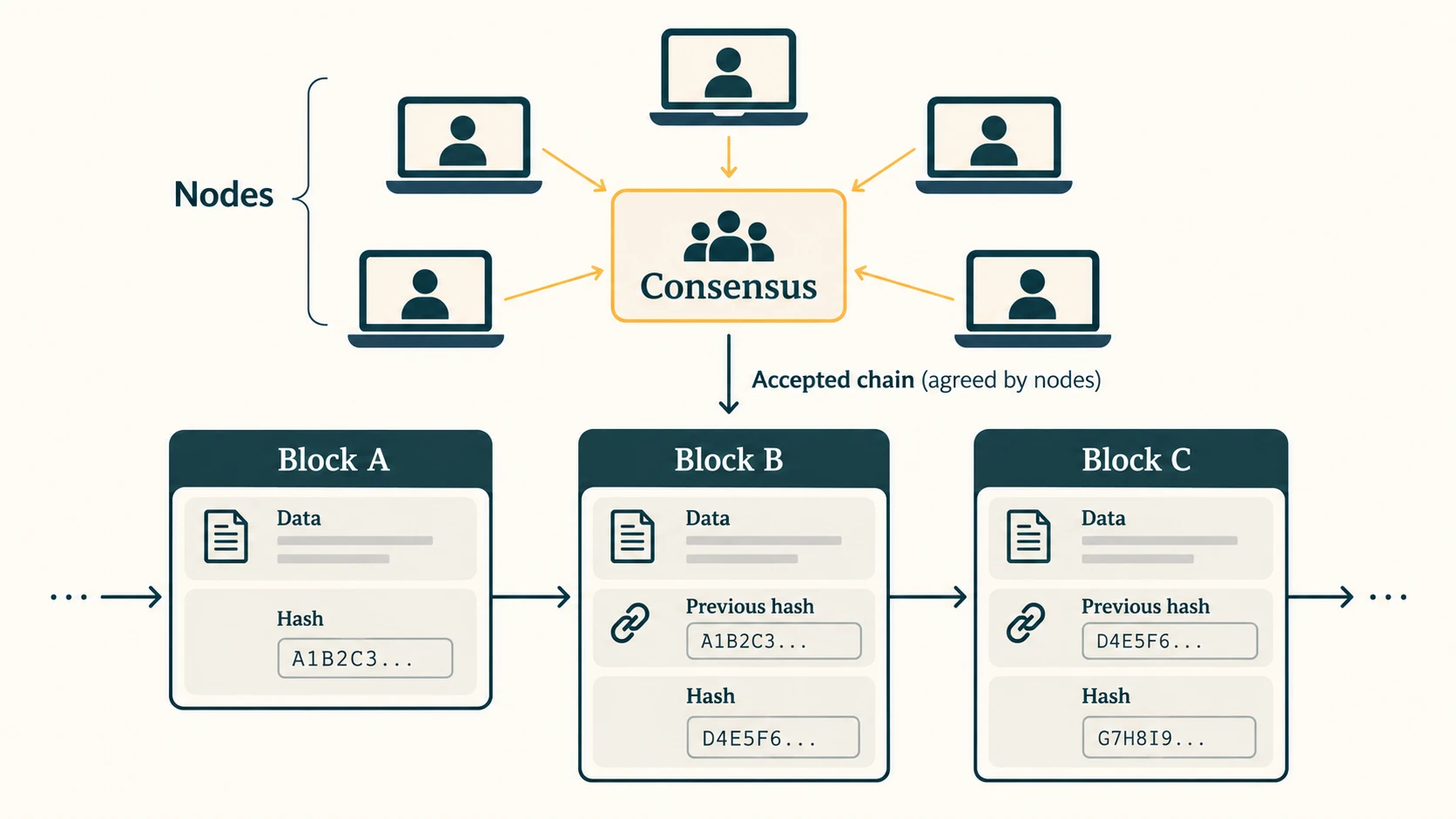
The simplified block chain
A typical conceptual block can contain transaction-related data, metadata, a reference/hash to the previous block, and other information required by the protocol. A cryptographic hash is a compact fixed-length digest calculated from data by a hash algorithm; changing the input normally changes the digest. This digest is not the same as a secret password or a guaranteed proof that the underlying transaction was truthful.
A simple visual model is:
Block A (data, hash A) → Block B (previous hash A, data, hash B) → Block C (previous hash B, data, hash C)
If someone alters past block data, the stored hash linkage can become inconsistent. Acceptance of any revised history depends on the network's consensus and governance rules, not just the presence of arrows between blocks.
Consensus, validation and participants
A distributed ledger needs a mechanism for participants to agree on a valid sequence or state. Consensus names the process/rules used to coordinate accepted records despite separate participating machines. Different systems use different approaches; introductory awareness generally needs recognition rather than advanced consensus mathematics.
- Node: A participating system running relevant network software.
- Transaction/record: A proposed ledger change or logged event.
- Validator/miner: A participant performing a protocol-defined validation or block-production role; exact roles vary.
- Smart contract: Software logic whose actions follow rules when executed by a supported blockchain environment; it is not automatically a legally enforceable paper contract.
- Digital signature: Cryptographic mechanism used in many systems to authenticate authorized transaction instructions; it does not establish that off-chain facts are true.
Proof of Work (PoW) and Proof of Stake (PoS) are examples of consensus-related blockchain mechanisms. They are not two cloud service models or two cryptocurrency symbols. No one method is universal across all ledgers.
Public, permissioned and private arrangements
Some blockchains permit broad public participation, subject to network rules. Others restrict validation, membership or visibility. Permissioned describes restricted participation or roles; permissionless allows open participation under the protocol rules. These concepts are not identical to whether the data is confidential, and governance patterns differ.
Blockchain versus cryptocurrency
A cryptocurrency is a digital asset system commonly using cryptographic methods and a distributed ledger. Bitcoin is a historical example of a cryptocurrency system implemented using a blockchain. However, a blockchain can be designed for record sharing, traceability or coordinated workflows without functioning as a public cryptocurrency. Conversely, electronic bank balances and standard digital payments do not inherently require a blockchain.
Possible banking-related contexts
A group of organizations might evaluate a permissioned shared record system where multiple parties need a consistent event history, subject to agreement on who can participate. It may be discussed for trade-document status, asset lifecycle records or other reconciliation scenarios. Before selecting blockchain, the group should ask whether a conventional shared database with appropriate audit logs would be simpler and safer. The presence of blockchain technology does not itself establish regulatory compliance, legal validity, confidentiality or business value.
Limits, corrections and common myths
The phrase immutable ledger is a teaching shorthand for tamper-evident/resistant history under the system's rules—not an absolute guarantee that no record can ever be changed, corrected, reorganized or replaced under any circumstances. If false information is entered by an authorized participant, a cryptographic hash will not make the claim true. Mistakes may be corrected with additional records or governed processes, depending on the network. Privacy risks arise when sensitive information is permanently shared more broadly than intended.
Important terms and objective-exam facts
| Exam clue | Concept |
|---|---|
| Shared synchronized ledger among participants | Distributed ledger |
| Linked batches of ledger entries | Blockchain |
| Digest derived from block contents | Cryptographic hash |
| Network process for agreed state/history | Consensus |
| Automated on-ledger rule execution | Smart contract |
| Broadly open participation under network rules | Permissionless |
| Restricted participation/governance | Permissioned |
| All digital banking must use blockchain | False |
Quick revision
- A ledger records entries; a DLT system shares/coordinates them among participants.
- Blockchain links batches of data cryptographically; DLT need not use blocks.
- Hash linkage aids tamper evidence, not proof that input data is true.
- Consensus determines what the participating systems accept.
- Blockchain and cryptocurrency are related in many systems, not synonymous.
Practice questions — CA-10-04
1. What is the primary purpose of a ledger?
A. Record entries or transactions
B. Produce electrical signals
C. Run a computer guest OS
D. Store an image as pixels only
2. A distributed ledger differs from a conventional single-copy ledger mainly because it:
A. Always permits anonymous unrestricted access
B. Can never contain incorrect input
C. Must use a Wi-Fi access point
D. Keeps synchronized agreed records across participants
3. Which is a common structural feature of a blockchain?
A. Blocks linked by cryptographic references
B. Single standalone editable spreadsheet only
C. No rules for accepting updates
D. Mandatory Internet-of-Things sensor
4. A cryptographic hash of a block is best described as:
A. The true meaning of every transaction
B. A reversible secret message
C. A bank interest rate
D. A digest calculated from data
5. What is consensus in a distributed ledger?
A. A keyboard shortcut
B. Automatic deletion of all duplicates
C. Rules/process for participants to agree on accepted records/state
D. A method for optical QR recognition
6. Which statement about blockchain and cryptocurrency is correct?
A. Every blockchain must have a cryptocurrency
B. Cryptocurrency and blockchain are identical terms
C. Some blockchains serve uses other than cryptocurrency
D. Every digital bank transfer is a blockchain transaction
7. What is a smart contract in typical blockchain terminology?
A. Software logic executing according to supported ledger rules
B. A guaranteed legally enforceable paper document
C. A physical RFID reader
D. A cloud deployment region
8. A restricted network where authorized participants validate entries is commonly called:
A. Always permissionless public chain
B. A public Wi-Fi SSID
C. Permissioned ledger/network
D. An unencrypted virtual disk
9. Which claim overstates blockchain reliability?
A. Hash links can expose tampering
B. Records are always true simply because they are hashed
C. A protocol has rules for validation
D. Participants may keep synchronized ledger copies
10. What does PoW stand for?
A. Platform on Wireless
B. Point of Web
C. Payment without Wallet
D. Proof of Work
11. Which is a responsible question before adopting a blockchain for internal records?
A. Can we remove all legal controls?
B. Would a conventional controlled database and audit trail work better?
C. Can users never make mistakes?
D. Can we skip identity management?
12. Is every distributed ledger necessarily a blockchain?
A. Yes, by definition
B. No; a blockchain is one possible DLT structure
C. Yes, if records are financial
D. Only when an NFC card is used
Answers and explanations — CA-10-04
1. A — Record entries or transactions. A ledger records entries, such as transaction-related events or other controlled updates.
2. D — Keeps synchronized agreed records across participants. DLT coordinates agreed records among multiple systems; access rules and data quality depend on implementation.
3. A — Blocks linked by cryptographic references. Blockchains commonly link ordered blocks with hashes or equivalent cryptographic references.
4. D — A digest calculated from data. A hash produces a digest; it does not prove the original data was truthful.
5. C — Rules/process for participants to agree on accepted records/state. Consensus helps independently operating participants decide which ledger updates/state are accepted.
6. C — Some blockchains serve uses other than cryptocurrency. Cryptocurrency is one prominent use, but distributed/blockchain ledgers may be designed for other record-sharing roles.
7. A — Software logic executing according to supported ledger rules. Smart contracts are code/logic on supported blockchain systems; legal status and correctness need separate consideration.
8. C — Permissioned ledger/network. Permissioned networks restrict eligible participants or roles according to governance rules.
9. B — Records are always true simply because they are hashed. Hashes attest to data linkage/integrity under assumptions, not to the correctness of real-world input.
10. D — Proof of Work. Proof of Work is a consensus-related mechanism used in some blockchain systems.
11. B — Would a conventional controlled database and audit trail work better?. Blockchain should solve an appropriate coordination problem; it is not necessarily simpler than standard databases.