
Internet of Things (IoT)
Internet of Things (IoT). Foundational Computer Awareness explanations, examples and explained practice questions for banking and recruitment exam preparation.
By Akhilesh Saini
Learning objectives
Define IoT; distinguish sensors, actuators, controllers and gateways; describe simple device-to-service data flow; recognize real-world applications and security concerns; and avoid confusing every connected gadget with an independently Internet-connected computer.
What is IoT?
The Internet of Things (IoT) concerns networks of physical objects equipped with electronic capabilities such as sensors, actuators, processing and connectivity, allowing them to exchange information and interact with the physical world. Typical examples include connected electricity meters, occupancy sensors, wearable monitors and industrial equipment. An IoT product can use nearby communication to a hub or gateway; not every sensor must have its own public IP address or direct Internet connection.
The word thing refers to a physical object, not a standalone webpage. In ordinary web use, a human requests information from a website. In IoT, a physical device may also collect measurements, report status or respond to commands with little continuous human intervention.
The main building blocks
| Component | Role | Illustrative example |
|---|---|---|
| Sensor | Measures a physical condition | Temperature sensor measures room temperature |
| Actuator | Produces a physical action | Relay switches a fan on or off |
| Controller/processor | Processes readings and commands | Local device controller compares a reading with a threshold |
| Network interface | Exchanges data/commands | Wi-Fi, Ethernet, cellular or short-range radio |
| Gateway | Connects different device networks and services where needed | Smart-building hub relays sensor events |
| Application/service | Stores, displays, analyzes or acts on data | Authorized energy-monitoring dashboard |
Sensor vs actuator is an especially important exam distinction: a sensor measures; an actuator acts. For example, a temperature sensor measures the room, while a switch/valve controller can change heating or cooling. An item may contain both.
Step-by-step IoT example
Imagine an organization monitors an equipment room:
- A temperature sensor takes a measurement.
- A small local controller reads the measurement.
- A network connection sends the reading, perhaps through a gateway, to an authorized service.
- A dashboard displays readings or raises a notification when a configured threshold is reached.
- Where designed and permitted, an actuator may switch on a fan or another controller may require human confirmation before action.
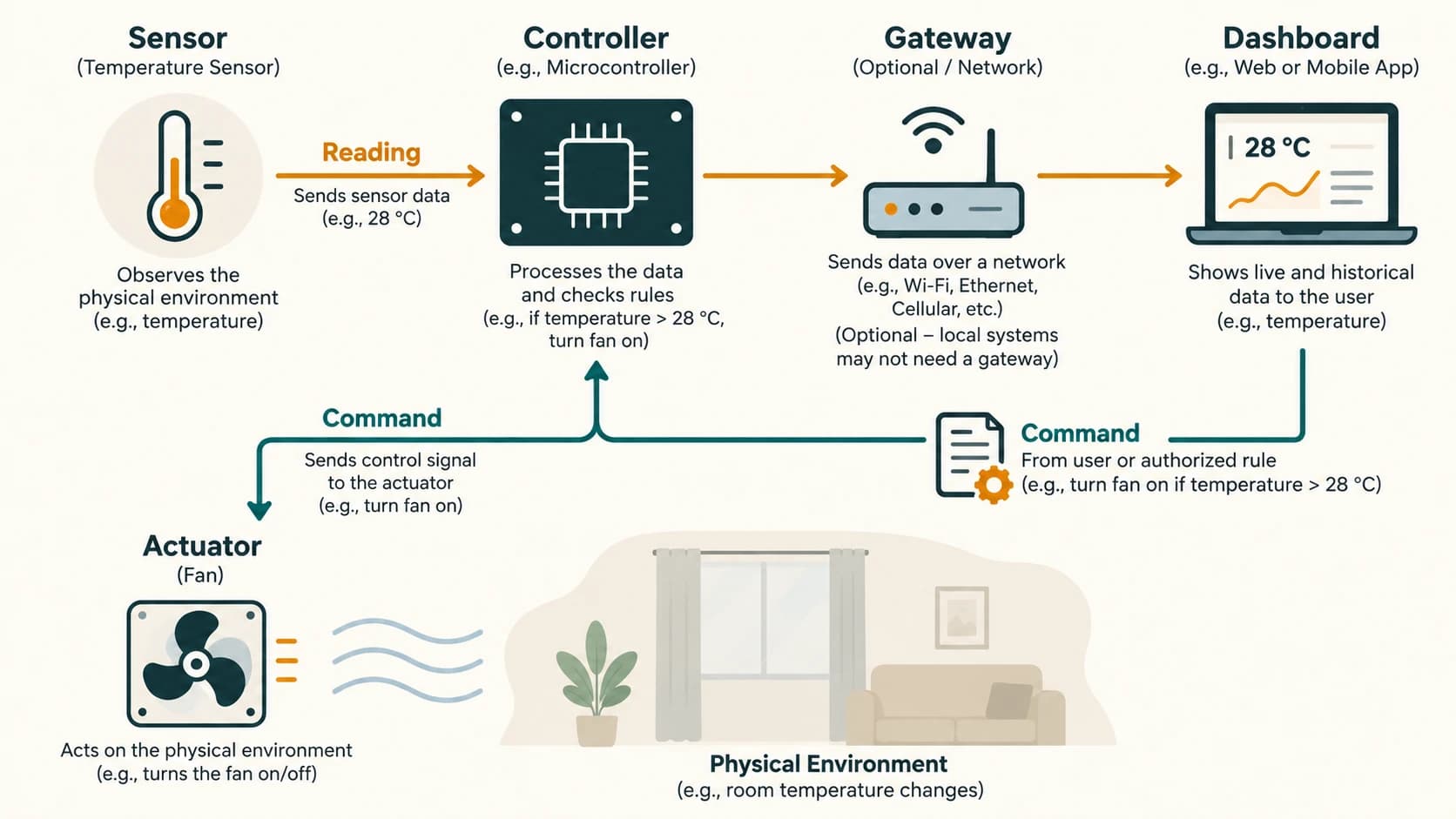
The data flow can be one-way reporting, two-way command/control, or local-only processing. Real systems vary. Sending a reading to a dashboard does not imply a remotely issued command is safe or automatically authorized.
Where IoT appears
- Smart homes: Connected lighting, thermostats, occupancy detectors and appliances.
- Healthcare and wearables: Sensors that measure and report activity or physiological signals, subject to device accuracy, medical-use restrictions and privacy.
- Industry: Machine condition monitoring, process instrumentation and predictive maintenance.
- Agriculture: Soil-moisture monitoring and controlled irrigation.
- Transport: Vehicle telematics and equipment-status sensors.
- Utilities: Electricity/water meters that report readings via supported communications.
- Facilities and banks: Environmental monitoring, approved equipment monitoring and physical access/event sensors, subject to policy and safeguards.
A connected camera is an example of a networked physical device, but the terms IoT, cloud, AI and automation are not interchangeable. An IoT sensor can provide data without any ML. ML can analyze IoT data, but AI is not mandatory for the definition of IoT.
Communication and edge computing
IoT devices may communicate over wired links (such as Ethernet) or wireless links (such as Wi-Fi, Bluetooth-based connections or cellular networks). They may report to a local gateway that sends summarized readings onward. Edge computing means processing information close to where it is generated, such as at the device or local gateway, rather than sending everything to a distant centralized service. Cloud processing and edge processing can coexist.
Example: if a local smoke detector must trigger an immediate alarm, relying only on a distant service could introduce a needless dependency. A local response can remain important even if an online service also records alerts. Implementation must be engineered for the real safety requirements.
IoT risks and practical limits
Connected devices can reveal schedules, locations or operational patterns. Weak default credentials, unpatched firmware, insecure communications, overbroad cloud permissions or unsupported devices increase risk. Useful principles include changing unsafe default settings, keeping devices supported and updated, segmenting networks appropriately, and collecting only necessary information.
IoT ≠ always Internet available: A connected system may function partly or entirely on local networks. IoT ≠ inherently smart in the AI sense: A threshold-triggered light can be ordinary automation. Sensor accuracy ≠ guaranteed: Measurement quality depends on placement, calibration and environment.
Important terms and objective-exam facts
| Clue | Answer |
|---|---|
| Connected physical objects exchange readings/commands | IoT |
| Measures light, temperature, motion | Sensor |
| Moves, opens, switches or adjusts | Actuator |
| Connects local device network to another network/service | Gateway |
| Processing near data source | Edge computing |
| Software embedded in device controlling hardware | Firmware |
| Real-time requirement | Depends on system design and latency, not just 'IoT' label |
Quick revision
- IoT connects physical-world devices with sensing/acting and communication.
- Sensors observe; actuators produce physical effects.
- Data can travel through controllers and gateways to dashboards and services.
- Edge processing happens near the data source; cloud services may also be used.
- Privacy, firmware maintenance and device access control remain critical.
Practice questions — CA-10-03
1. Which device component measures a room’s temperature?
A. Actuator
B. Gateway account
C. Sensor
D. Database key
2. A connected controller switches on a fan when authorized conditions are met. The switching component is an:
A. Optical scanner
B. Actuator
C. Hash
D. Hypervisor
3. Which arrangement is a reasonable IoT flow?
A. Sensor → controller/network → service → optional action
B. Paper poster → compiler → spreadsheet formula
C. Hash → cryptocurrency → antivirus only
D. Monitor → mouse → printer with no device logic
4. A nearby gateway relays small sensor messages to an organization’s network. It mainly:
A. Replaces the need for device security
B. Guarantees false readings become true
C. Always turns sensors into payment readers
D. Connects device/network systems where needed
5. Processing a machine reading on the local device rather than a remote data centre is an example of:
A. Public-key hashing
B. Optical payment
C. Edge computing
D. A relational primary key
6. Which statement is correct about connectivity in IoT?
A. Every sensor must itself have a public Internet IP
B. Only wired Ethernet counts
C. No device ever needs updates
D. IoT products may use local radio through a hub
7. A smart light follows a fixed motion-trigger rule but uses no learned model. It may be:
A. IoT automation without machine learning
B. Impossible because IoT requires AI
C. A blockchain validator
D. A virtual machine
8. Which is a common IoT security concern?
A. Too many printing shortcuts
B. An immutable optical QR pattern
C. Excel relative references
D. Unchanged unsafe default passwords
9. Which combination best describes a smart electricity meter system?
A. Only manually typed email messages
B. Sensing and communicating measurements
C. Machine code compilation only
D. No physical-world interaction
10. A bank uses temperature sensors to monitor a network room. The most important practical caution is:
A. Measurement accuracy and access controls still matter
B. The sensor is guaranteed to be calibrated forever
C. Every alert is final proof of fire
D. IoT devices cannot use Ethernet
11. Which is NOT a defining requirement of an IoT system?
A. Physical-world sensing/actuation in common definitions
B. Communication among components
C. Mandatory blockchain cryptocurrency ledger
D. Some data processing/control
12. In an IoT context, firmware is most closely associated with:
A. A paper receipt
B. Embedded software that controls device behavior
C. A printed matrix code
D. A wireless frequency standard only
Answers and explanations — CA-10-03
1. C — Sensor. A temperature sensor observes a physical condition; an actuator produces physical action.
2. B — Actuator. An actuator carries out an action such as switching, moving or adjusting a physical mechanism.
3. A — Sensor → controller/network → service → optional action. IoT systems commonly combine sensing, local processing, communication, services and possibly actuation.
4. D — Connects device/network systems where needed. Gateways bridge or coordinate networks/devices; they do not validate every physical fact automatically.
5. C — Edge computing. Edge computing performs processing near the source, potentially reducing dependence on distant services.
6. D — IoT products may use local radio through a hub. Connected physical objects may use local connections and gateways; direct public connectivity is not always required.
7. A — IoT automation without machine learning. Connected sensing/actuation can use ordinary rules. AI and IoT can interact but are not the same concept.
8. D — Unchanged unsafe default passwords. Default or weak credentials and unpatched firmware can expose network-connected devices.
9. B — Sensing and communicating measurements. Smart meters are examples of physical measurement devices that communicate readings.
10. A — Measurement accuracy and access controls still matter. Calibration, placement, secure connectivity and operational response procedures all affect usefulness.
11. C — Mandatory blockchain cryptocurrency ledger. IoT does not depend on blockchain or cryptocurrencies.