
Artificial Intelligence and Machine Learning Basics
Artificial Intelligence and Machine Learning Basics. Foundational Computer Awareness explanations, examples and explained practice questions for banking and recruitment exam preparation.
By Akhilesh Saini
Learning objectives
Explain AI, machine learning and deep learning in accessible language; recognize supervised, unsupervised and generative tasks; distinguish training and inference; understand why AI output can be mistaken; and recognize responsible use cases.
Why this topic matters
When a banking app flags a possible fraud pattern, a system recognizes text from a document, or a chatbot drafts an answer, several technologies may be involved. Calling every automated feature 'AI' is not precise. An ordinary rule-based program can automate a task without learning from example data, while machine-learning systems learn patterns during training. For an objective exam, understanding the broad categories matters more than knowing model mathematics.
AI, ML and deep learning
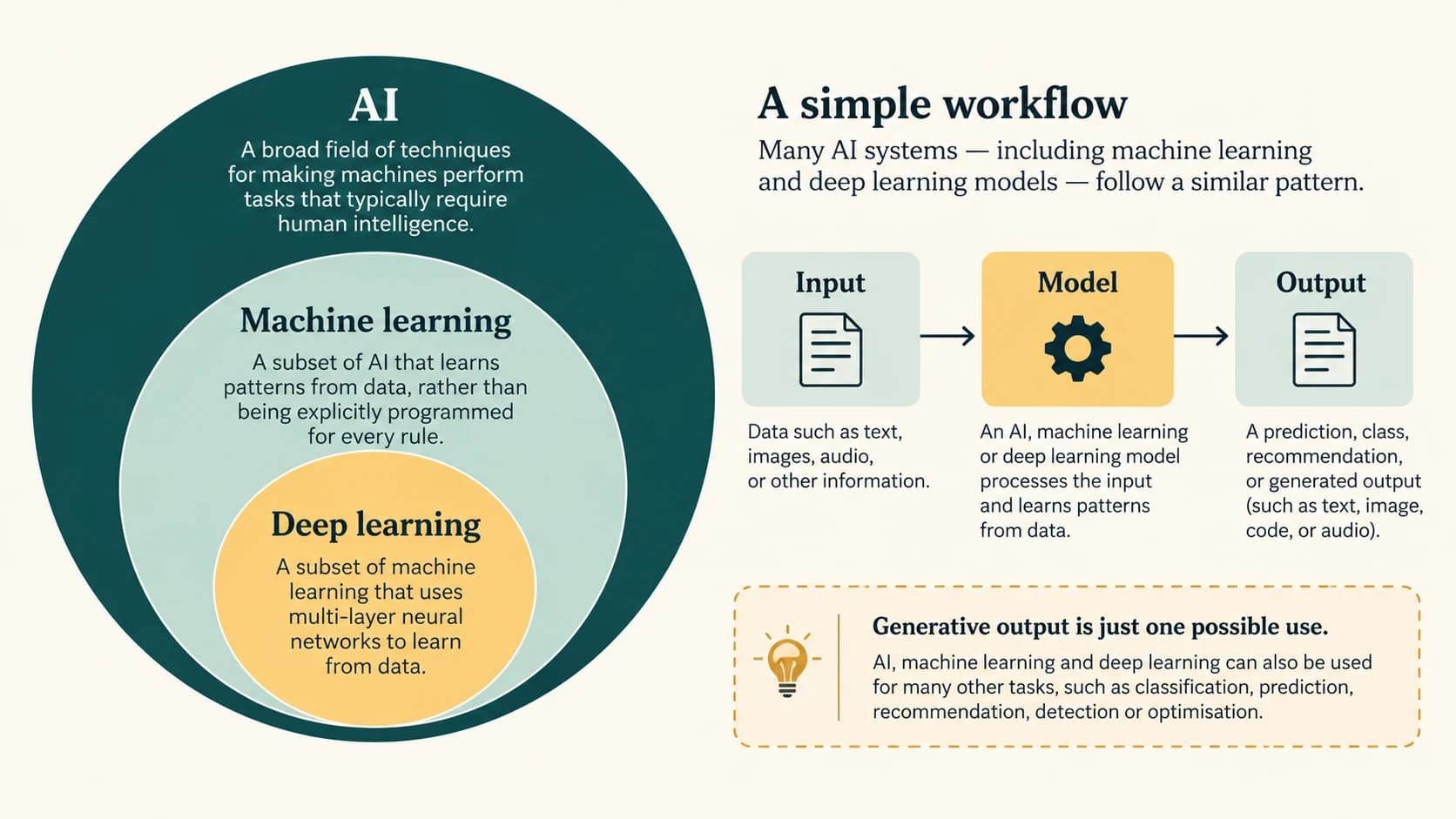
Artificial intelligence (AI) is a broad field concerned with building computer systems that perform tasks associated with intelligent behavior, such as reasoning, perception, prediction, language processing and planning. Some AI systems use explicit rules; others use learned statistical models.
Machine learning (ML) is a set of approaches in which models identify patterns from data during training and use them to make predictions, classifications or other outputs. Rather than programming every possible example as an individual rule, a designer supplies training objectives and suitable examples or feedback.
Deep learning (DL) is a family of ML methods that use neural networks with multiple processing layers. These systems can be useful for image, speech, language and other complex patterns, but not every ML application is deep learning.
The awareness-level inclusion relation is AI ⊃ ML ⊃ deep learning: ML is within the broader AI field, and deep learning is within ML. Generative AI describes systems that generate outputs such as text, images or code; modern examples often use large learned models, but 'generative' is a description of function, not a synonym for every AI system.
Typical tasks and everyday examples
| Task | Input and output | Banking-related example | Important caution |
|---|---|---|---|
| Classification | Input → category | 'Potentially suspicious' vs 'ordinary' transaction pattern | False positives and false negatives can occur |
| Prediction | Past patterns → estimated value | Forecasting a branch service workload | Future conditions may differ from training data |
| Recommendation | Preferences/history → suggested item | Suggesting a help article | Suggestions are not guaranteed correct |
| Computer vision | Images → labels/measurements | Extracting information from a document image | Image quality and privacy matter |
| NLP | Language → analyzed/generated language | Support chat and text categorization | Fluent text can be inaccurate |
| Generative AI | Instructions/context → newly generated content | Drafting a routine email for human review | Can fabricate details and should not expose secrets |
Natural language processing (NLP) is technology for working with human language; computer vision is technology for processing visual information. Both can employ ML, but they are application domains rather than service models like SaaS.
Learning approaches at awareness level
- Supervised learning: Examples have associated labels or target outcomes. Example: historical transactions labeled by an authorized review process are used to train a classifier.
- Unsupervised learning: Patterns or groupings are explored without the same explicit per-example target labels. Example: finding broad clusters of customer-service request types.
- Reinforcement learning: A learning agent improves behavior using feedback or rewards from interaction. It is not simply another name for supervised classification.
Training, inference, and model evaluation
Consider a fictional system that classifies complaint messages. First, examples are gathered and checked for permission, representation and correctness. During training, a model learns relationships from training data. During inference, it processes new messages and provides predictions. Evaluation measures performance on appropriately separated examples; memorizing the training set alone is not sufficient evidence of general usefulness.
Two mistakes are common. Overfitting occurs when a model matches training details or noise too closely and performs poorly on genuinely new examples. Bias can arise when data, assumptions, objectives or use conditions cause systematically unfair or distorted outcomes. Hallucination in generative AI refers to plausible-looking but unsupported or false content; apparent confidence in wording does not establish accuracy.
A system giving a probability or risk score does not provide a final verified fact. High-impact financial actions need policy, controls, review, and appropriate human oversight. Privacy, data minimization, security and record handling remain relevant.
Worked example: smart automation or machine learning?
A program blocks a transaction whenever amount > specified_limit because a developer explicitly coded that condition. That is rule-based automation. A trained model examines many permitted features and estimates whether a pattern resembles reviewed suspicious transactions. That is ML-based classification. A bank might combine both approaches; they are not mutually exclusive.
A text generator drafts an explanation of an account feature. It may help staff work faster, but a human or reliable process still needs to verify policy facts, numbers and customer-specific details. The ability to write polished language is not evidence of correctness.
Important terms and objective-exam facts
| Term | Remember |
|---|---|
| AI | Broad area of intelligent computer-system behavior |
| ML | Models learn useful patterns from data/feedback |
| Deep learning | ML using multi-layer neural networks |
| NLP | Working with human language |
| Computer vision | Processing/interpreting visual data |
| Supervised learning | Training with labeled target examples |
| Unsupervised learning | Discovering structure without those labels |
| Inference | Using a trained model on new input |
| Generative AI | Produces generated content |
| Hallucination | Unsupported or invented AI output |
Common confusions and exam traps
AI ≠ every automation: A script that copies files on schedule may use no AI. AI ≠ ML exclusively: Other AI techniques exist. Training ≠ inference: Training forms/adjusts model parameters, whereas inference applies a trained model. High accuracy ≠ zero errors: Incorrect classifications remain possible. Generative output ≠ evidence: Check source facts rather than trusting fluency.
Quick revision
- AI is broad; ML is a subset; DL is a subset of ML.
- Supervised uses labels; unsupervised looks for structure; reinforcement uses feedback/rewards.
- NLP works with language; vision works with images.
- Training and inference are different phases of using a model.
- Bias, privacy, model errors and fabricated text are practical limitations.
Practice questions — CA-10-02
1. Which relationship most accurately expresses the usual scope of these fields?
A. AI is a subset of deep learning
B. ML excludes AI
C. Deep learning is a subset of ML, which is within AI
D. Generative AI means all automation
2. A fraud-classification model trains using transactions already labeled as reviewed suspicious or ordinary. This is mainly:
A. Supervised learning
B. Unsupervised learning
C. Cloud elasticity
D. Encryption
3. A system groups complaint types without predefined group labels. This resembles:
A. Supervised classification
B. Unsupervised learning
C. Public-key signing
D. OCR only
4. What is inference in machine learning?
A. Writing every program line manually
B. Deleting all examples
C. Applying a trained model to new input
D. Encrypting a bank account
5. A fixed rule blocks every transaction above a specified limit. Is this automatically ML?
A. Yes, every if-statement is ML
B. No, it can be ordinary rule-based automation
C. Yes, because numbers are used
D. Only if it runs in the cloud
6. Which AI-related field commonly analyzes human-language text?
A. NFC
B. IaaS
C. BIOS
D. NLP
7. An image recognition service identifies objects in photos. Its application area is:
A. SMTP
B. Computer vision
C. Hypervisor scheduling
D. Relational joining
8. A model matches training samples extremely well but performs badly on new cases. This is a common sign of:
A. Overfitting
B. Perfect generalization
C. Encryption
D. Rapid elasticity
9. A text generator confidently invents a non-existent bank policy. This is an example of:
A. A guaranteed citation
B. A correct checksum
C. Network routing
D. Generative hallucination
10. Which is an example of generative AI?
A. A model drafting a new paragraph from instructions
B. A printed QR pattern alone
C. A passive paper form
D. A static Ethernet connector
11. Which statement about AI-assisted customer decisions is safest?
A. A model score is always definitive proof
B. Bias is impossible after training
C. AI output never contains personal data
D. Human review and policy controls may still be needed
12. Reinforcement learning is most associated with:
A. Only reading labeled spreadsheets
B. Encrypting web traffic
C. Learning via rewards or feedback from interaction
D. Buying cloud servers
Answers and explanations — CA-10-02
1. C — Deep learning is a subset of ML, which is within AI. The introductory nesting is deep learning within machine learning within the broader field of AI.
2. A — Supervised learning. Supervised learning uses labeled training examples to learn prediction or classification targets.
3. B — Unsupervised learning. Clustering and similar pattern discovery can be unsupervised when examples lack per-item target labels.
4. C — Applying a trained model to new input. Inference means using learned parameters/model behavior to produce output on input after training.
5. B — No, it can be ordinary rule-based automation. Explicit programmed conditions may automate decisions without a model learning patterns from training data.
6. D — NLP. Natural language processing focuses on written and spoken human language.
7. B — Computer vision. Computer vision handles visual information such as images and video.
8. A — Overfitting. Overfitting happens when a model learns training-specific details/noise that do not transfer well.
9. D — Generative hallucination. Generative systems can create plausible but unsupported claims; fluent wording is not verification.
10. A — A model drafting a new paragraph from instructions. Generative AI produces new content such as text, images or code from prompts/context.
11. D — Human review and policy controls may still be needed. Models can make errors or reflect bias; high-impact decisions require suitable controls, privacy and oversight.