ANC vs ENC in Earbuds: Which One Matters for Music, Calls and Online Meetings?
Understand ANC and ENC in earbuds, what each improves for music and calls, and how to judge real microphone quality before buying.
A pair of earbuds can advertise “AI ENC,” “50 dB ANC,” and six microphones, yet still disappoint on a busy road or during an office meeting. The problem is not necessarily a faulty product. These labels often describe different parts of the audio experience, and a large number on the box tells you surprisingly little about the result.
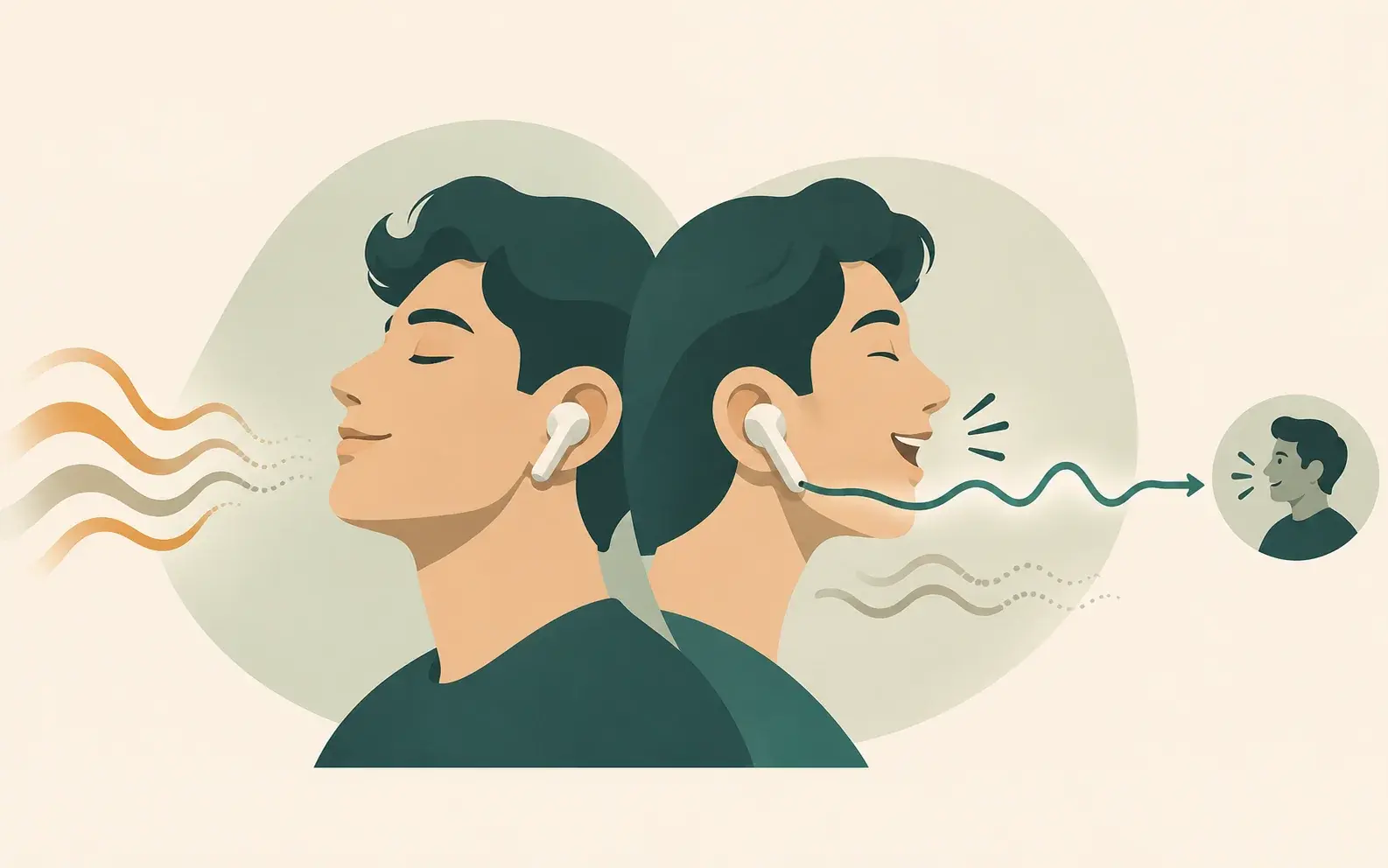
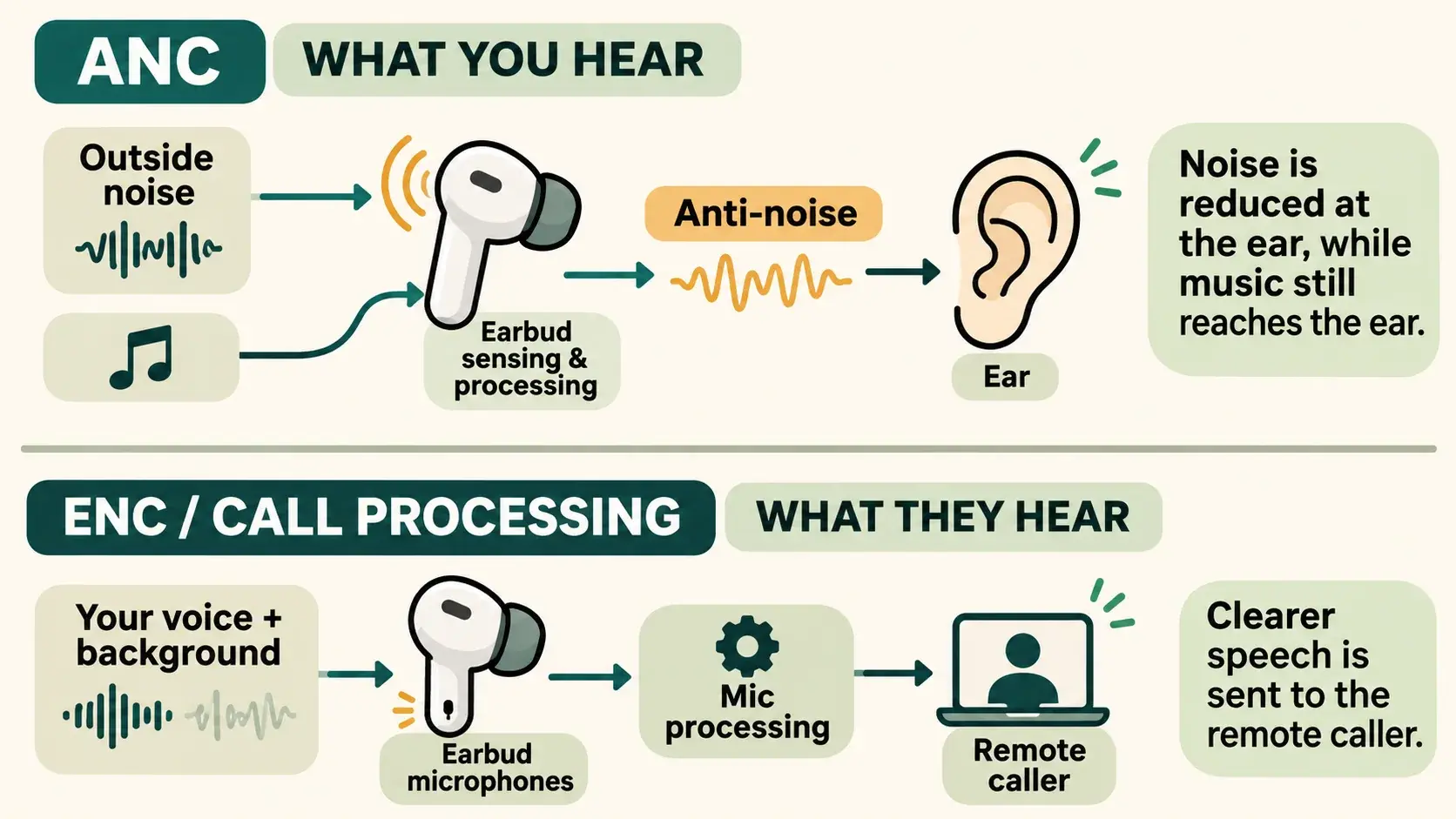
Active Noise Cancellation (ANC) mainly reduces outside sound reaching your ears. Environmental Noise Cancellation (ENC), as the term is commonly used in earbud marketing, mainly reduces background sound picked up by the microphones so the person listening to you hears your voice more clearly.
That distinction matters whether you are listening to music on a train, making a call beside a ceiling fan, or joining a meeting from a noisy room. It also explains why a good pair of earbuds may excel at one job but not another.
ANC vs ENC: the difference at a glance
| Question | ANC | ENC / call noise reduction |
|---|---|---|
| Main purpose | Make your surroundings quieter to you | Make your voice clearer to others |
| Where does it act? | Listening path to your ears | Microphone and call-audio processing path |
| Most useful for | Music, podcasts, travel, concentration | Phone calls, voice notes, video meetings |
| Best-known strength | Steady low-frequency noise such as engine hum | Suppressing some background sound around a speaker |
| Main limitation | Does not reliably erase every voice or sudden sound | May distort or cut your voice while filtering noise |
| How to evaluate | Independent isolation tests and an actual fit test | Recorded speech samples in realistic noise |
These are primary functions, not rigid boundaries. Some communication systems also process incoming call audio, and earbuds may use some of the same microphones for both jobs. But ANC and ENC should not be treated as two names for the same feature.
How ANC makes music and podcasts easier to hear
ANC works by using microphones to detect surrounding noise and audio processing to create an opposing sound signal. Played through the earbud speaker, this anti-noise reduces some of the unwanted sound reaching the ear. Manufacturers may use outward-facing microphones, inward-facing microphones, or both. Apple describes this approach in its AirPods noise-control documentation.
It is particularly effective against relatively predictable low-frequency sounds: a bus engine, aircraft cabin rumble, air-conditioner drone, or the continuous hum of machinery. These sounds are easier to track and counter than an unexpected shout or clattering dishes. Sony's noise-cancellation guidance explains this difference.
The ear-tip seal is part of the result
The silicone tip also blocks sound physically. This is called passive noise isolation. A good seal can reduce a range of outside noise even without electronic cancellation, and it improves the conditions in which ANC operates.
If an earbud fits loosely, impressive marketing specifications may not translate into a quiet listening experience. Try the included tip sizes and any fit-test feature in the companion app. Glasses, ear shape, earbud position and movement can also affect the result.
ANC does not make music intrinsically higher quality. Its most important benefit is that you can hear quieter passages and speech without competing as much with background noise. The drivers, tuning, fit and recording still determine how the music actually sounds.
What does ENC mean in earbuds?
In Indian earbud listings, ENC usually means Environmental Noise Cancellation, sometimes described instead as environmental noise reduction, AI call noise cancellation, or clear-call technology. The underlying goal is to favour your voice over sounds such as traffic, keyboards, fans and nearby conversations.
A call-focused system can combine several techniques:
- Multiple microphones compare sounds arriving from different directions.
- Beamforming attempts to favour speech coming from your mouth.
- Digital noise suppression identifies and reduces unwanted sound in the microphone feed.
- Echo cancellation and automatic gain adjustment can help conversations sound more consistent.
Qualcomm describes multi-microphone noise suppression, echo cancellation and gain control in its cVc call-audio technology. Realme separately describes ANC for listening and a multi-microphone ENC algorithm for calls in its Buds Air 5 Pro documentation.
ENC is not a guarantee that the person on the call will hear only your voice. Competing speech, strong wind and irregular loud noises can remain audible. Aggressive processing can make your words sound metallic, muffled or intermittent. Poor microphone positioning and a weak wireless connection can also undermine otherwise sophisticated processing.
Just as importantly, the letters ENC do not provide one universally comparable performance score on a retail specification sheet. One manufacturer's “AI ENC” may perform differently from another's. Treat it as a feature description, not a ranking.
Which matters more for listening to music?
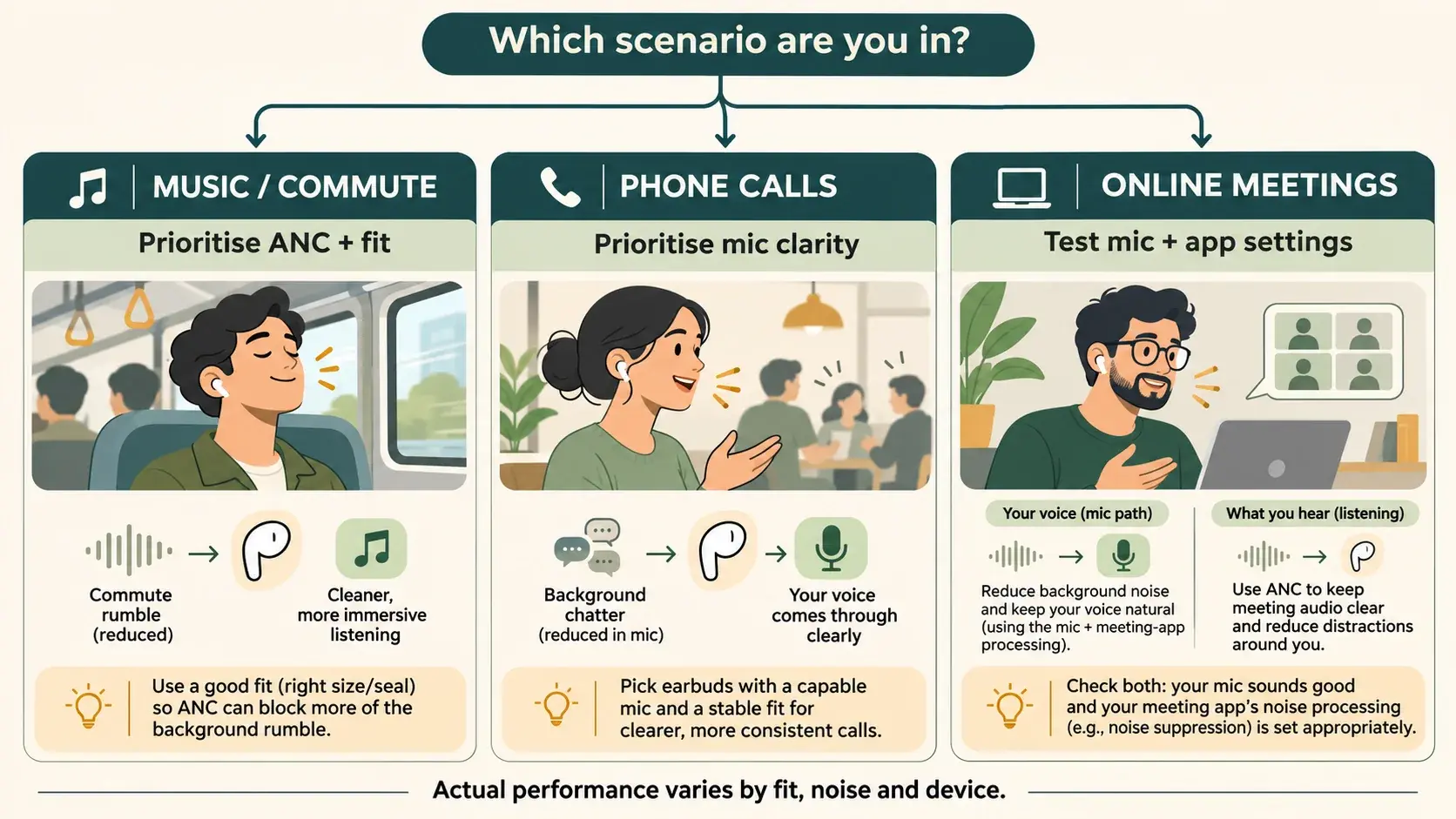
For music, podcasts and videos in noisy surroundings, ANC is generally the more relevant feature. You are the listener, so the problem to solve is the noise reaching your ears—not the sound captured by a call microphone.
Imagine two pairs of earbuds used on the same bus. Pair A has strong passive isolation and effective ANC. Pair B advertises dual-microphone ENC but no listening ANC. Pair B might improve how you sound when you call someone, yet it has no equivalent electronic system for reducing engine rumble while you listen to a song. Its ear tips may still provide useful passive isolation.
ANC is less important if you listen almost entirely in a quiet bedroom. In that setting, comfort, sound tuning, secure fit, battery life and connectivity may bring more value than the strongest noise-control system.
Two cautions matter outdoors. First, ANC may reduce awareness of traffic or announcements; transparency or ambient mode is often more appropriate when you need to hear your surroundings. Second, an advertised “up to 45 dB” or “up to 50 dB” ANC figure is not a complete measurement of how the earbuds behave across different frequencies. Without comparable test conditions, do not rank products purely by the biggest number.
Which matters more for phone calls?
For calls, ask two separate questions: Can I hear the caller? and Can the caller understand me?
ANC can help with the first question by reducing distracting sound around you. Call-oriented microphone processing—often marketed as ENC—addresses the second. Both can matter when you are speaking on a crowded train or near roadside traffic.
Consider a call in a kitchen with an exhaust fan running. ANC may make the caller's voice easier for you to follow. ENC may reduce how loudly the fan comes through on the caller's end. A pair that does only one of those jobs can still leave the conversation uncomfortable.
More microphones are not automatically better. Their placement, the processing algorithm and the physical design matter. Stem-style earbuds may place a microphone closer to the mouth, but a well-designed stemless model can still perform well. Independent microphone tests are more informative than a claim of “four mics” or “six mics.” RTINGS, for example, evaluates microphone noise handling separately from listening isolation.
Wind is a particularly revealing test
Wind striking an exposed microphone can produce intrusive buffeting. A model that suppresses a steady fan may perform poorly while walking outdoors. If you make frequent calls from streets, balconies or on the move, look for actual outdoor call recordings, not just quiet-room samples or a generic ENC badge.
What about Zoom, Google Meet and Microsoft Teams?
Online meetings involve more than the earbud hardware. There are at least three relevant stages:
- Listening: ANC or passive isolation helps you hear the meeting through background noise.
- Voice capture: The earbud microphones and their call-processing system capture and clean up your speech.
- Meeting software: The application may apply further noise suppression, echo cancellation and microphone adjustments.
Zoom documents its microphone noise removal and audio-isolation settings. Microsoft Teams provides background-noise suppression, while Google Meet offers noise cancellation where supported. Availability and controls depend on the app, device and account.
This means even earbuds without a prominent ENC label may deliver acceptable meeting audio in a quiet room, particularly when the meeting app's suppression works well. Conversely, expensive ANC earbuds are not automatically excellent meeting headsets.
A practical meeting setup
Before a crucial interview, class or work call, join a test meeting or record a short sample. Select the intended microphone input in your meeting application; sometimes the computer's built-in microphone is selected instead of the earbuds. Check the output device separately.
Speak normally with a fan running, then listen to a recording or ask a colleague how your voice sounds. If words are getting cut off, compare the software's suppression modes rather than assuming more filtering will always help. Excessive processing at several stages can make speech unnatural in some setups.
For frequent professional meetings, a headset with a microphone closer to the mouth—or a suitable dedicated microphone—may be a better tool than fashionable earbuds. The room and microphone placement can matter more than the ANC logo.
Why product claims can mislead
Marketing often combines measurements and features that answer different questions. Knowing what they refer to makes comparison more useful.
“Up to 50 dB ANC.” This is an attenuation claim under particular conditions; it is not a promise of 50 dB reduction for every voice, horn or frequency. Independent tests with frequency-dependent results are preferable.
“AI ENC.” This indicates some form of algorithmic voice/noise processing, not a defined guarantee that surrounding voices or wind will disappear.
“Six microphones.” A microphone count alone cannot tell you speech intelligibility, wind handling or how the processing behaves in a café.
“Hybrid ANC.” This usually refers to ANC using both outside and inside microphones. It does not mean the product also has superior call quality.
“Transparency mode.” This deliberately lets in or reproduces ambient sound so you can stay aware. It serves a different purpose from making your surroundings quieter.
There can also be trade-offs in power consumption. For example, realme lists different playback durations with noise cancellation enabled and disabled for the same earbuds. Treat any quoted battery duration as conditional on the exact mode, volume, codec and testing setup—not as a guaranteed real-world result.
How to test earbuds before buying or during the return window
You do not need laboratory equipment to identify obvious problems. A repeatable, realistic check is more useful than playing random noises once.
For ANC: Play a familiar podcast at a comfortable volume. Compare ANC on and off near a steady fan or air-conditioner. Then pause the podcast and listen for changes in background hum. Try different ear tips before judging the effect.
For call noise reduction: Record a voice message or call a willing friend from a quiet room, then repeat with a fan or distant conversation in the background. Keep your speaking level and distance reasonably consistent. Ask whether words remain natural and understandable, not merely whether the noise sounds quieter.
For meetings: Test with the actual laptop and app you use. Speak with and without the app's noise suppression, verify which microphone is active, and check whether switching between music and call mode changes your experience.
For outdoor use: If you can test safely, make a short call in moderate wind or near traffic without putting yourself at risk. Wind performance may be very different from indoor performance.
When reading reviews, prioritise recordings, repeatable isolation measurements, fit observations and battery conditions. Two products can advertise the same technology while performing very differently.
What should you choose for your use case?
| Your main use | Prioritise | Why |
|---|---|---|
| Music and podcasts on buses or trains | Good seal + effective ANC | Reduces noise you would otherwise hear |
| Frequent phone calls in noisy places | Proven microphone noise handling | Helps listeners understand your speech |
| Daily online meetings | Reliable mic, comfort, app compatibility | Call clarity depends on the entire setup |
| A mix of travel, calls and work | Both capable ANC and call processing | Addresses incoming and outgoing noise separately |
| Mostly quiet-room listening | Fit, sound, reliability and price first | Powerful ANC may bring limited benefit |
The best all-round choice is not necessarily the model with the largest ANC figure or the most microphones. Look for independent evidence of both listening isolation and microphone clarity, check whether the earbuds fit you comfortably, and confirm that the app and controls work with your phone or laptop.
If your budget forces a choice, match the feature to your problem: ANC for the noise you hear; ENC-style call processing for the noise other people hear. For online meetings, pay close attention to microphone recordings and your meeting software rather than choosing by either acronym alone.
Related reading: compare earbuds and wired alternatives by budget.
Sources and further reading
- Apple Support — Active Noise Cancellation and Transparency modes for AirPods
- Sony Support — What is noise cancellation and what can I expect?
- Qualcomm — cVc noise cancellation technology
- realme India — Buds Air 5 Pro: ANC and call-noise processing
- Microsoft Support — Reduce background noise in Teams meetings
- Zoom Support — Changing audio settings during a meeting
- Google Meet Help — Filter out noise from your meeting
- RTINGS — Microphone noise-handling test methodology
- RTINGS — Headphone noise-isolation test methodology