Bank Account Frozen, Debit Freeze or Lien Marked: What's the Difference and How Can You Resolve It?
Understand bank account freezes, debit restrictions and liens in India, why they happen, and how to seek release through your bank or the appropriate authority.
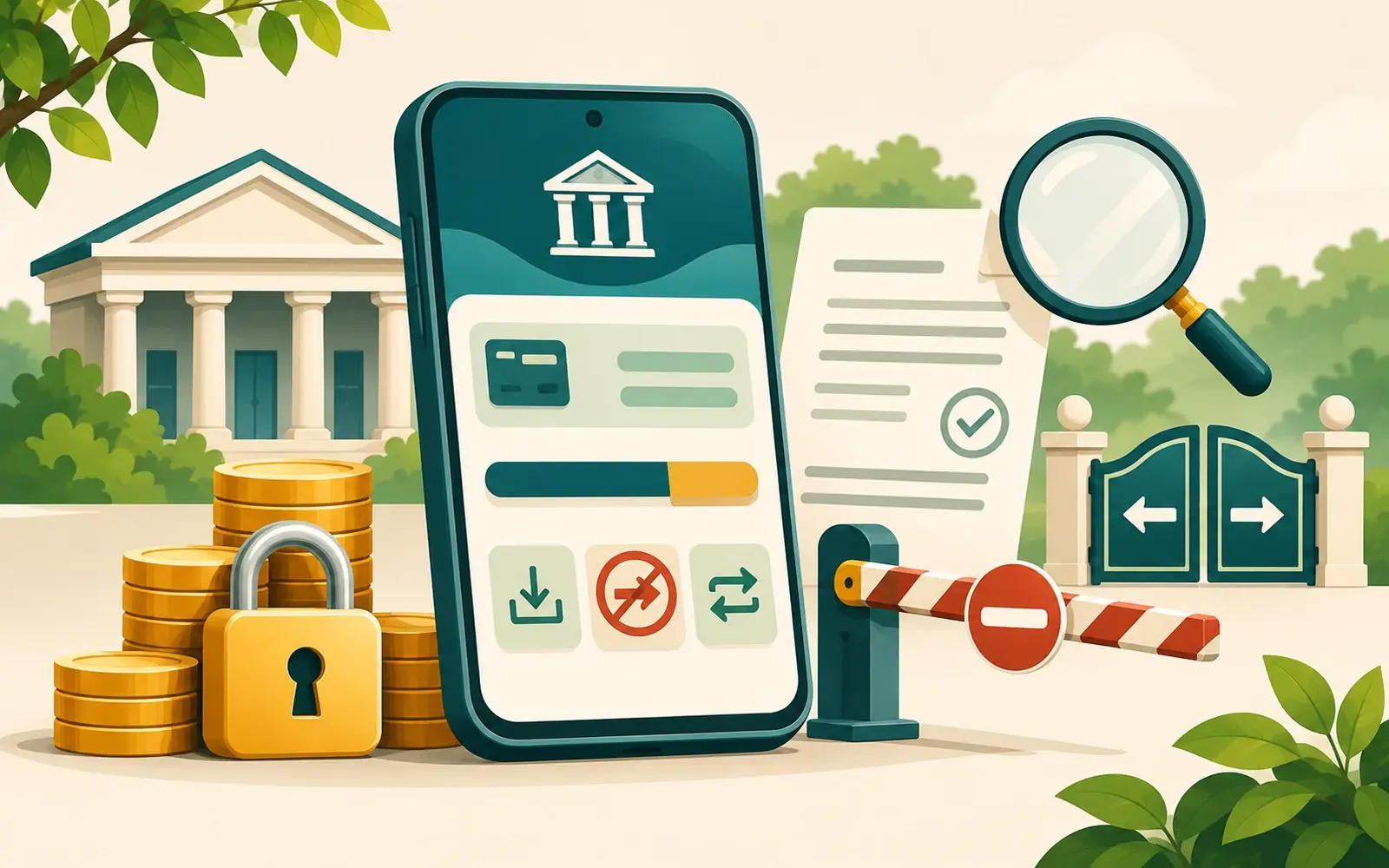
Your bank account shows ₹80,000, but an attempted payment fails. The mobile banking app displays a lien amount, or a branch employee tells you that your account has been debit frozen. You have not necessarily lost your money, yet you cannot use it as expected.
These situations look similar from the customer's perspective, but the restrictions can operate differently. One may prevent all outgoing transactions, another may reserve a specified amount, and a third may suspend both incoming and outgoing transactions. The procedure for removing them depends on why the restriction was imposed and who has the authority to release it.
In India, account restrictions can arise from ordinary banking arrangements, incomplete customer verification, suspected fraud, or directions from investigating agencies and courts. Understanding the difference is the first step towards resolving the problem without wasting time at the wrong office.
What is the difference between a freeze, debit freeze and lien?
Banks use different systems and descriptions for account restrictions. A phrase shown in an app is not necessarily a precise legal classification. Broadly, however, the following distinction is useful.
| Restriction | Incoming funds | Outgoing funds | What is restricted? |
|---|---|---|---|
| Full account freeze | May be blocked | Blocked | Account operations broadly |
| Debit freeze | Generally permitted | Blocked | Outgoing transactions |
| Amount-specific lien or hold | Generally permitted | Permitted from unrestricted funds | Specified amount |
| Digital banking restriction | Generally permitted | Affected electronic channels blocked | Particular services or channels |
These are typical operational effects, not universal banking rules. Multiple restrictions can coexist, and the actual instruction or bank policy determines the scope.
Full account freeze
A full freeze can prevent ordinary account operations in both directions. It may arise from an external legal direction or another valid account-level restriction. The displayed balance may still appear on a statement even when no withdrawal is possible.
The word frozen is also commonly used informally for debit-only restrictions. Ask the bank whether credits are permitted rather than assuming the account cannot receive funds.
Debit freeze
A debit freeze ordinarily prevents money from leaving an account. Salary or other credits might still arrive, but withdrawals, UPI payments, transfers and cheques can fail. Automatic payments, including loan instalments, may also be affected.
A restriction on UPI or a debit card alone is different. The account itself may remain operational through permitted channels. One failed payment does not establish an account-wide freeze: network outages, transaction limits and card security blocks can produce similar symptoms.
Lien marked or amount on hold
A lien or hold commonly makes a specified sum unavailable without immediately removing that sum from the account. In a simple case, the rest remains accessible. Banks may also mark a lien on an entire fixed deposit used as collateral.
The word has a legal meaning as well. Section 171 of the Indian Contract Act recognises a banker's general lien in specified circumstances. Contractual rights, the nature of the property and other applicable law matter. A cybercrime-related hold is not necessarily an exercise of that banker's lien: the same banking-system label can represent a different legal basis.
Why your balance can be higher than the money you can spend
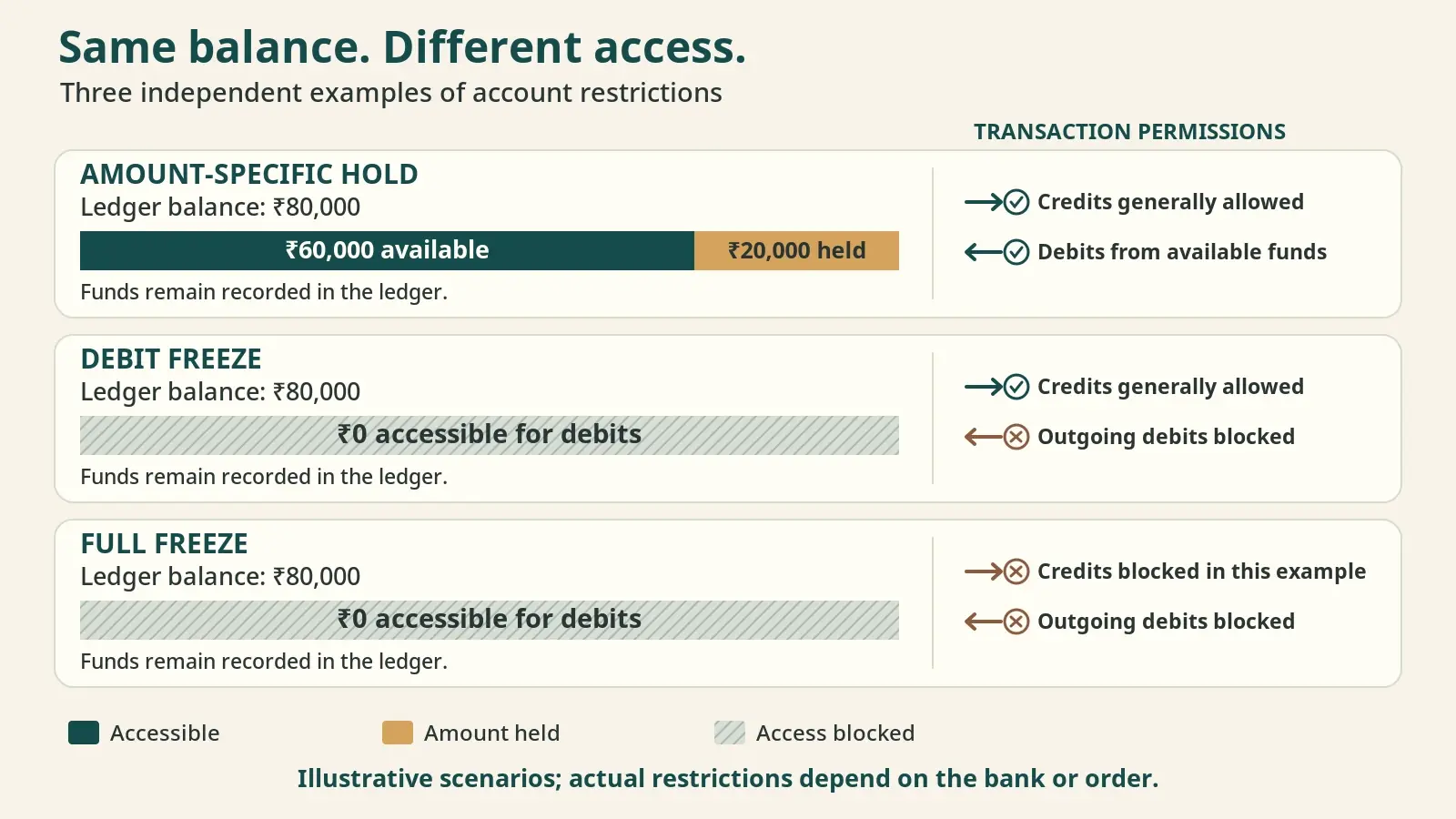
Consider three separate hypothetical cases involving the same ₹80,000 ledger balance, with no overdraft, other holds or pending transactions.
- With a ₹20,000 amount-specific hold, ₹60,000 remains available for ordinary spending.
- With a debit freeze, the ₹80,000 may remain recorded, but none of it can be withdrawn through the blocked debit operations.
- With a full freeze, the ₹80,000 remains recorded, while both ordinary credits and debits are assumed blocked in this example.
A hold is not the same as a debit entry. If the bank subsequently applies money to an outstanding liability or transfers it under a lawful restoration order, the account balance may actually decrease. Ask for the statement entry and authority for any completed deduction, rather than assuming a missing available balance means the money has already been transferred.
Why banks restrict accounts in the first place
The appropriate remedy becomes clearer once you identify the reason.
Loan security, investment applications and other routine holds
A customer borrowing against a fixed deposit may agree to restrictions on its withdrawal until the loan is settled. Banks may also exercise contractual rights relating to unpaid liabilities, subject to applicable law. A temporary block can be entirely unrelated to suspected wrongdoing.
An IPO application is another familiar example. Under SEBI's Application Supported by Blocked Amount (ASBA) process, the application money is reserved in the bank account pending allotment. The amount required for allotted shares is subsequently collected, while the unneeded amount is unblocked through the applicable process.
If a hold remains after the underlying purpose has ended, approach the bank and, where relevant, the loan department, investment intermediary or issue registrar. Request confirmation that the release instruction has been processed.
KYC, PAN and inactive accounts
Banks must verify customer identity, maintain updated records and monitor account activity. Problems with documentation or verification may result in restrictions under the applicable rules. But overdue KYC does not automatically justify every freeze.
The RBI's Commercial Banks – Know Your Customer Directions, 2025, updated on October 1, 2026, provide a specific concession for low-risk individual customers undergoing periodic KYC renewal. Transactions must continue during the permitted period, which extends to the later of June 30, 2026, or one year after the KYC due date. For example, a qualifying customer's KYC due in September 2026 has a permitted period extending into September 2027. This does not override an unrelated lawful freeze. The directions also require advance notifications and subsequent reminders for periodic renewal.
An inoperative savings or current account is a separate issue, generally arising after more than two years without customer-induced transactions. Under the RBI's Commercial Banks – Responsible Business Conduct Directions, banks must process complete activation applications within three working days and cannot charge for activation. KYC facilities are available at branches other than the home branch as well. Restoring an inoperative status does not cancel an independent police or court restriction.
Suspected fraud and cybercrime investigations
Imagine a shopkeeper receives payment through UPI for a genuine sale. The payer's money is subsequently traced to a reported online fraud. The receiving account may become part of the investigation even though the shopkeeper did not commit the fraud.
India's Citizen Financial Cyber Fraud Reporting and Management System (CFCFRMS), associated with the National Cybercrime Reporting Portal, enables coordination between participating financial institutions and investigating agencies to prevent suspected fraud proceeds from being moved further.
The Indian Cyber Crime Coordination Centre (I4C) has clarified in its public notice that it facilitates the reporting infrastructure rather than itself investigating individual cases or ordering bank freezes. The relevant law enforcement agency or bank is responsible for the restriction under the applicable framework.
Being affected by a hold does not establish criminal guilt. Equally, explaining that a transaction was genuine does not automatically entitle someone to immediate release of the disputed funds without verification.
How to find out exactly what happened
Start with the branch or the bank's official support service. Record the date you first encountered the restriction, save the error message and download recent statements. Avoid repeated payment attempts until you know what has happened.
Submit a written request asking for the following information, to the extent the bank can lawfully disclose it:
- The type and scope of the restriction, including whether credits and debits are permitted.
- The amount held, date of placement and relevant transaction reference or UTR, if applicable.
- Whether the restriction originated with the bank or an external authority, and its legal or contractual basis.
- For external directions, the issuing agency, complaint or FIR reference where available, and official contact details for the responsible officer.
- The procedure for review or release, documents required, and the bank's complaint reference number.
Some information may be restricted by confidentiality obligations or an ongoing investigation. Ask the bank to explain what it can provide and identify the channel through which you can contest the restriction. A verbal instruction to visit another office is much less useful than a recorded response identifying the next step.
How to resolve a bank account freeze in India
If the bank imposed the restriction itself
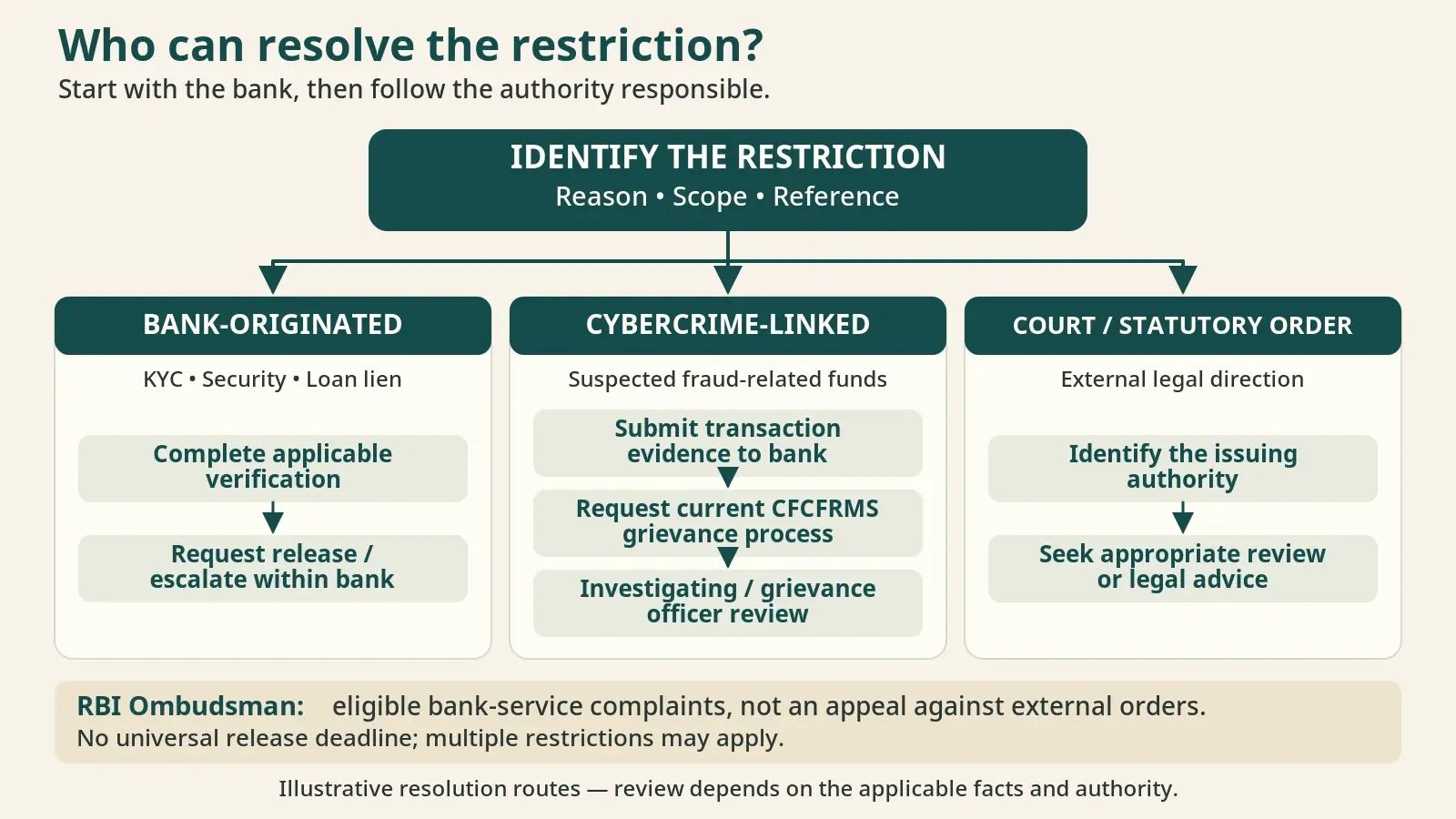
For KYC issues, obtain the exact list of outstanding requirements and submit the necessary documentation through an authorised banking channel. For a security block following suspected account compromise, complete the bank's verification process and secure your credentials. For loan-related liens, request a calculation of the liability and the relevant release conditions.
Keep acknowledgements of every submission. Ask for confirmation once the account status changes. If the branch cannot resolve an issue within its authority, escalate through the bank's published grievance hierarchy, including its designated nodal officer where applicable.
If the account is linked to a cybercrime complaint
Do not assume the bank can lift an externally imposed restriction merely because your KYC is complete. Establish which authority is responsible and submit evidence explaining the flagged transaction: invoices, payment confirmations, contracts, delivery records, correspondence or salary records, as appropriate. Provide accurate information and preserve original documents.
There is now a more structured route. The Ministry of Home Affairs reported that the CFCFRMS grievance-redressal and money-restoration modules became functional in April 2026. The standard operating procedure (SOP) available through the Chhattisgarh State Judicial Academy describes a process involving the bank's verification, submission of eligible grievances to the module, consideration by investigating officers, and review by designated grievance officers. Subsequent procedural updates may apply.
Ask the bank to process your representation under the current SOP and obtain a reference or acknowledgement of the escalation. If needed, contact the relevant investigating officer and the official State/UT cybercrime nodal or grievance officer. Where several agencies have imposed restrictions, clearing one hold may not clear the others.
Request a review of whether an amount-specific hold could protect the disputed funds while permitting access to unrelated money. Document hardship, including unpaid wages, medical expenses or essential household payments. Such a request is not a guaranteed entitlement to release.
If a court order or other statutory direction is involved
Identify the exact order and the authority capable of modifying it. A bank generally cannot disregard an operative legal direction on a customer's request. Under the Bharatiya Nagarik Suraksha Sanhita, 2023 (BNSS), Section 106 deals with police seizure of suspected property and reporting to the jurisdictional Magistrate, while Section 107 provides a judicial process for attachment and related relief. The legal distinction between seizure, attachment and restrictions on bank operations is important and has been the subject of litigation.
For example, the Bombay High Court's September 29, 2026 decision in Rajesh Mohanlal Pugalia v. Station House Officer directed banks to initiate grievance resolution under the 2026 cybercrime SOP. The outcome in any other case depends on its facts, jurisdiction and operative orders. Do not treat a High Court ruling as a universal automatic release instruction.
If the restriction persists, involves a large amount or prevents access to essential funds, seek advice from an Indian lawyer experienced in banking or criminal procedure about the appropriate administrative review or application to the competent court.
Can the RBI Ombudsman help?
The Reserve Bank – Integrated Ombudsman Scheme, 2026, effective July 1, 2026, replaced the 2021 scheme for new complaints. It is intended to address eligible deficiencies in services by covered regulated entities, not to determine criminal investigations.
First complain to the bank in writing. If its answer is unsatisfactory, or there is no answer after 30 days (or a longer applicable regulatory or payment-network deadline), an eligible complaint can be made free of charge at cms.rbi.org.in. Under the new scheme, the filing window is 90 days from the expiry of that response period or the last communication from the bank, whichever is later. Other admissibility requirements apply.
Failure to act on a valid release instruction, improper handling of a bank-originated restriction or deficient customer service may warrant a complaint. But action taken in compliance with orders of statutory, judicial or law-enforcement authorities is expressly excluded. An Ombudsman complaint is not an appeal against a police freeze; use the applicable review or judicial route for that issue. See the RBI's official 2026 scheme FAQs.
Protect yourself while the issue is being resolved
If you have actually suffered financial cyber fraud, immediately notify your bank and call 1930 or report it through cybercrime.gov.in. This victim-reporting route is not a universal account-unfreezing service.
Never share an OTP, UPI PIN, password or remote-access control with anyone claiming to release your account. Do not pay a supposed police officer or intermediary a personal fee for removing a lien. Verify all communications through independently obtained official contact details. Do not transfer or return disputed funds privately to an unknown caller; ask the bank or investigator how the transaction should be handled lawfully.
If an EMI or insurance premium is due, inform the lender or provider promptly and arrange a lawful alternative payment if permitted. A freeze does not automatically suspend your contractual payment obligations. Keep evidence of any charges or losses caused by the restriction.
The bottom line
A debit freeze restricts outgoing transactions; a lien typically reserves an amount; and a broader freeze may restrict the account in both directions. The correct remedy is determined not by the label in your banking app, but by the source, scope and legal basis of the restriction.
Get the facts in writing, preserve transaction evidence, and pursue the authority that can actually change the restriction. For bank-service failures, use the bank's grievance mechanism and, where eligible, the RBI Ombudsman. For cybercrime-related restrictions, follow the current grievance and investigative process. There is no universal release deadline or shortcut that applies to every frozen account.
This Article provides general educational information about Indian banking rules, not individual legal advice. Regulations, procedural instructions and court decisions can change.
Related reading: when to escalate an eligible service complaint to the RBI Ombudsman.
Sources and Further Reading
- RBI – Commercial Banks – Know Your Customer Directions, 2025 (updated October 1, 2026)
- RBI – Commercial Banks – Responsible Business Conduct Directions, 2025
- RBI – Integrated Ombudsman Scheme, 2026 FAQs
- India Code – Indian Contract Act, 1872, Section 171
- India Code – Bharatiya Nagarik Suraksha Sanhita, 2023, Sections 106–107
- SEBI Investor – Apply in IPO through ASBA
- I4C – Public notice explaining roles of agencies
- Ministry of Home Affairs – Parliamentary reply on cybercrime response and grievance modules
- Cybercrime SOP – copy hosted by Chhattisgarh State Judicial Academy, Section 10
- Bombay High Court – Rajesh Mohanlal Pugalia v. Station House Officer, September 29, 2026 (judgment indexed by Indian Kanoon)
- National Cybercrime Reporting Portal – State/UT nodal and grievance officer contacts