How to File an RBI Ombudsman Complaint When Your Bank Doesn't Resolve Your Problem
Learn how to file a bank complaint with the RBI Ombudsman in India, when to escalate, what documents to submit, and the 2026 deadlines, compensation and appeal rules.
Your bank has deducted money that it should not have, failed to reverse a transaction or refused to correct an account error. You have called customer care, submitted a complaint and followed up, but the problem remains unresolved. What can you do next without immediately going to court?
The Reserve Bank of India (RBI) provides a formal route for escalating eligible customer-service complaints against banks and certain other regulated financial institutions. You can use the RBI's Complaint Management System (CMS) to approach the RBI Ombudsman without paying a filing fee.
Complain to the bank first, keep evidence of that complaint, and approach the RBI Ombudsman when the bank's response is unsatisfactory or the applicable waiting period has expired. Do not confuse the waiting period with the deadline for filing your complaint.
The rules changed on 1 July 2026. This article explains the Reserve Bank – Integrated Ombudsman Scheme, 2026 (RB-IOS, 2026), as applicable on 24 November 2026, rather than relying on the earlier 2021 framework.
What is the RBI Ombudsman?
The RBI Ombudsman is part of an alternative dispute-resolution mechanism for customers who experience shortcomings in services that covered financial institutions are obliged to provide. Its purpose is to address individual grievances through examination, settlement and, where appropriate, formal directions for relief.
It is not a criminal investigation agency or a court with unlimited powers. Nor does it automatically decide every case in the customer's favour. A strong complaint identifies a specific service failure, provides supporting evidence and requests a remedy that relates to that failure.
The process is free for the customer, and you do not need to hire an agent or lawyer to submit a complaint. Under the scheme, you may act personally or appoint a representative in writing; an advocate cannot act as the authorised representative unless the advocate is the aggrieved person.
RBI Ombudsman vs the bank's Internal Ombudsman
These are different mechanisms. The Internal Ombudsman reviews certain decisions within the bank's own grievance system; the RBI Ombudsman is the external mechanism.
Under RBI's 2026 Internal Ombudsman directions for commercial banks, eligible wholly rejected or partially resolved complaints are automatically sent for internal review. In ordinary cases, that escalation should occur within 20 days of receipt; specific regulated complaint timelines have separate arrangements. Customers do not lodge complaints directly with the Internal Ombudsman. The bank remains responsible for communicating its final response.
Use the bank's customer-service channels or grievance officers for the initial complaint. You do not have to obtain the Internal Ombudsman's personal contact details, and waiting for a separate internal review should not cause you to miss the external filing deadline.
Which institutions and complaints are covered?
The 2026 scheme covers commercial banks, regional rural banks, state and central co-operative banks, scheduled urban co-operative banks and non-scheduled urban co-operative banks meeting the ₹50 crore deposit-size condition. It also includes eligible NBFCs, non-bank prepaid payment instrument issuers and credit information companies.
Not every financial company falls within the scheme. Eligible NBFCs generally include deposit-taking companies and those with a customer interface and assets of at least ₹100 crore, subject to specified exclusions, such as housing finance companies. Certain banks undergoing resolution, winding up or subject to all-inclusive directions are excluded. Check the covered and non-covered entity lists on the CMS portal rather than relying on an app's brand name.
If you borrowed through a digital lending app, identify the actual bank or NBFC in the loan agreement or Key Facts Statement. The app may only be an intermediary. If the regulated institution is outside the scheme, other RBI grievance arrangements, such as a Consumer Education and Protection Cell, may be relevant.
Examples of potential service deficiencies
| Problem | What to document and request |
|---|---|
| ATM debited the account but did not dispense cash | Transaction reference, debit entry, reversal and applicable delay compensation |
| Incorrect or duplicate bank charges | Statement entry, tariff or contract terms, refund of the incorrect charge |
| Loan closure or repayment not recorded correctly | Repayment evidence, loan statement, correction and applicable documents |
| Incorrect credit-report information | Credit report, disputed entry, correction request and lender response, subject to scheme exclusions |
| Delay in settling a deceased depositor's claim | Claim acknowledgement, documents submitted, applicable deadline and settlement |
| Unauthorised electronic transaction | Immediate fraud report, disputed transaction details, investigation and applicable customer-liability protections |
These are illustrative categories, not a guarantee of maintainability or success. For example, the credit information company being covered does not mean that every credit-information dispute qualifies: the scheme excludes grievances for which section 18 of the Credit Information Companies (Regulation) Act, 2005 provides a remedy.
What the Ombudsman generally cannot resolve
The scheme is not a way to challenge a lender's ordinary commercial judgment merely because it rejected a loan application or did not offer the lowest interest rate. A specific service failure is different from disagreement with a business decision. For example, a loan refusal alone may be excluded, but an incorrectly collected application charge can raise a separate question about service obligations.
Employment disputes with a bank, vendor disputes, action taken in compliance with orders of competent authorities and matters outside RBI's regulatory remit are also excluded. A request for general information or a suggestion is not an individual grievance seeking relief.
You cannot use the scheme to run the same grievance simultaneously before the Ombudsman and a court, tribunal, arbitrator or comparable judicial or quasi-judicial forum. Previously settled or merits-decided grievances are also subject to exclusions. Criminal investigations and criminal proceedings are expressly distinguished from that restriction. If your dispute is already in litigation, obtain legal advice before choosing another forum.
When can you approach the RBI Ombudsman?
There are two separate questions: when you become eligible to escalate, and when your opportunity to file expires.
Step 1: Give the bank an opportunity to resolve the problem
Submit a complaint to the relevant institution in a form that produces evidence. If you complain at a branch, obtain a dated acknowledgement or stamped copy. If you use email or the grievance portal, save the sent message or registration receipt. For a telephone complaint, retain the ticket and follow up in writing if necessary.
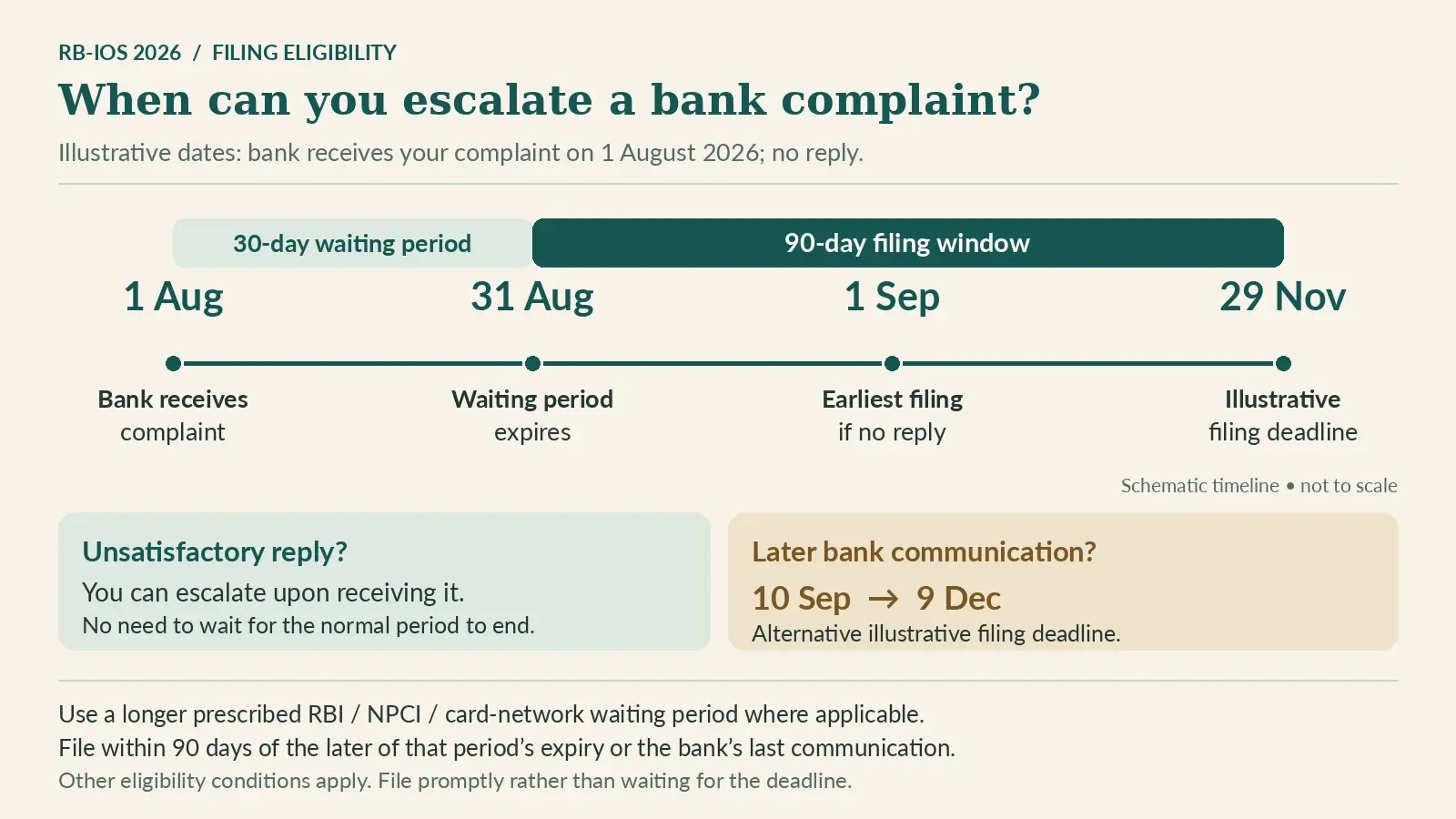
If the bank provides a response or resolution that does not satisfactorily address your grievance, you may approach the RBI Ombudsman without waiting for the normal period to finish. Explain precisely which part remains unresolved.
If the bank provides no reply, wait until the longer of these two periods has passed:
- 30 days from the bank's receipt of the complaint.
- Any longer period prescribed for the matter by RBI, NPCI or the applicable card-network rules.
A bank's acknowledgement is not necessarily a substantive resolution. Conversely, a short transaction-specific reversal deadline is not automatically the deadline for Ombudsman admission. For instance, an ATM reversal may be due after five calendar days, but if the bank remains silent, the standard 30-day escalation condition still matters.
Step 2: Observe the new 90-day filing window
Under clause 10 of RB-IOS, 2026, the filing deadline is 90 days after the later of the expiry of the applicable waiting period and the last communication from the institution. The original complaint to the institution must also have been made within the relevant statutory limitation period.
Do not rely on the older one-year filing rule commonly found in articles about the 2021 scheme. Complaints received under the old scheme before 1 July 2026, appeals from its decisions and enforcement of its Awards remain governed by the old framework under the transitional provision.
A worked example: calculating the deadline
Assume the bank receives your complaint on 1 August 2026, and no longer special waiting period applies.
| Event | Illustrative date |
|---|---|
| Complaint received by bank | 1 August 2026 |
| Thirty-day waiting period expires | 31 August 2026 |
| Earliest filing if no reply | 1 September 2026 |
| Ninety days after waiting period expires | 29 November 2026 |
| Alternative: bank's last communication arrives later | 10 September 2026 |
| Ninety days after that later communication | 9 December 2026 |
If the bank rejects the complaint on 10 August, you may escalate upon receiving that unsatisfactory reply. In the assumed circumstances, the end of the ordinary waiting period is still later than that reply for calculating the filing limit.
These dates illustrate elapsed calendar-day arithmetic, not an invitation to wait until the last day. File promptly once eligible. Do not assume that repeated reminders, automated messages or a reopened ticket will necessarily restart a limitation period.
How to file an RBI Ombudsman complaint online
The official portal is cms.rbi.org.in. Type the address directly or reach it through the RBI website. Do not pay a third party claiming to have an exclusive RBI complaint registration service.
1. Prepare your records before opening the form
Collect your name and contact details, the institution and branch concerned, the relevant account or loan details, the original complaint reference and date, the response received, if any, and evidence of the disputed event. Prepare a short description of the loss or inconvenience and what you want corrected.
Make a simple chronology if there have been multiple interactions. Use numbered attachments and clear filenames, such as 01-bank-complaint.pdf, 02-acknowledgement.pdf, 03-bank-response.pdf and 04-relevant-statement.pdf. This makes the complaint easier to examine than an unsorted collection of screenshots.
2. Start the complaint on CMS
Open the complaint-filing option and complete the identity and contact verification requested by the portal. Answer eligibility questions accurately, including whether you have approached the bank and whether another forum is dealing with the same grievance.
Select the institution that actually provided the disputed financial service. Use the closest complaint category available for your issue. The exact form labels and layout can change, so follow the current CMS prompts and use the official assistance videos if needed.
3. Describe the issue and specify the relief
A useful complaint answers five questions:
- What happened and when?
- Which institution or service was responsible?
- When did you raise the original complaint, and what was its reference?
- What has the bank failed to do or explain satisfactorily?
- What specific remedy would resolve the problem?
For example, if a charge was collected despite a written fee waiver, attach the waiver and statement showing the debit. Explain the conflict between the two documents rather than submitting a broad accusation that the bank is dishonest.
Quote a relevant RBI direction or contractual provision when you can identify it accurately. You do not need to fill your complaint with legal citations to establish a straightforward accounting error.
4. Attach evidence and submit
Upload the relevant records in the formats and limits accepted by CMS. Check that transaction dates and amounts match the documents and that your declarations are accurate. Read the submission carefully and save the acknowledgement and complaint number after successful registration.
Provide necessary identifying details through official secure channels. Never include a UPI PIN, card PIN, CVV, internet-banking password or OTP in the complaint or its attachments. Mask unrelated account information where it is not required for examination.
5. Track the complaint and respond to requests
Use the CMS tracking facility with the complaint number and mobile number. Retain emails, written responses and deadlines issued by the Ombudsman office. A complaint acknowledgement confirms registration, not that the case has been admitted on its merits or that compensation has been approved.
Can you file without using the online portal?
Yes. RBI also accepts complaints through the Centralised Receipt and Processing Centre (CRPC). Use the prescribed complaint format in the scheme's annex, provide supporting records and sign physical submissions.
| Channel | Official destination |
|---|---|
| Online | RBI CMS |
| crpc@rbi.org.in | |
| Post or physical submission | Centralised Receipt and Processing Centre, Reserve Bank of India, Central Vista, Sector 17, Chandigarh – 160017 |
| Guidance and status assistance | 14448 |
The contact centre provides recorded assistance around the clock; staff assistance is available from 8 AM to 10 PM, Monday to Saturday excluding national holidays, in English, Hindi and supported regional languages. It does not register Ombudsman complaints over the telephone. Use one of the three submission routes above and avoid duplicate submissions for the same grievance.
Sample complaint: an ATM reversal and missing compensation
Suppose ₹10,000 was debited on 5 August but the ATM did not dispense cash. Assume the transaction qualifies under RBI's failed-transaction framework. The amount was restored on 18 August, but the customer received no delay compensation.
The applicable ATM reversal deadline is T+5 calendar days, making 10 August the last permitted day. Eight days of delay at ₹100 per day produce ₹800 of eligible compensation. The refund of the original debit does not by itself satisfy the separate compensation requirement.
After an unsuccessful written complaint to the bank, a customer could adapt the following example to the relevant CMS fields or prescribed complaint form:
Subject: Non-payment of applicable compensation for delayed ATM reversal
On 5 August 2026, my account was debited ₹10,000 for an ATM withdrawal for which cash was not dispensed. The transaction reference is [reference]. The amount was reversed on 18 August 2026.
I submitted a written complaint to [bank name] on 20 August 2026, acknowledgement [reference]. In its reply dated 25 August 2026, the bank confirmed reversal of the debit but did not address the applicable delayed-reversal compensation.
The T+5 deadline was 10 August 2026. I request verification of the eight-day delay and credit of ₹800 under the applicable RBI failed-transaction compensation framework, along with written confirmation of the calculation.
I attach the statement showing debit and reversal, the original complaint and acknowledgement, and the bank's response.
This is a fictional example, not an official form or an actual decision. If the underlying facts differ, change the dates, amount, evidence and requested relief. Do not claim compensation that is unsupported by the applicable rules.
For other types of complaints, the same structure works: identify the transaction or obligation, explain the shortcoming, provide the bank's response and state the remedy. Distinguish any already-refunded amount from money that remains due.
How much compensation can the RBI Ombudsman award?
The 2026 scheme does not impose a ceiling on the disputed amount itself. It does, however, limit the Ombudsman's compensation powers.
| Type of relief | Applicable limit |
|---|---|
| Underlying amount in dispute | No prescribed monetary ceiling |
| Compensation for consequential loss | Up to ₹30 lakh |
| Additional compensation for time, expenditure, harassment or mental anguish | Up to ₹3 lakh |
These are maximum powers, not standard payments or guaranteed entitlements. You cannot simply ask for ₹33 lakh because a complaint was rejected or delayed. An exaggerated demand for consequential loss beyond the Ombudsman's jurisdiction can itself create grounds for rejection.
For illustration, suppose a wrongly debited ₹25,000 remains unpaid and the error has also resulted in a documented additional cost of ₹1,500. You might seek return of ₹25,000 and explain why the separate ₹1,500 expense resulted from the error. An additional claim for inconvenience should be proportionate and explained. The Ombudsman assesses the facts, causal connection and applicable rules rather than automatically granting the sum requested.
Do not confuse scheme compensation with amounts mandated by specific RBI directions, such as the ₹100-per-day failed-ATM compensation. Identify the applicable basis of each amount and avoid double-counting losses.
What happens after you file?
The complaint passes through an initial eligibility check and, if taken up, the institution is asked to respond. Under clause 14 of the scheme, its written submission is ordinarily due within 15 days of receipt of the complaint from the Ombudsman office; additional time can be permitted. This is not a 15-day deadline for the RBI to decide the entire case.
Review the bank's response if it is shared with you. If it says a disputed charge has been refunded, verify the credit in your statement. If it says a document was issued, check whether you received it and whether it addresses the actual issue. Point out concrete discrepancies with evidence, rather than repeating the entire original complaint. Respond within the time allowed; silence or failure to pursue the complaint can affect its outcome.
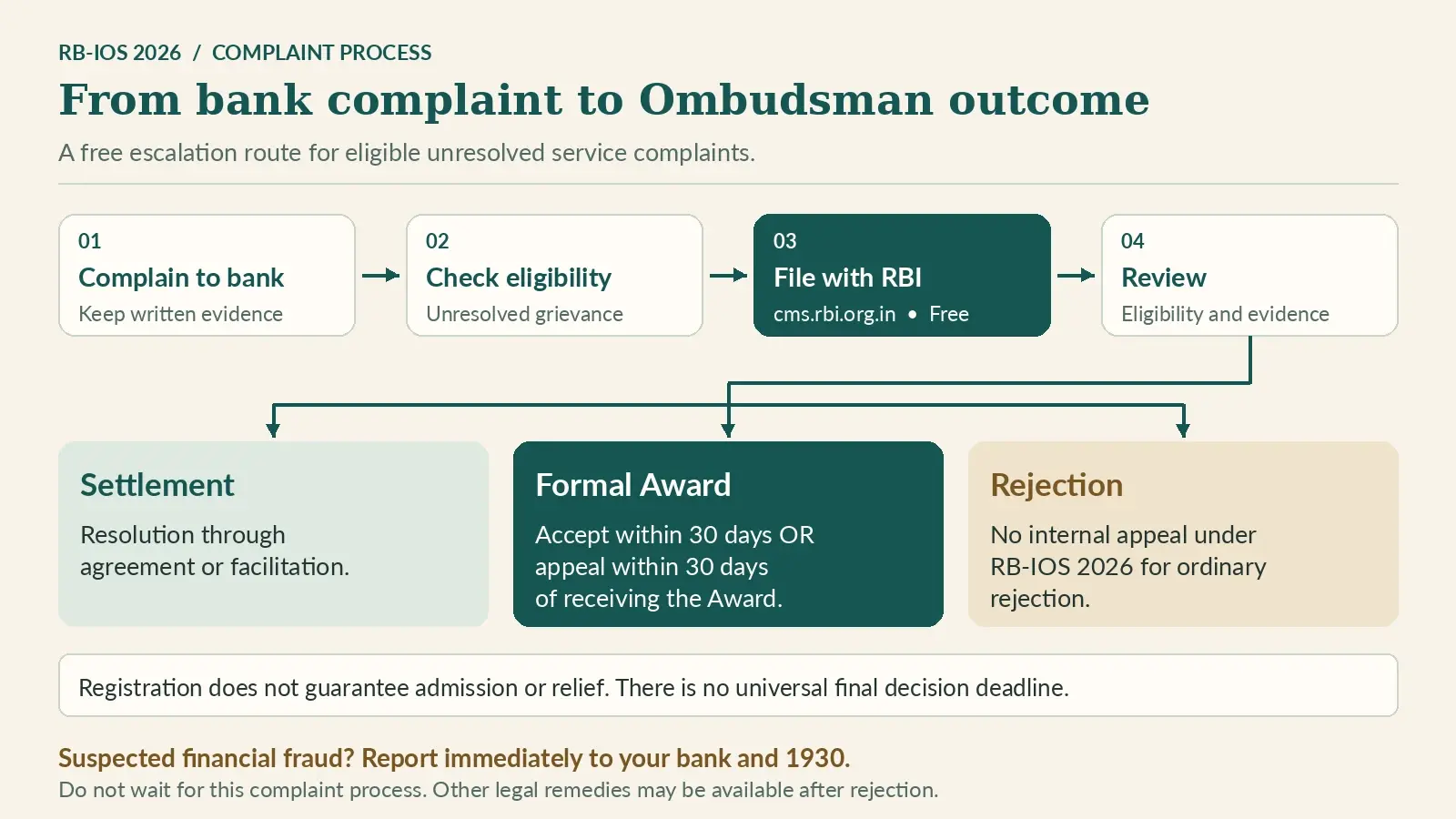
The process may end in settlement, a formal Award, or rejection. A conciliation meeting may be arranged, including online participation when appropriate. Not every case requires a meeting. If the case needs extensive witness testimony or complex adjudication, the Ombudsman may consider it unsuitable for this summary mechanism.
There is no universal guaranteed number of days in which every Ombudsman complaint must be finally resolved. Track the matter rather than relying on an assumed closure date.
What if you are dissatisfied with the outcome?
A formal Award and an ordinary closure or rejection are not the same. Read the decision, including the provision under which the case ended.
Under the 2026 scheme, a customer dissatisfied with an Award may appeal within 30 days of receiving it. The Appellate Authority may grant up to another 30 days for sufficient cause. The internal appeal route is not available for an ordinary rejection or settlement closure. This differs from the appeal arrangements under the earlier scheme.
If you accept an Award, send your full-and-final acceptance to the institution within 30 days of receiving the Award. If you appeal, do not submit that acceptance. Otherwise the Award can lapse for want of acceptance. Once acceptance is received, the institution has 30 days to comply or file an eligible appeal. Its appeal rights are subject to the scheme's conditions, including an exception for Awards arising from failure to furnish required information.
If the bank does not comply, notify the Ombudsman office using the existing reference and evidence of non-compliance. If the grievance is closed and no internal appeal is available, consider whether another legally appropriate remedy, such as a consumer commission or court, is suitable. Obtain advice for significant losses or complex disputes, and do not assume the Ombudsman process suspends any separate legal limitation period.
Special warning: do not wait to report financial fraud
The Ombudsman waiting period is not a deadline for reporting fraud. If an unauthorised transaction or financial cybercrime occurs, contact your bank immediately through its official fraud-reporting channel, secure the affected account or card, call 1930 and report the incident at cybercrime.gov.in. Preserve transaction references and evidence. Separate customer-liability rules and criminal investigation processes may apply.
Beware of anyone impersonating an RBI official who asks for a fee, remote access to your device or a payment to release a refund. A genuine grievance process does not require you to share payment-authentication secrets or transfer money to receive compensation.
The bottom line
The RBI Ombudsman offers a useful free escalation route when an eligible banking-service complaint remains unresolved. Its effectiveness depends on choosing the correct institution, complying with the filing rules, explaining the specific service deficiency and supplying evidence that supports a realistic remedy.
Start with a documented bank complaint, escalate promptly when eligible, and keep track of the 90-day filing window under the 2026 scheme. A clear chronology, relevant statement entries and a precise request for relief are often more useful than a long complaint full of general allegations.
Related reading: how to find the right reference number for a failed payment.
Sources and Further Reading
- RBI — Press release issuing the Reserve Bank – Integrated Ombudsman Scheme, 2026, 16 January 2026.
- RBI — Reserve Bank – Integrated Ombudsman Scheme, 2026 (official scheme PDF), especially clauses 8, 10–17 and 20.
- RBI — Frequently Asked Questions on RB-IOS, 2026, eligibility, filing, limits and appeals.
- Kerala Grameena Bank — Banking Ombudsman Scheme, 2026 (published text; select the 2026 section).
- RBI — Complaint Management System, filing and tracking assistance and lists of covered and non-covered entities.
- RBI — Commercial Banks – Internal Ombudsman Directions, 2026, particularly paragraphs 12 and 14.
- RBI — Harmonisation of Turn Around Time and customer compensation for failed transactions, 20 September 2019, including ATM reversal and compensation rules.
- National Cyber Crime Reporting Portal — Financial fraud reporting, emergency reporting and helpline 1930.