Breaking an FD vs Taking a Loan Against an FD: Which Costs Less?
Compare premature fixed deposit withdrawal and loans against FDs in India, including penalties, overdraft interest, tax and a practical break-even calculation.

You have ₹2 lakh in a fixed deposit (FD), but an unexpected expense means you need ₹1.8 lakh today. Your bank offers two options: close the deposit before maturity or borrow against it while it continues earning interest.
The second option sounds attractive. If the FD earns 7% and the loan costs 8%, surely borrowing costs only an extra 1%? Meanwhile, breaking the deposit may involve a premature withdrawal penalty. But comparing those percentages alone can lead to the wrong decision.
A loan against an FD can be economical for a temporary cash shortage, particularly when early closure would sacrifice valuable interest. Breaking the FD can be cheaper when the expense is permanent, borrowing is expensive or repayment is uncertain. Partial withdrawal may be better than either full closure or a large loan.
The right comparison is the money you will have left after meeting the same expense, paying interest and taxes, and settling all outstanding debt on the same future date.
What happens when you break a fixed deposit?
A fixed deposit is a contract under which the bank pays interest according to agreed terms for a specified period. Premature closure ends that arrangement before its maturity date. The bank credits the eligible proceeds to your account after recalculating interest and applying any relevant deductions.
There are two distinct ways early withdrawal can reduce your earnings.
1. The interest rate may be recalculated for the shorter tenure
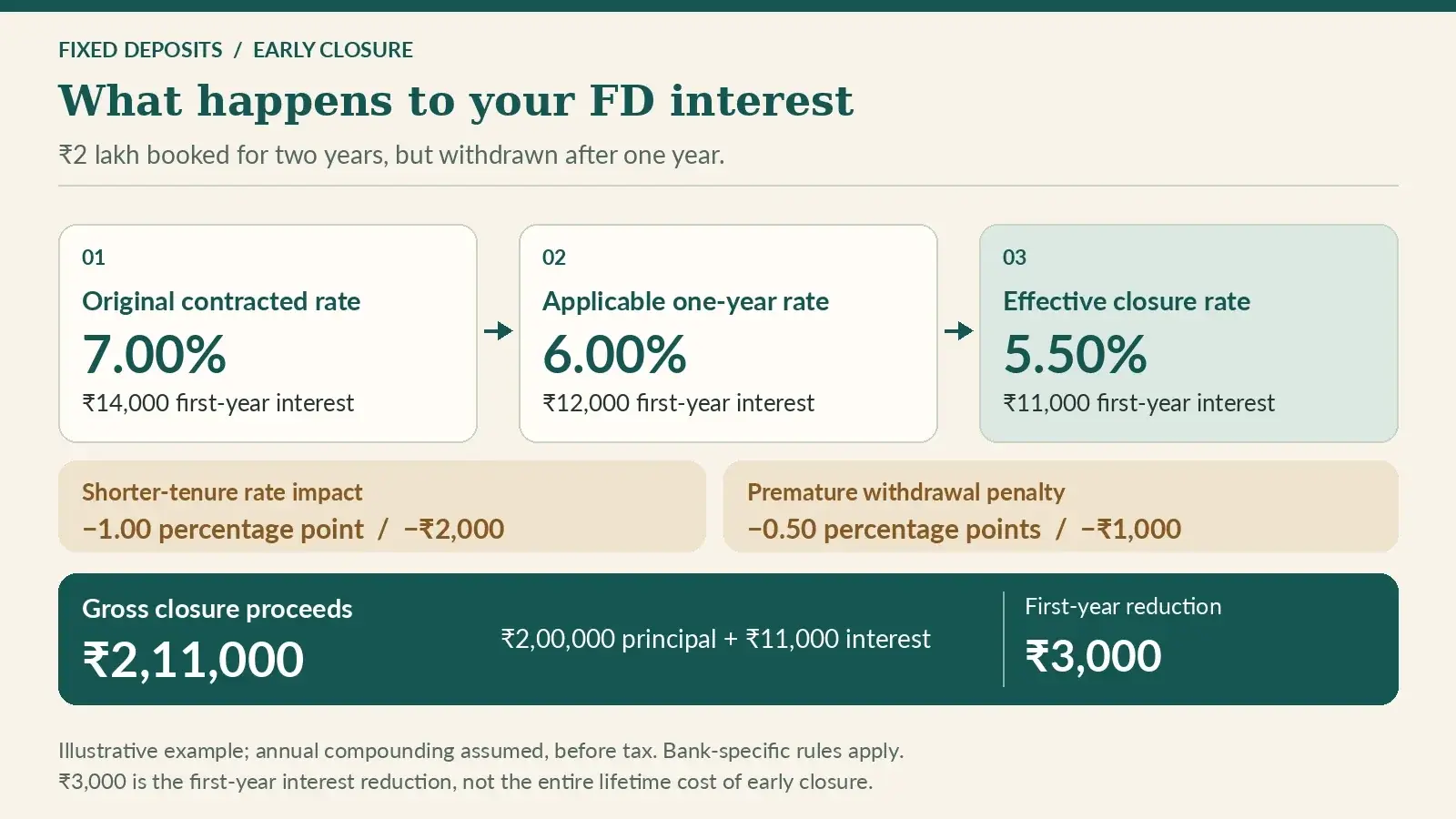
Suppose you booked a two-year FD at 7% per annum. On the day you opened it, the same bank offered 6% for a one-year deposit of the same size. If you close your two-year FD after one year, the bank generally uses the rate applicable to the actual holding period at the time of booking, rather than the originally promised two-year rate.
The RBI's Commercial Banks – Interest Rate on Deposits Directions, 2025, paragraph 11, provide for interest based on the actual period and amount held. If the deposit is withdrawn before the prescribed minimum tenure, no interest is payable under that provision.
The rate applicable to a one-year FD newly opened today is not necessarily the rate used for this recalculation. The historical rate card matters. Ask your bank for the exact applicable rate rather than trying to reconstruct it from its current advertisements.
2. A premature withdrawal penalty may reduce the applicable rate further
Banks can set premature withdrawal penalties through their approved policies. Under paragraphs 22–23 of the RBI directions, the penalty terms must be communicated when the deposit is accepted; otherwise, the bank cannot levy that penalty.
For example, SBI's published domestic retail deposit terms specify a 0.50-percentage-point penalty for deposits up to ₹5 lakh, with a higher 1-percentage-point penalty for the applicable larger retail deposit band. Its calculation uses the lower of the contracted and applicable shorter-period rates, after the relevant reduction. ICICI Bank also describes a rate reduction based on the actual tenure, subject to its published conditions.
These are examples of bank-specific policies, not a universal RBI-mandated penalty of 0.5% or 1%.
Consider this hypothetical deposit, with annual compounding for simplicity:
| Component | Value |
|---|---|
| Original principal | ₹2,00,000 |
| Contracted two-year rate | 7% p.a. |
| Applicable one-year rate at booking | 6% p.a. |
| Premature withdrawal penalty | 0.50 percentage points |
| Effective rate on early closure after one year | 5.50% p.a. |
| Interest payable on early closure | ₹11,000 |
| Gross closure proceeds | ₹2,11,000 |
At the contracted rate, the first year's accumulated interest would have been ₹14,000. Early closure reduces that figure by ₹3,000: ₹2,000 from the lower tenure rate and ₹1,000 from the penalty. The penalty is a reduction in the annual interest rate in this example, not a separate flat charge on the amount withdrawn.
The original FD would also have earned interest during its second year. That future income is another consideration, but some of it may be replaced by interest on any surplus cash you reinvest after closure.
For an FD that pays interest monthly or quarterly, the bank may adjust interest already paid when calculating the premature closure amount. A cumulative FD may have a different compounding convention from the simplified example. Use the actual net closure quote, not merely the principal shown in your app.
How does a loan against an FD work?
Instead of cancelling the deposit, you can offer an eligible FD as security for a loan. The bank places a lien on it, which restricts your ability to freely withdraw or otherwise use the pledged funds while the borrowing remains outstanding.
The FD normally continues earning its contracted interest. Separately, the bank charges interest on your outstanding borrowing. You still owe the loan principal, and the bank can enforce its security rights if the debt is not repaid according to the agreement.
The sanctioned loan is normally smaller than the value of the deposit. A 90% loan-to-value limit on a ₹2 lakh FD would allow borrowing of up to ₹1.8 lakh, subject to eligibility. The remaining 10% is the lender's margin. Different products and application channels can apply different limits.
SBI's published loan-against-time-deposit terms illustrate a spread of one percentage point over the linked FD rate, with borrowing of up to 90% under eligible arrangements. Its general product page also lists zero processing charges and no prepayment penalties for that facility. HDFC Bank advertises overdrafts of up to 90% and a two-percentage-point spread over the deposit rate for its published product. These are product examples reviewed in November 2026; confirm the actual offer for your deposit before applying.
A 7% FD with a one-percentage-point spread means an 8% annual borrowing rate, not a 1% loan rate. A two-point spread means 9%.
Overdraft versus demand loan
| Feature | Overdraft against FD | Demand or other fixed-disbursement loan against FD |
|---|---|---|
| Access to money | Draw as needed up to a sanctioned limit | A specified amount is disbursed |
| Interest | Generally on the outstanding utilised amount | On the outstanding loan balance under the contract |
| Repayment | Often flexible within facility conditions | According to agreed repayment or demand terms |
| Best suited to | Intermittent or short-term cash shortages | A known lump-sum requirement |
An overdraft (OD) is especially useful when the exact amount or duration of a cash shortage is uncertain. If the approved limit is ₹1.8 lakh but you use only ₹50,000, interest is generally charged on the utilised ₹50,000 rather than the entire approved limit. Facility fees, if any, must still be considered.
Assume you draw ₹50,000 for 30 days at 8% p.a., using a 365-day convention:
₹50,000 × 8% × 30 ÷ 365 = approximately ₹329 in interest.
If you repay ₹20,000 halfway through those 30 days, the simplified interest becomes about ₹263: roughly ₹164 for the first 15 days on ₹50,000 and ₹99 for the next 15 days on ₹30,000. Actual charging dates, interest debits and day-count rules depend on the bank.
Do not mistake flexible principal repayment for permission to ignore interest payments. Some facilities require periodic servicing of interest. If the OD is already fully drawn, unpaid interest can also cause limit-related problems. Check these conditions before using it.
A worked example: closing the FD or borrowing against it
Return to the ₹2 lakh deposit. You opened it for two years at 7%, and one year has passed. You now need ₹1.8 lakh for an expense. Compare both options on the original maturity date, one year from today.
For a fair comparison, assume the same ₹1.8 lakh is spent immediately under either option. The FD compounds annually for illustration; the remaining cash after early closure can earn 6% over the next year; the borrowing rate is 8%; and there are no fees or taxes in this first calculation. Assume the loan is held at ₹1.8 lakh for one year and interest is settled at the end without compounding or interim cash-flow effects. Actual OD contracts may require periodic interest payments, so this is a simplified economic comparison, not a repayment schedule offered by a bank.
Option A: break the FD today
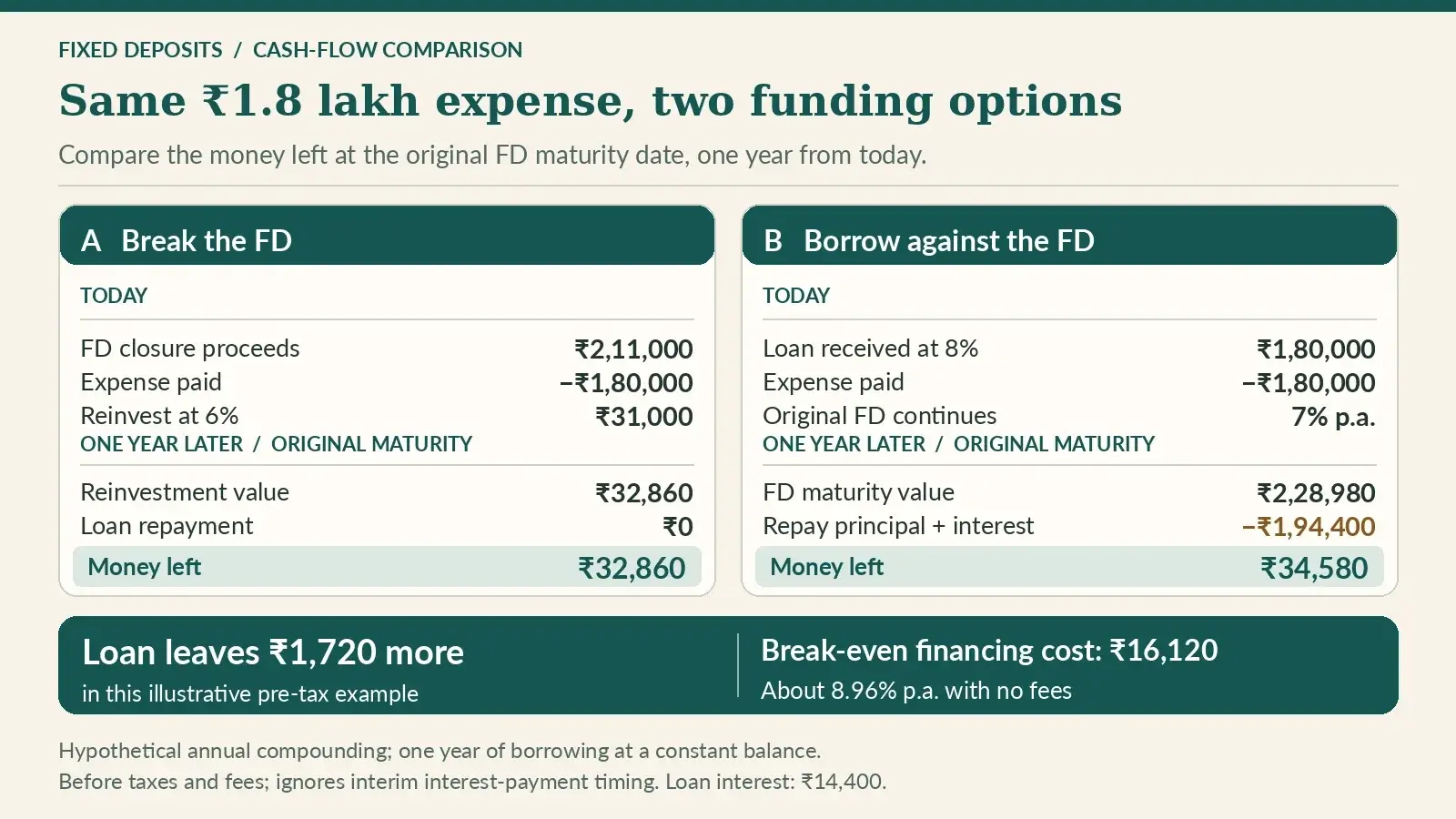
The bank credits ₹2,11,000 as calculated earlier. You spend ₹1,80,000 and reinvest the remaining ₹31,000 at 6% for one year.
At the original maturity date, that reinvested amount is worth ₹32,860. You have no loan to repay.
Option B: borrow ₹1.8 lakh and keep the FD
The deposit continues to grow at 7% for its full two-year term. Its gross maturity value is ₹2,28,980 (₹2,00,000 × 1.07 × 1.07).
The loan costs ₹14,400 in interest for one year (₹1,80,000 × 8%). Total repayment is ₹1,94,400. If this is paid from the matured deposit, the remaining money is ₹34,580.
| Cash-flow comparison | Break the FD | Loan against the FD |
|---|---|---|
| Cash available for the expense today | ₹1,80,000 | ₹1,80,000 |
| Surplus available for reinvestment today | ₹31,000 | ₹0 |
| Gross asset value at original maturity | ₹32,860 | ₹2,28,980 |
| Loan principal and interest payable then | ₹0 | ₹1,94,400 |
| Money left after repayment | ₹32,860 | ₹34,580 |
In this specific pre-tax example, borrowing leaves you ₹1,720 better off. That is far smaller than the maturity interest of ₹28,980, because you also pay loan interest and give up the ability to invest the surplus released through early closure.
The loan does not preserve the entire FD for your future use if the FD must ultimately repay the debt. It preserves the deposit contract while giving the bank a claim on its proceeds.
What if the loan rate is higher?
At a 9% loan rate, one year's loan interest becomes ₹16,200. The remaining balance after repaying the loan from maturity proceeds falls to ₹32,780. Now closing the FD leaves ₹80 more, even before tax or fees.
A small increase in the borrowing rate has reversed the result. The difference is so narrow that actual interest posting, tax and other charges could easily change the decision.
How to calculate your break-even borrowing cost
For a one-off cash requirement, compare both options on the same date. The original maturity date is often a convenient reference point if the borrowing will be settled then.
First obtain the bank's early closure quote and maturity value. Subtract the money you need from the closure quote and calculate what the remaining cash could be worth at maturity. Then compare that amount with the maturity value of the intact FD after subtracting the loan principal, all financing charges and applicable taxes.
In the simplified pre-tax case where the full loan principal remains outstanding until maturity:
Maximum break-even financing cost = FD maturity value − cash borrowed − future value of unused closure proceeds.
Using the worked example:
₹2,28,980 − ₹1,80,000 − ₹32,860 = ₹16,120.
This is the maximum combined loan interest and fees before the borrowing advantage disappears under those assumptions. With no fees and one year of borrowing at an unchanged principal of ₹1.8 lakh, it corresponds to about 8.96% p.a. If there is a ₹500 charge payable at the comparison date, the break-even interest cost falls to ₹15,620, equivalent to about 8.68% for the same year. An upfront charge should also account for the return that cash could otherwise earn.
| Annual loan rate | Loan interest for one year | Money left after loan repayment | Better option before tax and fees |
|---|---|---|---|
| 8% | ₹14,400 | ₹34,580 | Loan, by ₹1,720 |
| Approximately 8.96% | About ₹16,120 | About ₹32,860 | Roughly equal |
| 9% | ₹16,200 | ₹32,780 | Closure, by ₹80 |
This is not a universal break-even rate. A shorter borrowing period, a more severe premature withdrawal penalty, a different replacement investment rate or a different FD maturity date all change the result.
If you plan to repay the loan from salary in three months instead of from the FD at maturity, account for the same future salary in the closure option too. That salary could be saved or invested because there would be no loan to repay. With staggered repayments, use a cash-flow schedule that accounts for dates, declining loan balances and the returns on cash retained under each option. Simply comparing the full FD's interest with the loan interest would overstate the benefit of borrowing.
Why income tax can change the answer
FD interest is generally taxable for resident individuals. Tax deducted at source (TDS) is a collection mechanism, not necessarily the final tax liability. A borrower using the loan for ordinary personal spending should not assume that its interest can be deducted from taxable FD interest merely because the deposit is collateral. Deductibility depends on the purpose of the borrowing and applicable tax provisions.
Consider an illustrative ₹1 lakh earning 7% for a year, alongside ₹1 lakh of borrowing at 8% over the same period. At a hypothetical marginal tax rate of 30%, ignoring cess, surcharge and special deductions:
| Annual interest comparison | Amount |
|---|---|
| Gross FD interest | ₹7,000 |
| Illustrative tax on FD interest | ₹2,100 |
| Net FD interest | ₹4,900 |
| Loan interest | ₹8,000 |
| Interest-cost gap after tax | ₹3,100 |
Before tax the gap is ₹1,000; after tax it is ₹3,100. The example isolates equal amounts for explaining the interest spread; it is not a claim that a bank lends 100% of the deposit or that this is the complete cost of premature withdrawal.
In the earlier full comparison, taxes on both the intact FD and the closure-and-reinvestment path would need to be calculated, including any interest already reported in a previous tax year. The relative tax burden could wipe out the ₹1,720 pre-tax advantage. Compare after-tax returns and financing costs using your actual circumstances. If you have a business or housing-related borrowing purpose, obtain advice on the relevant deduction rules rather than automatically netting one interest figure against the other.
A third option: withdraw only what you need
The decision is often presented as either closing the whole FD or borrowing against it. Ask whether the bank permits partial premature withdrawal, or whether you have multiple separately booked deposits.
For example, if ₹5 lakh is held as five separate ₹1 lakh FDs and you need ₹1 lakh, closing only one eligible FD may allow the other four to continue at their contracted rates. That avoids a large loan and limits the amount affected by early closure. Check whether the deposits were booked at different rates or maturity dates before selecting which to close.
Some banks also permit partial withdrawal from a single deposit or offer a linked sweep-in facility. Confirm how the withdrawn portion is repriced, whether the remaining amount retains the original contract and whether the minimum balance or lien affects access. The RBI requires bank policies to address penalties on partial as well as full premature withdrawals; it does not guarantee an identical partial-withdrawal feature for every product.
Creating several independently accessible deposits or staggering maturity dates can improve liquidity when planning future savings. Consider the administrative effort and the fact that separate deposits at the same bank do not multiply deposit insurance coverage.
Which FDs can you actually withdraw or borrow against?
For ordinary individual bank term deposits of ₹1 crore and below, including jointly held deposits, the RBI's commercial-bank framework requires a premature withdrawal facility. Banks may offer non-callable deposits above that threshold. This general rule should not be confused with special statutory lock-ins.
Five-year tax-saving FDs under the relevant bank term deposit scheme normally cannot be prematurely closed or pledged for an ordinary loan during the lock-in period. Special exceptions, such as death-related settlement, have their own rules. SBI's Tax Savings Scheme expressly restricts loans against those deposits. Do not book a tax-saving FD with emergency money on the assumption that a secured loan will always be available later.
Loan eligibility also varies by deposit type, remaining maturity, ownership and bank policy. Some banks lend against certain non-callable FDs through particular facilities. Joint deposits may require all relevant holders' consent or a branch visit. An FD already pledged as security may not be available for another loan. NRE, NRO and foreign-currency deposits have additional rules; this article focuses on ordinary resident rupee bank FDs, not company deposits or post-office products.
Risks and practical details to check before borrowing
A secured loan is still debt. The bank may appropriate the deposit to settle unpaid amounts according to the agreement. A lien can prevent access to funds needed for another emergency, even though the FD continues appearing in your account. Confirm whether the whole FD is blocked or only a specified portion.
Find out what happens at maturity. Some facilities are settled from deposit proceeds if the customer has not repaid; other arrangements may allow renewal subject to approval. SBI's published terms, for example, differentiate between online and branch-based facilities and describe settlement at maturity for certain outstanding loans. Do not assume that an overdraft will renew automatically or that the original borrowing rate will continue indefinitely.
Ask about processing, documentation, renewal, penal charges, interest servicing and closure fees. Request the sanctioned limit, applicable rate, day-count convention, repayment terms and total cost in writing. If applicable, review the Key Facts Statement and other loan documents. A low advertised spread does not establish the complete cost for your particular facility.
Which option should you choose?
| Your situation | Option to examine first |
|---|---|
| Temporary shortfall with a reliable repayment date | Small overdraft against an eligible FD |
| Permanent expense with no clear repayment source | Premature or partial withdrawal |
| You need only a small fraction of a large deposit | Partial withdrawal or an OD limited to actual use |
| A high-rate FD would lose considerable accrued interest if closed | Calculate the cost of keeping the deposit and borrowing |
| The FD matures soon | Use the maturity proceeds if the expense can wait; otherwise compare a short bridge loan |
| The loan rate or tax-adjusted financing cost is high | Check whether early closure is cheaper |
| Deposit is locked or already pledged | Confirm which options are legally and contractually available |
Before deciding, obtain the exact closure proceeds (after all deductions), original maturity proceeds, available loan limit, loan rate and fees, expected repayment date, and realistic after-tax return on unused cash. Compare the outcomes on the same date. If the difference is small, the certainty of being debt-free and the availability of emergency funds may be more important than a theoretical saving.
Do not postpone an essential expense merely to protect an FD's interest. Equally, avoid using a secured loan to finance continuing discretionary spending without a repayment plan. A good liquidity decision protects both your savings and your ability to meet future obligations.
The bottom line
Breaking a fixed deposit can cost more than the advertised penalty because the bank may recalculate interest for the entire actual holding period. Borrowing against it can preserve the original interest rate but introduces financing costs, a lien and repayment obligations.
Neither option is automatically cheaper. Compare actual closure proceeds, reinvestment opportunities, loan interest, fees and taxes on a common future date. For short-term needs, a small OD may be an efficient bridge. For lasting expenses or uncertain repayment, using your savings may be the simpler and safer decision. And when partial withdrawal is available, you may not need to choose between closing everything and taking on debt at all.
Related reading: compare current retail FD schedules by exact tenure.
Sources and Further Reading
- RBI — Commercial Banks – Interest Rate on Deposits Directions, 2025, paragraphs 10–11 and 22–25, premature withdrawal and penalties.
- SBI — Deposit interest rates and premature withdrawal penalties.
- SBI — Loan against time deposit, security, interest, margins, channels and repayment.
- SBI — Loan against fixed deposit through YONO.
- HDFC Bank — Overdraft against fixed deposits.
- HDFC Bank — Overdraft against fixed deposits fees and charges.
- ICICI Bank — Fixed deposit terms and conditions.
- ICICI Bank — Closure and renewal of existing fixed/recurring deposits.
- SBI — Tax Savings Scheme, 2006, lock-in and lending restrictions.
- Income Tax Department — Income-tax Act, 2025 as amended by Finance Act, 2026, income from other sources and deductions, sections 92–94.
Bank product terms and regulatory references reviewed on 24 November 2026. All numerical examples are hypothetical and simplified, not current deposit or loan quotations.