Is Your Money Safe if a Bank Fails? India's ₹5 Lakh Deposit Insurance Explained
Learn how DICGC deposit insurance protects up to ₹5 lakh per depositor per bank in India, including fixed deposits, joint accounts, interest and claim timelines.

Imagine you have ₹2 lakh in a savings account and ₹6 lakh in fixed deposits at the same bank. One morning, the Reserve Bank of India restricts withdrawals because the bank is in financial difficulty. You have ₹8 lakh on paper, but you cannot necessarily withdraw it when you need it.
How much of that money is protected? Would opening another fixed deposit at a different branch help? And how long might you have to wait to receive your savings?
India's deposit insurance scheme protects eligible deposits up to ₹5 lakh per depositor per insured bank, for deposits held in the same right and capacity. The limit includes accrued interest as well as principal. It does not apply separately to every account or fixed deposit receipt.
Understanding that distinction matters more than simply knowing the ₹5 lakh figure. It can help you organise your savings without unnecessarily exposing a large portion of your emergency fund or retirement corpus to a single bank.
What is DICGC deposit insurance?
The Deposit Insurance and Credit Guarantee Corporation (DICGC) is a wholly owned subsidiary of the Reserve Bank of India. It administers India's bank deposit insurance scheme under the Deposit Insurance and Credit Guarantee Corporation Act, 1961.
A bank accepts deposits and uses part of those funds to make loans and investments. If borrowers fail to repay, investments lose value or depositors demand more cash than the bank can readily provide, the bank may encounter financial difficulties. Capital, liquidity and supervisory requirements are designed to reduce those risks, but they cannot eliminate every possibility of failure.
Deposit insurance provides an additional layer of protection. When a covered event occurs, the corporation becomes responsible for eligible claims within the statutory limit. It protects depositors rather than guaranteeing the survival of the bank itself.
You do not have to buy this insurance or pay a separate premium. Insured banks fund the scheme through premiums paid to DICGC. The current ₹5 lakh ceiling has been in effect since 4 February 2020. DICGC's current depositor guidance confirms the limit as of 24 November 2026.
How the ₹5 lakh limit is actually calculated
For an ordinary individual account holder, think of the insurance limit as a ceiling on your combined eligible deposit balance at one bank, rather than a benefit attached to each account number.
Suppose you hold these deposits at Bank A, in your individual name. All amounts in this example include any interest accrued by the relevant cut-off date.
| Deposit | Balance |
|---|---|
| Savings account at Branch 1 | ₹1,20,000 |
| Fixed deposit at Branch 1 | ₹3,00,000 |
| Fixed deposit at Branch 2 | ₹2,50,000 |
| Recurring deposit | ₹80,000 |
| Combined eligible deposits | ₹7,50,000 |
| Maximum insured amount | ₹5,00,000 |
| Amount above the insurance limit | ₹2,50,000 |
Assume the bank is insured, no dues need to be deducted and the deposits are all eligible. Opening another account at the same bank does not create another ₹5 lakh of protection. Neither does moving the existing FD to another branch.
The ₹2.5 lakh above the ceiling is not automatically lost. Its recovery depends on the outcome of the bank's resolution or liquidation. DICGC simply does not guarantee that excess through deposit insurance.
Interest is included, not added to the limit
Consider a hypothetical one-year FD paying 7% simple interest at maturity, before any tax deductions. Assume you have no other deposits at the bank and that the entire year's interest has accrued by the relevant cut-off date.
| Component | Amount |
|---|---|
| FD principal | ₹5,00,000 |
| Accrued interest | ₹35,000 |
| Total deposit balance | ₹5,35,000 |
| Insured amount | ₹5,00,000 |
| Uninsured excess | ₹35,000 |
Putting exactly ₹5 lakh into an FD does not leave room for its interest under the insurance ceiling. If you intend to keep the whole balance insured, allow a margin for accrued interest and for your other accounts at the bank. For instance, a ₹4.5 lakh FD earning 7% simple interest for one year grows to ₹4,81,500, leaving ₹18,500 of headroom in this simplified example. Actual compounding, tax deductions and other deposits can change that figure.
The relevant value is the amount owed by the bank on the applicable statutory cut-off date, not necessarily the eventual maturity value printed on the receipt.
Which banks and deposits are covered?
Deposit insurance applies to eligible deposits at insured banking institutions in India. The coverage is not limited to government-owned banks.
| Institution | DICGC protection for eligible deposits |
|---|---|
| Public sector and private sector banks | Yes, when insured |
| Small finance banks and payments banks | Yes, when insured |
| Regional rural banks and local area banks | Yes, when insured |
| Indian branches of foreign banks | Yes, when insured |
| State, district central and urban cooperative banks | Yes, when insured |
| Primary cooperative credit societies | No |
| Non-banking financial companies (NBFCs) and housing finance companies | No |
Check the precise legal name of your institution in the official DICGC list of insured banks. A cooperative bank and a cooperative credit society may have similar names, but they are not interchangeable for deposit insurance purposes.
Savings, current, fixed and recurring deposits generally qualify. Eligible deposits held by non-resident Indians at insured banks in India are not excluded merely because the depositor lives abroad. Deposits accepted outside India, deposits of foreign governments, central or state governments, interbank deposits and specifically exempted deposits fall outside the ordinary coverage rules.
Not everything sold by a bank is a bank deposit
A bank branch or banking app may offer mutual funds, insurance policies, bonds, shares and other financial products alongside FDs. Buying one of these through a bank does not turn it into an insured deposit. Similarly, corporate FDs and NBFC deposits are not protected by DICGC merely because they offer fixed interest.
Money held in a digital wallet is also not automatically an insured deposit in the wallet user's name. If an app arranges an FD with a partner bank, identify the actual deposit-taking institution and confirm whose name the deposit is recorded in. The underlying bank, ownership and legal nature of the balance determine the applicable protection.
Losses due to fraud, unauthorised transactions, theft of locker contents or investment-market movements are not bank-failure deposit insurance claims. Other remedies or protections may apply to those situations.
Can you increase coverage by using different banks?
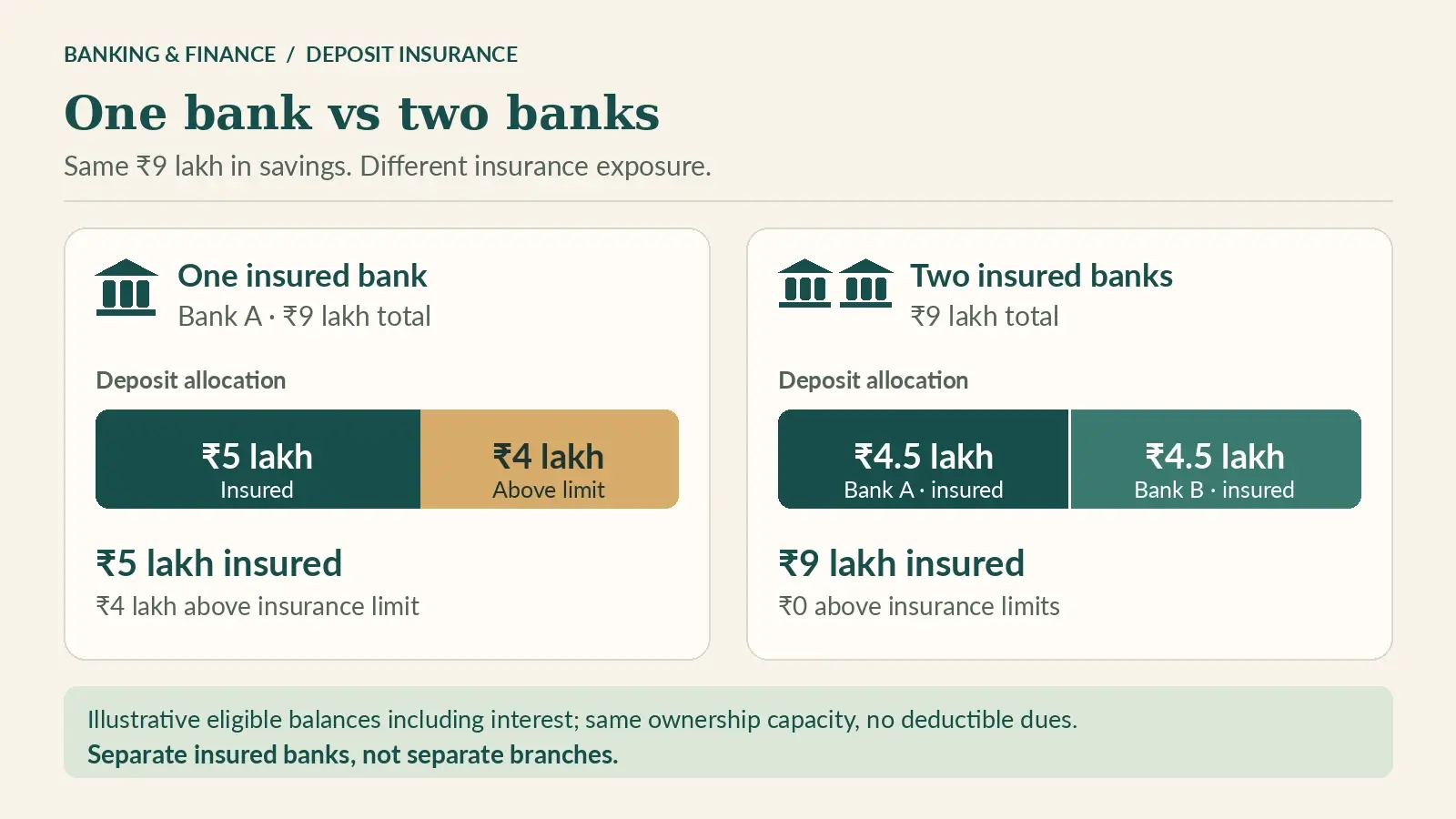
Yes. Separate insured banks have separate ceilings, even if the same depositor owns the accounts and both banks encounter trouble at the same time.
Consider two ways of holding ₹9 lakh. Assume that the amounts include interest, all deposits qualify and there are no deductible dues.
| Allocation | Total insured | Amount above the limits |
|---|---|---|
| ₹9 lakh at Bank A | ₹5 lakh | ₹4 lakh |
| ₹4.5 lakh at Bank A and ₹4.5 lakh at Bank B | ₹9 lakh | ₹0 |
This is one reason to diversify large bank savings. It can also reduce the inconvenience of being unable to access funds during a bank-specific disruption.
However, two different brands, apps or branch names do not necessarily mean two different insured banks. Verify the underlying legal bank, particularly when opening deposits through financial marketplaces. If two banks merge, balances previously insured independently may become part of one combined bank relationship; check the applicable merger scheme and reassess your allocation.
Diversifying does not mean chasing the highest interest rate at every available institution. Consider financial soundness, access, service quality and premature withdrawal conditions as well as insurance coverage.
How joint accounts and different ownership capacities work
The phrase “same right and same capacity” distinguishes the legal ownership of deposits. Money held for yourself, jointly with another person or in a genuine fiduciary capacity may belong to different insurance groups.
For example, suppose the following balances are all at Bank A and no deductions apply.
| Ownership group | Combined deposits | Insured amount |
|---|---|---|
| Asha, individual accounts | ₹6,00,000 | ₹5,00,000 |
| Ravi, individual accounts | ₹3,00,000 | ₹3,00,000 |
| Asha and Ravi, joint accounts in that order | ₹7,00,000 | ₹5,00,000 |
| Total | ₹16,00,000 | ₹13,00,000 |
Asha's individual deposits are not merged with the jointly held deposits merely because she is named on both. But the ₹7 lakh joint balance is covered up to ₹5 lakh for that ownership group, not ₹5 lakh for each of its two holders.
DICGC's guide also distinguishes joint holdings by the combination and sequence of names. For example, two deposits held jointly as Asha–Ravi are aggregated, whereas a separate genuine joint holding recorded as Ravi–Asha can be treated as a separate group under the current rules.
Deposits in legitimate capacities such as trustee, guardian or partner may qualify for separate treatment. There is an important exception for a sole proprietor: the person's individual balances and deposits belonging to that person's sole proprietorship are combined for insurance purposes at the same bank.
Adding a nominee does not create a new ownership group. A nominee facilitates claims in the event of death; nomination is not the same as creating a joint deposit. Do not change account ownership solely for insurance purposes without understanding the legal, tax and succession implications.
What happens if you also owe the bank money?
A bank may exercise its applicable right to adjust amounts owed by a depositor against deposits before calculating the eligible insurance claim. This is known as set-off.
Suppose you have eligible deposits of ₹6.2 lakh and ₹2 lakh of dues that are legally available for set-off at the cut-off date. After adjustment, the net amount is ₹4.2 lakh. In that simplified example, the insurance claim can cover ₹4.2 lakh rather than ₹5 lakh in addition to cancelling the dues.
Whether a particular liability can be adjusted depends on its terms, ownership and applicable legal rules. Do not assume that a bank failure automatically cancels your loan or that you can stop making scheduled repayments. Follow official instructions on how and where payments must be made.
When and how will depositors receive their money?
Not every bank failure follows the same process. A bank may be restricted temporarily, merged into another bank, reconstructed or wound up. These routes have different consequences for access to deposits and the processing of claims.
1. RBI restrictions on withdrawals: the 90-day framework
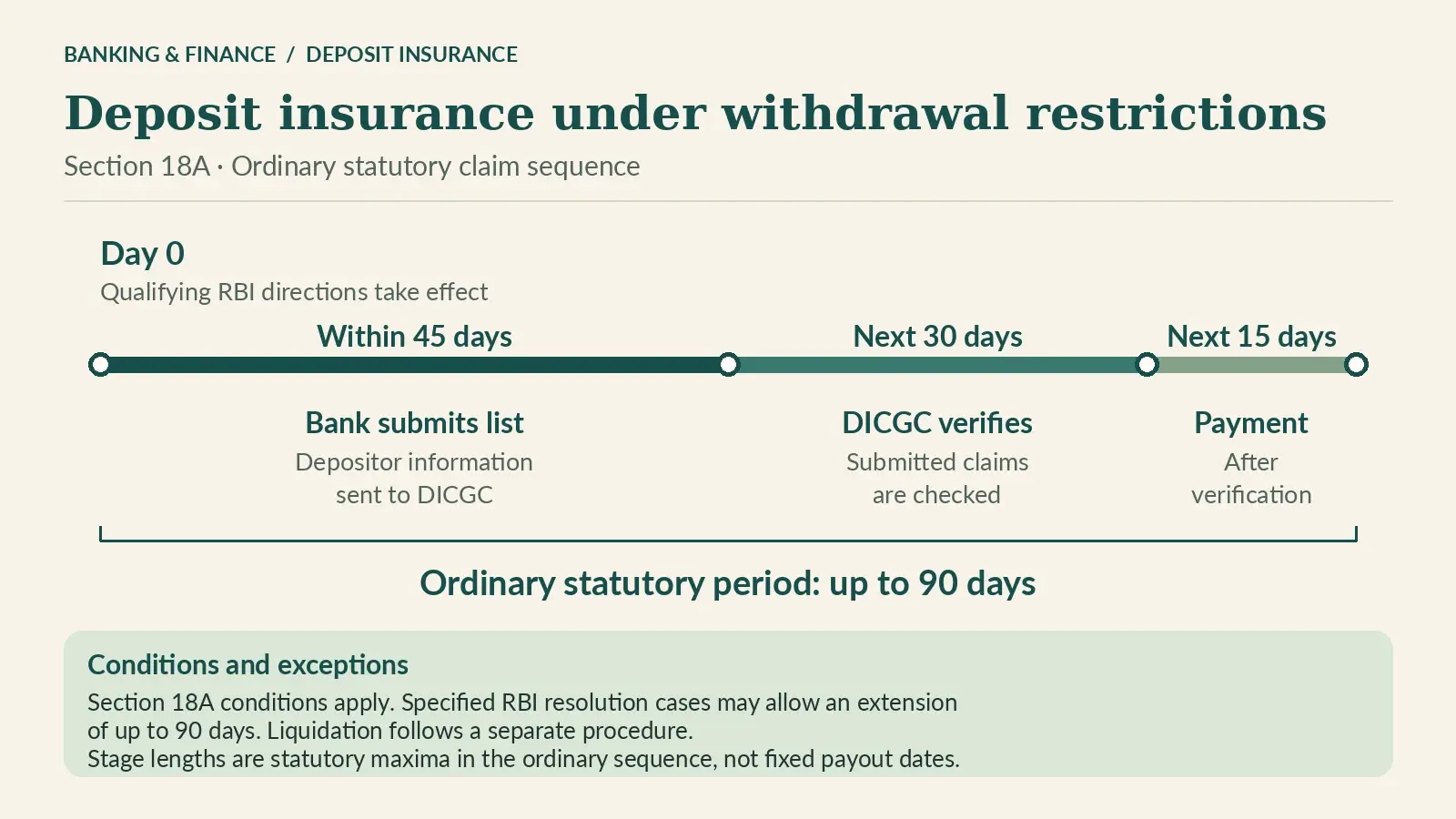
Since 1 September 2021, Section 18A of the DICGC Act has allowed eligible depositors of insured banks under qualifying withdrawal restrictions to receive insurance payments without waiting for liquidation.
The normal statutory sequence is:
| Stage | Time allowed |
|---|---|
| Insured bank submits depositor information | Within 45 days of the qualifying directions taking effect |
| DICGC verifies submitted claims | Within 30 days of receipt |
| Payment after verification | Within 15 days of completion |
| Ordinary overall statutory period | Up to 90 days |
This is not an unconditional promise of access within three months in every troubled-bank case. Section 18A(7) permits an additional period of up to 90 days in specified circumstances involving RBI-led resolution arrangements. DICGC also explains that late or missing depositor records from the bank can impede settlement. A depositor who submits documents later may receive payment in a subsequent claim batch.
If your bank is affected, contact its administrator or designated official and submit the required willingness form, identity documents and alternate bank account details as instructed. Use the official claim willingness portal where applicable. Submit promptly instead of assuming that payment will arrive automatically.
2. Liquidation: a different statutory clock
When an insured bank is formally wound up, the liquidator prepares the claim list. Under Section 17 of the Act, the liquidator is required to submit it within three months of taking office. DICGC's payment obligation is then measured from receipt of that list, with a statutory period of two months. The liquidator distributes the approved money to depositors.
The time spent before a liquidator takes charge, in resolving discrepancies or in actual distribution matters too. The 90-day framework for withdrawal restrictions should not be applied indiscriminately to liquidation.
3. Merger or reconstruction
A resolution scheme may transfer deposits to another bank and restore access, sometimes without the depositor needing any insurance payout. If the scheme provides less than the protected amount, DICGC can cover the eligible shortfall according to Section 16 and the applicable claim procedure. There is no double recovery of money already made available through the scheme.
What happens to money above ₹5 lakh?
The insurance ceiling limits DICGC's liability, not necessarily the depositor's entire legal claim. For instance, if you have ₹12 lakh at one insured bank in one ownership group, ₹7 lakh is outside the insurance safety net, assuming no set-off.
A successful rescue or merger could preserve more than the insured amount. In a liquidation, any further distribution depends on realised assets, statutory priorities and the proceedings. Recovery can be partial, delayed or absent. Do not treat an uninsured balance as certain to disappear, but do not plan your finances on the assumption that it will be recovered either.
Even a fully insured balance can be temporarily inaccessible. This is especially relevant for pensioners, households paying medical expenses and businesses that need immediate working capital.
Practical ways to make your bank savings safer
- Verify insurance status. Check the legal institution in the DICGC register before making a large deposit.
- Count all eligible balances together. Include savings, current, recurring and fixed deposits in the same ownership group, across branches, with accrued interest.
- Leave an interest buffer. Review balances as FDs accrue interest or automatically renew. A deposit that was initially within the ceiling can grow beyond it.
- Diversify when appropriate. Use separately insured banks for large balances, and keep some readily accessible emergency money outside your main bank.
- Keep records current. Retain account statements and FD receipts, update KYC and contact information, and maintain appropriate nomination or succession arrangements.
- Use official notices during a crisis. Check RBI and DICGC announcements, contact the designated bank official and keep acknowledgements of submitted claims. DICGC has a claim status tool for specified recent cases.
Deposit insurance requires no separate purchase from you. Be cautious of anyone demanding advance fees, passwords, PINs or OTPs to release an insurance payout. If your claim appears incorrect or delayed, ask the bank or liquidator for a written explanation and use DICGC's official contact or complaint channels.
The bottom line
India's deposit insurance system offers a meaningful safety net, but it is not unlimited and does not guarantee instant access to savings. The key is to think in terms of the legal bank, ownership capacity and total deposit balance including interest.
For most individual savers, keeping eligible balances within the ₹5 lakh ceiling at each separately insured bank, with a margin for interest, is a practical way to limit exposure. For larger amounts, balance insurance protection with liquidity needs and the quality of the institutions holding your money.
Sources and Further Reading
- DICGC — About Us, institutional role and legal basis.
- DICGC — A Guide to Deposit Insurance, coverage, ownership, interest, set-off and claims.
- DICGC — Frequently Asked Questions, including Section 18A procedures.
- RBI — Annual Report 2025–26, Regulation, Supervision and Financial Stability, deposit insurance coverage and institutional framework.
- DICGC — Deposit Insurance and Credit Guarantee Corporation Act, 1961, especially Sections 16–18A and 21.
- DICGC — List of Insured Banks.
- DICGC — Liquidators FAQs, claim processing and net eligible deposits.
- DICGC — Claim Willingness Form.
- DICGC — Claim Status.
- DICGC — Contact Us.
Coverage and claim guidance checked on 24 November 2026. All monetary examples are illustrative, not actual bank claims or deposit-rate recommendations.