How Does a Bank Decide Whether to Approve Your Loan?
Learn how banks assess income, credit history, existing EMIs, collateral and risk before approving, pricing or rejecting a loan application.
Two people can earn the same salary, apply for the same ₹5 lakh personal loan, and get different decisions. One may be approved in minutes. The other may be offered a smaller amount, a different interest rate, or no loan at all.
That is because a bank is not asking only, “How much does this person earn?” It is asking a broader question:
If we lend this money, how likely is the borrower to repay it on time?
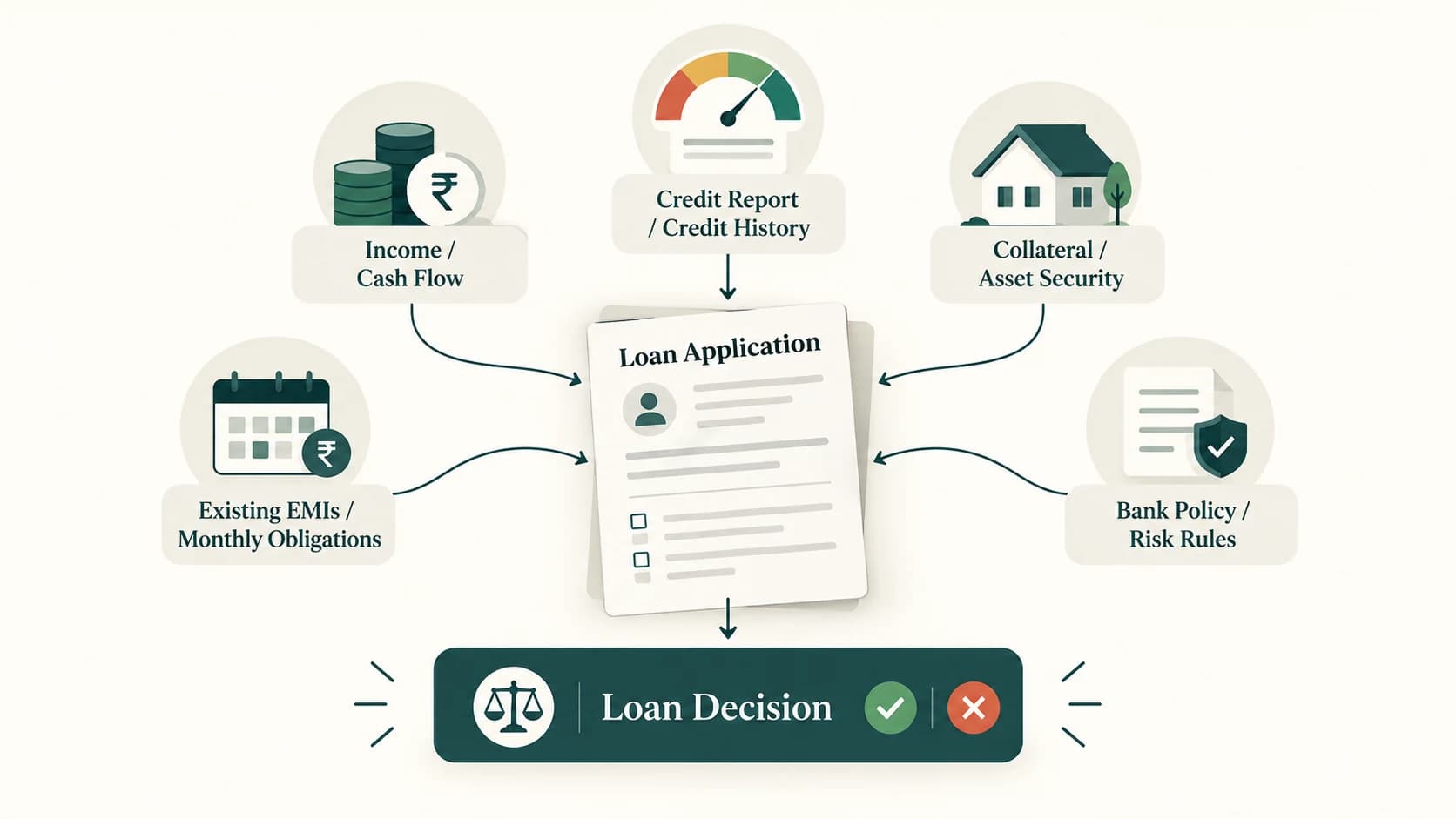
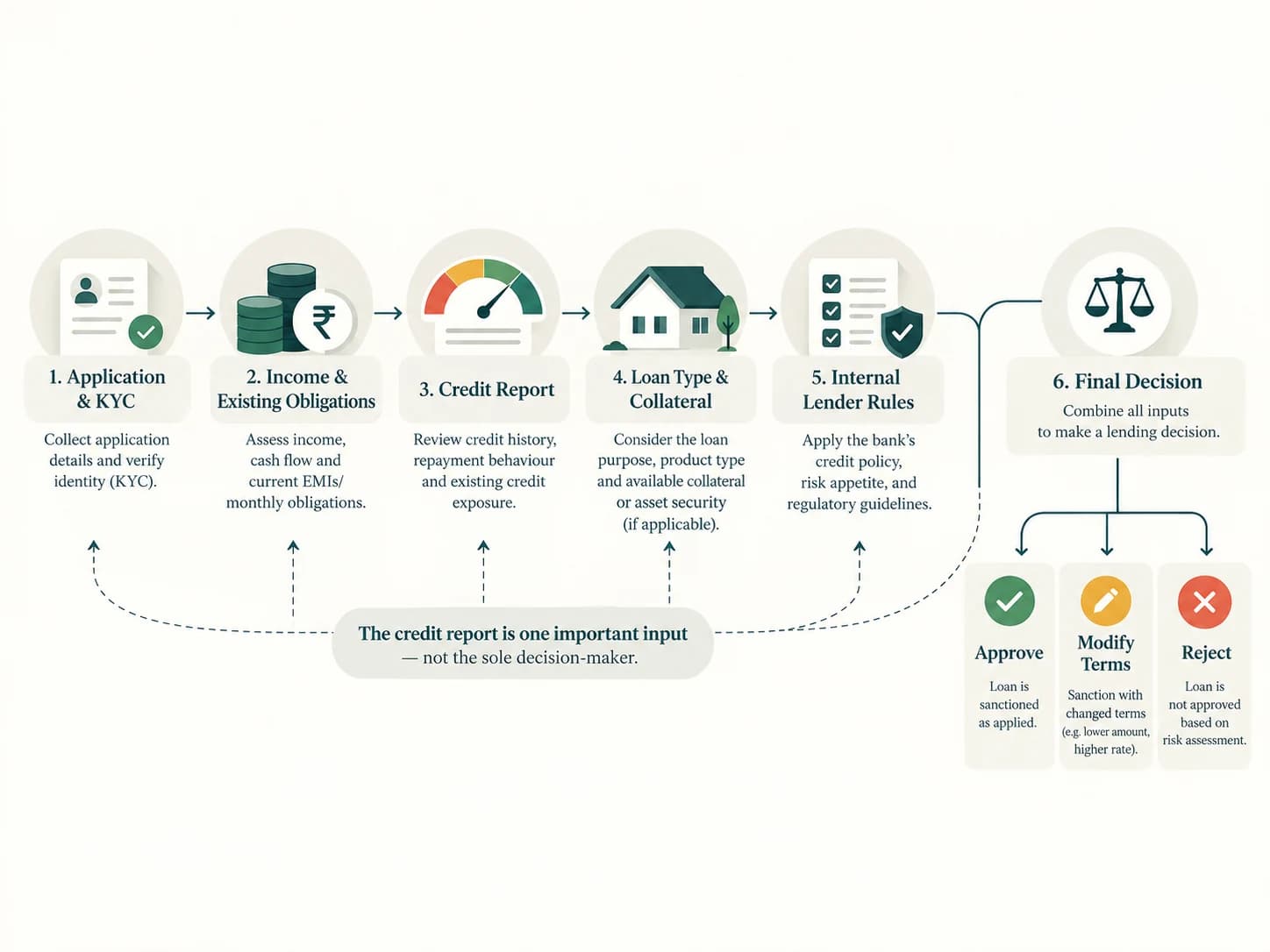
To answer that, the lender combines your identity, income, existing debts, credit history, loan type, collateral and its own internal risk rules. Some checks are automated; others may involve human review.
What the bank is really trying to decide
Most loan decisions come down to four questions:
- Can you repay? Does your income or cash flow support the new EMI?
- Are you likely to repay? What does your past borrowing behaviour suggest?
- What happens if repayment goes wrong? Is there collateral or another protection that reduces the lender’s possible loss?
- Does the application fit the lender’s policy? A financially sound applicant can still fall outside the rules for a particular product.
A high income helps, but it is only one part of the picture.
Step 1: The bank verifies who you are
Before judging the loan, the bank first has to establish that the application and applicant are genuine.
That usually means checking your identity and KYC details. Depending on the loan, it may also verify employment, business details, bank statements, tax documents or the asset being financed.
This stage is often confused with credit approval. They are different.
KYC answers “Who are you?”
Credit appraisal answers “Should we lend to you?”
A person can complete KYC successfully and still fail the credit assessment.
The bank may also look for inconsistencies: salary that does not match account credits, conflicting addresses, altered documents, unverifiable employment, or application details that do not match other information available to the lender.
Step 2: It works out whether you can afford the EMI
Loans are repaid from future cash flow, not from a credit score.
For a salaried borrower, a lender may examine salary credits, payslips, bank statements, Form 16 or tax information. For a self-employed borrower, it can look at income-tax returns, financial statements, turnover, bank transactions and other business records.
The important number is not simply your income. The bank also wants to know how much of it is already committed.
Suppose your monthly take-home income is ₹80,000 and you already pay ₹25,000 in EMIs. If a new loan adds another ₹25,000, half your income would be committed to debt repayments.
A lender may measure this using a fixed-obligation-to-income ratio (FOIR) or a similar debt-to-income calculation. The exact method and acceptable level vary by lender, borrower and product. There is no universal percentage that guarantees approval.
This is why someone with a high salary can still be rejected: the bank cares about income left after existing obligations, not income alone.
Step 3: It checks your credit report, not just your score
In India, lenders use information from credit information companies such as TransUnion CIBIL.
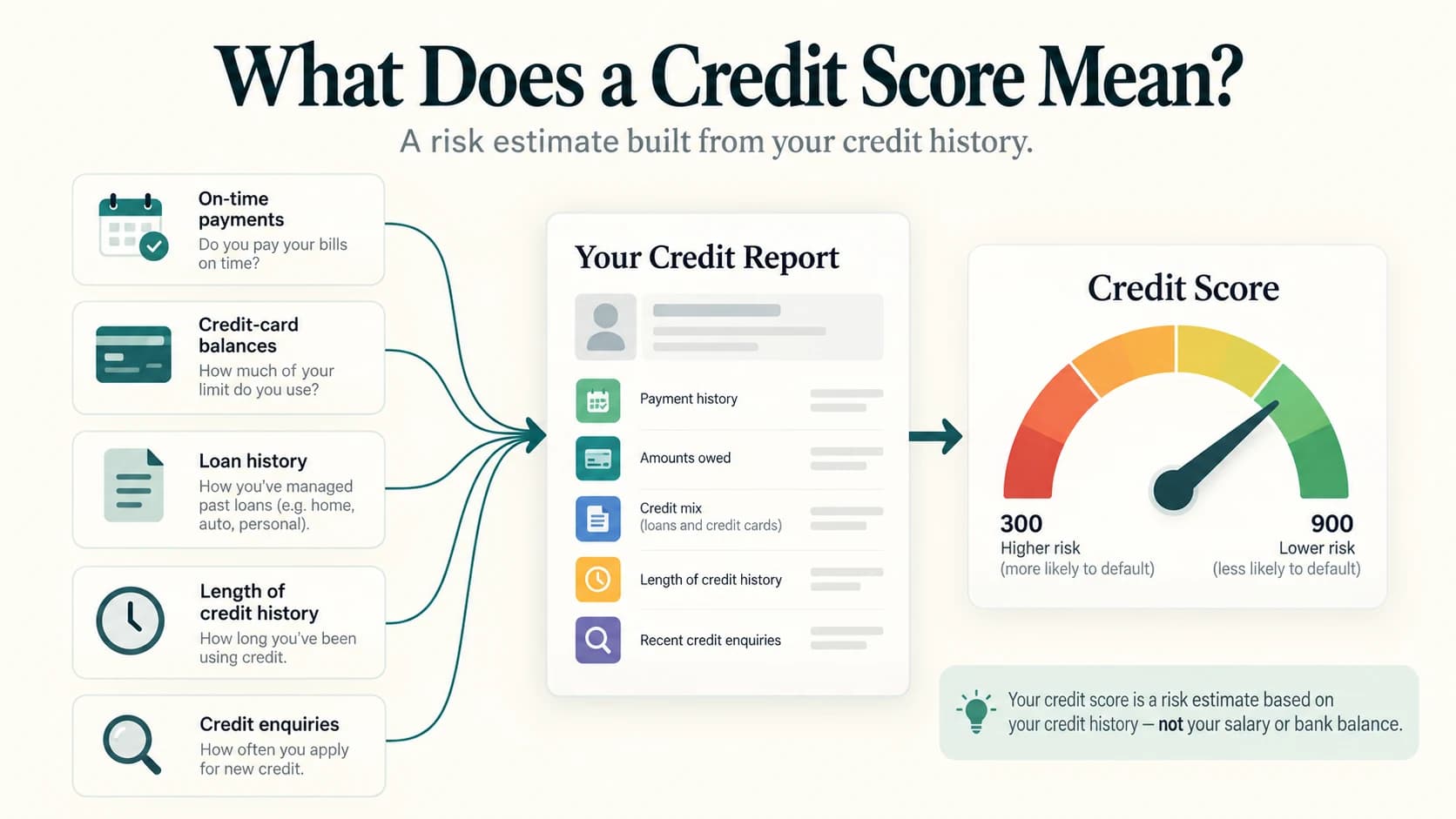
A CIBIL credit score is generally expressed on a 300–900 scale, with a higher score indicating lower predicted credit risk. But the score is only a summary.
The lender can also examine the underlying credit report, including active and closed loans, credit cards, repayment history, overdue amounts, outstanding debt and recent credit enquiries.
This is why “I have a good score, so my loan must be approved” is a misconception.
A good score can strengthen an application, but the lender still has to consider affordability, verification, policy rules and the loan itself. There is no universal CIBIL score that automatically qualifies a borrower at every bank.
What if you have never borrowed before?
No credit history is not the same as bad credit history.
A first-time borrower simply gives the lender less historical evidence. The bank may rely more heavily on income, employment, banking behaviour, loan size, collateral or models designed for new-to-credit customers.
A missing conventional score does not automatically mean rejection.
Step 4: The lender applies its own internal scorecard
The credit bureau does not approve your loan. The lender does.
Banks combine bureau information with their own underwriting rules or scorecards. Digital loan journeys can perform much of this automatically, while larger or borderline cases may receive additional human review.
Depending on the product, the lender may consider verified income, existing debt, repayment history, occupation or business, employment stability, requested amount, tenure, type of loan and its previous relationship with the customer.
Not every lender uses every factor, and the exact weights are usually proprietary.
That is why two banks can look at the same person and reach different decisions. Their risk appetite and internal policies are not identical.
Step 5: The type of loan changes what matters
Banks do not assess every loan in the same way.
For an unsecured personal loan, there is no specific house, car or other asset for the lender to fall back on. Income, existing obligations and credit history therefore matter heavily.
For a home loan, repayment capacity still matters, but the bank also evaluates the property and its legal documentation.
For a business loan, the lender may pay more attention to business cash flow, profitability, leverage, account conduct and the business’s ability to generate enough money to service the debt.
A ₹50,000 consumer loan and a ₹60 lakh home loan are different risks, so the underwriting cannot be identical.
Step 6: For secured loans, the bank evaluates the collateral
Collateral reduces potential loss, but it does not make repayment ability irrelevant.
For a home loan, the bank may examine the property’s valuation, legal title and acceptability under its policy. Vehicle loans and gold loans similarly involve security specific to the product.
Banks often limit a secured loan to a proportion of the asset’s accepted value. This is the loan-to-value ratio, or LTV.
If an eligible asset is valued at ₹50 lakh, the bank may not lend the full ₹50 lakh. The borrower’s contribution gives the lender a cushion if the asset value falls.
But collateral is not a substitute for proper underwriting. RBI fair-practice guidance has emphasized that security or margin should not replace due diligence on the borrower’s creditworthiness.
Banks would rather receive every EMI on time than recover money by selling collateral.
Step 7: The application must fit the bank’s policy
Sometimes a loan is rejected even though the borrower appears capable of repaying it.
The reason may be policy rather than one bad financial number.
Lenders can have product-specific rules for age, income, occupation, loan amount, tenure, geography, acceptable collateral, documentation and other risk limits. These rules differ between institutions and can change over time.
So rejection by one bank does not automatically mean no lender will approve the borrower. The application may simply not fit that lender’s product or risk policy.
Step 8: Fraud and verification checks can stop a strong application
Loan underwriting is also a fraud-control process.
Depending on the loan, verification can include document validation, bank-statement analysis, employer or business checks, contact verification, and legal or technical checks on collateral.
A borrower can therefore have a strong credit score and adequate income but still be rejected if important information cannot be verified or if documents are inconsistent.
Accurate information matters more than trying to make the application “look stronger.”
Step 9: Approval is not always a simple yes or no
The lender may approve the amount requested, approve a smaller amount, change the tenure, require a larger borrower contribution, seek additional security or a co-applicant where applicable, offer different pricing, or reject the application.
In risk-based pricing systems, two borrowers can sometimes receive different rates for the same broad loan product because the lender assesses their risk differently.
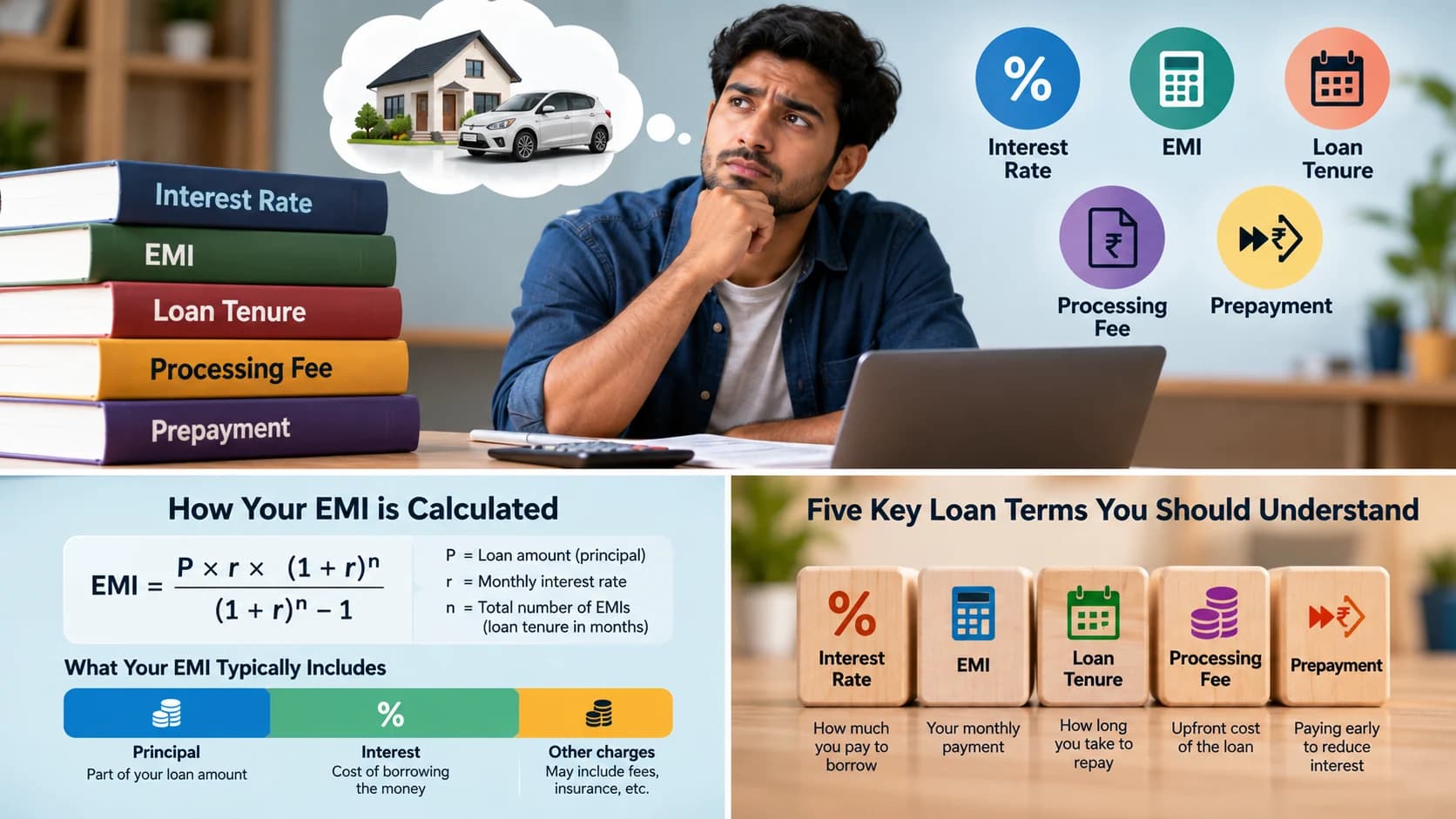
For covered retail and MSME loans, RBI’s disclosure framework provides for a Key Facts Statement (KFS) showing key loan terms in a standardised, easier-to-understand form. One useful number is the Annual Percentage Rate (APR), which reflects the annualised cost of credit including applicable charges covered by the framework, rather than merely the headline interest rate.
That is why comparing loans only by the advertised rate can be misleading.
Sanction is not always the same as disbursement
A bank can sanction a loan but attach conditions that must be completed before money is released.
A home loan may still need satisfactory legal and technical verification of the property. Other loans may require execution of documents, creation of security or completion of conditions listed in the sanction.
The process can therefore be:
Application → appraisal → sanction → completion of conditions → disbursement
An approval message does not always mean the money is immediately available.
Why can a high credit score still lead to rejection?
Because the score answers only part of the bank’s question.
A high-score applicant can still have too much existing debt, insufficient verified income, documentation problems, unacceptable collateral, an application outside the lender’s policy, or fraud-risk flags.
The reverse can also happen. Someone with a short credit history may still qualify if the lender is comfortable with the person’s income, obligations and overall risk.
The bank is evaluating the complete application, not rewarding a score.
A simple example: same salary, different risk
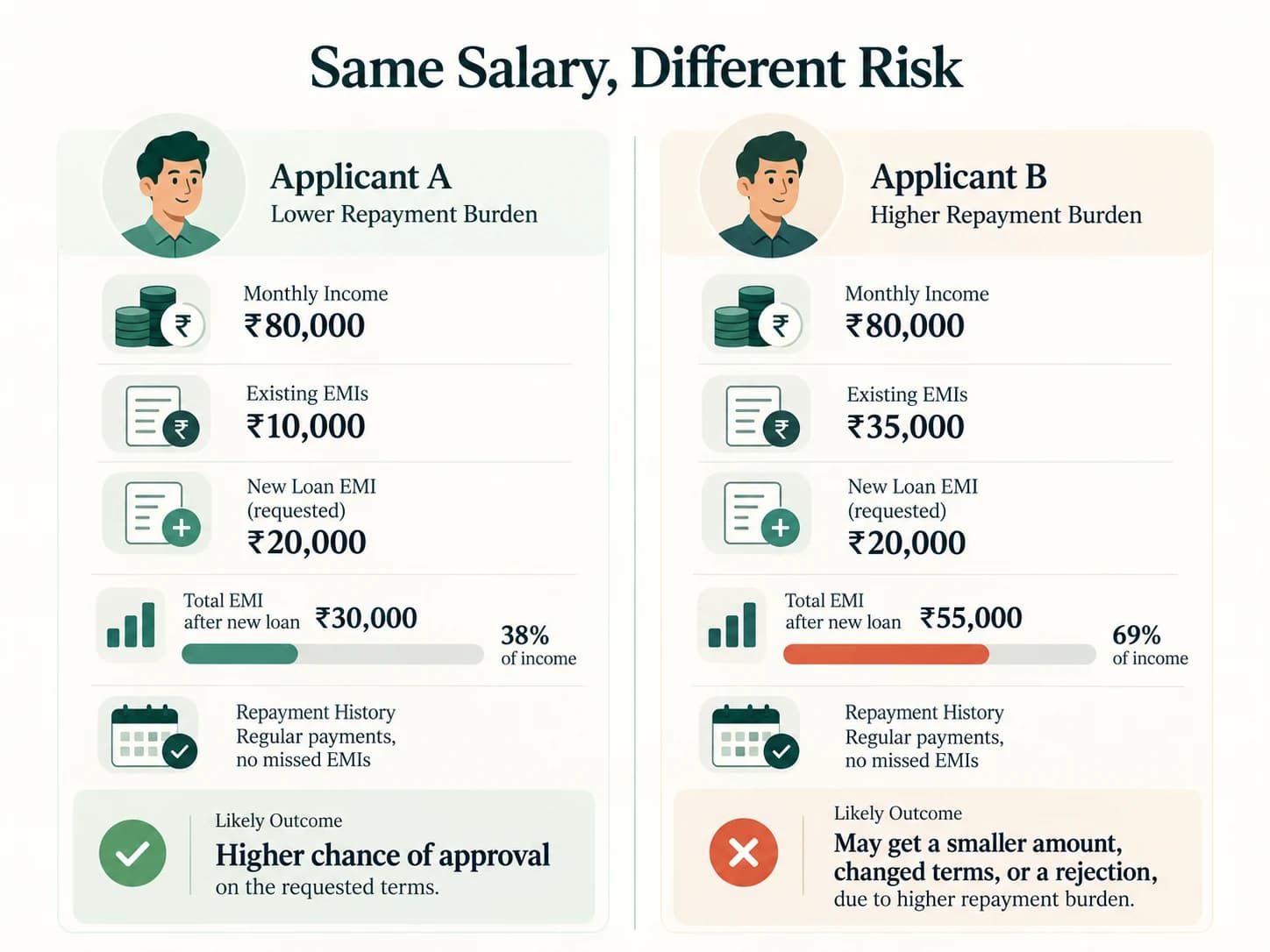
Consider two applicants who each earn ₹80,000 per month and request the same personal loan.
| Applicant A | Applicant B | |
|---|---|---|
| Monthly income | ₹80,000 | ₹80,000 |
| Existing EMIs | ₹10,000 | ₹35,000 |
| Repayment record | Regular | Regular |
| Requested new EMI | ₹20,000 | ₹20,000 |
| Total EMI after new loan | ₹30,000 | ₹55,000 |
Their salaries are identical and both may have good repayment records. But the new loan would leave Applicant B with much less income after debt repayments.
That changes the lender’s risk assessment.
This is why asking only, “What salary is needed for a ₹5 lakh loan?” rarely gives a complete answer.
What can improve your chances of approval?
There is no guaranteed formula, but a few habits make your profile easier to assess:
- Pay loans and cards on time. Repayment history is a major signal of credit behaviour.
- Check your credit report before applying. If there is an error, use the credit information company’s dispute process.
- Keep existing debt manageable. The bank cares about current EMIs as well as the new one.
- Apply for a realistic amount and tenure. A loan that fits your cash flow is easier to support.
- Avoid unnecessary applications to many lenders at once. Recent credit enquiries can be visible in your credit report.
- Keep income and application records consistent. Salary credits, tax records, business records and the application should tell the same story.
- For secured loans, expect valuation and legal checks. Your estimate of an asset’s value is not automatically the bank’s accepted value.
Most importantly, do not hide obligations or alter documents. A genuine application may sometimes be restructured; misleading information can become a verification or fraud problem.
The simplest way to understand loan approval
A bank is making a risk decision, not judging whether someone “deserves” a loan.
Your credit history helps answer how you have handled debt before.
Your income and existing EMIs help answer whether you can afford more debt now.
Collateral can help answer how much the lender might recover if repayment fails.
And the lender’s internal policy determines whether that combination of borrower, product and risk fits what it is willing to finance.
That is why no single credit score, salary figure or piece of collateral can explain every loan decision.
Once you understand those moving parts, approval becomes much less mysterious. It is a structured attempt to estimate whether a particular loan is likely to be repaid on time and on acceptable terms.