Five Loan Terms Everyone Should Understand Before Borrowing
Understand principal, APR, EMI, tenure and fixed vs floating rates before taking a loan, with simple examples of how each affects your cost.
A loan offer can look simple: ₹10 lakh, 9% interest, five years, EMI ₹20,758.
But those four numbers do not tell the whole story.
Two loans with the same headline interest rate can cost different amounts. A lower EMI can mean you pay much more interest over time. A floating-rate loan can become more expensive even after you sign it. And the amount you owe after two years may be surprisingly high because early EMIs often contain more interest than principal.
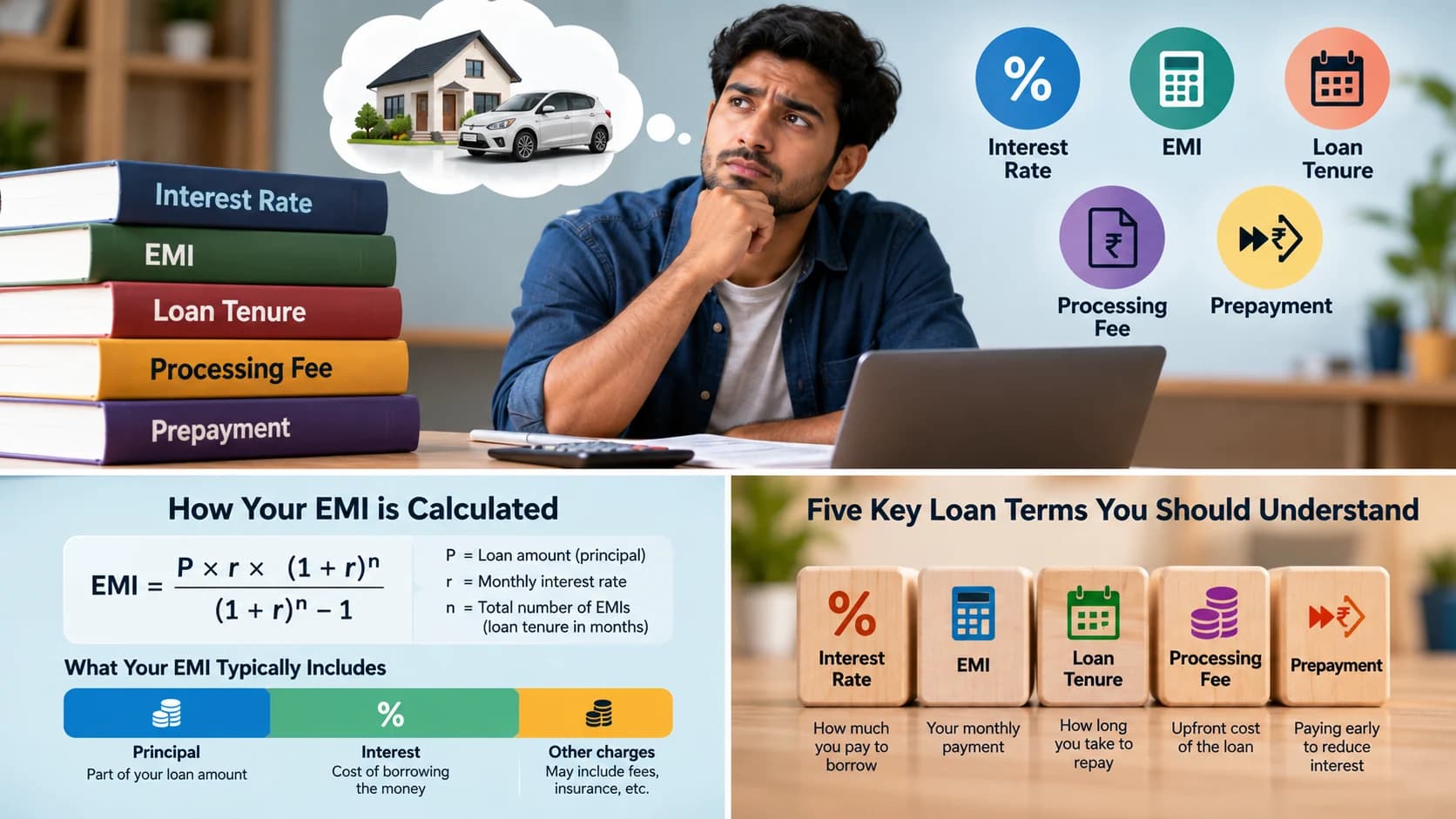
Before taking a personal, home, vehicle or other term loan, you should understand five terms particularly well:
principal, APR, EMI, tenure, and fixed versus floating interest rate.
Once these make sense, most loan offers become much easier to compare.
1. Principal: the amount you actually owe
The principal is the amount of money borrowed before interest is added.
If a bank lends you ₹10 lakh, your starting principal is ₹10 lakh.
That sounds obvious, but there is another number that matters after the loan begins: outstanding principal.
This is the portion of the original loan that you still have to repay.
Suppose you have paid ₹2 lakh through EMIs. It does not necessarily mean your outstanding principal has fallen from ₹10 lakh to ₹8 lakh. Part of those EMI payments went toward interest.
That distinction is important because, in a normal reducing-balance loan, interest is calculated on the outstanding loan balance rather than simply treating every EMI as an equal reduction in principal.
Why outstanding principal matters
It determines how much debt remains.
It also helps you understand:
- how much interest future instalments will generate;
- what happens if you make a part-prepayment;
- approximately how much you need to close the loan early; and
- why the balance may fall slowly in the first few years of a long loan.
Think of principal as the actual debt and interest as the price you pay for using that debt over time.
This leads to the next term, which is where many loan comparisons go wrong.
2. Interest rate and APR: they are not the same thing
Imagine two lenders both advertise a personal loan at 10% interest.
Loan A has a small processing fee.
Loan B has a large processing fee and additional charges associated with obtaining the loan.
If you compare only the 10% headline rate, the two loans look identical.
They may not be.
What is the interest rate?
The interest rate tells you the rate at which interest is charged on the loan according to its terms.
It is one of the biggest components of your borrowing cost, but it may not represent everything you pay to obtain the credit.
What is APR?
APR stands for Annual Percentage Rate.
RBI defines APR for the Key Facts Statement framework as the annual cost of credit to the borrower, including the interest rate and other charges associated with the credit facility.
For covered loans, the lender's Key Facts Statement must include an APR calculation and an amortisation schedule. Charges levied by the regulated lender are included in the APR, and third-party charges recovered by the lender on an actual basis, such as certain insurance or legal charges, are also included and disclosed separately.
This makes APR especially useful when comparing loan offers with different fee structures.
A loan advertising a slightly lower interest rate can still have a higher overall cost if its associated charges are large enough.
A simple example
Suppose two lenders offer you ₹5 lakh for the same tenure:
| Loan A | Loan B | |
|---|---|---|
| Headline interest rate | 10.0% | 9.8% |
| Processing/associated charges | Lower | Higher |
| APR | 10.4% | 10.7% |
The numbers are illustrative, not actual lender offers.
Loan B has the lower advertised interest rate but the higher annualised cost in this example.
That is why, when comparable APR figures are available, asking "What is the APR?" can be more useful than asking only "What is the interest rate?"
APR does not mean you can ignore the loan agreement. Contingent charges triggered by future behaviour, such as certain penalties for non-compliance, need to be understood separately.
3. EMI: not just a monthly bill
EMI stands for Equated Monthly Instalment.
It is the regular monthly amount paid toward a typical amortising loan.
An EMI contains two components:
principal repayment + interest
But these components do not usually stay equal throughout the loan.
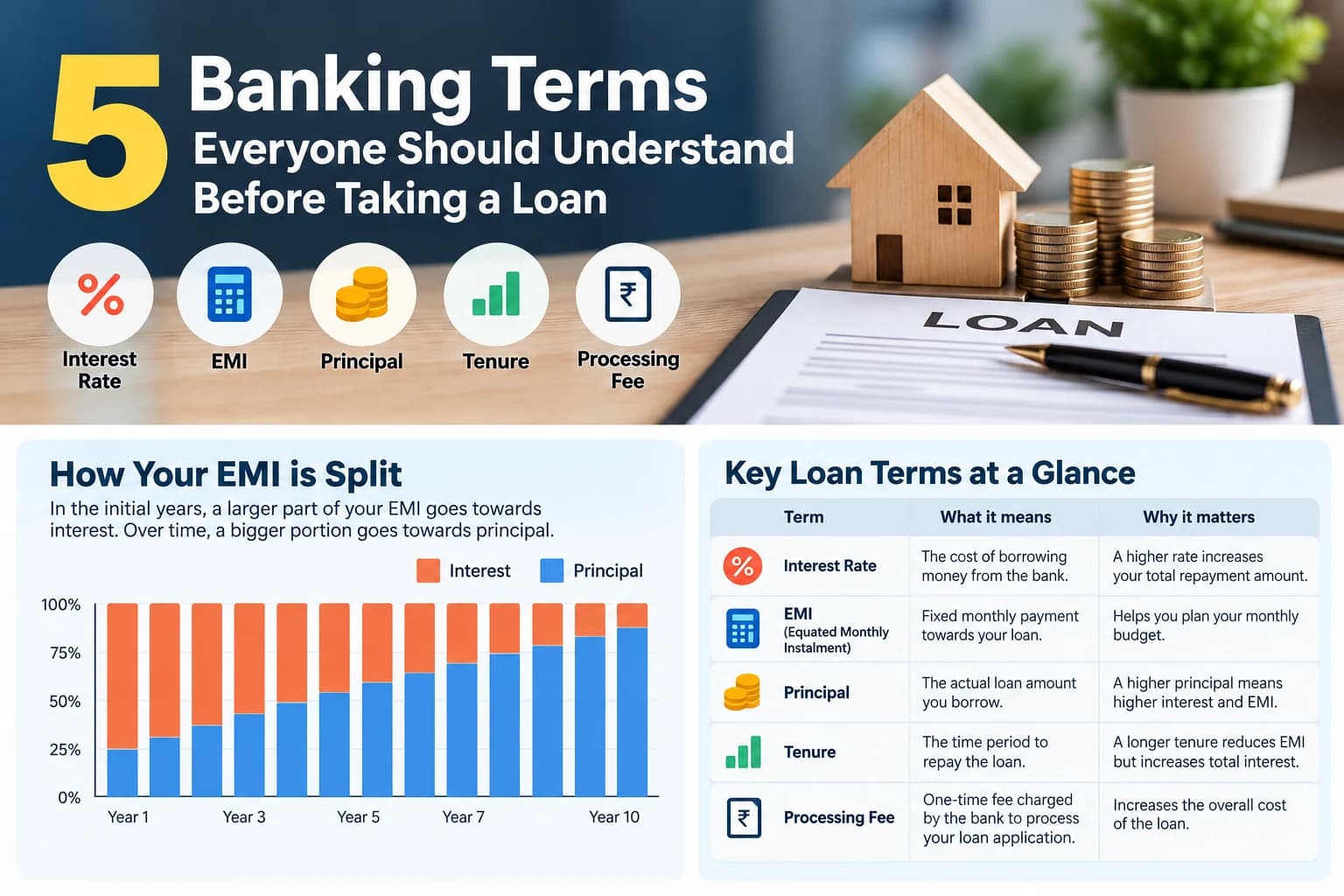
At the beginning of a conventional reducing-balance loan, the outstanding principal is at its highest. The interest component is therefore relatively large.
As the principal falls, the interest portion generally becomes smaller and more of each EMI goes toward principal.
This gradual repayment process is called amortisation.
Why the EMI can be misleading on its own
A lender might say:
Your EMI is only ₹12,668.
That may sound more affordable than an EMI of ₹20,758.
But without knowing the loan tenure and interest rate, the comparison tells you very little.
A small EMI can simply mean the repayment has been stretched over many more years.
So never compare loans by EMI alone.
Compare at least:
- loan amount;
- rate and APR;
- EMI;
- tenure; and
- total amount payable.
Read the amortisation schedule
RBI's KFS framework requires an amortisation schedule for covered loans.
That schedule shows how the loan balance changes over time and how instalments are allocated between principal and interest.
It can answer questions that the EMI number cannot:
How much principal will still be outstanding after two years?
How much total interest will I pay?
What difference would an early prepayment make?
For a long-duration loan, those are important questions.
4. Tenure: a lower EMI can cost you more
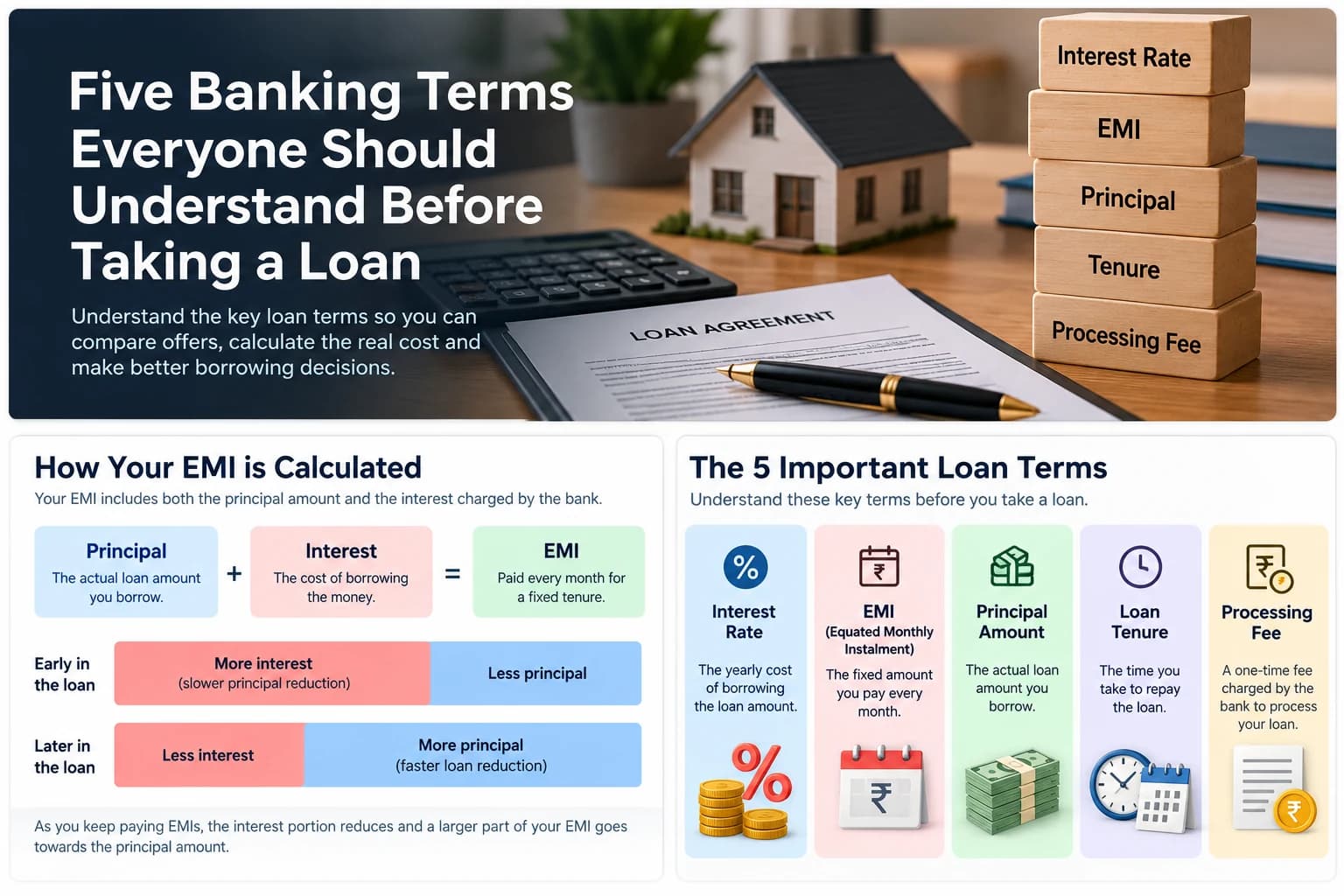
The tenure is the period over which you agree to repay the loan.
For example, the same loan might be available for five, seven or ten years.
A longer tenure generally reduces the monthly EMI because repayment is spread across more instalments.
That sounds helpful. It often is, especially when monthly affordability matters.
But there is a trade-off.
Longer tenure usually means more total interest.
Consider a purely illustrative ₹10 lakh loan at 9% annual interest, assuming the rate stays unchanged and the loan is repaid through monthly reducing-balance EMIs:
| Tenure | Approx. EMI | Approx. total interest |
|---|---|---|
| 5 years | ₹20,758 | ₹2.46 lakh |
| 7 years | ₹16,089 | ₹3.51 lakh |
| 10 years | ₹12,668 | ₹5.20 lakh |
The ten-year EMI is about ₹8,000 lower than the five-year EMI.
But the borrower pays roughly ₹2.74 lakh more in total interest over the longer repayment period.
This is one of the most important lessons in borrowing:
The cheapest EMI is not necessarily the cheapest loan.
So should you always choose the shortest tenure?
Not necessarily.
A very short tenure can create an EMI so high that your monthly finances become fragile.
The goal is not to minimise interest at any cost. It is to choose a repayment period that balances:
- manageable monthly cash flow;
- total interest cost;
- emergency savings;
- other financial obligations; and
- the possibility of making prepayments later.
The right tenure is one you can realistically sustain without unnecessarily stretching the loan.
5. Fixed versus floating interest rate: who carries the rate risk?
A loan's interest rate may be fixed or floating.
This distinction matters most on longer loans because interest rates can change significantly over time.
Fixed-rate loan
In regulatory terminology, a fixed-rate loan is one where the interest rate remains fixed for the agreed duration covered by the fixed-rate terms.
The main advantage is predictability.
If your rate is genuinely fixed for the entire tenure, market-rate changes do not alter that rate during the loan.
That makes budgeting easier.
But fixed-rate loans can be priced differently from floating-rate loans, and their switching or prepayment conditions may also differ. Always read the actual agreement rather than assuming that a product labelled "fixed" works the same way at every lender.
Floating-rate loan
A floating rate can change during the loan.
For many bank loans, the rate is structured around a benchmark plus a spread.
A simplified example might look like:
Benchmark: 6.5%
Spread: 2.5%
Loan rate: 9.0%
If the applicable benchmark later changes and the loan resets according to the contract, the rate charged to the borrower can change as well.
The important question is therefore not only:
What is my rate today?
It is also:
What is the benchmark, what is the spread, how often can the rate reset, and what happens to my EMI or tenure when it does?
What happens when a floating rate rises?
Suppose you have a home loan with an EMI of ₹30,000 and interest rates rise.
The lender might need to:
- increase the EMI;
- extend the tenure;
- use some combination of the two; or
- provide other options permitted under the applicable framework.
RBI's framework for EMI-based floating-rate personal loans requires regulated lenders to communicate the impact of rate resets and provide specified choices, including changes to EMI/tenure, switching to fixed rates under the lender's policy, and part or full prepayment subject to applicable rules.
This is why a floating-rate loan should not be evaluated only on its starting EMI.
You need to know what happens if the rate moves.
How the five terms connect
These concepts are easier to understand together than separately.
Imagine you borrow ₹10 lakh.
Principal tells you how much debt starts out.
Interest rate determines a major part of the price charged on that debt.
APR helps show the annualised overall cost after relevant associated charges.
EMI tells you what the regular monthly repayment looks like.
Tenure determines how long those repayments continue and strongly affects total interest.
Fixed or floating rate tells you whether the interest rate is predictable or can reset during the loan.
Change one variable and the others can move.
Increase the tenure, and the EMI usually falls.
Increase the interest rate, and the EMI or tenure may rise.
Make a large prepayment, and outstanding principal falls, reducing the base on which future interest is calculated.
That is why a loan should be understood as a system of connected numbers rather than one attractive interest rate printed in an advertisement.
Three more things to check before signing
These are not part of the five core terms, but they can materially affect your experience.
Processing and other charges
A processing fee can make two apparently similar loans cost different amounts.
For covered loans, relevant charges form part of the KFS and APR framework. Do not assume that a low interest rate means low total borrowing cost.
Also check whether taxes or third-party expenses apply.
Penal charges
If you fail to comply with material loan terms, the lender may levy disclosed penal charges.
RBI's fair-lending framework says such penalties should be treated as penal charges, rather than being added to the interest rate as "penal interest", and those penal charges should not themselves be capitalised to generate further interest.
The amount and reason should be disclosed.
Prepayment or foreclosure
Part-prepayment means repaying some principal ahead of schedule.
Foreclosure means closing the loan before its scheduled end by paying the required outstanding amount.
Prepayment can reduce future interest substantially, particularly when done earlier in a long loan.
Whether a charge can apply depends on factors such as the lender, loan purpose, rate structure and current RBI rules. Do not assume every loan has either a penalty or a penalty-free exit.
Check the applicable prepayment terms before signing.
The document you should actually read: the Key Facts Statement
Loan agreements can be long. The document designed to make the crucial numbers easier to understand is the Key Facts Statement, or KFS.
RBI introduced a standardised KFS framework for retail and MSME loans by regulated entities so prospective borrowers can see important information before entering the loan contract.
Depending on the loan, the KFS includes key information such as:
- loan amount;
- tenure;
- repayment instalments;
- interest information;
- APR;
- charges;
- an amortisation schedule; and
- other important contractual facts.
RBI also requires the KFS to be provided in a language understood by the borrower, and the borrower must have a specified validity period in which to consider the terms.
For applicable loans, fees or charges that are not mentioned in the KFS cannot simply be imposed later by the regulated lender without the borrower's explicit consent.
That makes the KFS one of the most useful documents to compare before accepting a loan.
The best loan is not automatically the one with the lowest EMI
A loan advertisement is designed to make borrowing look simple.
Your decision should go one level deeper.
Before signing, ask:
How much am I actually borrowing?
What is the interest rate, and what is the APR?
How much of each EMI goes toward principal and interest?
How long will I be paying?
Is the rate fixed or floating, and what happens if it changes?
Then look at the KFS and calculate the total rupees you are likely to pay, not just the EMI you see each month.
Once you understand those five terms, you stop seeing a loan as "₹20,000 per month" and start seeing what it really is: a multi-year financial contract with a principal amount, a price, a repayment structure and a set of risks that you should understand before accepting them.