What Happens If You Stop Paying a Loan? From Missed EMI to NPA and Recovery
Understand what happens after a missed EMI in India, from overdue status and credit-report impact to SMA, NPA, recovery and secured-asset enforcement.
Missing one EMI does not instantly turn a loan into an NPA, and a bank cannot normally seize your house or car the next morning.
But a missed payment does start a process.
The account becomes overdue. The lender may add permitted charges and begin reminders. The delay can be reported to credit bureaus. If the overdue continues, the account moves through increasingly serious stress categories. For an ordinary term loan, once the overdue crosses the regulatory threshold, the account can become a non-performing asset (NPA). After that, recovery efforts may intensify.
What happens next depends heavily on the type of loan, the security behind it, the borrower’s response and the lender’s recovery policy.
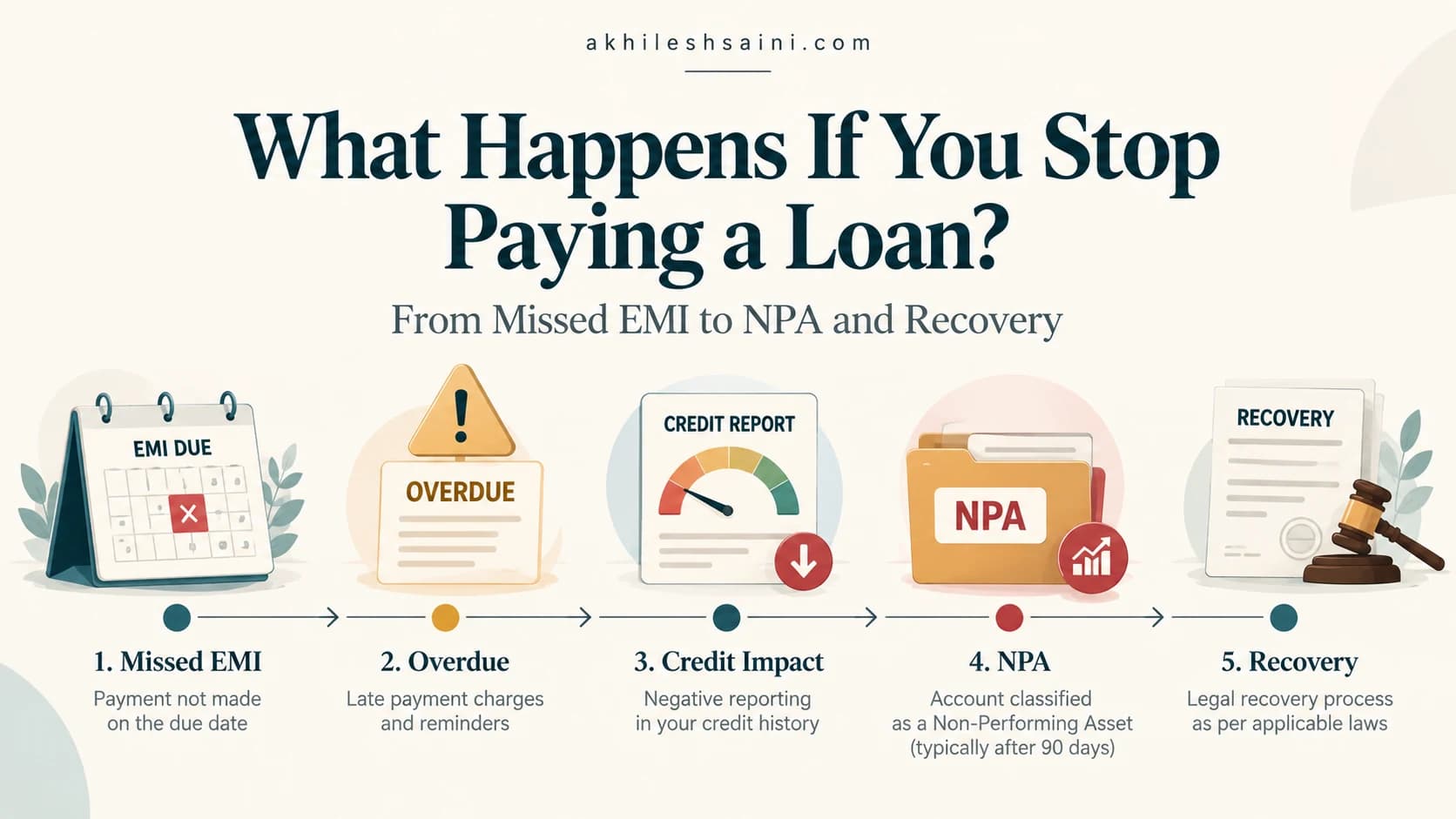
Here is the journey from one missed EMI to possible recovery.
The first thing that happens: your EMI becomes overdue
Suppose your EMI is due on the 5th of every month and there is not enough money in your account.
If the payment is not made on the due date, the amount becomes overdue.
That does not mean the entire loan has immediately failed. It means you have not met a scheduled payment obligation.
The lender may send an SMS, email, app notification or phone reminder. If an automatic debit failed, there may also be charges connected with the failed payment or non-compliance with the loan terms, depending on the agreement.
RBI rules require regulated lenders to disclose applicable penal charges and communicate the reason when such charges are levied. These charges are not supposed to be disguised as an additional rate of “penal interest” added to the normal loan interest.
Normal contractual interest, however, can continue according to the loan terms.
A missed EMI can start affecting your credit history
Loan repayment information is shared with credit information companies such as TransUnion CIBIL, Experian, Equifax and CRIF High Mark.
Since January 2025, RBI requires covered credit institutions to update credit information on a fortnightly basis, as of the 15th and the last day of the month, or even more frequently if agreed with the credit bureau.
That means overdue information can enter your credit report relatively quickly.
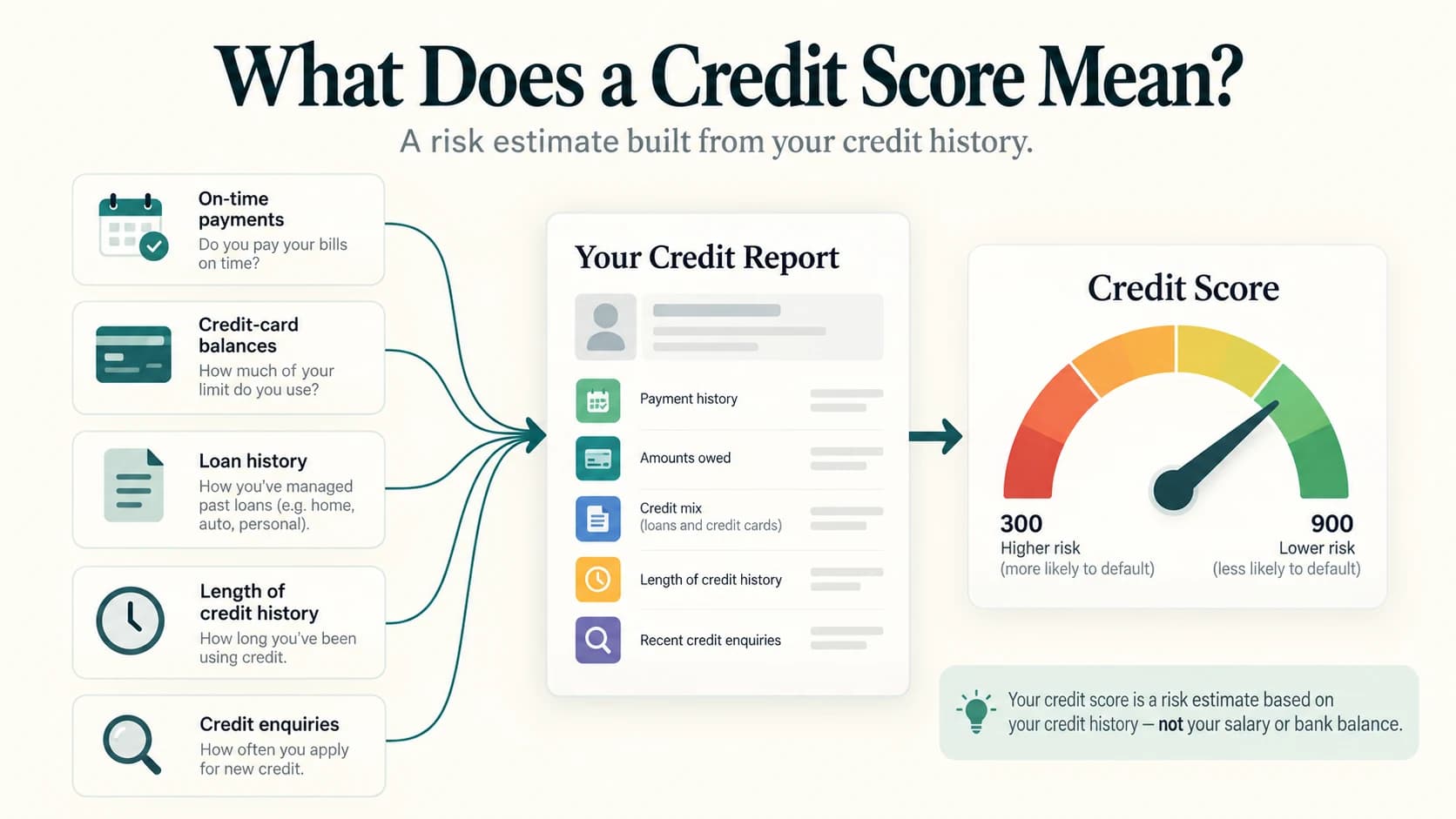
Credit reports commonly record how many days a payment has remained past due. A late payment can therefore affect how future lenders view your repayment behaviour.
There is no reliable rule such as “one missed EMI reduces your score by exactly 50 points.” Credit-scoring models are proprietary, and the effect depends on the borrower’s overall credit profile.
The safest assumption is simpler: the longer and more serious the delinquency, the more damaging it can become.
From overdue to SMA: the bank starts formally tracking stress
RBI requires banks to identify stress in loan accounts before they become NPAs.
For loans other than revolving facilities, the categories are:
| Status | How long the payment is overdue |
|---|---|
| SMA-0 | Up to 30 days |
| SMA-1 | More than 30 days and up to 60 days |
| SMA-2 | More than 60 days and up to 90 days |
| NPA | More than 90 days for an ordinary term loan |
SMA means Special Mention Account.
These categories are primarily regulatory and monitoring classifications. They allow lenders to identify deteriorating accounts before the 90-day NPA threshold is crossed.
For retail term loans, the progression can be thought of like this:
Missed EMI → overdue → SMA-0 → SMA-1 → SMA-2 → NPA
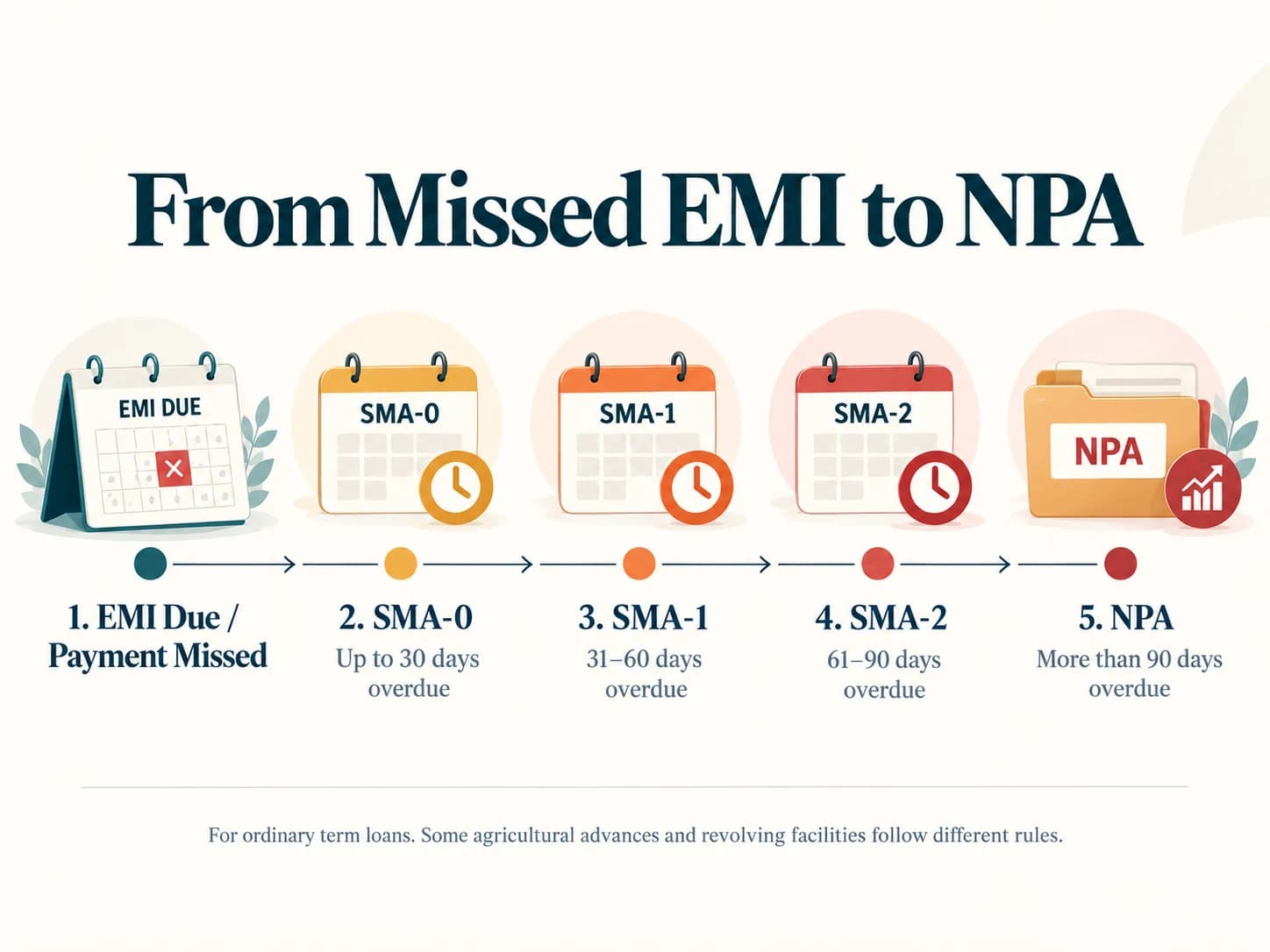
The classification is based on the actual overdue position and is carried out through the lender’s day-end process.
There are exceptions. Certain agricultural advances use crop-season-based rules rather than the standard 90-day term-loan test, and revolving facilities such as cash credit or overdraft follow “out of order” rules.
For a normal home, vehicle or personal term loan, however, the 90-day concept is the important one to understand.
What exactly does NPA mean?
NPA stands for Non-Performing Asset.
The name sounds as though the borrower has been declared permanently unable to pay. That is not what it means.
From the bank’s perspective, a loan is an asset because it is expected to generate interest and principal repayments. Once scheduled payments remain overdue beyond the regulatory limit, the asset is treated as non-performing.
For an ordinary term loan, RBI’s prudential rules classify the loan as an NPA when interest or an instalment of principal remains overdue for more than 90 days.
NPA classification has accounting and regulatory consequences for the lender. It must recognise the deterioration in the asset and make provisions according to applicable rules.
For the borrower, it usually means the situation has become substantially more serious.
Collection activity can intensify, future borrowing becomes more difficult, and the lender may begin formal recovery steps.
Can an NPA become normal again?
Yes.
An account does not necessarily remain an NPA forever simply because it crossed the threshold once.
Under RBI rules for banks, an NPA can generally be upgraded to a standard asset when the borrower pays the entire arrears of interest and principal required for upgradation.
If a borrower has multiple credit facilities with the same bank, the rules can require arrears across those facilities to be cleared before the accounts are upgraded.
This is why paying one recent EMI may not be enough once a loan has become an NPA. The borrower may need to clear the accumulated overdue amount.
What does the bank do before legal recovery?
There is no single script followed by every lender.
Early in the process, the bank will usually try to restore regular repayment. That may involve reminders, collection calls, branch contact or discussion with the borrower.
If the borrower is facing a genuine temporary financial problem, contacting the lender early is usually far better than ignoring communications.
Depending on the circumstances and lender policy, possible outcomes may include:
- clearing the overdue amount and returning to the normal schedule;
- changing the payment arrangement or restructuring the debt where permitted;
- refinancing or extending the repayment period in an eligible case;
- a negotiated compromise settlement in a stressed account; or
- escalation to recovery proceedings.
None of these is an automatic right. The lender has to agree to any change in the contractual repayment terms.
Restructuring and settlement are not the same thing
These terms are often used as though they mean the same thing.
They do not.
Restructuring
A restructuring changes the original terms of the loan because the borrower is experiencing financial difficulty.
Depending on the approved arrangement, that could involve changes to the repayment schedule, instalment amount, tenure or other terms.
The aim is generally to create a repayment structure that the borrower can realistically service.
Compromise settlement
A compromise settlement is a negotiated arrangement in which the lender agrees to settle its claim for an agreed cash amount. The lender may waive part of what it would otherwise claim.
Settlement can have consequences for the borrower’s credit record and future borrowing ability, so it should not be treated as an easy alternative to normal repayment.
The exact reporting will depend on the circumstances and applicable credit-reporting rules.
A “write-off” does not necessarily mean the debt has disappeared
This is another major misconception.
A bank may technically write off a bad loan in its accounts for accounting purposes.
RBI explicitly distinguishes this from forgiving the borrower’s debt.
A technical write-off does not, by itself, waive the lender’s claim against the borrower. Recovery can continue even after the amount has been written off in the lender’s books.
So if someone says, “The bank wrote off the loan, so I no longer have to pay it,” that conclusion may be completely wrong.
Write-off is an accounting action. Waiver or settlement is a legal/contractual outcome.
Those are different things.
What happens during recovery depends on whether the loan is secured
This is one of the most important distinctions.
Unsecured loans
A personal loan or some consumer loans may be unsecured, meaning there is no specific house, vehicle or other asset pledged against that particular loan.
If the borrower defaults, the lender cannot simply point to an unrelated asset and take it as though it had been pledged.
It can still pursue recovery through the rights available under the loan contract and applicable law. That can include collection efforts, legal proceedings and other lawful recovery mechanisms.
The absence of collateral does not mean the debt is unenforceable.
Secured loans
A home loan, vehicle loan or other secured borrowing is backed by an identified asset or security interest.
If serious default continues, the lender may eventually enforce that security according to the contract and law.
But the process is not simply:
Miss EMI today → bank takes property tomorrow.
There are notices and legal procedures.
How recovery of secured assets can work under SARFAESI
For eligible secured loans, banks and other secured creditors may use the Securitisation and Reconstruction of Financial Assets and Enforcement of Security Interest Act, 2002, usually called the SARFAESI Act.
Where the Act applies, Section 13 provides a structured enforcement process.
Broadly, after default and NPA classification, a secured creditor may issue a written demand notice requiring the borrower to discharge the liability within 60 days.
If the borrower does not comply, the creditor may then take measures permitted by the Act, which can include taking possession of the secured asset and proceeding toward its sale, subject to the applicable rules and borrower remedies.
That 60-day notice is not the same thing as the 90-day NPA period.
They are separate stages:
Overdue period → NPA classification → SARFAESI demand notice, where applicable → further enforcement if dues remain unpaid
This distinction is often lost in simplified explanations.
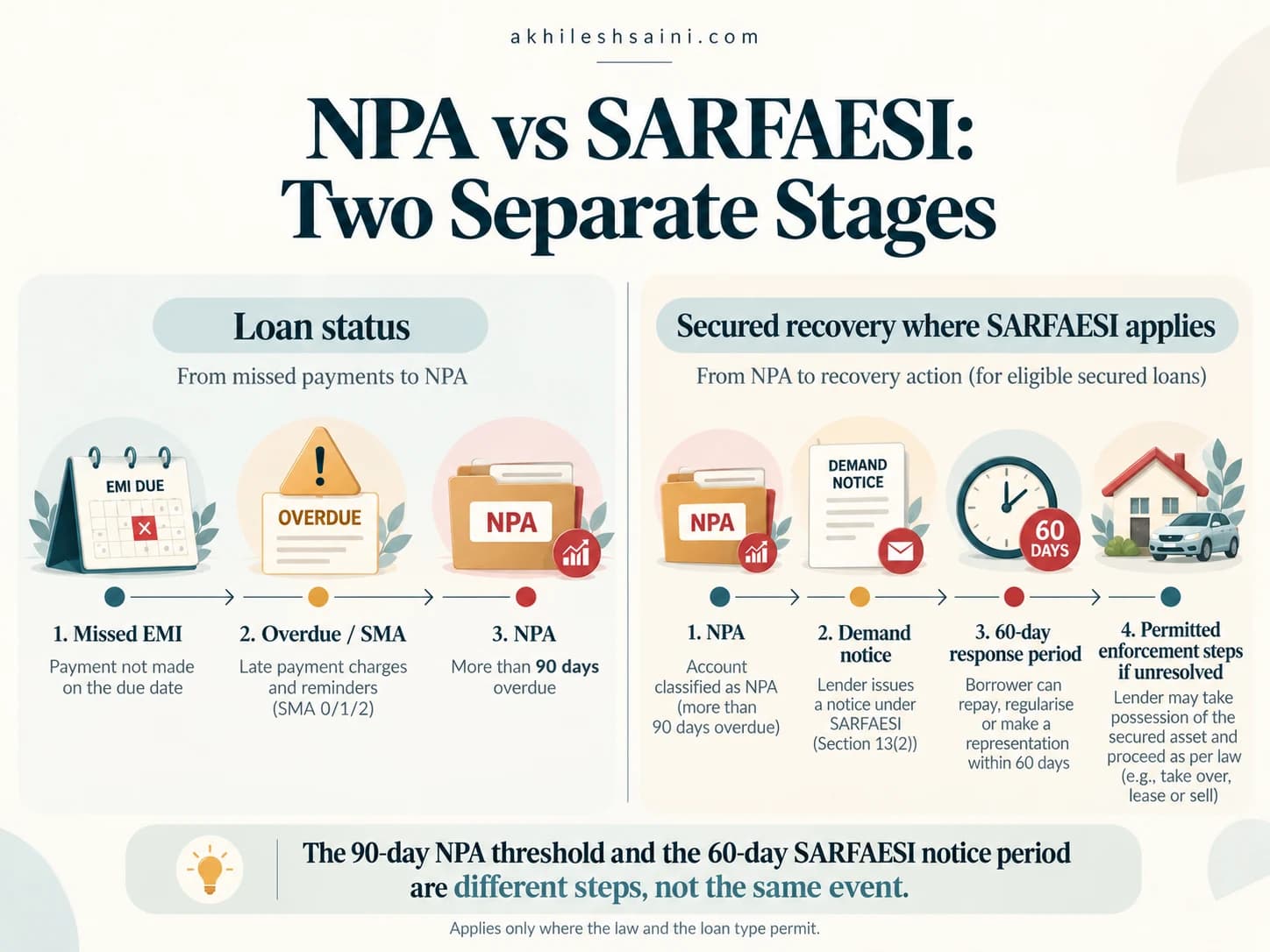
SARFAESI also does not apply identically to every debt or every form of security. Specific exclusions, thresholds and procedural requirements exist, so individual cases depend on the loan and the law applicable to it.
What about a vehicle loan?
A vehicle loan is usually secured by the financed vehicle.
If the borrower persistently defaults, repossession may become possible according to the loan agreement and applicable law.
But lenders and their agents must follow fair-practice requirements. Recovery does not give them unlimited authority to threaten, intimidate or publicly humiliate a borrower.
The lender remains responsible for the conduct of recovery agents it appoints.
What recovery agents are not allowed to do
RBI has specifically told regulated entities and their recovery agents not to use intimidation or harassment in debt collection.
Prohibited conduct includes threatening or anonymous calls, public humiliation, intrusion into the privacy of family members and friends, inappropriate social-media messages and false or misleading representations.
RBI also states that recovery calls should not be made before 8:00 a.m. or after 7:00 p.m.
A borrower owes the debt, but that does not remove the borrower’s right to lawful and fair treatment.
If a bank or its agent violates these standards, the borrower can complain through the lender’s grievance-redress mechanism. For eligible complaints involving deficiency in service, the RBI Integrated Ombudsman framework may become available after the regulated entity has had the opportunity to resolve the complaint.
Does missing a loan payment make you a wilful defaulter?
No. Not automatically.
“Wilful defaulter” is a specific regulatory classification, not a casual synonym for anyone who has missed an EMI.
RBI has separate directions governing when wilful default can be identified and how that determination must be made.
A borrower who loses a job, suffers a business failure or experiences genuine financial distress is not automatically a wilful defaulter simply because repayments have stopped.
Likewise, an NPA and a wilful-default classification are not the same thing.
Can the bank send you to jail for not paying a loan?
Ordinary inability to repay a loan is fundamentally a debt-recovery matter, not something that automatically results in imprisonment simply because an EMI was missed.
That does not mean every situation is purely civil.
Separate legal issues can arise if there is fraud, forged documentation, dishonest conduct, cheque-related offences or another independent criminal allegation.
But loan default itself should not be confused with fraud.
The lender’s normal objective is recovery of the money owed.
What happens to a guarantor or co-borrower?
If another person is a co-borrower or has guaranteed the loan, default can affect them too.
Their obligations depend on the loan and guarantee documents and applicable law. A lender may pursue contractual remedies against a co-borrower or guarantor where those obligations are enforceable.
This is why signing as a guarantor is not merely giving someone a reference. It can create a real financial liability.
What should you do if you know you cannot pay?
Ignoring the lender is usually the worst strategy.
If the problem is temporary, contact the lender before the overdue grows. Explain the situation accurately and ask what options are available under its policy.
You should also:
- check how much principal, interest and overdue amount is actually outstanding;
- read the loan agreement and repayment schedule;
- ask for charges and proposed arrangements in writing;
- avoid making promises you cannot realistically keep;
- check your credit report for accurate reporting;
- keep records of payments and communications; and
- use the lender’s grievance process if collection conduct becomes improper.
If the debt has become large, secured-property enforcement has started, or legal notices have been issued, obtaining advice from an appropriate legal or financial professional can be worthwhile.
The whole journey in one view
For a typical term loan, the broad progression is:
EMI due → payment missed → overdue → reminders and possible charges → credit reporting → SMA-0 → SMA-1 → SMA-2 → NPA after more than 90 days → intensified recovery → restructuring/settlement where agreed or legal recovery → secured-asset enforcement where legally available
Not every account travels all the way through that chain.
Many borrowers cure the overdue early. Some agree on revised terms. Others enter settlement or formal recovery.
The most important point is that default is a process, not a single event.
The first missed EMI is a warning. As the overdue period grows, the financial, credit and legal consequences become progressively harder to reverse.
Acting early gives both the borrower and the lender more options than waiting until the loan has already become a serious recovery case.