Bank Account Nominee vs Legal Heir: Who Gets the Money After the Account Holder Dies?
Understand bank account nominee and legal heir rights in India, the four-nominee rules, deceased deposit claims, required documents and RBI's 15-day settlement deadline.

A father leaves ₹12 lakh in his bank account and names his son as the nominee. After his death, the bank releases the money to the son. His daughter then asks for her share. The son argues that the nomination makes the entire ₹12 lakh his.
Is he right? Not simply because he is the nominee.
In India, a bank nomination identifies who can receive the deposit from the bank after the depositor's death. It does not, by itself, determine who ultimately inherits that money. Inheritance depends on a valid Will, where applicable, or the succession law governing the deceased person's estate.
The distinction has become especially relevant since India introduced multiple bank nominees in November 2025 and standardised the deceased-customer claim process. Families can now plan for easier access to deposits, but they still need to consider the separate question of legal ownership.
Nominee and legal heir: what is the difference?
A nominee is someone whose name the depositor registers with the bank for the purpose of receiving the deposit after death. The nomination helps the institution identify the appropriate recipient without having to resolve the entire family's inheritance arrangements.
A legal heir is a person who inherits under the applicable law of succession. A beneficiary under a valid Will may also be entitled to property even if that person would not otherwise inherit under intestate succession (succession without a Will).
The same person can be a nominee and an heir. However, the two roles are not interchangeable.
| Question | Bank nominee | Legal heir or beneficiary |
|---|---|---|
| How is the person identified? | Nomination registered with the bank | Applicable succession law or valid Will |
| What is the primary role? | Receive the deposit through the bank's claim process | Inherit the property to which they are legally entitled |
| Can the person use the account during the owner's life? | Not merely because of nomination | Not merely because of expected inheritance |
| Does the designation alone confer ownership of the whole deposit? | No | No; entitlement depends on the relevant succession rules and facts |
| Can the person be unrelated to the depositor? | Yes | A Will may benefit an unrelated person, subject to applicable law |
A nomination is therefore different from adding a joint account holder, appointing an authorised signatory or granting a power of attorney. Nomination alone provides no authority to operate a living depositor's account.
What the law says about ownership of bank deposits
Section 45ZA of the Banking Regulation Act, 1949 governs nomination for bank deposits. It creates a statutory mechanism for paying the nominee when the sole account holder, or all joint depositors, have died.
In Ram Chander Talwar v. Devender Kumar Talwar, decided on 6 October 2010 (2010) 10 SCC 671, the Supreme Court considered precisely this distinction. One brother claimed the full balance of his deceased mother's account because she had nominated him. The Court rejected that interpretation: the nominee's statutory entitlement concerns receipt of the deposit from the bank, while the money remains subject to the rules governing inheritance of the deceased's estate.
The RBI's current banking directions reinforce this distinction. A bank settling a valid nomination or survivorship claim must clarify in writing that the recipient holds the payment in a representative capacity for the heirs; the payment does not extinguish other persons' legitimate claims against the recipient.
There are consequently two separate stages:
- Bank settlement: The bank verifies the claim and pays the eligible recipient. A properly completed payment can discharge the bank's liability.
- Estate distribution: The recipient accounts for the amount and distributes or retains it according to lawful inheritance entitlements, subject to the administration of the estate.
The bank is not ordinarily responsible for dividing the money among all heirs when a valid nomination can be acted upon. Nor does its payment decide which family member ultimately owns the money. Where a nominee has an inheritance entitlement of their own, they may retain that lawful share.
A worked example: one nominee, four heirs
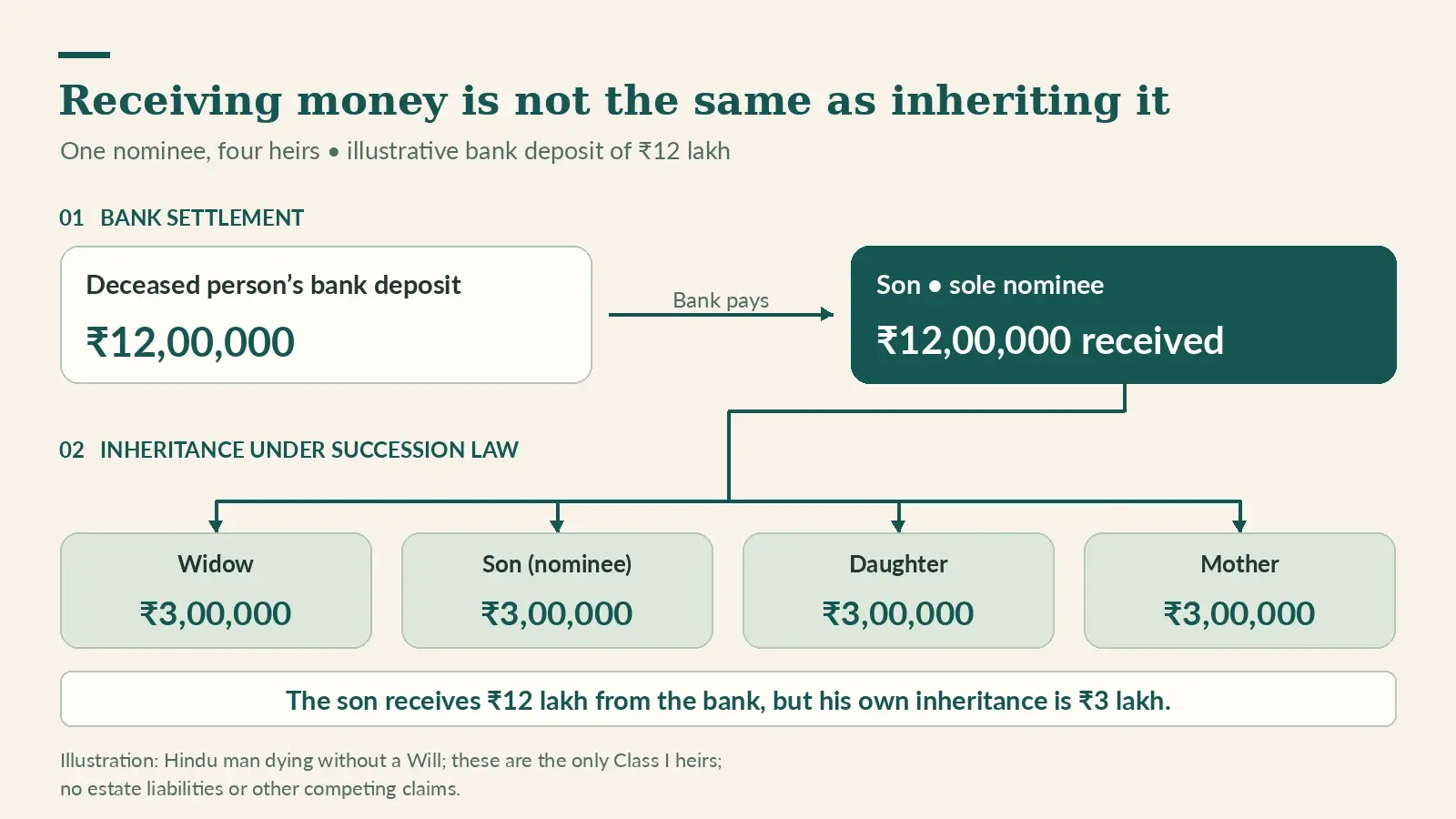
Suppose Rajesh, a Hindu man governed by the Hindu Succession Act, 1956, dies without a Will. He leaves ₹12 lakh of his own money in a sole bank account. His adult son is the only registered nominee.
Assume Rajesh is survived by his widow, one son, one daughter and his mother. Assume these are his only Class I heirs, there are no relevant debts, estate expenses, other competing entitlements or court restrictions, and the entire balance is available for distribution.
Under Sections 8–10 of the Hindu Succession Act, the four heirs in this example each receive an equal share.
| Recipient | Illustrative inheritance share |
|---|---|
| Widow | ₹3,00,000 |
| Son (registered nominee) | ₹3,00,000 |
| Daughter | ₹3,00,000 |
| Mother | ₹3,00,000 |
| Total | ₹12,00,000 |
The bank may release the entire ₹12 lakh to the son following the prescribed claim process. But on these assumptions, his own inheritance is only ₹3 lakh. The remaining ₹9 lakh belongs to the other three heirs.
This is not a universal four-way formula. The result can change with a Will, the family structure, applicable personal law, the nature of the property, estate liabilities or other circumstances. For example, intestate succession to a Hindu woman's property is governed by different provisions from those applying to a Hindu man. Other communities may be subject to different rules. Do not use a simplified example to calculate a disputed real-life inheritance.
Can a Will override a bank nomination?
A valid Will may determine the beneficial entitlement to money even if the bank's nomination names someone else. But a Will does not automatically amend the nomination recorded by the bank.
Suppose an account holder names a friend as nominee but later executes a valid Will leaving the deposit to a daughter. Assuming the disposition is legally effective, the friend does not become the beneficial owner merely because the bank pays the friend. The daughter can assert her entitlement under the Will. The appropriate bank settlement route will depend on the recorded nomination, the documentation and any binding court orders.
The opposite is also possible: a depositor can leave money to a nominee through a valid Will. In that case, the person may have both the right to collect the deposit and the right to inherit it. Their inheritance comes from the legally effective disposition, not from the nomination alone.
A Will may be challenged on grounds such as invalid execution, lack of capacity or undue influence. Restrictions on testamentary freedom may also apply under the relevant law. In a contested case, a succession lawyer can help determine the proper remedy.
The practical lesson is to keep the bank nomination and estate plan aligned rather than expecting a bank employee to reconcile inconsistent instructions after death.
New bank nomination rules: up to four nominees
The Banking Laws (Amendment) Act, 2025 and the Banking Companies (Nomination) Rules, 2025 introduced a revised nomination framework effective 1 November 2025. Bank depositors can nominate as many as four individuals using either a simultaneous or a successive arrangement.
Simultaneous nomination: divide the bank payout
The depositor specifies a percentage for each nominee, covering 100% of the deposit. Imagine a ₹10 lakh balance with the following nomination:
| Nominee | Payout percentage | Amount received from bank |
|---|---|---|
| Spouse | 50% | ₹5,00,000 |
| Daughter | 30% | ₹3,00,000 |
| Son | 20% | ₹2,00,000 |
| Total | 100% | ₹10,00,000 |
Assuming the nominees are alive and eligible when paid, this arrangement determines the distribution by the bank. It does not replace the succession law or establish that these are necessarily the final inheritance percentages.
The amended Act also provides that if a simultaneous nominee dies before receiving the money, that person's nomination ceases to apply to their portion. That portion is handled as an unnominated deposit; it is not automatically divided among the other nominees.
Successive nomination: arrange alternative recipients
Instead of allocating percentages, the account holder ranks nominees. Only one nomination is operative at a time. For example, a spouse may be first, a daughter second and a son third. A lower-ranked nominee becomes operative on the death of the higher-ranked nominee or nominees, according to the statutory priority rules.
This is useful when the main aim is to provide a backup recipient, rather than to divide the bank payout. A higher-ranked nominee's unwillingness to claim is not itself the statutory trigger that advances a lower-ranked nominee.
The two methods are alternatives for a deposit nomination, not a combined allocation system. Bank lockers and articles in safe custody permit successive nomination, rather than simultaneous percentage allocation.
Existing depositors should ask their bank how to register or update nominations using the revised forms. Do not assume that an old single nomination has automatically been converted into a four-person arrangement. Obtain confirmation of the recorded details.
How does a nominee claim money after death?
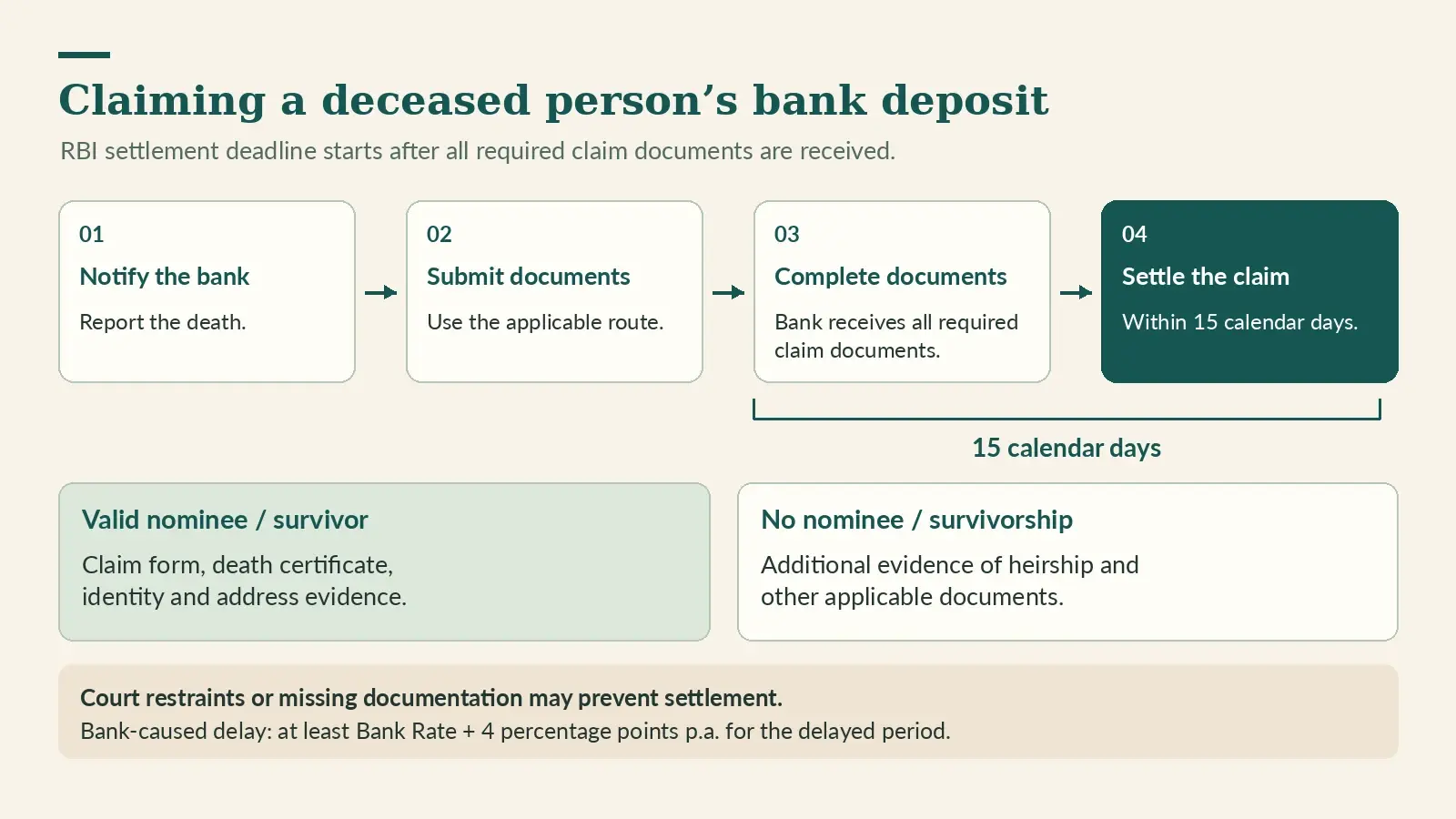
The RBI's September 2025 deceased-customer directions required implementation by 31 March 2026. The framework is now reflected in the category-specific Responsible Business Conduct directions. For an ordinary deposit account with a valid nomination, the usual claim documents are:
- Completed claim form signed by the nominee or eligible survivor.
- Death certificate of the depositor.
- An officially valid identity and address document for the claimant.
Where these requirements and the applicable conditions are met, the bank should not treat a succession certificate as a routine prerequisite merely because the balance is large. The nominee route is not subject to the simplified no-nomination monetary threshold discussed below.
Notify the bank through its official channels. Request its deceased-claim form and a written acknowledgment. Provide accurate account details, respond to requests for missing documentation, and retain a record of the claim and settlement. Commercial banks must accept lodgement at any branch; online submission may also be available.
If a competent court has restrained payment or receipt, the bank must respect the order. A nomination cannot be used to evade a court's restriction. If a minor is nominated, ask the bank which authorised adult can receive payment on the minor's behalf; receipt for the child does not make the adult the owner.
What happens if the account has no nominee?
The money does not become the bank's property because a nomination is missing. The rightful claimants can still obtain the balance. What changes is the evidence the institution needs before making payment.
For uncomplicated cases involving neither a nomination nor an applicable survivorship instruction, the RBI has set minimum thresholds for a simplified procedure:
| Bank category | Simplified claim threshold |
|---|---|
| Co-operative banks | ₹5 lakh |
| Other banks | ₹15 lakh |
An individual bank may set a higher threshold. The claim amount is assessed in aggregate with accrued interest at the application date. These limits concern documentation, not a cap on what heirs can inherit and not the ₹5 lakh DICGC deposit insurance limit.
Claims within the simplified threshold
The simplified route is intended for cases without a Will, a competing claim or a known court restraint. In addition to the claim form, death certificate and identity/address evidence, the bank requires an indemnity, any necessary no-objection or disclaimer from heirs not making the claim, and evidence identifying the heirs. An acceptable independent person's declaration can substitute for a legal heir certificate under the prescribed procedure. No third-party surety bond is required within this threshold.
An indemnity is a commitment to protect the bank against specified losses arising from the claim. A disclaimer or no-objection may have consequences for the signatory's rights; do not sign one without understanding its effect.
Claims exceeding the threshold
A succession certificate is one route, but it is not automatically the only route. For eligible undisputed claims, the RBI directions also permit evidence of heirship through a legal heir certificate or the prescribed sworn affidavit, with supporting claim documents and indemnity. A bank may require suitable third-party sureties under this alternative procedure.
When there is a Will or a dispute
An uncontested Will may be processed with probate or letters of administration where applicable. A bank also has discretion to accept a lawful, genuine and undisputed Will without probate under specified conditions and with additional safeguards. Contested cases may require a relevant judicial document such as a succession certificate, probate, letters of administration or an appropriate court order.
These legal documents serve different purposes. A legal heir certificate identifies heirs; a succession certificate generally authorises collection of specified debts and securities; probate establishes a Will through the competent court; letters of administration provide authority to administer an estate. The correct document depends on the particular circumstances, not just the account balance.
What about joint accounts and fixed deposits?
If an account has an 'Either or Survivor' mandate, the bank may pay or permit the surviving holder to deal with the balance in accordance with that mandate. Nomination for a joint deposit generally becomes relevant after all depositors have died. If one joint holder dies, the nominee cannot assume an immediate right to withdraw the entire balance while another holder survives.
Survivorship arrangements simplify the bank's dealings but do not automatically establish that the survivor owns all the funds beneficially. Ownership can depend on the source of the money, the parties' intentions and the applicable succession law.
A fixed deposit can generally be closed early following the depositor's death without a premature-closure penalty under the RBI framework. This does not necessarily mean the original contracted maturity interest will be payable; the applicable interest calculation may reflect the actual period for which the deposit ran.
Joint fixed deposits require special care. A survivor seeking premature closure may need the consent of the deceased holder's heirs unless the depositors jointly registered a specific mandate allowing the survivor to withdraw early on death. A normal survivorship clause alone is not necessarily sufficient for early closure. Check the FD's instructions before deciding whether to close or retain it until maturity.
Government savings schemes administered through banks, including PPF and SCSS, have their own rules and are outside this ordinary bank deposit claim framework. Insurance policies, mutual funds, securities and pension products also need separate examination.
How long should the bank take to settle a claim?
The current RBI directions prescribe a maximum of 15 calendar days after receipt of all required claim documents for deceased deposit settlement. The period does not start automatically on the date of death or the first incomplete application.
Keep proof of the date the bank confirms that your documents are complete. If the deadline is missed, the bank must provide reasons. For delay attributable to the bank, compensation on the amount due is calculated for the delayed period at an annual rate no lower than the prevailing RBI Bank Rate plus four percentage points, using the prescribed reference date.
The clock is not a guarantee that a disputed estate will be resolved in two weeks. A court restraint or missing legal documentation may prevent settlement. It also does not set a deadline for the nominee to distribute the estate to its beneficiaries.
If the bank mishandles the claim, complain in writing to its grievance redressal department. For an eligible unresolved service complaint, the RBI Complaint Management System is available under the applicable Integrated Ombudsman Scheme. That process addresses banking service deficiencies; it is not a substitute for a civil court determining contested inheritance rights.
What account holders and families should do
While you are alive, maintain a list of your bank accounts and deposits, check the recorded nomination for each, and review it after important family changes. Decide whether percentage-based or backup nominations better suit the intended bank payout. Prepare an estate plan, with professional advice where needed, and make it consistent with your nominations. Keep documents safely accessible to the people who will administer the estate without sharing passwords or PINs.
After a death, inform the bank rather than continuing to use the deceased person's ATM card, UPI credentials or internet banking login. Possession of a PIN is not proof of authority to access the estate. Check for a Will, identify lawful claimants, obtain the correct claim documents and preserve the settlement records.
A nominee receiving money should keep a clear account of the funds and avoid spending disputed amounts. Where the nominee refuses to distribute money to entitled persons, those persons may need a formal demand and appropriate legal proceedings. Seek independent legal advice promptly rather than relying on a verbal family agreement or assuming the bank will reverse an otherwise valid settlement.
The bottom line
Nomination answers a banking question: who can collect the money? Succession answers a property question: who is legally entitled to it? The answers may coincide, but they do not have to.
The newer nomination options and standardised claim procedures make it easier for families to access bank deposits. They do not eliminate the need for proper estate planning. Keeping nominations up to date and preparing a valid, consistent Will where appropriate can prevent a straightforward bank claim from becoming a lengthy family dispute.
This article explains ordinary Indian bank deposits and is not a determination of entitlement in any individual estate. Seek qualified legal advice in cases involving disputed Wills, competing heirs, joint ownership, minors or estate liabilities.
Sources and Further Reading
- Banking Laws (Amendment) Act, 2025 — statutory text, Sections 10–13 — amendments to nomination and successive priority provisions.
- Ministry of Finance / PIB — commencement of nomination provisions on 1 November 2025.
- Government of India — Banking Companies (Nomination) Rules, 2025.
- Supreme Court — Ram Chander Talwar & Anr. v. Devender Kumar Talwar & Ors., 6 October 2010 — judgment text, particularly paragraphs discussing Section 45ZA(2).
- Hindu Succession Act, 1956 — Sections 8–10, 15–16 and Schedule.
- RBI — Settlement of Claims in respect of Deceased Customers of Banks Directions, 2025 — original harmonised framework and implementation deadline.
- RBI — Commercial Banks: Responsible Business Conduct Directions, 2025 — version updated 1 October 2026; nomination and deceased-customer claim sections.
- RBI — Urban Co-operative Banks: Responsible Business Conduct Directions, 2025 — co-operative bank claim framework.
- RBI — Integrated Ombudsman Scheme, 2026 FAQs and Complaint Management System.