Bharat NCAP vs Global NCAP: How to Understand Car Safety Ratings Before Buying
Understand Bharat NCAP and Global NCAP car safety ratings, adult and child protection scores, crash tests and how to verify your exact car variant in India.
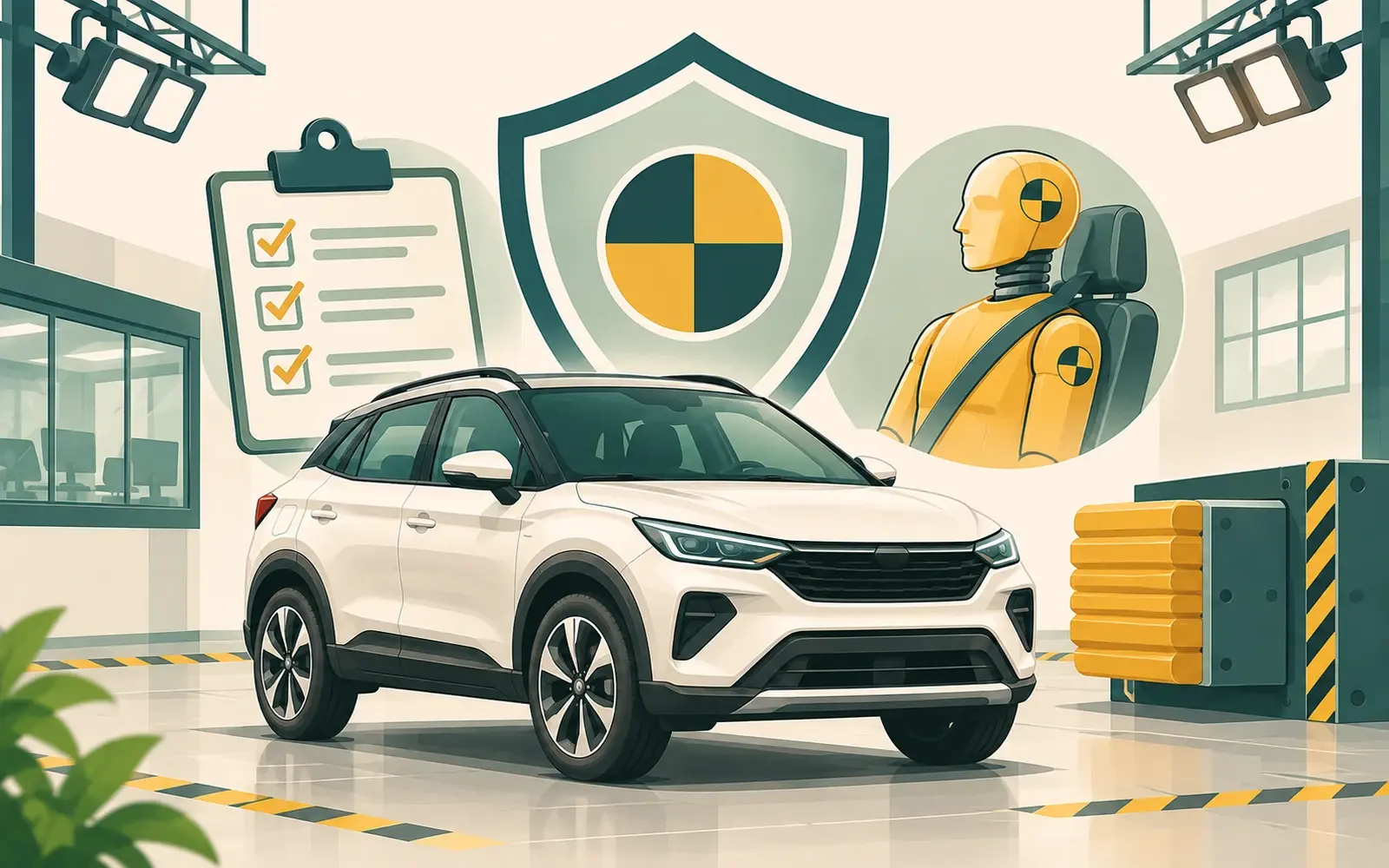
A five-star safety rating can be one of the strongest reasons to shortlist a car. But what happens when one manufacturer advertises five stars from Bharat NCAP, another advertises five stars from Global NCAP, and a third points to a crash test conducted several years ago? Are all three claims equally useful?
Not necessarily. A safety rating describes how a particular vehicle specification performed under a defined assessment procedure. The organisation conducting the assessment, the protocol version, the tested configuration and the protection offered to different occupants all matter.
For Indian buyers, Bharat NCAP and Global NCAP provide valuable evidence about vehicle safety. Understanding the evidence behind their stars is more useful than treating the badges as interchangeable awards.
What are Bharat NCAP and Global NCAP?
NCAP stands for New Car Assessment Programme. These programmes evaluate vehicle safety and publish results that buyers can use to compare cars beyond their styling, equipment and engine specifications.
Bharat NCAP (BNCAP) is India's national vehicle safety assessment programme, overseen by the Ministry of Road Transport and Highways (MoRTH). It began operating under the AIS-197 standard on 1 October 2023. It covers eligible passenger vehicles manufactured or imported for the Indian market, within the programme's specified vehicle category and weight limits. Manufacturers can submit vehicles voluntarily; the framework also allows government nomination. Bharat NCAP's official website publishes results and their applicability.
Global NCAP (GNCAP) is an international vehicle safety initiative operated by a UK-registered charity. Its Safer Cars for India campaign, launched in 2014, helped make independent crash-test evidence widely available to Indian consumers before Bharat NCAP existed. Its India results archive remains particularly valuable when researching older and used cars, and it has continued to publish Indian vehicle assessments after Bharat NCAP's introduction.
Neither programme should be confused with the minimum regulatory requirements a car must satisfy to be legally sold. An NCAP assessment provides additional consumer information about safety performance; the absence of a published NCAP rating does not automatically mean a vehicle is illegal or that it has failed a test.
What actually happens during a crash test?
A crash test is not simply an exercise in seeing how badly a car is damaged. Engineers use instrumented dummies to assess the loads on different body regions, and examine how the vehicle structure and restraint systems behave. The condition of the passenger compartment, the movement of the dummies and the effectiveness of belts and airbags matter more than whether the bonnet looks intact.
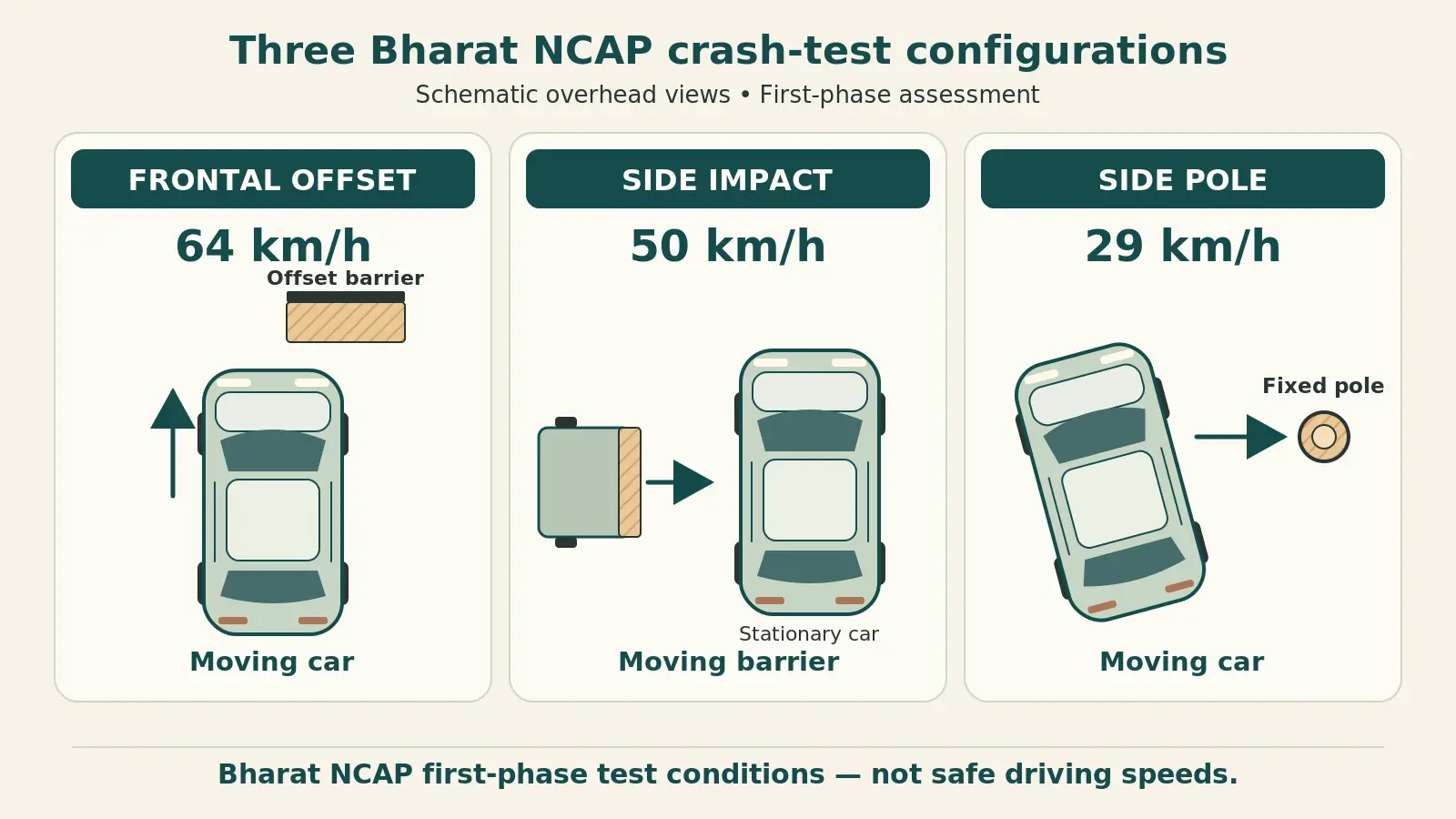
The first-phase Bharat NCAP protocol specifies three important impact scenarios:
- Frontal offset impact — 64 km/h: Part of the vehicle's front strikes a deformable barrier. The test examines frontal crash protection, including the ability of the structure and restraints to manage impact forces.
- Side impact — 50 km/h: A moving deformable barrier strikes the side of a stationary test car. The test examines protection where there is relatively little space between the occupant and the impact.
- Side pole impact — 29 km/h: The test vehicle is moved sideways into a rigid pole. This concentrates the impact over a narrow area, making side-head protection especially important. Applicable testing and qualification rules determine how the result affects the rating.
Global NCAP's more recent Indian assessments similarly include frontal and side crashworthiness and side-head protection requirements. Its earlier India results should not be assumed to cover the same test suite.
These speeds belong to specific laboratory configurations. They are not safe driving speeds, nor do they establish a maximum speed at which occupants will survive a crash. A collision involving a truck, a different impact angle or a much heavier vehicle can create entirely different loading conditions.
Why visible damage can be misleading
A crumple zone is intended to deform and absorb energy. A vehicle with substantial front-end damage may have protected its occupants well if the passenger compartment remained sufficiently intact and the restraints controlled their movement. Conversely, relatively little visible damage does not establish low injury risk: abrupt deceleration or harmful contact with the interior can still cause serious injuries.
Look at the test results rather than drawing conclusions from crash photographs alone.
Adult protection and child protection are separate ratings
Most current Indian NCAP result pages publish two separate star ratings. A five-star adult result is not automatically a five-star child result.
Adult Occupant Protection (AOP)
AOP considers the protection provided to the adult dummies in the specified impact scenarios. Injury measurements, structural behaviour and restraint performance all contribute to the assessment. Certain weaknesses can reduce scores or restrict the star rating even when other measurements are favourable.
Under the original Bharat NCAP AIS-197 framework, adult protection carries a maximum of 32 points, split equally between frontal and side impact assessments. Additional safety qualifications apply. The five-star adult threshold is 27 points, subject to the remaining applicable criteria.
For a buyer, this means the adult score should be read together with the injury-region information and safety equipment list. A high total does not mean that every body region achieved the best possible protection.
Child Occupant Protection (COP)
Child assessment is about more than the presence of ISOFIX mounting points. The programme examines how child dummies perform in appropriate child restraint systems, whether specified restraints can be installed correctly, and whether the vehicle provides suitable features for their use.
The first-phase Bharat NCAP child assessment has 49 available points: 24 for crash performance, 12 for restraint installation and 13 for vehicle-related assessment. A five-star result requires at least 41 points under its scoring rules. The specified dynamic tests use dummies representing children aged approximately 18 months and three years.
This is especially relevant to families. A highly rated vehicle does not replace a correctly chosen child seat. Use a restraint appropriate for the child's size and follow both the car and restraint manufacturer's installation instructions. Prefer a suitable rear seating position; never place a rear-facing child restraint in front of an active frontal airbag.
Bharat NCAP vs Global NCAP: the important differences
The two programmes share broadly similar crashworthiness objectives, but their scores and requirements are not identical. The following comparison deliberately uses Bharat NCAP's first-phase standard and Global NCAP's July 2022–2025 assessment framework, the latter being the basis of many familiar Indian results.
| Assessment | Bharat NCAP (first phase) | Global NCAP (July 2022–2025) |
|---|---|---|
| Scope | Indian-market assessment | International programme with India-specific results |
| Adult protection maximum | 32 points | 34 points |
| Child protection maximum | 49 points | 49 points |
| Frontal and side crash assessment | Included | Included |
| Side-head protection, ESC and other safety criteria | Relevant rating qualifications | Relevant rating qualifications |
| Where to check applicability | Official model page and fact sheet | Official India result and fact sheet |
An important difference in adult scoring is that the Global NCAP framework includes up to two points for qualifying seat belt reminders, whereas the original Bharat NCAP adult total is based on the two impact scores, with reminder requirements handled through its qualification framework. The two totals therefore cannot be compared directly, even when converted to percentages.
The Global NCAP protocol library also contains the newer August 2025–2029 assessment documents. Among other requirements, the August 2025 adult protocol requires qualifying electronic stability control (ESC) for two stars or above. More demanding requirements apply at higher star levels. In September 2025, Global NCAP reported five adult and five child stars for the Maruti Suzuki Victoris under its new protocols.
Bharat NCAP 2.0: why the test date will matter even more
The Central Motor Vehicles (Tenth Amendment) Rules, 2026, notified through G.S.R. 540(E) and published on 1 July 2026, specify the adoption of AIS-197 (Revision 1) for the relevant Bharat NCAP assessments from 1 October 2027. The revised programme is intended to broaden the assessment beyond the first-phase framework. The scheduled change is not a reason to read current first-phase results as if they already used the revised methodology.
Always check the protocol identified in a published result, particularly when researching cars around a transition between testing standards. An older result does not become a newly tested result just because a newer protocol has been introduced.
A real example: the Tata Nexon has ratings from both programmes
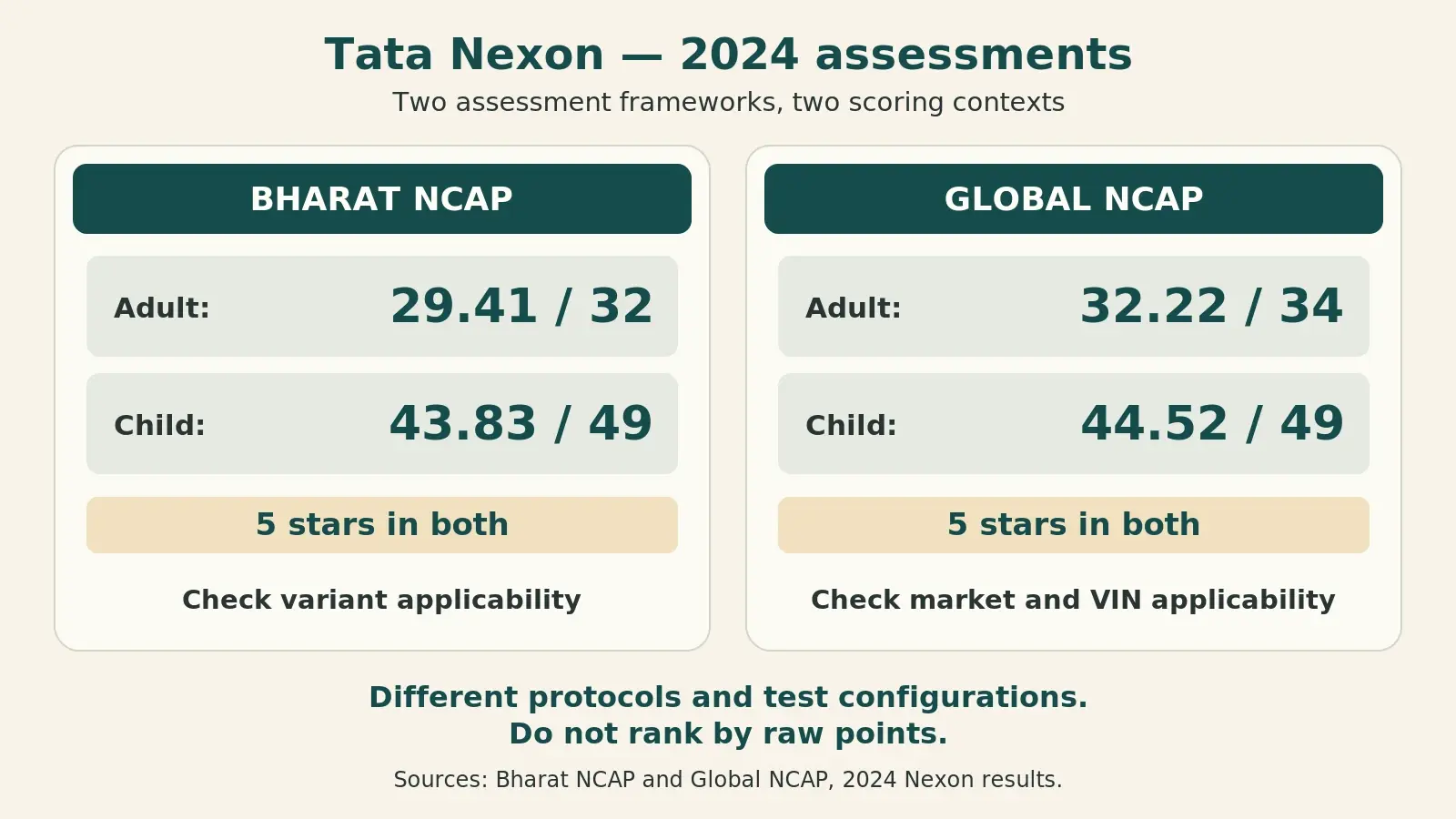
The Nexon illustrates why comparing raw scores without their context is misleading. Both programmes published five-star adult and child ratings for the Nexon in 2024, with the following results:
| Published 2024 assessment | Adult protection | Child protection |
|---|---|---|
| Global NCAP | 32.22 / 34 | 44.52 / 49 |
| Bharat NCAP | 29.41 / 32 | 43.83 / 49 |
Sources: Global NCAP's Nexon report and Bharat NCAP's Nexon result.
It would be wrong to subtract 29.41 from 32.22 and conclude that the car performed 2.81 points worse in the Indian programme. The adult scales differ, and the assessed vehicles have different listed crash-test weights: 1,608 kg for Global NCAP and 1,638 kg for Bharat NCAP. Nor does the small difference in child scores, by itself, establish that one assessment is more stringent.
The useful conclusion is that the applicable Nexon configurations achieved strong results in both assessments. The Bharat NCAP page also provides a variant applicability table, revised in August 2026. The Global NCAP report identifies the Indian market and the VIN from which its rating applies. Those details help a buyer determine whether the published evidence actually covers the car being considered.
What five stars do not tell you
Crash protection and crash prevention are complementary, not interchangeable. A strong structure, airbags and seat belts help protect occupants during an impact. ESC can help a driver maintain control, while automatic emergency braking (AEB), when fitted and functioning within its operating limits, may help prevent or mitigate certain collisions. These features do not all receive the same assessment treatment under every NCAP protocol.
Five stars do not establish that a car has every advanced driver-assistance feature, that its headlights are outstanding or that it has been comprehensively tested in every rollover, rear impact or high-speed accident scenario. Likewise, an impressive list of airbags or ADAS functions does not establish good crashworthiness without supporting evidence.
Vehicle size and mass also matter. Two cars with the same number of stars can behave differently in a collision with each other, particularly if their masses and structural geometry differ. Comparisons are generally more informative between vehicles of similar size and weight. The IIHS research on vehicle size and weight explains this physical limitation.
How to verify a safety rating before buying
A dealer's brochure may highlight the best rating available for a model family. Before paying a booking amount, take a few minutes to establish what the claim actually covers.
- Identify the exact car. Record the generation, variant, engine or electric powertrain, transmission and model year. Do not rely solely on the model name. A petrol car and its electric counterpart can have separate assessments.
- Find the original result. Search the official Bharat NCAP database and Global NCAP India archive. Read the publication year and protocol details.
- Check applicability. Look for the precise variant list, production period, market and any VIN restrictions. A rating may extend beyond the tested variant through an approved assessment, but this is not something to assume automatically.
- Read both protection scores. Examine adult and child results separately and look at the available injury-region information. If a report describes poor protection or an unstable structure, understand that finding instead of ignoring it because of an attractive aggregate score.
- Verify the equipment on the car you will receive. Check ESC, airbags (including side and curtain coverage), three-point seat belts and appropriate head restraints, child-seat anchorages and any advertised driver-assistance systems. Ask for confirmation in writing if the specification differs from the report.
For a used car, the original rating is only the beginning. Have an independent professional inspect its accident history, structural repairs, airbag system and seat belts. A previously damaged car with incorrect repairs may no longer provide the protection demonstrated by a new test vehicle.
A missing test result is an information gap, not a zero-star rating. If comparable alternatives have recent, strong and applicable assessments, that evidence is a sensible reason to prefer them when other important factors are similar.
Which rating should an Indian buyer trust more?
For a new car currently sold in India, start with Bharat NCAP because it directly assesses Indian-market vehicles and publishes detailed applicability information. If the same generation also has a relevant Global NCAP result, use it as additional evidence rather than trying to select a winning organisation. For older cars, Global NCAP's historical archive may be the only readily available independent assessment.
When choosing between similarly priced cars, give greater weight to strong adult and child protection under a recent, comparable protocol, confirmed coverage of your exact variant, and useful standard safety equipment. Avoid treating a single number as a complete description of risk.
Finally, even a well-rated car needs responsible driving, maintained tyres and brakes, and correctly worn seat belts in every occupied seat. The purpose of a safety rating is to help you buy better protection, not to make a dangerous situation safe.
Sources and Further Reading
- Bharat NCAP — official programme and FAQs
- AIS-197 — Bharat NCAP assessment standard, tables 1–3 and applicability provisions
- MoRTH / PIB — Bharat NCAP launch and voluntary testing framework
- Global NCAP — current and archived assessment protocols
- Global NCAP — August 2025 adult occupant protocol
- Global NCAP — August 2025 child occupant protocol
- Global NCAP — 2025 Victoris assessment
- Global NCAP — 2024 Tata Nexon fact sheet
- Bharat NCAP — Tata Nexon scores and variant applicability
- Central Motor Vehicles (Tenth Amendment) Rules, 2026 — G.S.R. 540(E), Gazette text reproduced by Gazette Tracker
- IIHS — vehicle size and weight