Books, Videos or AI Tutors: What Is Each Best For?
Books, videos and AI tutors each solve different learning problems. Learn when to read, watch, ask AI and practise independently for better learning.
Suppose you want to learn a difficult topic such as recursion, organic chemistry, monetary policy or calculus.
You could read a book.
You could watch a video.
Or you could open an AI tutor and start asking questions.
All three can teach the same subject, but they do not create the same learning experience.
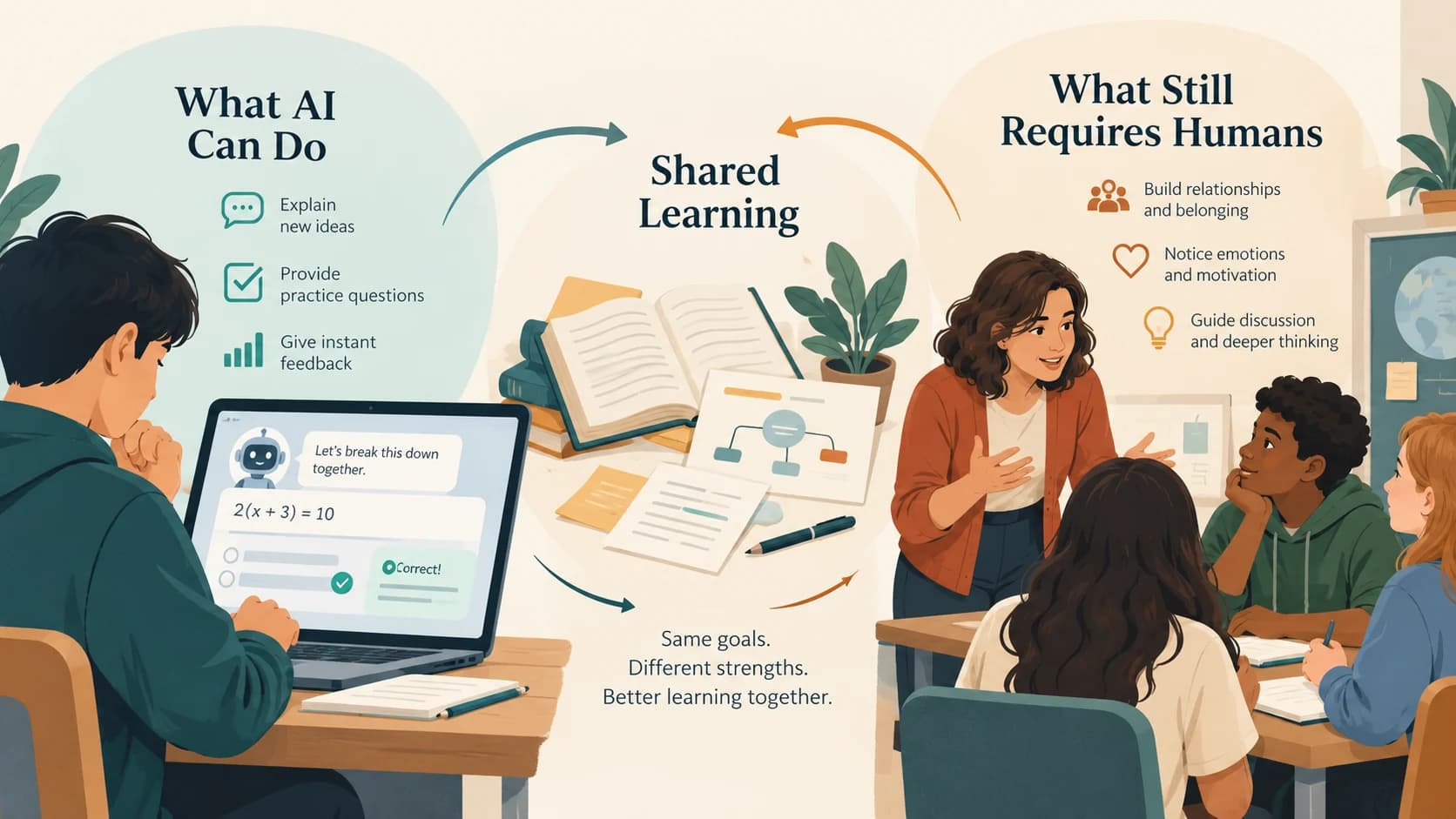
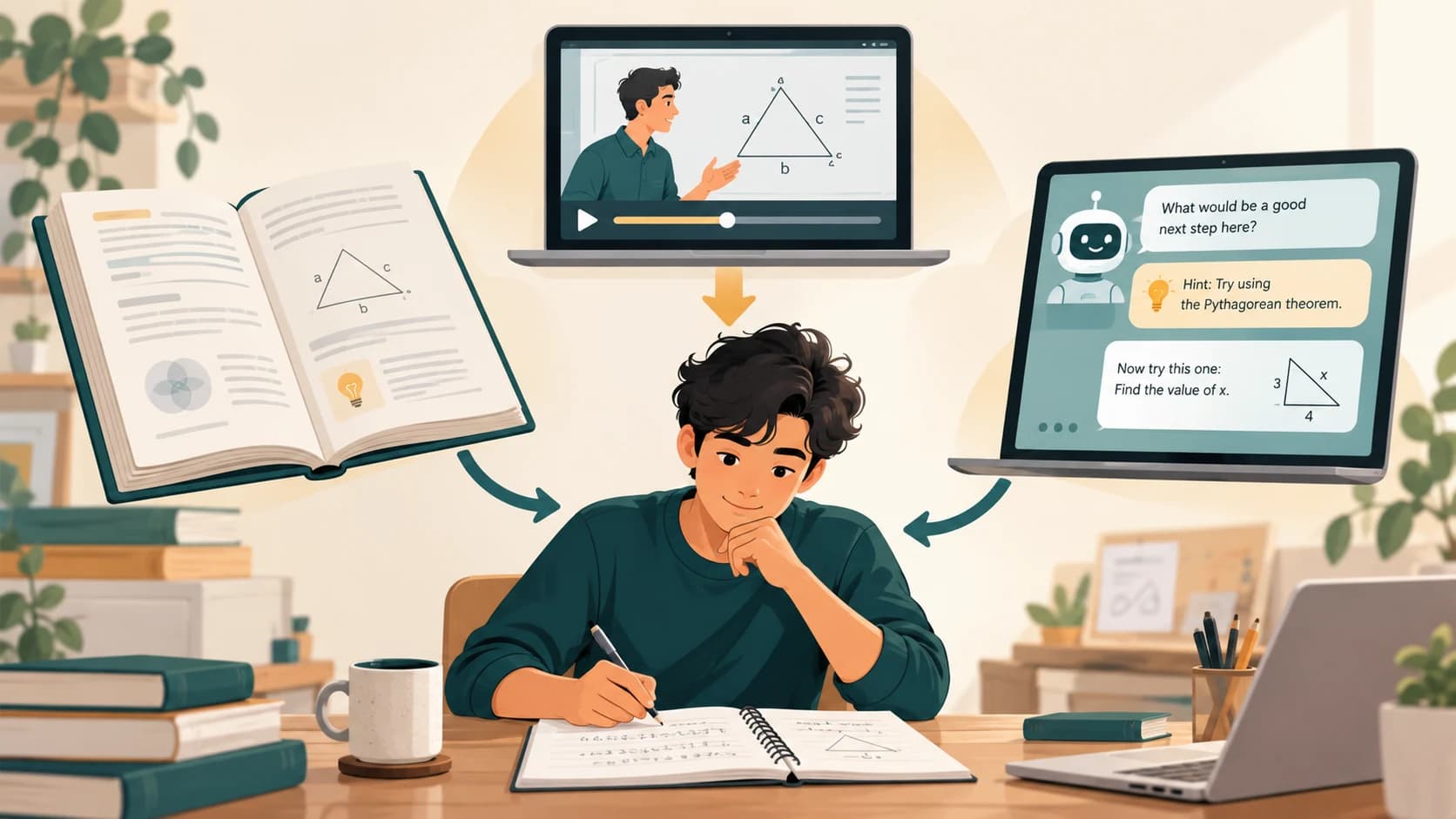
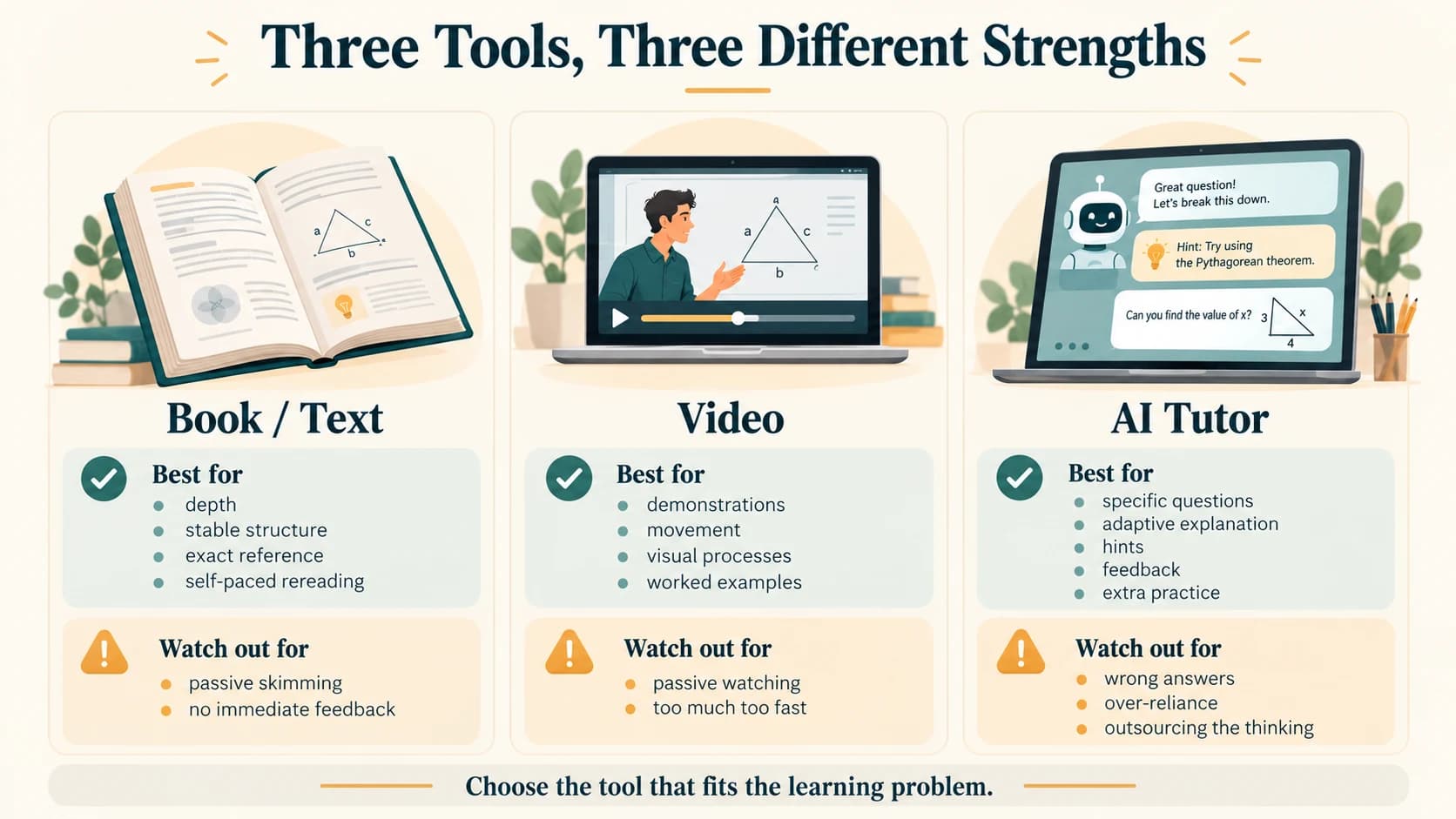
A book gives you a stable, detailed explanation that you can move through at your own pace. A good video can make a process visible in a way that text struggles to do. An AI tutor can respond to your exact question, change its explanation and give you immediate practice.
Each also has weaknesses.
A book cannot notice that you misunderstood a paragraph. A video can make you feel as if you understand simply because the explanation was easy to follow. An AI tutor can confidently give you a wrong answer—or do so much of the thinking that you never learn to do it yourself.
So the useful question is not:
“Which is the best way to learn?”
It is:
“What kind of learning problem am I trying to solve right now?”
Once you ask that, the strengths of books, videos and AI tutors become much clearer.
Books are best when you need depth, structure and precise control
Books and other well-designed long-form texts are particularly good at giving a subject a stable structure.
A good textbook does not simply answer one question. It builds a sequence:
definition → explanation → example → exception → practice → next concept
That structure matters when you are learning a subject in depth. A textbook on operating systems, for example, can place virtual memory inside a larger framework involving processes, address spaces, paging and hardware support rather than treating each concept as an isolated answer.
Text lets you control the pace very precisely
When reading, you decide when to stop.
You can spend five seconds on an easy paragraph and ten minutes on a difficult diagram.
You can move backward by one sentence rather than rewinding an entire explanation.
You can compare two definitions on the same page, write a note in the margin or keep a formula visible while solving a problem.
That control is valuable.
Research on learner control shows, however, that control is not automatically beneficial. Learners need enough prior knowledge and self-regulation to know when to slow down, what to reread and which parts deserve attention.
A beginner can have complete control over a textbook and still skim the most important paragraph.
The medium gives you control. It does not guarantee that you use it well.
Books are also good reference tools
Imagine you studied a chapter three weeks ago and now need the exact definition of a database functional dependency.
A book is easy to return to.
Its information has a fixed location and surrounding context. You can find the definition, inspect the examples around it and see how the author uses the term later.
This makes long-form text especially useful when definitions, formulas, classifications or arguments must be revisited precisely.
A video is harder to scan in the same way. An AI tutor can retrieve an explanation instantly, but the wording may change each time and the answer may need verification.
Does reading on paper make you learn better?
Sometimes, but the claim needs care.
Research comparing paper and digital reading has produced mixed results.
Several earlier meta-analyses found a small comprehension advantage for paper, particularly for informational text and under time pressure.
A 2026 network meta-analysis found that paper generally performed better than computers and smartphones for comprehension, especially when digital reading required scrolling. It found no reliable overall difference between paper and tablets in the main comparison.
Other recent meta-analytic work has found little overall difference once different reading conditions are considered.
So the sensible conclusion is not:
“Printed books are always superior.”
It is that the way text is presented and read matters. Long scrolling documents, distractions and superficial screen reading can make comprehension harder, while well-designed digital text can work very well.
The bigger difference is usually between active reading and passive reading, not simply paper and pixels.
Videos are best when seeing the process matters
Some things are difficult to understand from a static description.
Imagine learning:
- how a piston moves inside an engine;
- how blood flows through the heart;
- how to perform a laboratory procedure;
- how a sorting algorithm rearranges elements;
- how to pronounce a foreign-language sound; or
- how a geometry construction develops step by step.
A well-designed video can combine narration, diagrams, movement and timing.
That can reduce the mental work needed to convert a verbal description into a visual model.
Research on multimedia learning generally finds that people can learn more deeply from appropriately combined words and relevant pictures than from words alone.
The important word is appropriately.
More animation does not automatically mean more learning.
Good educational video is designed, not merely recorded
A 90-minute recording of someone speaking over dense slides is technically a video, but it does not necessarily use the medium well.
Research on instructional video suggests that videos work better when they follow principles such as:
- removing irrelevant material;
- signalling what the learner should notice;
- breaking complicated explanations into manageable segments;
- matching narration with useful visuals; and
- prompting the learner to retrieve, explain or apply what was shown.
The ability to pause also matters.
Complex multimedia presented too quickly can overload the learner. Segmenting material into learner-controlled parts can help people process difficult explanations more effectively.
This is why a five-minute animation showing how a four-stroke engine works may teach that mechanism better than three textbook pages.
But the same video may be much worse than a book if you need a detailed table of engine specifications or a precise definition to quote later.
The biggest danger of video is the illusion of learning
A clear video feels good.
You watch the teacher solve a problem and every step makes sense.
Then you close the video and try the same problem yourself.
Nothing happens.
The problem is that recognising someone else's reasoning is easier than generating the reasoning yourself.
Learning research consistently shows the value of retrieval practice: attempting to recall or produce information from memory improves later retention and exposes what you do not yet know.
So after a video, do something that forces the knowledge back out of your own head.
Pause and predict the next step.
Recreate the diagram.
Solve a similar problem.
Explain the process without looking.
If you cannot do that, the video may have produced familiarity rather than mastery.
AI tutors are best when you need interaction
Books wait.
Videos play.
AI can respond.
That difference is enormous.
Suppose a textbook says:
“A process can be in the ready, running or blocked state.”
You do not understand why a blocked process cannot simply use the CPU.
With a book, you search the next paragraph.
With a video, you find another explanation.
With an AI tutor, you can ask:
“Why can’t the CPU just run a blocked process?”
Then:
“Explain that with an example involving keyboard input.”
Then:
“Now quiz me on it without giving the answer.”
That conversational loop is difficult for books and ordinary videos to reproduce.
AI is especially useful for diagnosis and practice
A good AI tutor can do more than explain.
It can ask you a question, inspect your answer and respond to the specific mistake.
For example:
AI: What is the time complexity of binary search?
Student: O(n).
Instead of simply saying “wrong,” the tutor can ask:
“After one comparison, how much of the search space remains?”
That kind of hint keeps some of the thinking with the learner.
AI can also generate extra practice, easier or harder examples, flashcard-style questions, mock oral examinations and comparisons between similar concepts.
This can approximate parts of one-to-one tutoring at a scale that human tutoring cannot easily match.
A 2025 randomized study in a Harvard undergraduate physics course found that a carefully designed AI tutor produced larger short-term learning gains than the active-learning classroom condition tested, while students spent less time on the lesson.
But there is an important qualification.
The researchers did not simply give students a general chatbot. The tutor was deliberately scaffolded, carefully prompted and supplied with structured course material and solutions.
The design of the tutor mattered.
AI can help you learn—or help you avoid learning
This is the central problem with AI tutors.
An AI system can respond in two very different ways.
Useful mode
You ask for help solving a problem.
The AI gives you a hint.
You attempt the next step.
It identifies your misconception.
You correct it.
You eventually solve the problem yourself.
Unhelpful mode
You paste the problem.
The AI solves it.
You read the answer.
You paste the next problem.
The output may be excellent while your learning is not.
The OECD's 2026 Digital Education Outlook makes this distinction clearly. General-purpose generative AI can improve the quality of work produced while failing to produce corresponding learning gains if the learner outsources the cognitive work.
In some studies, students performed better while AI was available but lost that advantage—or did worse—when the tool was removed.
The lesson is simple:
An AI tutor is most valuable when it makes you think, not when it replaces your thinking.
AI also has a reliability problem
A textbook from a reputable publisher can contain errors.
A teacher can make a mistake.
A video can explain something incorrectly.
AI introduces an additional problem: it can generate an answer that is false while sounding fluent, detailed and certain.
This is often called a hallucination.
The danger is highest for beginners, who may not know enough to recognise the error.
For low-stakes clarification, AI can be extremely useful.
For important facts, formulas, legal rules, medical information, historical quotations or anything you will rely on in an examination or professional setting, verify the answer against authoritative material.
AI is a powerful tutor.
It is not automatically an authoritative source.
What is each medium best for?
The simplest comparison is this:
| Learning need | Books / text | Videos | AI tutors |
|---|---|---|---|
| Build a complete foundation | Excellent | Good | Good if well structured |
| Look up an exact definition | Excellent | Poor | Fast, but verify |
| Understand a moving process | Good with diagrams | Excellent | Good with explanation |
| Watch a procedure demonstrated | Limited | Excellent | Limited unless multimodal |
| Ask a very specific question | Limited | Limited | Excellent |
| Get immediate feedback | Limited | Limited | Excellent |
| Generate extra practice | Limited to included exercises | Limited | Excellent |
| Study at your own pace | Excellent | Good with controls | Excellent |
| Maintain a stable reference | Excellent | Good | Variable |
| Adapt to your misconception | No | Usually no | Potentially excellent |
| Risk of passive consumption | Moderate | High | High if used for answers |
| Risk of confident generated errors | Low in edited texts | Depends on source | Meaningful; verify |
This is not a ranking.
It is a map of strengths.
The best resource also depends on your stage of learning
The same learner may need a different medium twenty minutes later.
When you know almost nothing
Start with structure.
A good chapter, course text or well-organised introductory video can give you the vocabulary and mental map needed to ask useful questions.
If you open an AI tutor before you know the basic structure of the topic, you may jump between questions without knowing what you are missing.
When one concept refuses to make sense
Switch representation.
If the textbook explanation is not working, watch a diagram or animation.
If the video is too fast, read the text.
If both leave one specific gap, ask the AI to explain that exact point and test your interpretation.
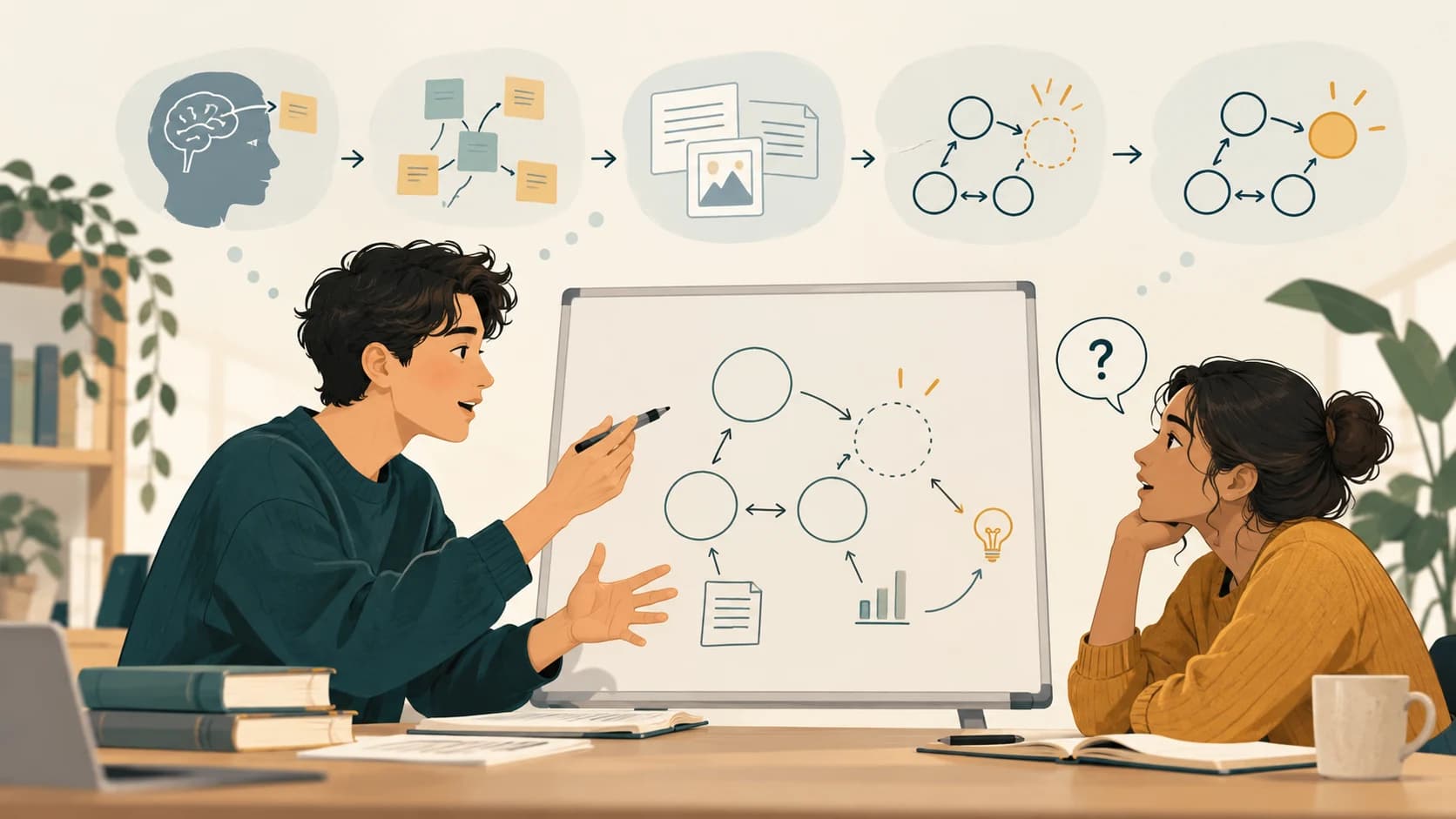
Different representations can complement one another because they expose different aspects of the same idea.
When you think you understand
Stop consuming.
Test yourself.
Close the book.
Pause the video.
Tell the AI not to show the solution.
Try to retrieve, explain or solve independently.
That reveals whether the knowledge is actually yours.
A strong learning workflow uses all three
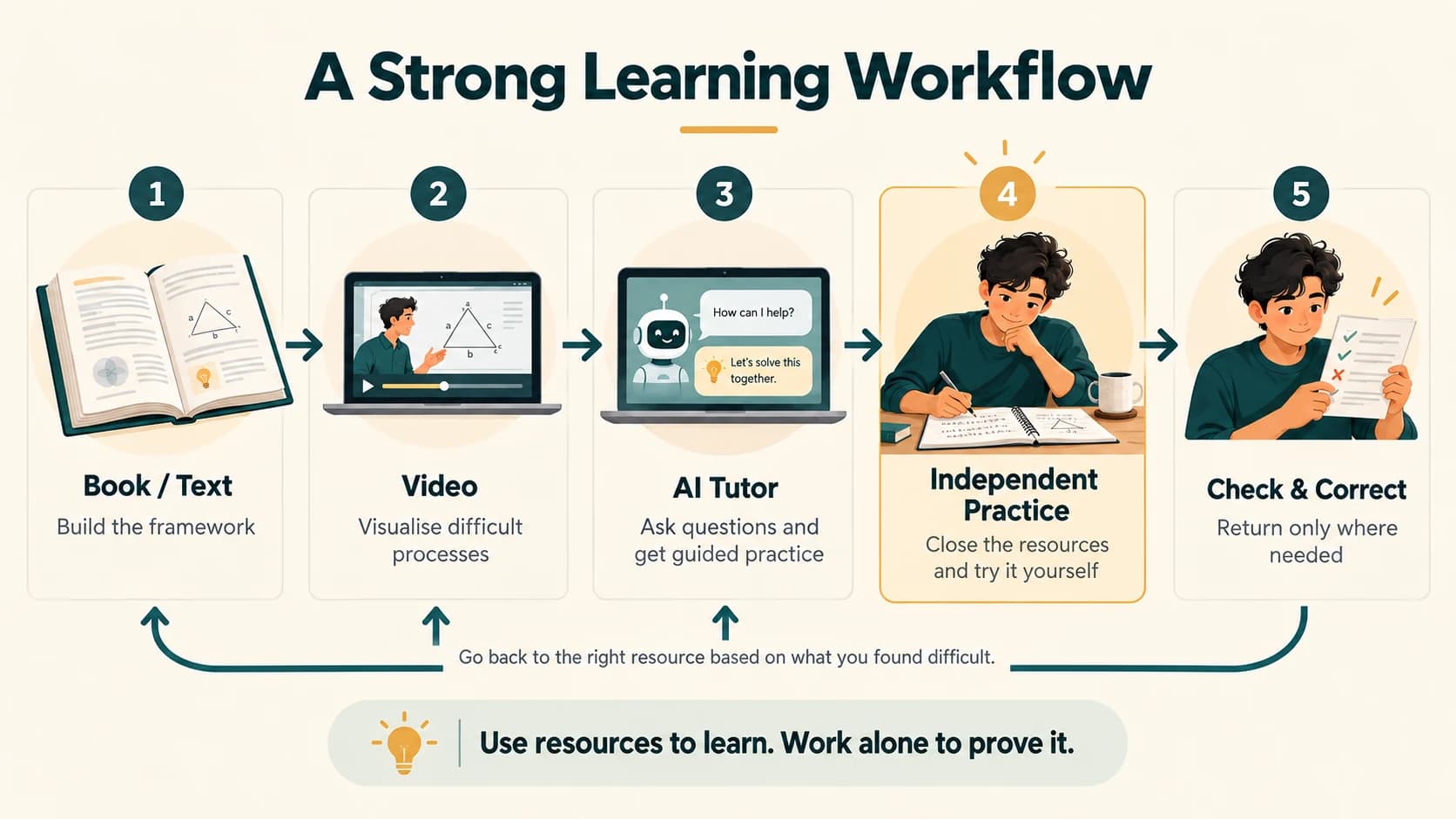
Suppose you are learning database normalization.
1. Use the book to build the framework
Read the section on functional dependencies, candidate keys, 1NF, 2NF and 3NF.
Mark the exact definitions.
Work through one carefully chosen example.
Now you have a stable reference.
2. Use a video if the transformation still feels abstract
Watch someone take one messy table and transform it step by step.
Seeing columns move into new relations can make the logic more concrete.
Pause before each transformation and predict what should happen.
3. Use AI to interrogate the weak points
Ask:
“Give me a relation that violates 2NF but not 1NF. Do not tell me why yet.”
Analyse it.
Then ask the tutor to challenge your reasoning.
Request another example if you were wrong.
4. Finish without any resource
Take a fresh relation.
Identify the keys.
Find the dependencies.
Normalise it yourself.
Then check the answer.
This final stage is essential because examinations, interviews and real problem-solving often require you to perform without a book, video or chatbot guiding every step.
The resources help build the ability.
They are not the ability itself.
Do not choose the most entertaining medium; choose the one that fixes the problem
A video may be easier to watch than a chapter.
An AI tutor may be more enjoyable than searching a textbook.
That does not automatically make either one the better learning choice.
Ask what is currently stopping you.
“I do not know the overall structure.”
Use a strong book, chapter or structured course resource.
“I cannot visualise how this happens.”
Use a good video, animation or demonstration.
“I have one specific confusion.”
Ask an AI tutor or human teacher.
“I need more practice at my level.”
AI can generate it quickly, but verify technical correctness.
“I need to know whether I actually remember this.”
Use none of them for a moment. Retrieve the answer yourself.
That last step is easy to forget because modern learning tools are very good at keeping information available.
Learning ultimately means being able to do something when the information is not being supplied to you.
Books, videos and AI tutors are tools for different cognitive jobs
Books are not obsolete because video exists.
Video is not automatically shallow because books provide more detail.
AI tutors do not make either of them unnecessary.
Each medium changes the problem.
A book gives you stable structure and precise learner-controlled access.
A video can turn an invisible or dynamic process into something you can see unfold.
An AI tutor can turn a one-way explanation into a conversation and adapt the next question to what you just said.
Strong learners switch deliberately:
read for structure, watch for visualisation, ask for interaction, practise for feedback—and finally work alone to prove that the learning has transferred.
The goal is not to find the perfect learning medium.
It is to know what your brain needs next.